The Science of Extrapolation: Bridging Biological Scales to Accelerate Discovery and Development
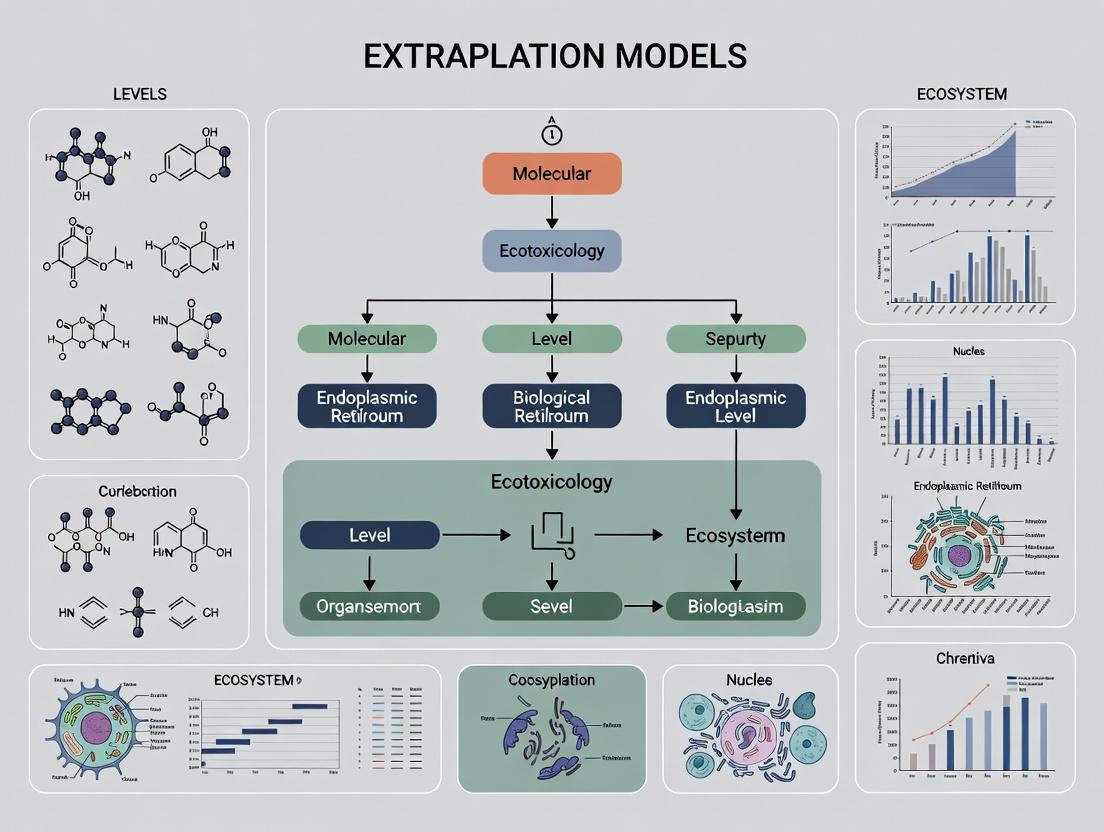
This article provides a comprehensive examination of extrapolation models as essential tools for translating biological knowledge across different levels of organization—from molecules and cells to whole organisms and populations.
The Science of Extrapolation: Bridging Biological Scales to Accelerate Discovery and Development
Abstract
This article provides a comprehensive examination of extrapolation models as essential tools for translating biological knowledge across different levels of organization—from molecules and cells to whole organisms and populations. Aimed at researchers, scientists, and drug development professionals, it explores the foundational principles that justify cross-scale inferences, surveys key methodological approaches from pharmacokinetic-pharmacodynamic modeling to machine learning on fitness landscapes, and addresses critical challenges in model validation and uncertainty quantification. Through analysis of current applications in drug development, translational research, and ecological forecasting, the review synthesizes strategies for robust extrapolation, evaluates comparative model performance, and outlines future directions for enhancing predictive accuracy in biomedical and clinical research.
The Principles and Justification of Biological Extrapolation: From Molecules to Populations
Core Concepts and Troubleshooting Fundamentals
In biomedical research, extrapolation is the translation or transfer of relationships observed in one experimental setting to another, such as from animal models to humans [1]. The core challenge, the scale-translation problem, arises from the need to predict outcomes across different levels of biological organization (e.g., molecular, cellular, organismal) or between different species [2]. This process is foundational to risk assessment and drug development, where data from controlled experiments must inform understanding of complex, real-world biological systems [1].
The validity of extrapolation hinges on understanding the conservation of biological pathways. A fundamental principle is that animals are reasonable surrogates for humans; for instance, the genetic makeup of mice and rats is more than 95% identical to humans [1]. However, subtle differences in metabolic pathways, receptor binding affinities, or organ function can lead to failed predictions. Effective troubleshooting in this field therefore requires a systematic approach to identify whether a problem stems from flawed extrapolation assumptions or from technical experimental errors [3].
Common Technical Issues and Validation Failures:
- Weak or No Signal in Detection Assays: This could indicate a technical protocol failure (e.g., antibody degradation) or a genuine biological difference (e.g., low protein expression in the target species) [3].
- Inconsistent Dose-Response Relationships: Discrepancies between model species and humans often point to differences in toxicokinetics (how the body handles a chemical) or toxicodynamics (how the chemical affects the body) [2].
- High Variability in Replicate Experiments: This may expose uncontrolled variables in the experimental system or highlight greater biological variability in the test subject than in the original model [1].
Systematic Troubleshooting Steps:
- Repeat the Experiment: Rule out simple human error or one-off technical failures [3].
- Validate Your Controls: Ensure positive and negative controls are performing as expected. A failed positive control suggests a protocol-wide issue [3].
- Audit Reagents and Equipment: Check storage conditions, expiration dates, and equipment calibration. Molecular biology reagents are particularly sensitive [3].
- Isolate Variables Methodically: Change only one experimental parameter at a time (e.g., antibody concentration, fixation time) to identify the root cause [3].
- Revisit Biological Assumptions: If technical issues are ruled out, critically reassess the conservation of the target pathway or mechanism between your model and target system [2].
Detailed Troubleshooting Guides
Problem: Inconsistent Results in Cross-Species Protein Expression Analysis (e.g., Western Blot, IHC)
Question: My immunohistochemistry (IHC) staining for a conserved protein shows strong signal in mouse liver tissue but is consistently weak or absent in human liver cell lines. My controls are working. Is this a technical failure or a valid biological difference?
Answer: This discrepancy requires a structured investigation to distinguish between assay failure and a true biological result [3].
Step-by-Step Diagnosis:
- Verify Assay Integrity:
- Positive Control: Run a parallel sample known to express the target protein highly (e.g., a different cell line or tissue lysate). If this fails, the protocol is faulty [3].
- Antibody Validation: Confirm the primary antibody's cross-reactivity for the human epitope. Consult the datasheet and search for published validation in human samples [4].
- Sample Quality: Check RNA-seq or qPCR data from your human cell line to confirm the gene is transcribed. Degraded protein samples can also cause failure [3].
Optimize Protocol for New System:
- If the assay is valid but signal is weak, the established mouse protocol may need optimization for human cells.
- Perform a Primary Antibody Titration: Test a range of concentrations (e.g., 1:100 to 1:2000) to find the optimal signal-to-noise ratio for the human sample [3].
- Adjust Epitope Retrieval: For IHC on paraffin-embedded cells, the heat-induced epitope retrieval (HIER) time or pH may need adjustment for human vs. mouse tissue morphology [4].
- Consider Fixation: Over-fixation can mask epitopes. Try reducing the fixation time for human cell pellets [4].
Interpret Biological Meaning:
- If technical optimization fails to yield a strong signal, the result may be valid. The protein may be expressed at lower levels, in a different isoform, or localized to a different subcellular compartment in human cells.
- Next Step: Employ an alternative, more sensitive detection method (e.g., immunofluorescence with signal amplification) to confirm low-level expression [5].
Problem: Divergent Toxicological Response in a Novel Organoid Model
Question: We are developing a human liver organoid model to extrapolate drug-induced toxicity. The organoids show a much higher sensitivity to Drug X compared to primary rat hepatocytes. How do we determine if this is a promising model of human susceptibility or an artifact of the immature organoid system?
Answer: This is a classic scale-translation problem where the in vitro system's predictive value must be rigorously validated [2].
Validation Protocol:
- Establish a Benchmark: Compile known in vivo human and rat toxicity data (e.g., clinical dose, plasma concentration, known adverse outcomes) for Drug X and related compounds [1].
- Correlate Internal Dose: Measure the internal concentration of Drug X and its metabolites in your organoid media and compare it to known human therapeutic or toxic plasma levels. Use techniques like Mass Spectrometry Imaging [2].
- Interrogate the Mechanism:
- Pathway Analysis: Use RNA sequencing or proteomics on treated organoids and compare pathway activation (e.g., apoptosis, oxidative stress) to signatures from human case reports or rat studies [2].
- Functional Conservation Check: Verify that the drug's target (e.g., a specific receptor) is expressed and functional in your organoids at a level comparable to mature human liver [2].
- Refine the Model: If the organoid system is immature, consider prolonging differentiation or using patterning factors to drive maturity. Co-culture with non-parenchymal cells may also provide more realistic metabolic feedback [4].
- Control for Artifacts: Ensure the increased sensitivity is not due to baseline stress (e.g., suboptimal culture conditions, high passage number) by thoroughly characterizing control organoid health (viability, ATP levels, albumin secretion) [4].
Diagram: An Adverse Outcome Pathway (AOP) Framework for Extrapolation Troubleshooting This framework links a molecular initiating event to an adverse outcome through measurable key events. When extrapolation fails, assays (blue ovals) can pinpoint at which conserved key event the prediction breaks down [2].
Problem: Failures in QuantitativeIn VitrotoIn VivoExtrapolation (QIVIVE)
Question: Our *in vitro enzyme activity data suggests a drug should be cleared rapidly, but in vivo pharmacokinetic (PK) studies in rats show prolonged half-life. Which part of the extrapolation model is likely wrong?*
Answer: QIVIVE failures typically originate in the assumptions linking in vitro data to whole-organism physiology [2].
Diagnostic Checklist:
- Toxicokinetic (TK) Parameters: Did your model correctly account for plasma protein binding, blood-to-plasma ratio, and organ-specific blood flow rates in the rat? These factors dramatically affect the free drug concentration available for clearance [2].
- Metabolic Competence: Does your in vitro system (e.g., recombinant enzyme, microsomes) express all relevant Phase I and II metabolizing enzymes at physiological ratios and activities? Co-factor concentrations (e.g., NADPH) must also be optimal [4].
- Transport and Distribution: The in vivo half-life depends on distribution volume and re-absorption processes. Your in vitro clearance assay may not account for transporter-mediated uptake/efflux in the liver or renal reabsorption [2].
- Non-Linear Kinetics: Check if the drug saturates metabolic enzymes or transporters at the in vivo dose, moving away from first-order kinetics assumed in the simple model.
Recommended Action: Develop or apply a Physiologically Based Kinetic (PBK) model. This computational framework incorporates species-specific anatomy, physiology, and biochemistry to mechanistically simulate absorption, distribution, metabolism, and excretion (ADME). Start by populating a rat PBK model with your *in vitrodata and *in vivo PK data to identify which parameters need refinement [2].
Key Experimental Protocols for Validating Extrapolation
Protocol: Cross-Species Target Conservation Analysis
Objective: To quantitatively compare the binding affinity and functional response of a drug target (e.g., a receptor) between a model species and humans, validating a core assumption of pharmacodynamic extrapolation [2].
Materials:
- Recombinant protein (target) from human and model species (e.g., rat) [4].
- Radiolabeled or fluorescent ligand for the target.
- Appropriate cell lines expressing the target from each species.
- Functional assay kit (e.g., cAMP, calcium flux, reporter gene) compatible with both cell systems [4].
Method:
- Express & Purify: Produce recombinant target proteins or generate stable cell lines expressing the target at comparable levels.
- Saturation Binding:
- Incubate serial dilutions of the labeled ligand with a fixed amount of target protein/cell membrane from each species.
- Determine total, non-specific, and specific binding.
- Calculate Kd (dissociation constant) and Bmax (receptor density) for each species.
- Competition Binding:
- Use a fixed concentration of labeled ligand and increasing concentrations of the unlabeled drug candidate.
- Calculate the IC50 (half-maximal inhibitory concentration) for each species.
- Functional Assay:
- Treat cells expressing the target with a range of drug concentrations.
- Measure the functional output (e.g., cAMP generation).
- Calculate EC50/IC50 for the functional response.
- Data Analysis:
- Compare Kd and EC50/IC50 values between species. A difference greater than 10-fold suggests a significant pharmacodynamic divergence that must be factored into the extrapolation model [2].
Protocol: Metabolite Profiling for Toxicokinetic Extrapolation
Objective: To identify and quantify species-specific drug metabolites in in vitro hepatic systems, informing cross-species differences in metabolism that impact toxicity predictions [2].
Materials:
- Cryopreserved hepatocytes or liver microsomes from human and relevant model species (rat, dog) [4].
- Drug candidate (substrate).
- Co-factors (NADPH, UDPGA).
- Liquid Chromatography-Mass Spectrometry (LC-MS/MS) system.
Method:
- Incubation: Incubate the drug with hepatocytes/microsomes and necessary co-factors at physiologically relevant temperature and time [4].
- Sample Collection: Terminate reactions at multiple time points (e.g., 0, 15, 30, 60, 120 min) with an organic solvent (e.g., acetonitrile) to precipitate proteins.
- Sample Preparation: Centrifuge, collect supernatant, and evaporate under nitrogen. Reconstitute in MS-compatible solvent.
- LC-MS/MS Analysis:
- Use a C18 column for separation.
- Employ full-scan and data-dependent MS/MS to detect and identify metabolites.
- Use authentic standards for major suspected metabolites when possible.
- Data Interpretation:
- Compare metabolic stability (half-life) between species.
- Identify qualitative differences (unique metabolites in one species) and quantitative differences (different rates of formation for shared metabolites).
- Integrate these findings into PBK models to improve in vivo predictions [2].
Diagram: Iterative Workflow for Validating an Extrapolation Model This workflow emphasizes that extrapolation is a hypothesis-driven, iterative process. Models must be tested with targeted validation experiments in the system of concern, and refined based on the outcome [1] [2].
Frequently Asked Questions (FAQs)
Q1: What is the simplest first step when an extrapolation prediction fails? A: Re-examine your fundamental conservation assumptions. Before deep-diving into complex model parameters, verify that the primary drug target, key metabolizing enzyme, or critical pathway is functionally equivalent between your model and the target species. A quick in vitro binding or activity assay comparing the two systems can save significant time [2].
Q2: How do I choose the most appropriate model species for extrapolation to humans? A: There is no universal "best" model. Selection requires a weight-of-evidence approach based on your specific endpoint [1]. The table below compares key considerations:
| Biological Factor | Priority for Pharmacokinetics | Priority for Toxicology | Example |
|---|---|---|---|
| Metabolic Pathway Similarity | Critical | Critical | Use guinea pigs for aspirin metabolism studies (similar hydrolysis) [1]. |
| Target Sequence/Function | High | High | Use transgenic mice expressing the human drug target. |
| Organ System Physiology | Moderate | High | Use dogs for cardiovascular toxicity (similar heart conduction) [1]. |
| Life Stage & Development | Low | Moderate | Use juvenile rats for developmental neurotoxicity. |
Q3: What is a "read-across" approach and when should I use it? A: Read-across is a comparative data gap-filling technique. When you lack toxicity data for "Chemical A" in the target species, you predict its properties based on data from a similar, well-studied "Chemical B" in the same or a different species. It is most defensible when the chemicals are structural analogs with a common mode of action, and the biological system's response is conserved [2]. It is commonly used in environmental safety assessment of pharmaceuticals [2].
Q4: Can in silico (computational) models replace animal testing for extrapolation? A: Not yet, but they are powerful complementary tools. In silico models like Quantitative Structure-Activity Relationship (QSAR) and PBK models are excellent for generating hypotheses, prioritizing chemicals for testing, and exploring mechanisms. However, regulatory decisions still generally require in vivo data to capture the complexity of integrated organismal responses. The future lies in defined Integrated Approaches to Testing and Assessment (IATA) that combine computational, in vitro, and limited in vivo data [2].
The Scientist's Toolkit: Essential Reagents & Materials
| Category | Specific Item | Function in Extrapolation Research | Key Consideration |
|---|---|---|---|
| Biological Systems | Cryopreserved Hepatocytes (Human, Rat, Dog) | Study species-specific drug metabolism and intrinsic clearance [4]. | Verify viability and metabolic competence upon thawing. Lot-to-lot variability can be high. |
| Recombinant Proteins (Cytochromes P450, Transporters) | Mechanistically dissect individual contributions to PK differences [4]. | Ensure proper post-translational modifications and membrane incorporation for functional assays. | |
| 3D Organoid Culture Kits (e.g., Liver, Kidney) | Create more physiologically relevant human in vitro models for toxicity testing [4]. | Differentiation maturity and batch consistency of basement membrane extract are critical. | |
| Assay Technologies | Phospho-Specific Antibody Arrays | Profile activation of conserved signaling pathways across species in response to a stressor [4]. | Confirm antibody cross-reactivity with the model species' protein epitope. |
| Multiplex Cytokine/Apoptosis Assays (Luminex, ELISA) | Quantify conserved biomarkers of immune or cellular stress response in different models [4]. | Use identical assay platforms and calibrators for direct cross-species comparison. | |
| LC-MS/MS System | Identify and quantify species-specific metabolites for TK modeling [2]. | Requires method development and optimization for each new chemical class. | |
| Specialized Reagents | Species-Matched Antibody Pairs | Accurately quantify protein biomarkers (e.g., kidney injury molecule-1) in different model species [4]. | Avoid using an antibody against the human protein to measure its rat ortholog unless explicitly validated. |
| Activity-Based Protein Profiling (ABPP) Probes | Directly measure functional enzyme activity (not just expression) in tissue lysates across species. | Probe must be designed for the specific enzyme family of interest. | |
| Reference Data | Annotated Genomes & Proteomes (Ensembl, UniProt) | Align sequences to identify orthologs and check for critical amino acid differences in binding sites. | The quality of functional annotation can vary significantly between non-model species. |
Quantitative Data for Extrapolation Planning
Successful extrapolation relies on quantitative understanding of similarities and differences. The following table summarizes core data that should be compiled before building an extrapolation model [1] [2].
| Parameter for Comparison | Typical Range of Variation (Model vs. Human) | Impact if Ignored | How to Obtain |
|---|---|---|---|
| Plasma Protein Binding (%) | Can vary by >2-fold (e.g., 95% vs 99% bound). | Drastically mispredicts free, active drug concentration. | Equilibrium dialysis or ultrafiltration with species-specific plasma. |
| Hepatic Intrinsic Clearance (mL/min/kg) | Often differs by an order of magnitude. | Leads to incorrect predictions of half-life and dosing. | In vitro metabolic stability assay using hepatocytes. |
| Receptor Binding Affinity (Kd) | Ideally <3-fold difference for valid PD extrapolation. | Misestimates the effective dose for efficacy or toxicity. | Radioligand binding assays with recombinant receptors. |
| Organ Weight/Body Weight (%) | Relatively conserved among mammals (allometry). | Errors in PBK model structure and dose scaling. | From anatomical textbooks or dedicated studies. |
| Key Enzyme Expression Level | Can vary >50-fold (e.g., CYP3A4 in liver). | Fails to predict metabolic routes and drug-drug interactions. | Proteomics or immunoblotting of tissue samples. |
The Philosophical and Mechanistic Basis for Cross-Level Inference
Philosophical Foundation: From Causation to Prediction
Cross-level inference in biological research is fundamentally a problem of causal explanation. The philosophical "new mechanist" approach provides a critical framework, asserting that explaining a phenomenon involves elucidating the multi-level, organized system of entities and activities responsible for it [6]. A mechanistic explanation does not merely establish a statistical association between an input (e.g., a chemical) and an output (e.g., toxicity); it details the step-by-step causal process across biological scales—from molecular interaction to cellular response to tissue damage [6].
This constitutive, part-whole relationship is key to cross-level inference [6]. The validity of extrapolating from a model system (like an in vitro assay or a rodent model) to a target system (like humans) rests on demonstrating a shared underlying mechanism. The greater the mechanistic similarity—conserved molecular targets, homologous signaling pathways, analogous tissue responses—the more justified the inference [7]. This moves prediction from a black-box statistical exercise to a principled, biologically grounded conclusion.
Technical Support Center: Troubleshooting Cross-Level Inference
Common Experimental Challenges & Solutions
Researchers face specific technical and interpretive hurdles when building and validating cross-level extrapolation models. The following table outlines frequent issues and evidence-based corrective actions.
Table 1: Troubleshooting Guide for Cross-Level Inference Experiments
| Problem Symptom | Potential Root Cause | Diagnostic Checks | Recommended Solution |
|---|---|---|---|
| In vitro bioactivity does not predict in vivo outcome. | Poor toxicokinetic mimicry (absorption, distribution, metabolism, excretion) in the test system [8]. | Check for metabolizing enzyme activity (e.g., CYP450) in cell lines. Compare metabolic profiles of the compound in vitro vs. in vivo. | Use primary cells or co-cultures with hepatocytes. Incorporate physiologically based kinetic (PBK) modeling to bridge concentration differences [8]. |
| High toxicity in model organism but no effect in target species (or vice versa). | Divergent toxicodynamics; the molecular target is absent, non-functional, or has a different physiological role in the target species [8]. | Perform a target conservation analysis (sequence alignment, structural modeling). Validate target engagement and downstream signaling in both systems. | Define the Taxonomic Domain of Applicability for the Adverse Outcome Pathway (AOP). Use phylogenetically closer models or humanized assays [8]. |
| Population-level model (e.g., species sensitivity distribution) is overly protective or under-protective. | Model assumes individual-level endpoints (survival, growth) linearly scale to population impacts, ignoring density-dependence and life-history traits [9]. | Analyze population growth rate (e.g., using matrix models). Test if sensitivity differs across life stages (e.g., juvenile vs. adult). | Use individual-based models (IBMs) that integrate life-cycle data and demographic stochasticity for ecological risk assessment [9]. |
| Omics signatures are inconsistent across biological replicates or levels. | Cytotoxic burst or overwhelming stress response at high concentrations masks specific pathway effects [8]. | Conduct a concentration-response series. Check for markers of general stress/necrosis (e.g., LDH release) alongside specific endpoints. | Use benchmark concentration (BMC) modeling to identify the lowest effective concentration for pathway-specific analysis. |
| Uncertainty in extrapolation is unquantified, reducing regulatory confidence. | Reliance on a single point estimate or default safety factors without probabilistic quantification [7]. | Perform sensitivity analysis on key model parameters (e.g., interspecies metabolic scaling factors). | Use probabilistic risk assessment methods (e.g., Bayesian inference, Monte Carlo simulation) to characterize uncertainty [7] [9]. |
Frequently Asked Questions (FAQs)
Q: What is the fundamental scientific basis for extrapolating from animals to humans?
- A: The basis is the evolutionary conservation of biological processes. Genetic makeup of key mammalian models (rats, mice) is >95% identical to humans, leading to similarity in host defense, metabolic systems, and organ function [7]. For example, renal transport and metabolic functions are conserved, justifying the use of animal models for urinary toxicology unless chemical-specific data indicates otherwise [7].
Q: How do New Approach Methodologies (NAMs) change the extrapolation paradigm?
- A: NAMs (in vitro, in silico, omics) shift the basis of prediction from observed apical endpoints in whole animals (e.g., mortality) to mechanistic perturbations at the molecular and cellular level [8]. The extrapolation challenge becomes one of quantitatively linking a mechanistic perturbation described in an AOP to an adverse outcome in a target species, often using bioinformatic tools to assess pathway conservation [8].
Q: When is an extrapolation from individual-level effects to population-level consequences potentially misleading?
- A: It can be misleading when population dynamics are strongly influenced by density-dependent compensation or when the toxicant affects life-history traits with high elasticity (strong influence on population growth rate). A toxicant reducing juvenile survival in a species with high fecundity and low juvenile survival may have minimal population impact, whereas the same effect on a long-lived species with low fecundity could be catastrophic [9].
Q: What is the role of the Adverse Outcome Pathway (AOP) framework in cross-level inference?
- A: The AOP framework provides a structured, modular knowledge map linking a molecular initiating event to an adverse outcome across biological levels of organization. It explicitly defines key events and the relationships between them, allowing researchers to identify where knowledge is sufficient for extrapolation and where critical gaps exist. Its utility hinges on establishing the taxonomic domain of applicability for each key event relationship [8].
Core Experimental Protocols for Validating Inference
Protocol: Establishing the Taxonomic Domain of Applicability for an AOP
Objective: To determine the range of species across which a postulated Key Event Relationship (KER) in an AOP is conserved. Materials: Sequence databases (NCBI, Ensembl), protein structure prediction tools (AlphaFold), phylogenetic analysis software, relevant cell lines or tissues from multiple species. Procedure:
- Identify Molecular Initiating Event (MIE): Precisely define the protein target or DNA binding site of the chemical stressor.
- Perform Conservation Analysis:
- Retrieve amino acid/nucleotide sequences of the target from multiple species.
- Conduct multiple sequence alignment and construct a phylogenetic tree.
- Model the 3D structure of the binding pocket/promoter region in different species.
- Functional Assay: Test target engagement (e.g., receptor binding, enzyme inhibition) in vitro using proteins or cells from species of interest.
- Validate Downstream Key Event: Measure the immediate downstream cellular key event (e.g., phosphorylation, gene expression) in exposed cells/tissues from different species.
- Synthesis: Integrate sequence, structural, and functional data to define the phylogenetic boundary within which the KER is operative [8].
Protocol: Population-Level Extrapolation Using Life-Table Response Experiments (LTRE)
Objective: To translate chemical effects on individual life-cycle traits (survival, growth, reproduction) into impacts on population growth rate (λ). Materials: Synchronized cohort of test organisms (e.g., Daphnia, insects), controlled exposure system, tools for measuring individual traits. Procedure:
- Exposure: Randomly allocate organisms to a control and multiple toxicant concentrations. Maintain exposure over a full life cycle.
- Life-Cycle Trait Measurement: For each treatment, longitudinally track age-specific survival (l_x) and fecundity (m_x).
- Population Model Construction: Construct an age- or stage-structured population projection matrix from the control data.
- Analysis: Calculate the population growth rate (λ) for each treatment group using the Euler-Lotka equation or matrix projection.
- Elasticity Analysis: Perform elasticity analysis on the control matrix to identify which vital rates (e.g., juvenile survival, adult fecundity) contribute most to λ. Compare the sensitivity of λ to the sensitivity of individual traits [9].
- Modeling: Use the results to parameterize an individual-based model (IBM) to explore long-term and stochastic population outcomes under exposure scenarios [9].
Table 2: Key Analytical Outputs from LTRE Protocol
| Output Metric | Description | Interpretation for Cross-Level Inference |
|---|---|---|
| Population Growth Rate (λ) | The per-capita rate of population increase. λ>1 = growth, λ<1 = decline. | The integrated endpoint linking individual toxicity to population sustainability. |
| Critical Effect Concentration (CEC) | The exposure concentration causing a specified decline in λ (e.g., 10%). | A more ecologically relevant benchmark than an individual NOEC for setting safety thresholds [9]. |
| Elasticity of λ to Vital Rates | The proportional sensitivity of λ to changes in a specific vital rate (e.g., juvenile survival). | Identifies which individual-level endpoints are most critical to measure for accurate population-level prediction. |
Visualizing Core Concepts: Pathways and Workflows
Adverse Outcome Pathway Logical Structure
Cross-Level Inference & Validation Workflow
Table 3: Key Research Reagent Solutions for Cross-Level Inference Studies
| Tool/Reagent Category | Specific Example(s) | Function in Cross-Level Inference |
|---|---|---|
| Phylogenetically Broad Cell Panels | Primary cells or induced pluripotent stem cell (iPSC)-derived cells from human, primate, rodent, zebrafish. | Enables direct in vitro comparison of toxicodynamic responses across species, grounding extrapolation in empirical data. |
| Pathway-Reporter Assays | Luciferase-based reporters for conserved pathways (NF-κB, Nrf2, p53, ER stress). | Measures specific Key Event activities in a high-throughput format, allowing quantification of pathway perturbation potency. |
| Bioinformatics Databases & Tools | Comparative Toxicogenomics Database (CTD), AOP-Wiki, BLAST, phylogenetic analysis software (MEGA, Phylo.io). | Supports target conservation analysis, AOP development, and identification of homologous genes/pathways across species [8]. |
| Physiologically Based Kinetic (PBK) Modeling Software | GastroPlus, Simcyp, open-source tools like 'R` packages (httk). |
Simulates absorption, distribution, metabolism, and excretion to bridge between in vitro effective concentrations and in vivo external or tissue doses [8]. |
| Defined In Vitro Systems | Organ-on-a-chip, 3D spheroids, co-culture systems. | Provides more physiologically relevant tissue context and simple cell-cell interactions, improving the biological relevance of the in vitro starting point for extrapolation. |
| Reference Chemicals | Chemicals with well-characterized, species-specific modes of action (e.g., agonists for non-conserved receptors). | Serves as positive and negative controls to test and validate the performance and domain of applicability of new extrapolation models. |
Technical Support Center: Troubleshooting Extrapolation Across Biological Scales
This support center is framed within a thesis on extrapolation models in biological research. It provides resources for researchers, scientists, and drug development professionals facing challenges when translating experimental findings across the hierarchical levels of biological organization—from molecular and cellular systems to tissues, organs, whole organisms, and populations [10] [11] [12].
Frequently Asked Questions (FAQs)
Q1: What is meant by "translation" and "discontinuity" between biological levels? A1: In extrapolation models, a "point of translation" is a conserved biological mechanism (e.g., a specific protein interaction or metabolic pathway) that functions predictably across different levels, such as from in vitro cell assays to in vivo organ systems. A "discontinuity" is a breakdown in this predictability, where emergent properties, unique tissue microenvironments, or systemic feedback loops cause a mechanism observed at one level (e.g., cellular cytotoxicity) to manifest differently or not at all at a higher level (e.g., organ failure) [13] [14].
Q2: What is the primary scientific basis for extrapolating from animal models to humans? A2: The fundamental principle is the high degree of genetic and physiological conservation among mammals. The genetic makeup of mice or rats is >95% identical to humans, and key host defense, metabolic, and organ systems (like the urinary system) are very similar. This conservation provides a reasonable basis for assuming animals are good surrogates, unless chemical-specific data indicate otherwise [7].
Q3: How can the Adverse Outcome Pathway (AOP) framework help in cross-species extrapolation? A3: The AOP framework organizes knowledge into causal pathways linking a Molecular Initiating Event (MIE) to an adverse outcome at the organism or population level. By defining the Taxonomic Domain of Applicability for each key event in the pathway, researchers can assess whether a biological mechanism is structurally and functionally conserved across species. This allows for informed extrapolation and can reduce redundant animal testing [14].
Q4: What are common sources of variability when moving from cellular to tissue/organ-level experiments? A4: Key discontinuities arise from:
- Tissue Microarchitecture: The 3D organization, extracellular matrix, and cell-cell interactions absent in 2D cultures.
- Pharmacokinetics/ Toxicokinetics: Differences in compound absorption, distribution, metabolism, and excretion (ADME).
- Systemic Signaling: Endocrine, immune, and neural communications that modulate local cellular responses.
- Emergent Tissue Functions: Properties like contractility or filtration that only arise from integrated tissue organization [13] [14].
Troubleshooting Guides
Issue 1: In vitro assay result fails to predict in vivo organ toxicity.
- Possible Cause 1: Lack of metabolic competence. Your cellular model may not express the cytochrome P450 enzymes or other metabolizing systems present in the target organ.
- Solution: Use primary cells or co-culture systems that include metabolically active cells (e.g., hepatocytes). Consider validated metabolically competent cell lines or add S9 fractions.
- Possible Cause 2: Absence of tissue-specific microenvironment. The assay misses critical stromal interactions, biomechanical forces, or soluble factors.
- Solution: Implement more complex 3D culture models (spheroids, organoids) or organ-on-a-chip systems that recapitulate tissue-tissue interfaces and fluid flow [14].
Issue 2: Animal model data does not accurately translate to expected human response.
- Possible Cause 1: Species-specific toxicokinetics or toxicodynamics. Differences in ADME or the affinity of a compound for its target protein.
- Solution: Conduct comparative in vitro studies using human and animal hepatocytes or microsomes. Use physiologically based pharmacokinetic (PBPK) modeling to scale dosages.
- Possible Cause 2: The adverse outcome is mediated by a mechanism not conserved in the test species.
Issue 3: Difficulty integrating data from multiple levels of organization (e.g., molecular, cellular, organ) into a coherent prediction.
- Possible Cause: No conceptual framework to logically link events across scales.
- Solution: Develop or use an existing Adverse Outcome Pathway (AOP). Systematically map your molecular and cellular data onto specific Key Events (KEs) and establish Key Event Relationships (KERs) that logically bridge levels of biological organization. This creates a testable, mechanistic hypothesis for extrapolation [14].
The Scientist's Toolkit: Key Research Reagent Solutions
Table: Essential tools for investigating cross-level translation.
| Tool/Reagent | Primary Function in Cross-Level Research |
|---|---|
| Cross-Species Biomarker Panels (e.g., urinary kidney injury markers) | Quantify conserved functional responses (e.g., tubular damage) across species, bridging organ-level physiology to molecular events [7]. |
| Organoid/3D Tissue Culture Systems | Model tissue- and organ-level complexity (cell diversity, architecture, function) in a controlled in vitro setting, filling the gap between cells and whole organisms [14]. |
| AOP (Adverse Outcome Pathway) Framework | Provides a structured, modular template to formally describe and evaluate the mechanistic sequence of events linking an initial molecular perturbation to an adverse outcome at the organism or population level [14]. |
| PBPK/PD (Physiologically Based Pharmacokinetic/Dynamic) Models | Mathematical models that simulate the absorption, distribution, metabolism, and excretion of compounds across different tissues and species, crucial for quantitative dose and route extrapolation [7]. |
| NAMs (New Approach Methodologies) | An umbrella term for in silico, in chemico, and in vitro assays that provide mechanistic data on toxicokinetics and toxicodynamics, reducing reliance on apical animal testing for extrapolation [14]. |
| Comparative 'Omics Databases (e.g., genomic, proteomic) | Enable analysis of the conservation of genes, proteins, and pathways between model species and humans, informing the domain of applicability for extrapolation [14]. |
Experimental Protocols & Data
Protocol: Developing an Adverse Outcome Pathway (AOP) for Cross-Level Extrapolation This methodology structures existing knowledge to test extrapolation hypotheses [14].
- Define the Adverse Outcome (AO): Start with a precise phenotypic endpoint at the organism or population level relevant to risk assessment (e.g., liver fibrosis, population decline).
- Identify the Molecular Initiating Event (MIE): Characterize the initial, specific interaction between a chemical/stressor and a biomolecular target (e.g., receptor binding, protein oxidation).
- Map Key Events (KEs): List essential, measurable biological steps bridging the MIE to the AO. Assign each KE to a relevant level of organization (cellular, tissue, organ).
- Establish Key Event Relationships (KERs): For each pair of KEs, describe the scientific evidence supporting a causal or correlative link. Evaluate the strength and consistency of the evidence.
- Define Taxonomic Domain of Applicability: For each MIE, KE, and KER, critically assess and document the species for which there is evidence of structural/functional conservation.
- Quantitative AOP Development: Where possible, use computational models to describe the quantitative relationships between KEs (e.g., dose-response, temporal sequence).
Quantitative Data for Extrapolation Context Table: Key data informing cross-species and cross-level extrapolation.
| Data Type | Representative Finding | Implication for Extrapolation |
|---|---|---|
| Genetic Similarity | Mouse/rat genome is >95% identical to human; non-human primate >99% [7]. | Provides a strong foundational basis for using mammalian models as human surrogates. |
| ECOTOX Knowledgebase Trend | Since ~2000, a marked increase in molecular/cellular effects data reported, alongside steady apical (growth/mortality) data [14]. | Supports a paradigm shift towards using mechanistic, lower-level data to predict higher-level outcomes via AOPs. |
| Regulatory Animal Use | U.S. EPA directive to eliminate mammalian studies by 2035; EU REACH mandates animal testing as "last resort" [14]. | Drives urgent development and acceptance of NAMs and computational extrapolation models. |
Visualizing Relationships: Pathways and Workflows
The following diagrams, created using the specified color palette and contrast rules, illustrate core concepts.
Adverse Outcome Pathway Linking Biological Levels
Workflow for Mechanistic Cross-Species Extrapolation
Historical Precedents and Foundational Case Studies in Biomedical Extrapolation
Welcome to the Technical Support Center for Extrapolation Research. This resource provides targeted troubleshooting guides and FAQs for researchers, scientists, and drug development professionals working on extrapolation models across levels of biological organization. The content is framed within the broader thesis that effective extrapolation is fundamental to translating discoveries from molecular systems to individuals and populations, with a focus on historical precedents that inform contemporary methodologies [15] [16].
Fundamental Principles & Troubleshooting
FAQ 1: My clinical trial results are not being adopted by physicians for a key patient demographic. How can I improve the relevance and acceptance of my data?
- Key Issue: The perceived relevance of trial evidence is not solely dependent on average efficacy but is critically influenced by the representativeness of the trial population [15].
- Troubleshooting Guide:
- Diagnose the Gap: Compare the demographic and clinical characteristics of your trial population to the disease burden in the target treatment population. Significant underrepresentation of any group can limit extrapolation confidence [15].
- Assess Impact: Understand that physicians are more willing to prescribe drugs tested on representative samples. A study found that for physicians treating Black patients, a one standard deviation increase in Black trial participation increased prescribing intention by 0.11 standard deviations—an effect about half the size of the drug's efficacy itself [15].
- Implement Solution: Proactively design trials with inclusive enrollment strategies to ensure the study sample is representative. This improves both regulatory robustness and downstream adoption by healthcare providers and patients [15].
- Thesis Context: This addresses extrapolation from the trial cohort level to the broader patient population level. A model of similarity-based extrapolation shows that evidence is weighted more heavily when the sample is more representative of the group being treated [15].
FAQ 2: I am developing a therapy for a rare disease and cannot run a traditional randomized controlled trial (RCT). What alternative evidentiary approaches are accepted?
- Key Issue: For rare diseases, low prevalence, ethical concerns, and practical limitations often make large RCTs impossible [17].
- Troubleshooting Guide:
- Explore Regulatory Pathways: Engage early with regulators (e.g., FDA, EMA). Statutes allow for approval based on one adequate and well-controlled investigation plus confirmatory evidence [17].
- Gather Alternative & Confirmatory Data (ACD): Develop a robust evidence package using alternative sources. The core strategy is to supplement your primary trial data with external evidence [17].
- Select Appropriate ACD Sources:
- Natural History Studies: These observational studies track the disease course without intervention and are a primary source for external control arms [17] [18]. Example: The approval of omaveloxolone for Friedreich's ataxia used natural history data as a control [17].
- Patient Registries: Organized systems collecting uniform data on a specific disease population. They can inform disease progression, standards of care, and serve as a source for historical controls [17] [18].
- Historical Controls (HC): Data from past patients (from prior studies, charts, or registries) used as a comparator for a new treatment in a single-arm trial [18].
- Follow a Roadmap: When using HCs, follow a structured plan from design to analysis to maintain scientific validity. This involves rigorous assessment of data similarity, accounting for biases, and pre-planning sensitivity analyses [18].
- Thesis Context: This is a critical case of extrapolation across the level of experimental design, using external, real-world data hierarchies to bridge the evidence gap when direct concurrent comparison is not feasible [17] [18].
Foundational Case Studies & Methodologies
FAQ 3: How can I optimize a pharmacokinetic (PK) study in a pediatric rare disease where I can only collect very sparse blood samples?
- Key Issue: Ethical and practical constraints in pediatric rare diseases result in extremely sparse and unbalanced PK data, leading to high risk of biased parameter estimates [19].
- Troubleshooting Guide:
- Employ Bayesian Frameworks: Integrate "prior knowledge" into your analysis. This involves using existing, informative PK parameter estimates (e.g., from adult studies) as a Bayesian prior, which is then updated with the sparse new pediatric data [19].
- Quantify the Benefit: A case study on deferasirox in pediatric hemoglobinopathies demonstrated that using highly informative priors increased the probability of successful model convergence from 12% (with no priors) to 75% [19].
- Optimize Study Design: Use experimental design optimization techniques (e.g., ED-optimality) in conjunction with prior information. For example, increasing the number of samples per subject from 1 to 3, guided by prior knowledge, can reduce the probability of significant parameter bias from >60% to <20% [19].
- Ensure Comparability: The validity of this extrapolation depends on demonstrating similarity in drug disposition processes between the source (adult) and target (pediatric) populations, after accounting for known covariates like body size and organ function [19].
- Thesis Context: This is a prime example of extrapolation across levels of biological development (adult to pediatric) and population size, using mathematical modeling (Bayesian statistics) to formally integrate information across these levels [19].
Table 1: Case Study Summary: Bayesian Analysis of Sparse Pediatric PK Data (Deferasirox)
| Analysis Scenario | Probability of Successful Convergence | Key Implication |
|---|---|---|
| No use of prior knowledge | 12% | Sparse data alone are highly unreliable. |
| Use of weakly informative priors | 56% | Even limited prior information drastically improves model stability. |
| Use of highly informative priors | 75% | Strong, relevant prior knowledge is most effective for extrapolation. |
Source: Adapted from pediatric deferasirox PK study [19].
Diagram 1: Bayesian Workflow for Pediatric PK Extrapolation [19].
FAQ 4: How do I systematically find hidden connections in existing literature to generate new hypotheses for drug repurposing or mechanism discovery?
- Key Issue: Vast, fragmented scientific literature contains "undiscovered public knowledge"—latent connections between concepts published in non-interactive literatures [20].
- Troubleshooting Guide:
- Define Literature-Based Discovery (LBD): This is the use of computational tools to mine scientific text to generate novel hypotheses by revealing hidden links [20].
- Leverage Existing Successes: The most prominent application is drug repurposing. For example, early in the COVID-19 pandemic, BenevolentAI used LBD on knowledge graphs to identify baricitinib as a candidate from 378 possibilities within days, leading to rapid clinical testing and authorization [20].
- Understand the Methods: Modern LBD uses natural language processing (NLP), machine learning, and large language models (LLMs) on structured knowledge graphs built from literature databases [20].
- Acknowledge the Challenges: LBD has an evaluation problem. Real-world prospective discoveries are rare due to the difficulty of validating computational hypotheses and the inherent noise in literature data [20].
- Thesis Context: LBD is a form of extrapolation across the level of scientific knowledge organization. It connects isolated "islands of knowledge" from disparate subfields to infer new relationships at a higher systems level [20].
Diagram 2: Literature-Based Discovery Connects Disparate Knowledge [20].
Data, Tools & Reagent Management
FAQ 5: How do I know if my historical control data or natural history dataset is too outdated to use for my current trial analysis?
- Key Issue: Data, especially external data used for extrapolation, can lose relevance over time—a concept analogous to "expiration" [16].
- Troubleshooting Guide:
- Assess Data Currency: Evaluate if the conditions captured in the historical data still reflect the current reality. Key factors include changes in: standard of care, diagnostic criteria (e.g., stage migration), supportive care, and disease awareness [18] [16].
- Review Data Immutability Policy: Regulators emphasize data immutability (data is never deleted or altered). "Expiration" here refers to a change in the utility status of the data for a specific Context of Use (COU), not its deletion [16].
- Conduct a Status Review: Periodically re-evaluate foundational datasets. For example, natural history data collected before a new treatment became available may still be useful for understanding the untreated disease trajectory but cannot represent the current patient management landscape [16].
- Document Everything: Clearly document the provenance, limitations, and your assessment of relevance for any external dataset used in your analysis [16].
- Thesis Context: Managing data expiration is crucial for maintaining the validity of longitudinal extrapolations. It ensures that inferences drawn across time levels (past data to present trials) are based on sound and relevant comparisons [16].
Table 2: The Scientist's Toolkit: Key Research Reagent Solutions for Extrapolation
| Tool/Reagent Category | Specific Example | Primary Function in Extrapolation |
|---|---|---|
| Bayesian Priors | PK parameter estimates from an adult population model [19]. | To formally integrate prior knowledge into the analysis of new, sparse data, stabilizing estimates and reducing required sample size. |
| Historical Control Data | Curated data from a natural history study or patient registry [17] [18]. | To serve as an external comparator arm in single-arm trials, enabling efficacy assessment when randomized concurrent controls are not feasible. |
| Real-World Data (RWD) Platforms | Linked EHR and claims databases (e.g., Flatiron, Optum) [21]. | To understand disease epidemiology, standard of care, treatment patterns, and outcomes in broad, heterogeneous populations beyond clinical trials. |
| Literature-Based Discovery Engines | AI-driven knowledge graphs mining PubMed/MEDLINE [20]. | To generate novel hypotheses by revealing hidden connections between concepts across fragmented scientific literatures. |
| Standardized Disease Registries | IAMRARE (NORD) or RARE-X platforms for rare diseases [17]. | To provide structured, longitudinal patient data essential for characterizing rare diseases and serving as a source for external controls. |
FAQ 6: What advanced statistical methods exist to formally integrate external evidence into my survival extrapolations for Health Technology Assessment (HTA)?
- Key Issue: Survival extrapolations based solely on often immature trial data are uncertain. Incorporating external evidence can reduce uncertainty and improve realism for long-term projections [22].
- Troubleshooting Guide:
- Map the Methodology Landscape: A systematic review identified four major thematic approaches [22]:
- Informative Priors: Using Bayesian methods with priors informed by external data (e.g., from other trials or real-world sources).
- Piecewise Methods: Fitting different survival models to different periods (e.g., trial data for short-term, general population life tables for long-term).
- General Population Adjustment: Adjusting trial data using general population mortality statistics.
- Other Complex Approaches: Including mixture cure models or methods leveraging external data on disease progression.
- Select Based on Evidence & Context: The choice depends on the available external data, the disease (most applications are in cancer), and the specific extrapolation question [22].
- Note the Validation Gap: Be aware that while many methods exist, there is a lack of direct comparative studies evaluating their relative performance and accuracy [22].
- Map the Methodology Landscape: A systematic review identified four major thematic approaches [22]:
- Thesis Context: These methods represent sophisticated quantitative frameworks for extrapolation across the time level (short-term trial data to lifetime horizon) and the population level (trial cohort to general or real-world population) [22].
Diagram 3: Methods for Integrating External Evidence in Survival Extrapolation [22].
Extrapolation in Practice: Key Methodologies and Their Applications in Research & Development
Quantitative Pharmacokinetic-Pharmacodynamic (PK-PD) Modeling and Clinical Trial Simulation
技术支援中心:疑难排解指南与常见问题
本技术支援中心旨在为研究人员、科学家和药物开发专业人士提供支持,解决在定量PK-PD建模与临床试验模拟实践中遇到的具体问题。内容基于更广泛的跨生物组织层次外推模型研究论文框架。
核心概念澄清
1. 什么是模型可识别性(Identifiability),为什么它在同时分析母体药物和代谢物数据时尤为重要?
模型可识别性是指能否根据可观测数据唯一地估计出模型中的所有参数。当同时为母体药物和代谢物建立PK模型时,由于数据更多,似乎更容易建模,但常会忽略可识别性原则。若模型结构过于复杂(例如,试图同时为两者建立多室模型并包含相互转化的速率常数),而数据信息不足,则会导致参数无法唯一确定,造成模型拟合失败或结果不可信。关键在于确保模型复杂度与数据信息量匹配,并可能需要对某些参数进行固定(基于先验知识)以达成可识别 [23]。
2. 如何理解稳态(Steady State)及其在试验设计中的意义?
当药物的给药速率与消除速率相等时,即达到稳态。此时,体内药量(和血药浓度)在一定范围内波动并保持相对稳定。在PK/PD建模中,稳态数据对于准确评估药物的暴露-反应关系至关重要。在设计多次给药的临床试验时,需要通过模拟预测达到稳态的时间,并确保在稳态期间采集PK/PD样本,以获得反映长期治疗效果的参数 [23]。
3. -2LL(负两倍对数似然值)或对数似然比在模型比较中起什么作用?
-2LL是用于比较嵌套统计模型拟合优度的指标。其值越小,表示模型对数据的拟合越好。当在两个具有嵌套关系的模型之间进行选择时(例如,完整模型与简化模型),两个模型-2LL值的差值服从卡方分布。该检验(似然比检验)可用于判断增加的模型参数(如协变量效应)是否提供了统计学上显著的拟合改进 [23]。
实验设计与数据收集
4. 在临床研究中,是否应为PK血样采集设定“时间窗”?
不建议设定宽松的“时间窗”。最佳实践是严格遵循方案设计的采样时间点。虽然PK参数计算可以校正实际采样时间,但引入时间窗会增加操作的复杂性和不必要的数据变异。更重要的是,这可能导致在关键PK特征区域(如峰浓度附近)采样密度不足,从而影响对吸收、分布等过程的准确表征 [23]。
5. 如何在儿科人群中进行PK外推建模?关键考虑因素是什么?
儿科外推的核心是利用成人或较大儿童的数据,结合生理学知识,预测年幼儿童的PK行为。关键步骤包括:
- 异速生长缩放:使用理论指数(清除率CL用0.75,分布容积V用1)或基于数据的估计值,用体重校正大小差异 [24]。
- 成熟度函数:对于婴儿和新生儿,必须使用成熟的Hill或Sigmoid Emax模型来表征肾脏、肝脏等器官功能的发育过程。注意,体重和年龄高度共线性,成熟度函数和异速生长指数不应同时估计 [24]。
- 验证:最终的模型预测必须在目标儿科人群中进行验证,即使数据稀疏 [24]。
6. 采用“组合给药”(Cassette Dosing)进行临床前PK筛选有哪些优缺点?
优点:能显著提高效率,在单一动物实验中同时评估5-10个化合物的PK特性,减少动物使用量和研究时间 [23]。 缺点:存在药物-药物相互作用的潜在风险(例如,竞争代谢酶或转运体),可能扭曲单个化合物的真实PK参数。因此,组合给药通常仅用于早期筛选排序,对优选出的化合物仍需进行传统的单独给药PK研究以确认结果 [23]。
建模、模拟与验证
7. 机器学习(ML)如何改变了传统的PK/PD建模流程?
传统建模是顺序、分步的,容易忽略参数间的交互作用。ML算法(如遗传算法)可以非顺序地同时探索包含多个结构假设(如不同吸收模型、消除模型、协变量关系)的庞大“模型空间”,自动评估数百个候选模型。它通过一个综合了拟合优度、稳健性和简洁性的“适应度评分”来快速识别最优模型,大大提高了效率并可能发现更优的模型结构 [25]。
8. 如何评估一个机制性模型(如PBPK模型)的可信度?
模型评估应遵循验证与确认(V&V)框架。关键活动包括:
- 验证:确保模型被正确实现(即“是否正确地建造了模型”)。检查数学方程、代码、参数单位等。
- 确认:评估模型在多大程度上准确地代表了现实世界(即“是否建造了正确的模型”)。将模型的预测与未用于模型构建的独立实验数据进行比较 [24]。
- 敏感性分析:识别对模型输出影响最大的参数,指导后续研究聚焦于关键不确定性。
- 不确定性量化:表征参数和模型结构的不确定性如何影响预测结果。
9. 当PD效应滞后于PK浓度时(即出现“磁滞环”),应如何建模?
这种现象通常表明药物从血浆到效应部位存在分布延迟。标准建模方法是引入一个效应室。效应室是一个虚拟的房室,通过一级速率常数(ke0)与中央室相连。效应室的浓度并非直接测量,而是用于驱动PD模型(如Emax模型)。ke0表征了效应滞后于血浆浓度的程度,其估计值对于确定药效起效和抵消时间至关重要 [26]。
监管与申报
10. 向监管机构提交建模与模拟结果时,应呈现哪些关键图表和数据?
对于支持儿科剂量选择的PK模拟,EMA建议提供 [24]:
- 连续尺度图:关键暴露指标(如AUC, C_max)随体重和年龄变化的预测图。
- 箱线图:针对拟议的体重/年龄分段剂量,展示各亚组预测暴露范围的箱线图,并叠加成人参考范围。
- 剂量函数对比图:显示拟议的阶梯式给药方案与基于模型的连续剂量函数之间的对比,以证明剂量方案的合理性。
- 数值表格:提供上述图表中预测暴露范围的汇总统计表。
11. 监管机构如何看待建模与模拟在首次人体试验剂量预测中的作用?
FDA和EMA均强烈建议将建模与模拟纳入申报资料。特别是对于大分子生物药,EMA的首次人体试验指南推荐采用最先进的建模(如PK/PD和PBPK)并结合异速生长缩放来预测起始剂量。使用最低预期生物效应水平法确定剂量时,PK/PD模型至关重要 [27]。
数据与方案概要
关键PK参数与PD端点
下表汇总了PK/PD建模中常用于描述药物行为和效应的核心指标。
| 类别 | 参数/端点 | 符号 | 描述与意义 | 典型获取方法 |
|---|---|---|---|---|
| 药代动力学 (PK) | 药时曲线下面积 | AUC | 反映药物在体内的总暴露量,是链接剂量与系统效应的关键指标。 | 非房室分析(梯形法)或模型积分估算 [26]。 |
| 峰浓度 | C_max | 给药后达到的最高血药浓度,与某些疗效或安全性事件相关。 | 直接观测或模型预测。 | |
| 表观清除率 | CL | 单位时间内清除药物的血浆容积,决定维持剂量。 | 房室模型或非房室分析(剂量/AUC)估算 [26]。 | |
| 表观分布容积 | V | 理论上药物均匀分布所需的容积,反映药物在组织中的分布程度。 | 房室模型参数。 | |
| 消除半衰期 | t_1/2 | 血药浓度下降一半所需时间,决定给药间隔。 | 0.693/消除速率常数(λz) [23]。 | |
| 药效动力学 (PD) | 最大效应 | E_max | 药物所能产生的最大效应。 | 通过Sigmoid E_max模型拟合浓度-效应数据得到 [26]。 |
| 产生50%最大效应的浓度 | EC_50 | 衡量药物产生效能的指标,值越小效能越高。 | 通过Sigmoid E_max模型拟合得到 [26]。 | |
| 受体占有率 | RO% | 靶点被药物结合的百分比,是许多靶向药物的关键生物标志物。 | 通过流式细胞术等实验方法测定 [28]。 | |
| 生物标志物变化 | ΔBiomarker | 治疗前后特定生物标志物(如细胞因子、基因表达)的变化量。 | ELISA、MSD、qPCR、RNA测序等平台检测 [28]。 |
建模方法与实验协议
非房室分析与房室建模的衔接协议
- 目的:利用非房室分析获得的标准PK参数,为机制性房室模型提供初始估计值,加速模型拟合进程。
- 步骤:
a. 数据准备:收集个体或平均的血浆药物浓度-时间数据。
b. NCA执行:使用经过验证的软件进行非房室分析,计算AUC(0-t)、AUC(0-∞)、Cmax、tmax、λz、t1/2、CL、Vz等参数 [23]。
c. 参数转换:
* 清除率
CL可直接作为房室模型CL参数的初始值。 * 末端消除速率常数λz可用于估算房室模型的消除速率常数K_e(K_e ≈ λz)。 * 分布容积V_z可作为一室模型V的初始值,或作为二室模型中央室容积V_c的参考。 d. 模型拟合:将上述初始值输入房室建模软件,进行非线性混合效应模型拟合,优化参数并评估模型 [26]。
群体PK/PD模型开发与验证的标准工作流程
- 基础模型开发:基于药物作用机制和先前知识,选择结构模型(如一室/二室)。在不考虑协变量的情况下,建立描述群体典型值和个体间变异性的基础模型 [26]。
- 协变量筛选:系统性地考察人口统计学(体重、年龄、性别)、实验室指标(肾功能、肝功能)、遗传因素等对PK/PD参数的影响。采用逐步法(前向纳入/后向剔除),依据统计学标准(如似然比检验)和临床相关性决定是否纳入 [25]。
- 模型验证:
- 内部验证:使用重采样技术(如自举法、交叉验证)评估模型的稳定性和参数估计的可靠性。
- 外部验证:使用另一独立数据集检验模型的预测性能,这是评估模型外推能力的黄金标准 [24]。
- 预测校正验证图:直观比较模型预测值与观测值,是评估模型预测准确性的常用图形工具。
- 模拟与应用:使用最终验证后的模型,通过蒙特卡洛模拟回答剂量选择、试验设计优化等关键问题 [29]。
用于PK/PD分析的关键研究试剂与平台解决方案 下表列出了支撑PK/PD实验分析的核心技术平台及其应用。
| 类别 | 平台/试剂 | 主要功能与描述 | 典型应用场景 |
|---|---|---|---|
| 浓度定量 | LC-MS/MS | 高灵敏度、高特异性的黄金标准方法,用于小分子药物及部分大分子的定量分析。 | 非临床和临床生物样品中的药物浓度测定 [23]。 |
| ELISA | 基于抗原-抗体反应,成本较低,通量高,经验丰富。 | 大分子药物(单抗、融合蛋白)的PK检测和抗药抗体筛选 [28]。 | |
| 电化学发光(MSD) | 基于电化学发光原理,灵敏度高,动态范围宽,可多重检测,所需样本量少。 | 大分子药物PK检测、生物标志物多重分析 [28]。 | |
| 药效/生物标志物分析 | 流式细胞术 | 多参数单细胞水平分析,可同时检测多个表面标志物和细胞内信号。 | 免疫细胞分型、受体占有率分析、细胞内磷酸化信号检测 [28]。 |
| 多重免疫分析(Luminex/MSD) | 同时定量检测多种细胞因子、趋化因子等可溶性蛋白标志物,通量高。 | 免疫治疗相关的细胞因子风暴评估、药效学生物标志物谱分析 [28]。 | |
| 自动化Western Blot(JESS等) | 自动化、定量化的蛋白质印迹分析,重复性好,通量高于传统Western。 | 靶点蛋白表达水平、信号通路蛋白磷酸化程度的定量分析 [28]。 | |
| qPCR/数字PCR | 高灵敏度、定量检测特定核酸序列(DNA或RNA)。 | ASO/siRNA药物的PK研究(检测载体或药物相关核酸)、基因表达水平变化 [28]。 | |
| 数据整合与建模 | AI/ML驱动建模工具 | 采用遗传算法等ML技术,非顺序性探索庞大模型空间,自动识别最优PK/PD模型结构 [25]。 | 处理复杂PK/PD数据,识别传统方法可能遗漏的关键参数交互作用。 |
| PBPK建模软件 | 整合生理学、生物化学和解剖学知识,机制性预测药物在人体不同组织器官中的处置过程。 | 首次人体剂量预测、药物-药物相互作用评估、特殊人群外推 [27]。 |
关键流程与关系图解
PK/PD建模在药物开发中的整合工作流程
图解:PK/PD建模与模拟整合工作流程
从数据到决策的PK/PD概念关系
图解:从数据到决策的PK/PD核心概念关系
新兴技术(AI/ML)与经典PK/PD建模的融合
图解:AI/ML增强范式与经典PK/PD建模的融合
Technical Support Center: Troubleshooting & FAQs
This technical support center is designed for researchers and drug development professionals working on extrapolating long-term therapeutic effects from clinical trial data. The guidance is framed within a broader thesis examining the challenges and limitations of extrapolating observations across different levels of biological organization—from cellular mechanisms to patient populations and beyond [30].
Frequently Asked Questions (FAQs)
Q1: What is survival analysis, and why is it critical for long-term extrapolation in drug development? Survival analysis, or time-to-event analysis, is a set of statistical methods used to analyze the time until a predefined event occurs, such as patient death, disease relapse, or progression [31] [32]. In drug development, while clinical trials provide data over a limited period, payers and regulatory bodies require estimates of treatment benefits over a patient's lifetime to assess cost-effectiveness and long-term value [33]. Survival modeling is the primary tool for extrapolating observed trial outcomes beyond the follow-up period to estimate these long-term effects [33].
Q2: What does "censoring" mean in my dataset, and how do survival models handle it? Censoring occurs when the exact time-to-event for some individuals is unknown. This is a fundamental feature of survival data and commonly happens because a patient has not experienced the event by the trial's end, is lost to follow-up, or withdraws [34] [31]. Survival analysis methods, like the Kaplan-Meier estimator, incorporate information from censored patients up to their last known follow-up time, allowing for the valid use of all available data without introducing bias from incomplete observations [34] [35].
Q3: My Kaplan-Meier curves for two treatment groups separate early but seem to converge later. Is the Log-Rank test still appropriate? The Log-Rank test is most powerful for detecting differences when the hazard rates (instantaneous risk of the event) between groups are proportional over time—meaning the survival curves maintain a consistent separation [31]. If the curves cross or converge, it suggests non-proportional hazards, where the treatment effect changes over time (e.g., a strong initial effect that wanes). In this case, the standard Log-Rank test may be misleading [36]. You should investigate models that accommodate non-proportional hazards, such as stratified Cox models or models with time-dependent covariates [36].
Q4: I have fitted multiple parametric models (Weibull, Gompertz, Log-Normal) to my trial data. They all fit the observed period well but produce wildly different long-term extrapolations. Which one should I choose? This is a central challenge in survival extrapolation [33]. The choice should not be based on statistical fit alone. You must assess the biological and clinical plausibility of the long-term hazard shapes each model implies [33].
- Consult external data sources (disease registries, longer-term trials) for clues about the expected long-term hazard pattern.
- Consider the mechanism of action: Is a "cure" fraction biologically plausible (suggesting a mixture cure model)? Or is the hazard expected to plateau or eventually align with general population mortality? [33]
- Follow health technology assessment (HTA) guidelines, which recommend presenting a range of plausible models to demonstrate uncertainty, rather than selecting a single "best" fit [33].
Q5: What are mixture cure models, and when should I consider using them? Mixture cure models split the patient population into two groups: those who are theoretically "cured" (and will never experience the event) and those who are "uncured" and remain at risk [33]. They are useful when a treatment modality (e.g., some cell and gene therapies) suggests the potential for long-term remission or functional cure. However, reliably estimating the "cure fraction" from short-term data is difficult and can lead to high uncertainty in predictions [33].
Q6: How does the concept of "emergence" in biological hierarchies relate to the risk of model misspecification in extrapolation? In biology, higher-level entities (like populations) exhibit properties that are not merely the sum of their lower-level components (like organisms or cells). This is called emergence [30]. A key thesis is that processes validated at one level of organization (e.g., tumor shrinkage in an individual) do not always extrapolate cleanly to another (e.g., population-level progression-free survival over decades) [30]. Similarly, a survival model that perfectly fits observed trial-level aggregate data may be misspecified for predicting long-term outcomes because new, "emergent" factors (late toxicities, changing standards of care, competing risks of mortality) can alter the hazard trajectory in ways not captured by the short-term data [33] [30]. This underscores the need for cautious extrapolation grounded in external evidence.
Troubleshooting Guides
Guide 1: Addressing Poor Model Fit to Observed Trial Data
- Symptoms: The modeled survival curve systematically deviates from the Kaplan-Meier empirical estimates. Statistical goodness-of-fit tests (like AIC/BIC comparisons) indicate a poor fit.
- Diagnosis & Solutions:
- Visual Inspection: Always plot the model-predicted survival/hazard function against the non-parametric Kaplan-Meier curve [35].
- Consider a More Flexible Model: Standard parametric models (Exponential, Weibull) assume simple hazard shapes. If the observed hazard is complex (e.g., peaks then declines), switch to a more flexible model like:
- Incorstrate Time-Dependent Effects: If the treatment effect appears to change over time (non-proportional hazards), extend the Cox model or use a parametric model with a time-dependent coefficient [36].
Guide 2: Handling Immature Data with High Censoring Rates
- Symptoms: A high percentage (>60-70%) of patient records are censored. Extrapolations are highly sensitive to the choice of model, leading to unreliable long-term estimates.
- Diagnosis & Solutions:
- Quantify Uncertainty: Use confidence intervals and simulation (e.g., bootstrapping) to illustrate the wide range of possible extrapolated outcomes. This is more honest than presenting a single, precise estimate [33].
- Leverage External Data: Anchor or inform your model using relevant long-term data from disease registries, historical cohorts, or real-world evidence. This can constrain implausible extrapolations [33].
- Use a Range of Plausible Models: Pre-specify and present results from several models that reflect different clinically plausible scenarios (e.g., continued benefit, waning effect, cure). This is a recommended practice by bodies like NICE [33].
- Clearly Report Limitations: All conclusions should be framed with the data immaturity as a key limitation. Propose a plan for data maturation and model re-assessment.
Guide 3: Managing Competing Risks in Non-Mortality Endpoints
- Symptoms: The event of interest (e.g., disease progression) can be precluded by a competing event (e.g., death from an unrelated cause). Using standard survival analysis (which censors competing events) can overestimate the cumulative incidence of the primary event.
- Diagnosis & Solutions:
- Recognize the Problem: Competing risks are common in studies of non-fatal endpoints in elderly populations or aggressive diseases [36].
- Apply Competing Risks Methodology: Instead of the Kaplan-Meier estimator, use the Cumulative Incidence Function (CIF). For regression, use models like the Fine-Gray subdistribution hazard model, which is designed specifically for competing risks analysis [36].
Experimental Protocols for Model Development & Validation
Protocol 1: Systematic Workflow for Developing a Survival Extrapolation
| Step | Action | Key Considerations & Tools |
|---|---|---|
| 1. Define Event | Precisely define the event (e.g., “death from any cause,” “radiographic progression”) and the time origin (e.g., date of randomisation) [32]. | Ensure the definition is unambiguous and consistently adjudicated. Document censoring rules [32]. |
| 2. Prepare Data | Create a dataset with one row per patient, containing: time (to event/censoring) and status (1=event, 0=censored) [32] [35]. |
Use software commands like stset in Stata or Surv() in R to declare survival data [32] [35]. |
| 3. Explore Data | Generate Kaplan-Meier curves and life tables. Calculate median survival times. Test for differences between key groups (Log-Rank test) [34] [35]. | Visual inspection is crucial. The survminer package in R is excellent for publication-ready plots [35]. |
| 4. Select Candidate Models | Fit a set of standard parametric models (Exponential, Weibull, Gompertz, Log-Logistic, Log-Normal, Generalized Gamma) [33]. | Compare statistical fit using AIC/BIC. Plot fitted curves against KM plots [33]. |
| 5. Assess External Validity | Compare the long-term shape of the extrapolated hazard with external data and clinical/biological rationale [33] [30]. | Ask: Is a rising/falling/constant hazard plausible? Is a cure fraction plausible? This step is critical for credibility [33]. |
| 6. Estimate & Present | Calculate long-term outcomes like lifetime mean survival, restricted mean survival time (RMST), or quality-adjusted life years (QALYs). | Present results from a plurality of plausible models to convey decision uncertainty, as required by many HTA agencies [33]. |
Protocol 2: Validating an Extrapolation Using External Registry Data
- Objective: To test the external validity of a long-term survival extrapolation derived from a short-term Phase 3 trial.
- Materials:
- Index trial dataset (with mature follow-up for the validation time horizon, e.g., 5 years).
- Population-based disease registry data (e.g., SEER, national cancer registry) with long-term follow-up for a comparable patient cohort.
- Procedure: a. Using the index trial data only, fit your proposed extrapolation model(s). b. Generate predicted survival probabilities and hazard rates for years 5-10 post-diagnosis. c. From the external registry data, identify a cohort matched as closely as possible to the trial eligibility criteria. d. Calculate the observed (Kaplan-Meier) survival probabilities and hazard rates for the same 5-10 year period in the registry cohort. e. Perform a quantitative comparison: Calculate the mean absolute error (MAE) between the model-predicted and registry-observed survival probabilities at years 6, 7, 8, 9, and 10. f. Perform a qualitative comparison: Visually overlay the extrapolated curve and the registry-based curve. Do the shapes align? Does the model systematically over- or under-predict?
- Interpretation: A model that shows close alignment (low MAE, consistent visual shape) with the external registry data gains credibility for use in further extrapolation. Significant divergence requires re-evaluation of the model's assumptions [33].
Visualization of Key Concepts
Diagram 1: Biological Hierarchy and Extrapolation Challenge
Diagram 2: Survival Extrapolation Model Development Workflow
The Scientist's Toolkit: Essential Materials & Reagents
| Item / Category | Function & Application in Survival Modeling | Example / Specification |
|---|---|---|
| Statistical Software | Platform for performing all survival analyses, from Kaplan-Meier estimation to complex parametric and semi-parametric modeling. Essential for data management, model fitting, and visualization. | R (with survival, survminer, flexsurv packages), Stata, SAS, Python (lifelines, scikit-survival). |
| Clinical Trial Dataset | The primary source of observed time-to-event data. Must include precise event times (or censoring times) and key covariates (treatment arm, age, biomarkers, etc.). | Time variable (days/months), status variable (event=1, censored=0), patient ID, treatment group, other covariates [32]. |
| External Data Source | Provides long-term evidence to inform or validate the shape of the extrapolated hazard function. Critical for assessing model plausibility [33]. | Disease registries (e.g., SEER), long-term follow-up studies, pooled analyses of historical trials, general population life tables. |
| Model Selection Criteria | Quantitative metrics to compare the goodness-of-fit of different statistical models to the observed data. | Akaike Information Criterion (AIC), Bayesian Information Criterion (BIC). Lower values indicate a better fit, penalized for model complexity. |
| Clinical / Biological Rationale | The conceptual framework guiding which long-term hazard shapes are plausible. Informs model choice beyond statistical fit [33] [30]. | Knowledge of disease natural history (chronic, progressive, curable?), mechanism of drug action (continuous effect, time-limited, curative?), and understanding of emergent risks at the population level. |
| Health Technology Assessment (HTA) Guidelines | Documents outlining the expectations of regulatory and reimbursement bodies regarding survival extrapolation methodology, transparency, and presentation of uncertainty. | NICE (UK) DSU Technical Support Document 21, CADTH (Canada) Guidelines, ISPOR Good Practices Reports. |
Exposure-Matching and Extrapolation in Pediatric Drug Development
Data Landscape: Utilization of Extrapolation and Modeling
The table below summarizes key quantitative findings on the application of extrapolation and model-informed strategies in pediatric drug development, based on analyses of regulatory approvals and study designs.
Table 1: Utilization of Extrapolation and Modeling & Simulation (M&S) in Pediatric Drug Development
| Metric | Data | Source / Context |
|---|---|---|
| Drugs approved with pediatric extrapolation (Japan, 2019-2023) [37] | Complete Extrapolation: 43.2%Partial Extrapolation: 30.5%No Extrapolation: 26.3% | Survey of 95 pediatric drug products [37] |
| Use of M&S for dose selection/rationale | 60.0% of approved pediatric drugs [37] | Major rationale for pediatric trial dose or approved regimen [37] |
| Range of exposure ratios (Pediatric/Adult) | Mean Cmax Ratio: 0.63 to 4.19Mean AUC Ratio: 0.36 to 3.60 [38] | Analysis of 31 products (86 trials) with efficacy extrapolation (1998-2012) [38] |
| Trials with pre-defined exposure matching boundaries | 8.1% (7 of 86 trials) [38] | Systematic review of pediatric PK studies [38] |
| Off-label use in intensive care | PICU: Up to 70%NICU: Up to 90% [39] | Historical context underscoring the need for pediatric development [39] |
Core Experimental Protocols and Methodologies
Protocol 1: Establishing a Pediatric Extrapolation Framework per ICH E11A This protocol outlines the foundational regulatory and scientific assessment required before designing pediatric studies [40].
- Develop the Pediatric Extrapolation Concept: Systematically compare the reference (adult) and target (pediatric) populations across three pillars:
- Disease: Assess similarities/differences in pathophysiology, diagnostic criteria, and natural history of disease progression [40].
- Drug Pharmacology: Evaluate known or potential differences in Absorption, Distribution, Metabolism, and Excretion (ADME) and mechanism of action [40].
- Treatment Response: Analyze exposure-response relationships and drug target biology across ages [40].
- Formulate the Extrapolation Plan: Based on the concept, define the data package. This plan specifies [40]:
- The extent of efficacy extrapolation (full, partial, or none).
- The need for additional PK, efficacy, or safety studies in pediatric subgroups.
- The modeling and simulation (M&S) analyses to be employed.
- Integrate Adolescents into Development: When disease and drug response are sufficiently similar, include adolescent subjects in adult trials or study them in parallel to accelerate development [40].
Protocol 2: Exposure-Matching via Population PK/PD Modeling This protocol details the standard methodology for matching pediatric exposures to an established adult therapeutic window [39].
- Develop a PopPK Model: Using sparse data from pediatric trials, build a population pharmacokinetic (PopPK) model with non-linear mixed-effects modeling (e.g., using NONMEM) [39].
- Identify Covariates: Test physiological covariates (e.g., body size via allometric scaling, age, organ function) to explain variability in PK parameters (Clearance, Volume of Distribution) [39].
- Validate the Model: Perform internal (e.g., visual predictive checks, bootstrap) and external validation to ensure robust predictive performance [39].
- Simulate to Match Exposure: Use the validated model to simulate concentration-time profiles in virtual pediatric populations. Iterate on proposed dosing regimens until key exposure metrics (e.g., AUC, Cmax) match the target range derived from adult efficacy/safety data [38].
- Prospective Validation: The final simulated dosing regimen must be tested and challenged in a prospective clinical trial [39].
Protocol 3: Implementing a PBPK Modeling Workflow for Pediatric Extrapolation This protocol describes building a mechanistic Physiologically Based Pharmacokinetic (PBPK) model to extrapolate from adults to children [41].
- Gather System and Drug Parameters:
- Organism Parameters: Use software databases for age-specific organ volumes, blood flows, and enzyme expression/ontogeny profiles [41].
- Drug Parameters: Input measured or estimated physicochemical properties (lipophilicity, pKa, molecular weight) and in vitro data (permeability, fraction unbound, metabolic clearance) [41].
- Build and Verify the Adult Model: Assemble the PBPK model structure (compartments for key organs). Verify and refine the model by ensuring it accurately predicts observed adult PK data [41].
- Scale to Pediatric Populations: Replace the adult physiological system parameters with those for the target pediatric age groups (e.g., neonate, infant, child). Incorporate relevant maturation functions for metabolic enzymes and renal function [41].
- Predict and Evaluate: Simulate pediatric PK profiles. Evaluate the prediction against any available pediatric data. Use the model to optimize dosing or assess drug-drug interaction risks in children [42] [41].
Protocol 4: Accuracy for Dose Selection (ADS) Evaluation for Study Design This novel protocol evaluates a pediatric PK study's power to select correct doses, rather than just precisely estimate parameters [43].
- Define Target and Doses: Establish a target exposure (e.g., adult AUC). Define a set of feasible, discrete dose levels (e.g., available tablet strengths) [43].
- Generate Virtual Population: Simulate a large virtual pediatric population with realistic distributions of demographics (age, weight) and PK parameter variability [43].
- Simulate Trials: For many replicates (e.g., 1000):
- Sample a virtual study cohort per the proposed design.
- Assign doses based on initial strategy.
- Generate simulated PK data using a pre-defined model.
- Re-estimate PK parameters from the simulated data.
- Select the final dose for each weight band that is predicted to get closest to the target exposure.
- Calculate ADS Power: Determine the percentage of simulated trials where the selected dose for each group is the same as the true optimal dose (known from the simulation model). A power >80% is desirable [43].
Troubleshooting Guides & FAQs
FAQ 1: Our PBPK model predicts pediatric PK poorly. What are the common failure points?
- Problem: Inaccurate ontogeny functions for elimination pathways.
- Solution: Verify the enzyme/transporter ontogeny profiles used. For novel pathways, consider a reverse-translational approach: use observed pediatric PK data to back-estimate the ontogeny function, as done for FMO3 with risdiplam [42].
- Problem: Incorrect assumption of disease effects on physiology.
- Solution: Incorporate disease-specific physiology. For example, for a drug used in spinal muscular atrophy, account for potential differences in body composition compared to healthy children [42].
FAQ 2: How do we justify a small sample size for a pediatric PK study?
- Problem: Ethical and practical constraints limit patient numbers, making traditional powering difficult.
- Solution: Use a model-based approach.
- Propose a design with sparse sampling across populations [39].
- Use a Parameter Precision (PP) approach: Simulate to show that 95% confidence intervals for key PK parameters will fall within 60-140% of the geometric mean estimate with ≥80% power [43].
- Use an Accuracy for Dose Selection (ADS) approach: Demonstrate via simulation that your design can correctly identify the optimal dose from discrete options with high probability, which is more directly relevant to the study objective [43].
FAQ 3: The exposure-response relationship appears different in children. Can we still extrapolate efficacy?
- Problem: This invalidates the assumption of full extrapolation.
- Solution: Shift to a partial extrapolation strategy [37].
- Use Quantitative Systems Pharmacology (QSP): Build a mechanistic model of the disease and drug action. Populate it with adult and available pediatric biomarker data to quantitatively assess similarity in disease progression and treatment response at a biological level [44].
- Re-scope the pediatric trial: The trial may need to confirm efficacy, but can be optimized using the QSP model (e.g., enriching for a responsive subgroup, selecting a sensitive endpoint) [44].
- Leverage real-world data (RWD): RWD can be used to strengthen understanding of the disease course in pediatric patients and support the extrapolation concept [40].
FAQ 4: How should we handle safety extrapolation from adults to children?
- Problem: Safety profiles can differ due to developmental biology.
- Solution: Safety extrapolation is more challenging and requires justification [40].
- Conduct a thorough nonclinical juvenile animal study to identify potential developmental toxicities [40].
- Ensure the pediatric extrapolation concept specifically addresses known age-related safety concerns (e.g., off-target effects in developing organs) [37].
- Implement active safety monitoring and pharmacovigilance in pediatric trials and post-marketing. Use PBPK models to assess if safety-critical exposures are exceeded in specific age groups [37] [41].
The Scientist's Toolkit: Key Reagent Solutions
Table 2: Essential Materials and Tools for Pediatric Extrapolation Research
| Item / Solution | Function in Research | Key Considerations |
|---|---|---|
| PBPK Software Platform (e.g., GastroPlus, Simcyp, PK-Sim) [41] | Provides integrated physiological databases and modeling frameworks to build, validate, and simulate PBPK models for pediatric extrapolation. | Must include reliable, curated ontogeny profiles for enzymes, transporters, and organ sizes. |
| Non-Linear Mixed Effects Modeling Software (e.g., NONMEM, Monolix) [39] [43] | The standard tool for developing population PK and PK/PD models from sparse, real-world trial data. Essential for exposure-matching. | Requires expertise in model coding, diagnostics, and validation. |
| Sensitive Bioanalytical Assays (LC-MS/MS, Capillary Electrophoresis) [39] | Enables accurate drug quantification from the very small blood volumes (50-100 µL) permissible in pediatric studies. | Critical for generating the high-quality, sparse PK data needed for modeling. |
| Alternative Sampling Matrices (Dried Blood Spots, Saliva) [39] | Provides a less invasive method for sample collection, improving ethical acceptability and feasibility of pediatric studies. | Requires validated methods to establish correlation with plasma concentrations. |
| Validated Pediatric Biomarker Assays | Provides pharmacodynamic or disease progression data that can be used in QSP or PD models to assess treatment response similarity. | Biomarker must be measurable and relevant across the age continuum [44]. |
| Real-World Data (RWD) Sources (Disease registries, electronic health records) | Informs the extrapolation concept with data on natural disease history, standard of care, and outcomes in pediatric populations [40]. | Data quality, standardization, and relevance to the trial population must be assessed. |
Technical Process Visualizations
Diagram 1: Pediatric Extrapolation Strategy Workflow (89 characters)
Diagram 2: Exposure-Matching Logic for Dose Selection (82 characters)
Leveraging Bioengineered Human Disease Models (Organoids, Organs-on-Chips) for Translational Predictions
Technical Support & Troubleshooting Center
This technical support center is designed to assist researchers in overcoming common experimental challenges when working with advanced human disease models. The guidance is framed within the critical thesis of improving extrapolation models across levels of biological organization—from cellular responses in vitro to tissue, organ, and whole-human outcomes [45] [46]. Successfully navigating these technical hurdles is essential for generating predictive, translatable data that can bridge the notorious "Valley of Death" in drug development [47] [45].
General Troubleshooting for Bioengineered Models
Q1: Our model shows high batch-to-batch variability, compromising reproducibility. How can we standardize our protocols?
- Problem: Variability often stems from inconsistent starting materials (e.g., stem cell lines, ECM lots) and manual handling steps [48].
- Solution & Protocol:
- Source Control: Use certified, low-passage cell banks. For extracellular matrix (ECM) like Matrigel, test and qualify large batch aliquots [48].
- Automation: Implement liquid handlers for consistent cell seeding and medium exchange in 96- or 384-well formats [47].
- QC Metrics: Establish quantitative quality control checkpoints. For organoids, this includes measuring diameter distribution, quantifying key marker expression (via qPCR or imaging), and confirming expected functional output (e.g., albumin secretion for liver organoids) before starting an experiment [49].
- Reference Controls: Include a well-characterized positive/negative control compound in every assay plate to normalize inter-experiment data.
Q2: How do we validate that our model is sufficiently "mature" and clinically relevant?
- Problem: Stem cell-derived models, especially organoids, often exhibit a fetal-like phenotype and lack adult tissue functionality [47] [49].
- Solution & Protocol:
- Transcriptomic Benchmarking: Perform RNA sequencing on your model and compare its gene expression profile to publicly available datasets of primary human adult and fetal tissue.
- Functional Maturation: Apply physiological cues. For cardiac models, implement electrical pacing. For liver models, consider cyclic hormonal treatments. For many tissues, prolonged culture (4+ weeks) with controlled perfusion in organ-on-chip systems enhances maturity [48] [49].
- Multi-parameter Assessment: Maturity is not one-dimensional. Assess structure (histology), function (tissue-specific output), metabolism (e.g., cytochrome P450 activity for liver), and electrophysiology (for neural/cardiac tissues) in combination [50].
Organoid-Specific Challenges
Q3: Our organoids develop necrotic cores. How can we improve nutrient and oxygen diffusion?
- Problem: Organoids grown in standard ECM domes exceed the diffusion limit (typically ~200 µm), causing central cell death [49].
- Solution & Protocol:
- Size Control: Use microwell arrays or droplet microfluidics to generate uniformly sized organoids (<300 µm in diameter) [49].
- Enhanced Perfusion: Transfer organoids to a perfusion-based organoid-on-a-chip device. The microfluidic flow delivers nutrients and removes waste dynamically [49].
- Vascularization Co-culture: Introduce endothelial cells and supporting pericytes during the early stages of organoid formation to promote the self-assembly of a primitive vascular network [49].
Q4: How can we integrate immune cells into tumor organoids to study immunotherapy?
- Problem: Traditional organoid culture media and conditions do not support the survival and function of immune cells [48].
- Solution & Protocol:
- Use Patient-Derived TME: Start with tumor tissue that naturally contains resident immune cells (tumor-infiltrating lymphocytes, macrophages). Use specialized, immune-supportive hydrogel matrices (e.g., hyaluronic acid-based) and cytokine-supplemented media to maintain all cell types [48].
- Add-Back Approach: For established organoids, re-introduce autologous peripheral blood mononuclear cells (PBMCs) or isolated T cells into the culture. This often requires co-culture in a chip device with channels that allow immune cell migration into the tumor compartment [48] [50].
- Functional Readout: Monitor immune cell activation (e.g., CD8+ T cell degranulation, cytokine release) and tumor cell killing (real-time imaging of apoptosis) in response to immune checkpoint inhibitors [48].
Organs-on-Chips and Multi-Organ Systems
Q5: Cells in our organ-on-chip device are detaching or dying unexpectedly. What are the key parameters to check?
- Problem: Microfluidic environments introduce biophysical forces absent in static cultures. Improper setup is a common failure point [50].
- Solution & Protocol:
- Shear Stress Calculation: Calculate the expected shear stress on cells: τ = (6μQ)/(w*h²), where μ is medium viscosity, Q is flow rate, w is channel width, and h is channel height. For epithelial layers, keep shear stress in the physiological range (e.g., 0.5 - 2 dyn/cm²) [50] [49].
- Priming Protocol: Always prime the chip's ECM-coated channels with cell culture medium for at least 1-2 hours before cell seeding to ensure complete hydration and protein adsorption.
- Bubble Elimination: Bubbles are lethal. Use degassed medium and syringe pumps with bubble traps in-line. Introduce a "wet prime" step with 70% ethanol followed by PBS to ensure hydrophilic channels, then medium.
Q6: How do we scale organ compartments correctly when linking multiple organs-on-chips?
- Problem: Incorrect scaling leads to unphysiological metabolite or drug concentrations, making pharmacokinetic (PK) and pharmacodynamic (PD) predictions inaccurate [48].
- Solution & Protocol:
- Apply the "Functional Scaling" Principle: Scale organ chamber volumes based on human physiological tissue mass ratios or functional output (e.g., hepatic cytochrome P450 activity) rather than simple geometric scaling [48].
- Reference Model: Use established scaling factors from literature. A common approach is to scale volumes proportional to the relative tissue surface area or cell number in the human body. For example, the liver compartment is typically made larger than the heart compartment [48].
- Circulating Volume: Ensure the total recirculating medium volume in the system is scaled to approximate human blood plasma volume relative to tissue sizes [48].
Comparative Analysis of Model Systems
Selecting the appropriate disease model is crucial for effective translational extrapolation. The table below compares key characteristics [47] [50] [49].
Table 1: Comparison of Human Disease Model Platforms for Translational Research
| Feature | 2D Cell Culture | Organoids | Single Organ-on-a-Chip (OoC) | Multi-Organ Chip (Body-on-a-Chip) |
|---|---|---|---|---|
| Clinical Biomimicry | Low; lacks 3D architecture and tissue context | Moderate; recapitulates some tissue structure and heterogeneity | High; incorporates tissue-tissue interfaces, mechanical forces, perfusion | Very High; captures inter-organ communication and systemic responses |
| Throughput | Very High (96-1536 well plates) | High (96-384 well plates) | Moderate to Low | Low |
| Lifespan | Days to weeks | Weeks to months | Weeks | Weeks to a month+ [48] |
| Key Strengths | High-throughput screening, genetic manipulation, low cost | Patient-specificity, disease modeling, stem cell biology | Physiological relevance, real-time analysis, barrier function studies | PK/PD modeling, systemic toxicity, metabolite testing |
| Major Limitations | Poor predictive value for tissue/organ response | Limited maturation, necrotic cores, no perfusion | Lower throughput, technical complexity, scaling challenges | Very high complexity, low throughput, data integration challenges |
| Best for Extrapolating: | Cellular & molecular mechanisms | Patient-specific disease phenotypes & intra-organ pathology | Organ-level drug efficacy & toxicity | Systemic human responses & multi-organ toxicity [48] |
Key Experimental Protocols for Translational Predictions
Protocol: Generating a Patient-Derived Tumor Organoid (PDTO) Biobank for Drug Screening
- Objective: To create a reproducible, high-throughput platform for testing chemotherapeutic and targeted therapy efficacy on patient-specific tumors [48].
- Materials: Fresh tumor tissue, digestion enzymes (Collagenase/Dispase), advanced ECM hydrogel (e.g., defined hyaluronic acid matrix), organoid growth medium with tailored growth factors, 24-well low-adhesion plate.
- Method:
- Mechanically dissociate and enzymatically digest tumor tissue to a single-cell/small cluster suspension.
- Mix cells with ECM hydrogel and plate as domes in a pre-warmed 24-well plate. Polymerize at 37°C for 30 mins.
- Overlay with organoid growth medium, refreshed twice weekly.
- Passage organoids every 2-3 weeks by mechanically breaking and re-embedding in fresh ECM.
- For drug screening, dissociate to small fragments, seed into 384-well plates, treat with compound libraries for 5-7 days, and assess viability via ATP-based luminescence.
- Translational Data Integration: Dose-response curves from PDTOs can be used to extrapolate to patient subpopulations. By correlating drug sensitivity with genomic sequencing data from the same tumors, researchers can identify biomarkers predictive of clinical response, bridging the cellular and patient levels [48].
Protocol: Conducting a Multi-Organ Pharmacokinetic Study on a Linked Chip System
- Objective: To predict human systemic exposure and organ-specific toxicity of a new drug candidate [48].
- Materials: Liver-on-chip (hepatocytes + Kupffer cells), kidney-on-chip (proximal tubule cells), heart-on-chip (iPSC-derived cardiomyocytes), microfluidic linking modules, peristaltic pump, recirculating serum-free medium.
- Method:
- Culture and mature each single-organ chip independently for 7-10 days, confirming tissue function.
- Hydrate and connect organ chips via microfluidic channels according to a physiologically scaled layout (e.g., liver first, then kidney, then heart).
- Initiate recirculating medium flow at a scaled cardiac output.
- Introduce the drug candidate at a concentration scaled from animal doses.
- Over 14 days, periodically sample the circulating medium for:
- Parent Drug Concentration (to calculate half-life, using liver chip metabolism and kidney chip clearance).
- Toxic Metabolite Accumulation.
- Biomarkers of Injury (e.g., troponin from heart chip, albumin from liver chip).
- Translational Data Integration: This protocol generates a dynamic PK/PD profile. The calculated in vitro drug half-life and tissue-specific toxic thresholds can be input into physiologically based pharmacokinetic (PBPK) in silico models. This creates a powerful extrapolation cascade: from multi-organ chip data to a computational "digital twin" of a human, which can refine clinical trial dosing predictions [45] [46].
Visualizing Workflows and Relationships
The Translational Extrapolation Workflow
Organ-on-Chip Experimental Workflow
The Scientist's Toolkit: Essential Research Reagents & Materials
Table 2: Key Reagents and Materials for Bioengineered Disease Models
| Item | Function & Role in Model | Key Consideration for Translation |
|---|---|---|
| Induced Pluripotent Stem Cells (iPSCs) | Patient-derived starting material for generating any cell type; enables personalized medicine models and genetic disease studies [47] [49]. | Use clinically relevant differentiation protocols. Ensure genomic stability and screen for residual pluripotency markers post-differentiation. |
| Defined, Xenofree ECM Hydrogel | Provides a reproducible, human-relevant 3D scaffold for cell growth and signaling. Avoids batch variability and immunogenic components of animal-derived Matrigel [48]. | Essential for standardization and regulatory acceptance. Allows incorporation of specific adhesive peptides and matrix stiffness matching the target tissue. |
| Organ-on-Chip Device (PDMS) | Microfluidic platform made of polydimethylsiloxane to house tissues, control perfusion, and apply mechanical forces [50] [49]. | PDMS can adsorb small hydrophobic drugs, distorting PK. Consider surface coatings, alternative polymers, or correct for adsorption in calculations. |
| Physiological Media (Co-culture) | A common, serum-free medium capable of supporting multiple cell types simultaneously in a linked system [48]. | Critical for multi-organ chip viability. Must provide baseline needs for all tissues without skewing their phenotypes. |
| Integrated Biosensors | Micro-electrodes or optical sensors for real-time, non-destructive monitoring of metabolic rates (O2, pH), barrier integrity (TEER), and contractility [50] [49]. | Provides dynamic, high-content data for systems biology models, moving beyond single endpoint snapshots to capture disease/drug response trajectories. |
| Functional Readout Assays | Tissue-specific quantifiable outputs: e.g., albumin (liver), beat rate (heart), cytokine release (immune), trans-epithelial electrical resistance - TEER (barrier) [50]. | These quantitative functional metrics are the direct link for extrapolation, more valuable than simple viability. They must be calibrated to human in vivo ranges. |
Technical Support & Troubleshooting Center
Welcome to the technical support center for machine learning-driven protein engineering. This resource, framed within a broader thesis on extrapolation models across levels of biological organization, is designed to help researchers, scientists, and drug development professionals diagnose and resolve common issues encountered when deploying neural networks to navigate protein fitness landscapes.
Troubleshooting Guide: Common Experimental Issues
This guide addresses frequent pitfalls in ML-guided protein engineering projects, from data collection to final experimental validation.
Issue 1: Poor Model Generalization and Extrapolation Failure
- Symptoms: Your model shows excellent performance on held-out test data from the training distribution but fails dramatically when predicting sequences with higher mutational distances (e.g., beyond 5-10 mutations). Designed variants have low or no function.
- Diagnosis & Solutions:
- Diagnose Landscape Ruggedness: High epistasis (non-additive interactions between mutations) creates a rugged landscape that is difficult to extrapolate across. Analyze your training data for signs of strong epistasis [51].
- Switch or Ensemble Models: Simple models like Fully Connected Networks (FCN) often outperform complex ones like Convolutional Neural Networks (CNN) for local extrapolation (2-5 mutations). For more distant exploration, consider an ensemble of CNNs, which averages predictions (EnsM) or uses a conservative percentile (EnsC) to improve robustness [52].
- Implement Test-Time Training (TTT): If using a pre-trained model, employ TTT. This method self-supervisedly fine-tunes the model on the target protein sequence at inference time, without needing new labeled data, to improve fitness prediction accuracy [53].
- Use Focused Training (ftMLDE): Augment your initial dataset with variants selected by zero-shot predictors (based on evolution, structure, or stability). This enriches the training set with higher-fitness sequences and improves model guidance [54].
Issue 2: Model Instability and Divergent Predictions
- Symptoms: Retraining the same model architecture on the same data yields vastly different predictions for distant sequences, leading to inconsistent design proposals.
- Diagnosis & Solutions:
- Understand the Cause: Neural networks have millions of parameters unconstrained by limited training data. Their random initialization leads to divergence in unexplored regions of sequence space [52].
- Adopt an Ensemble Approach: Train 50-100 models with identical architectures but different random seeds. Use the median (EnsM) or a lower percentile (EnsC) of their predictions as your design objective. This stabilizes outputs and improves experimental success rates [52].
Issue 3: Experimental Validation Yields Only Non-Functional Designs
- Symptoms: Designed proteins express well and are stable (folded) but lack the desired functional activity (e.g., binding, catalysis).
- Diagnosis & Solutions:
- Architecture Bias: Some models learn biophysical folding principles better than specific function. CNNs, with their parameter-sharing across sequence, have been observed to design well-folded proteins with very low sequence identity to wild-type (down to ~10%) that are non-functional [52].
- Refine Search Strategy: Use a model suited to your goal. For function improvement within a local region, FCNs may be superior. To explore radically novel scaffolds, CNNs might be appropriate, but require stringent functional screening.
- Incorporate Functional Priors: Use zero-shot predictors based on evolutionary conservation of functional sites to bias your training data or design search towards sequences more likely to retain function [54].
Issue 4: Active Learning Cycles Stall or Become Inefficient
- Symptoms: Sequential rounds of ML-assisted Directed Evolution (MLDE) fail to find fitness improvements after the first few rounds.
- Diagnosis & Solutions:
- Check Landscape Navigability: MLDE provides the greatest advantage over random sampling on landscapes that are challenging for traditional directed evolution (fewer active variants, more local optima) [54].
- Optimize Training Set Design: Move beyond random sampling from libraries. Actively select training variants using diversity- or fitness-based criteria from zero-shot predictors to build more informative initial models [54] [55].
- Combine with Focused Training: Integrate zero-shot predictor pre-screening into each active learning cycle (ftMLDE) to propose more promising variants for experimental testing in the next round [54].
Frequently Asked Questions (FAQs)
Q1: Which neural network architecture should I choose for my protein engineering project? A: There is no universally best architecture; the choice depends on your goal and data.
- Fully Connected Network (FCN): Often excels at local extrapolation (up to ~10 mutations), designing high-fitness functional variants. It is a strong default choice for improving an existing protein [52].
- Convolutional Neural Network (CNN): Can venture deeper into sequence space, sometimes designing stable but non-functional folds. Best used in ensembles (EnsM/EnsC) to mitigate instability and for exploring novel scaffold regions [52].
- Graph Convolutional Network (GCN): Incorporates structural information and may better capture epistasis from residue contacts. Can show high recall in identifying top fitness sequences from combinatorial libraries [52].
- Linear Model: Serves as a simple baseline but fails to capture epistasis, leading to poor performance on rugged landscapes [52] [51].
Q2: How much data do I need to start an ML-guided design project? A: Data requirements vary by model complexity and landscape ruggedness.
- While deep learning traditionally needs big data, strategies exist for low-data regimes.
- Key Strategies:
- Use Informative Sequence Representations: Employ embeddings from protein language models (e.g., from ESM) as model inputs. These pre-trained features can drastically reduce the required labeled data [55].
- Leverage Zero-Shot Predictors: Use predictors like EVmutation or DeepSequence to generate initial fitness estimates and guide focused training set design, effectively amplifying the value of your experimental data [54].
- Implement Active Learning: Start with a small, well-designed library (e.g., 100-500 variants), test them, and iteratively refine the model, maximizing information gain per experiment [54] [55].
Q3: Why does my model perform well in cross-validation but its designs fail in the lab? A: This is the core challenge of extrapolation versus interpolation.
- Standard train-test splits assess interpolation within the data distribution. Protein design is an extrapolation task, requiring predictions far from training examples.
- Solution: Evaluate models on tasks that mimic real design, such as predicting the fitness of higher-order mutants (e.g., 4-mutants) when trained only on singles/doubles, or measuring the recall of truly high-fitness variants from a vast space [52] [51]. Performance on these extrapolation benchmarks better correlates with real-world design success.
Q4: How can I assess the difficulty of the fitness landscape I am working with? A: Landscape "ruggedness," primarily driven by epistasis, is a key determinant of ML difficulty [51]. You can estimate it by:
- Analyzing Existing Data: If you have combinatorial mutant data, quantify the prevalence and strength of pairwise or higher-order epistatic interactions.
- Using Theoretical Models: The NK model is a tunable rugged landscape simulator used to benchmark algorithm performance under different epistatic conditions [51].
- Empirical Rules: Landscapes with fewer functional variants and more local fitness peaks are generally more challenging for both directed evolution and ML, creating greater opportunity for ML to provide an advantage [54].
Detailed Experimental Protocols
Protocol 1: Neural Network Ensemble for Robust Protein Design
This protocol is based on the methodology from [52] for designing GB1 variants with stabilized predictions.
Objective: To generate diverse, high-fitness protein sequences using an ensemble of convolutional neural networks to mitigate prediction instability in extrapolative regimes.
Materials:
- Software & Code:
nn-extrapolationGitHub repository [56]. - Training Data: Sequence-fitness dataset for the target protein (e.g., GB1 double mutant data with ~500k variants).
- Computing: Access to GPU acceleration is recommended for efficient model training and design simulation.
Procedure:
- Model Initialization: Train 100 independent CNN models using the same architecture and hyperparameters on the same training data, varying only the random seed for parameter initialization.
- Ensemble Predictor Construction: Create two ensemble predictors.
EnsM: For a query sequence, collect fitness predictions from all 100 models and compute the median value.EnsC: For a query sequence, compute the 5th percentile of the 100 predictions (a conservative estimate).
- In Silico Design via Simulated Annealing:
- Use the ensemble predictor (
EnsMis standard) as the objective function for a simulated annealing search over sequence space. - Run hundreds of independent simulated annealing trajectories (e.g., 500 runs) from different random starting sequences to broadly explore the landscape.
- Use the ensemble predictor (
- Cluster and Select Designs:
- Cluster all final designed sequences based on sequence similarity (e.g., using Hamming distance) to identify unique families.
- From each major cluster, select the sequence with the highest predicted fitness. This yields a final, diverse set of design candidates (e.g., 41 unique sequences) for experimental testing.
Protocol 2: Machine Learning-Assisted Directed Evolution (MLDE) with Focused Training
This protocol integrates zero-shot predictors to enhance MLDE, as benchmarked across diverse landscapes [54].
Objective: To efficiently traverse a combinatorial fitness landscape (e.g., 3-4 mutated sites) using ML guided by evolutionary and structural priors.
Materials:
- Zero-Shot Predictors: Software tools such as EVmutation (evolutionary), Rosetta (energy/structure), or ProteinMPNN (folding).
- Initial Library: A combinatorial saturation mutagenesis library targeting key functional sites.
- High-Throughput Assay: A method to screen or select for the desired function (e.g., binding, enzymatic activity).
Procedure:
- Focused Library Design:
- For your target protein, use one or more zero-shot predictors to score all possible variants within your planned combinatorial mutational space (e.g., all 20^4 variants for 4 sites).
- Instead of random sampling, select the top N variants (e.g., 96 or 384) ranked by the zero-shot predictor(s) to constitute your initial training set. This "focused training" set (
ftMLDE) is enriched for functional variants.
- Initial Model Training & Prediction:
- Synthesize and experimentally test the focused training set to obtain ground-truth fitness data.
- Train a supervised model (e.g., FCN, Gaussian Process) on this data.
- Use the trained model to predict fitness for all variants in the full combinatorial space.
- Iterative Active Learning Rounds:
- Select a batch of new variants for the next round. Choose variants with both high predicted fitness and high model uncertainty to balance exploitation and exploration.
- Test the new batch experimentally, add the data to the training set, and retrain the model.
- Repeat for 3-5 rounds or until fitness plateaus.
- Validation: Express and characterize the top predicted variants from the final model in a low-throughput, quantitative assay (e.g., SPR for binding, HPLC for enzyme kinetics).
Experimental Workflows & Conceptual Diagrams
Diagram 1: GB1 Fitness Landscape Extrapolation Workflow
Diagram 2: Active Learning Cycle for MLDE
The Scientist's Toolkit: Research Reagent Solutions
Table: Key Reagents and Materials for ML-Guided Protein Engineering Experiments
| Item Name | Category | Function in Experiment | Example/Reference |
|---|---|---|---|
| GB1 Deep Mutational Scanning Dataset | Data | Serves as a benchmark training dataset containing fitness values for nearly all single and double mutants of the GB1 protein domain. Used to train and compare model extrapolation performance. | Wu et al. dataset; used in [52] [54]. |
| Yeast Display System | Assay | A high-throughput platform for screening protein libraries for foldability and binding. Displayed variants that are properly folded and bind a fluorescently tagged target (e.g., IgG-Fc) are sorted via FACS. | Used for experimental validation of designed GB1 variants in [52]. |
| nn-extrapolation GitHub Repository | Software/Code | Contains the code for model training, ensemble construction, simulated annealing design, and data analysis from the key Nature Communications study. Essential for reproducibility. | [56] |
| Zero-Shot Predictors (e.g., EVmutation) | Software/Algorithm | Algorithms that predict variant fitness from evolutionary, structural, or biophysical principles without requiring experimental training data. Used for focused training set design. | Key component of ftMLDE strategy evaluated in [54]. |
| Simulated Annealing Algorithm | Software/Algorithm | A global optimization heuristic used to search the vast protein sequence space by guided Monte Carlo sampling, aiming to find sequences that maximize the model's predicted fitness. | Core component of the in silico design pipeline in [52]. |
| Combinatorial Saturation Mutagenesis Library | Molecular Biology | A DNA library encoding all or a subset of amino acid combinations at 3-4 targeted residue positions. Serves as the source for initial training data in MLDE. | Base library for MLDE studies across 16 landscapes [54]. |
Species Distribution Modeling (SDM) and Ecological Forecasts
This technical support center is designed to assist researchers, scientists, and drug development professionals working at the intersection of Species Distribution Modeling (SDM), ecological forecasting, and extrapolation science. Within the context of a broader thesis on extrapolation models across levels of biological organization, these tools are critical for predicting patterns—from species ranges to disease risks—by transferring relationships observed in one context (e.g., a model species, a specific region, or a controlled experiment) to another [7] [57]. This guide provides targeted troubleshooting and methodological protocols to address common challenges in building robust, predictive ecological models.
Frequently Asked Questions (FAQs)
Q1: What is the core difference between the fundamental and realized niche, and why does it matter for my SDM? The fundamental niche represents the full set of environmental conditions where a species can physiologically survive and reproduce, absent biotic interactions like competition or predation. The realized niche is the subset of those conditions where the species is actually found, constrained by biotic interactions and dispersal limits. Many SDM protocols default to reconstructing the realized niche from occurrence data, which can lead to underestimations of a species' potential range, especially for invasive species or under climate change scenarios. A theory-driven workflow that differentiates between the two is essential for accurate prediction [58].
Q2: How do I choose an appropriate algorithm for my SDM project? Algorithm selection should be guided by your research question and the ecological niche you aim to model. For reconstructing a species' fundamental niche, simpler models like Generalized Linear Models (GLMs) have been shown to be effective [58]. For modeling the realized niche with complex interactions, machine learning algorithms like Random Forests or Maximum Entropy (MaxEnt) are commonly used [59] [60]. Ensemble modeling, which combines multiple algorithms, is often recommended to improve predictive performance and quantify uncertainty [58].
Q3: What are ecological forecasts, and how do they differ from standard SDM projections? Ecological forecasting involves making predictive, probabilistic estimates of future ecosystem states, often at specific time horizons (e.g., seasonal, annual). While an SDM might project a potential future geographic range under a climate scenario, an ecological forecast is typically iterative, updated with new data, and explicitly incorporates measures of uncertainty. The field emphasizes near-term forecasts to inform real-world management decisions, such as predicting algal blooms or disease outbreaks [61] [62].
Q4: My model performs well in calibration but poorly in new areas or times. What is happening? This is a classic extrapolation problem. Your model may be extrapolating into non-analog environmental conditions—combinations of environmental variables not present in the data used for calibration. This is common in studies projecting to future climates or different geographic regions. Performance metrics like AUC can be high even when extrapolation is extensive. It is critical to quantify and report the degree of extrapolation using tools like the Multivariate Environmental Similarity Surface (MESS) index to interpret model reliability accurately [57].
Q5: Where can I find curated data and community resources to start an ecological forecasting project? Numerous resources exist:
- Data: The National Ecological Observatory Network (NEON) provides open, continental-scale ecological data [62]. The Global Biodiversity Information Facility (GBIF) and Ocean Biodiversity Information System (OBIS) are key sources for species occurrence records [59] [63].
- Community & Challenges: The Ecological Forecasting Initiative (EFI) runs community forecasting challenges (e.g., for NEON data, river chlorophyll) that provide infrastructure for submitting, scoring, and visualizing forecasts [61] [64]. They also host workshops and tutorials on forecasting methods [62] [64].
Table 1: Key Forecasting Challenge Resources for Researchers [61] [62] [64]
| Forecast Challenge Name | Primary Ecosystem Focus | Key Variables | Target User Skill Level |
|---|---|---|---|
| EFI NEON Ecological Forecast Challenge | Terrestrial & Aquatic | Beetle abundance/richness, tick populations, phenology, ecohydrology | Beginner to Advanced |
| EFI-USGS River Chlorophyll Forecasting Challenge | Freshwater (Rivers) | Chlorophyll-a concentration | Intermediate |
| Virginia Ecoforecast Reservoir Analysis (VERA) | Freshwater (Reservoirs) | Water temperature, dissolved oxygen, chlorophyll | Intermediate |
Troubleshooting Common Technical Issues
Issue 1: Model Overfitting and Poor Transferability
- Symptoms: Exceptionally high accuracy on training data but unrealistic, overly complex predicted distributions that fail when projected to new regions or times.
- Diagnosis: The model has learned noise or specific patterns from the training data that are not generalizable. Complex algorithms (e.g., hypervolume methods like kernel density estimation) are particularly prone to this when calibrating to realized niche data [58].
- Solution:
- Simplify the model: Use simpler algorithms (e.g., GLM) or increase regularization parameters in machine learning models.
- Reduce predictor dimensionality: Use variable selection (e.g., based on ecological relevance and collinearity) to limit the number of input variables.
- Use spatial or environmental block cross-validation: This evaluates performance on spatially or environmentally independent data, providing a better estimate of transferability [58] [57].
Issue 2: Spatial Autocorrelation in Residuals
- Symptoms: Model residuals (the difference between observed and predicted values) are not randomly distributed in space but show clustered patterns.
- Diagnosis: Nearby occurrences are not statistically independent, violating a key assumption of many statistical models. This inflates perceived model accuracy and biases parameter estimates.
- Solution:
- Incorporate spatial random effects: Use mixed modeling frameworks that include spatial structure as a random effect.
- Employ spatial cross-validation: As noted above, this helps assess true predictive performance.
- Thin occurrence data: Systematically reduce data density in highly sampled clusters to approximate independence [58].
Issue 3: Quantifying and Communicating Extrapolation Uncertainty
- Symptoms: Uncertainty about where model predictions are reliable, especially in projections to novel environments.
- Diagnosis: Standard model outputs (suitability maps) do not distinguish between interpolation (within calibration bounds) and extrapolation (outside calibration bounds).
- Solution:
- Calculate the MESS Index: This identifies and maps areas where at least one environmental variable falls outside the range used in model calibration [57].
- Restrict the projection domain: Use known physiological tolerances (e.g., maximum depth, lethal temperature) to mask out implausible extrapolation areas before projection [57].
- Always report extrapolation maps: Pair every SDM projection with a corresponding map of extrapolation uncertainty (MESS) for transparent interpretation [57].
Table 2: Performance and Extrapolation in SDM Algorithms (Synthesized from Case Studies) [58] [57]
| Algorithm Type | Typical Use Case | Strength | Key Limitation Regarding Extrapolation |
|---|---|---|---|
| Generalized Linear Model (GLM) | Fundamental niche estimation [58] | Simplicity, interpretability, less prone to overfitting | May miss complex nonlinear relationships in realized niche |
| Maximum Entropy (MaxEnt) | Realized niche modeling with presence-only data | Handles presence-only data effectively | Can struggle to characterize the full fundamental niche; extrapolation can be unstable [58] |
| Machine Learning (RF, XGBoost) | High-performance realized niche modeling | Captures complex interactions, high predictive accuracy | High risk of overfitting; "black box" nature makes extrapolation behavior hard to anticipate [59] |
| Ensemble of Multiple Algorithms | Improving robustness & quantifying uncertainty | Reduces reliance on any single model, provides uncertainty metrics | Computationally intensive; requires careful design of ensemble rules |
Detailed Experimental Protocols
Protocol 1: Building a Python-based SDM with Scikit-learn Objective: To create a reproducible SDM workflow in Python for predicting species distribution from occurrence and environmental raster data [59] [60].
- Workspace & Data Setup: Create
inputs/andoutputs/directories. Obtain species presence/absence or presence-background data (e.g., from GBIF) as a shapefile or GeoPackage. Load it as a GeoDataFrame usinggeopandas. Load environmental raster predictors (e.g., Bioclim variables from WorldClim) as a stack [59]. - Data Preprocessing: Extract environmental values at species occurrence locations. Check for and remove duplicate records and
NaNvalues. Split data into training and testing sets, ensuring spatial or environmental independence if testing transferability. - Model Training & Evaluation: Use
scikit-learnto train a classifier (e.g.,RandomForestClassifier,XGBClassifier). Perform k-fold cross-validation and evaluate using metrics like accuracy, AUC, and TSS. Critical Step: To assess transferability, use spatial block cross-validation instead of random k-fold [59]. - Prediction & Visualization: Apply the trained model to the full stack of environmental rasters to generate a continuous suitability map (
probability_1.tif). Visualize the map usingmatplotlibor export to GIS software [59]. - Extrapolation Analysis: Calculate the MESS index for the projection area using the calibration data as the reference. Mask or clearly distinguish extrapolation zones in the final output [57].
Protocol 2: Conducting a Marine SDM in R for Conservation Planning Objective: To model the distribution of a marine species (e.g., sea turtle) using presence-only data to inform marine protected area design [63] [57].
- Biological Data Acquisition: Download presence records for the target species from the Ocean Biodiversity Information System (OBIS) using the
robisR package. Clean the data for spatial and temporal biases. - Environmental Data Preparation: Access high-resolution marine environmental layers (e.g., sea surface temperature, salinity, bathymetry) via the
sdmpredictorspackage. Process rasters to a common projection and resolution for the study area (e.g., the Southern Ocean). - Background Points & Model Calibration: Generate pseudo-absence (background) points within a defined accessible area (M) for the species. Use the
dismoorbiomod2package to calibrate a model (e.g., MaxEnt). Critically, incorporate known species physiological limits (e.g., maximum dive depth) as a constraint during calibration and projection to reduce unrealistic extrapolation [57]. - Quantifying Extrapolation: For any projection (e.g., to a future climate scenario or a different region), use the
messfunction in thedismopackage to create an extrapolation uncertainty layer alongside the habitat suitability projection. - Conservation Application: Overlay high-suitability, low-extrapolation areas with existing threat maps (e.g., shipping lanes) to identify priority zones for protection [57].
Visualizing Workflows and Relationships
SDM Workflow with Extrapolation Check
Iterative Ecological Forecasting Cycle
The Scientist's Toolkit: Essential Research Reagents & Materials
Table 3: Key Tools and Resources for SDM and Ecological Forecasting Research
| Item / Resource | Category | Primary Function | Example / Source |
|---|---|---|---|
| Global Biodiversity Information Facility (GBIF) | Data | Global repository for species occurrence records (presence data). | gbif.org [59] |
| WorldClim / Bio-ORACLE | Data | Source of current, past, and future climate raster data for terrestrial and marine environments. | worldclim.org, bio-oracle.org [59] [63] |
dismo & biomod2 R packages |
Software | Comprehensive suites for building, evaluating, and ensembling SDMs in R. | CRAN repositories [58] |
scikit-learn & pyimpute Python libraries |
Software | Machine learning and spatial analysis tools for building SDMs in Python. | PyPI repositories [59] |
| Multivariate Environmental Similarity Surface (MESS) | Method | Index to quantify and map areas where model predictions involve extrapolation. | Implemented in dismo R package [57] |
| NEON Ecological Forecasting Challenge Cyberinfrastructure | Platform | Community platform to submit, score, visualize, and compare ecological forecasts. | ecoforecast.org [61] [64] |
| Ecological Forecasting Initiative (EFI) | Community | Hub for tutorials, workshops, working groups, and standards in ecological forecasting. | ecoforecast.org [61] [62] [64] |
Navigating Uncertainty: Pitfalls, Validation Strategies, and Optimizing Extrapolation Models
Welcome to the Technical Support Center for Extrapolation Modeling in Biological Research. This resource is designed to help researchers, scientists, and drug development professionals identify, troubleshoot, and mitigate risks associated with extrapolating model predictions to novel conditions. A core thesis in modern systems biology posits that mechanisms governing resilience and function can differ fundamentally across levels of biological organization (e.g., from molecular pathways to organisms to populations), making direct extrapolation between these levels a primary source of error [65].
Core Concepts & Error Framework
Extrapolation is defined as making a prediction from a model beyond the range of the data used to fit it [66] [67]. This is often unavoidable in biological research when predicting responses for new patient populations, environmental conditions, or untested chemical compounds. The central problem is that model validity can degrade sharply under novel conditions, leading to inaccurate or dangerously misleading predictions.
Errors primarily arise from two scenarios:
- Predicting for Novel Covariate Space: Making predictions for conditions defined by covariate values (e.g., extreme drug concentration, novel protein structure, unprecedented ecosystem stress) not represented in the training data [66].
- Cross-Level Extrapolation: Applying a relationship validated at one level of biological organization (e.g., in vitro cell response) to a different level (e.g., whole-organism toxicology) without accounting for emergent properties and differing regulatory networks [65] [68].
The following diagram illustrates the logical framework connecting a core research model to potential extrapolation errors when applying it to a novel biological context.
Troubleshooting Guides
Use these guides to diagnose and address common extrapolation failures.
Troubleshooting Guide 1: Diagnosing Model Performance Drop in Novel Conditions
| Symptom | Potential Cause | Diagnostic Check | Corrective Action |
|---|---|---|---|
| Sharp increase in prediction error for new data, but good performance on test data from the same distribution. | Prediction is occurring outside the independent variable hull (IVH)—the multivariate space defined by training covariates [66]. | Calculate leverage or Mahalanobis distance for new data points. Use Multivariate Predictive Variance (MVPV) measures (trace/determinant) to flag extrapolations [66]. | 1. Use simpler models (e.g., Linear Regression) that may extrapolate more conservatively than tree-based models [67].2. Apply domain constraints to bound predictions.3. Clearly report predictions as extrapolations with quantified uncertainty. |
| Model fails to predict extreme or outlier events (e.g., toxic high dose, rare disease complication). | Training data lacks coverage of tail distributions. Model has learned nothing about these regimes. | Visually inspect distributions of key covariates. Formally create an extrapolation set (e.g., top 10% of target values) to test performance [67]. | 1. Employ models designed for extremes.2. Use mechanistic modeling to inform the shape of the relationship in unobserved regions [69].3. Prioritize data collection in the extreme region. |
| An AI/ML model validated in silico fails in early experimental or clinical testing. | Domain shift: The real-world data distribution differs from training data (e.g., cell line vs. patient tissue). Over-reliance on correlative features not causally robust. | Perform extensive out-of-distribution validation using the most biologically relevant data available. Use explainable AI (XAI) to check feature importance for plausibility. | 1. Integrate diverse data sources (omics, phenomics) during training to improve biological representation [70].2. Adopt a "fit-for-purpose" modeling strategy, aligning model complexity with the context of use and available data [69]. |
Troubleshooting Guide 2: Addressing Failures in Cross-Level Extrapolation
| Symptom (Bridging Levels) | Root Problem | Diagnostic Check | Corrective Action |
|---|---|---|---|
| A molecular pathway inhibitor effective in vitro shows no efficacy or adverse effects in vivo. | The homeostatic regulatory network at the organism level introduces compensation, redundancy, or off-target effects not present in the reduced system [65]. | 1. Check if the targeted node's function is embedded in a more complex network in vivo.2. Assess pharmacokinetics/ADME: Does the compound reach the target? [71] | 1. Use Quantitative Systems Pharmacology (QSP) models that explicitly incorporate organ-level physiology and network interactions [69].2. Develop middle-out models that anchor molecular data to phenotypic outcomes at the next relevant level. |
| A toxicity threshold established in an animal model is dangerously inaccurate for humans. | Quantitative species scaling fails due to structural dissimilarities in underlying mechanisms (e.g., metabolism, immune response) [68]. | Apply the three-step mechanism verification process [71]: Are mechanisms (1) fully known, (2) similar between species, and (3) operating in similar contexts? | 1. Use Physiologically Based Pharmacokinetic (PBPK) modeling for interspecies scaling [69].2. Use human-on-a-chip or organoid data to calibrate models, reducing reliance on pure animal-to-human extrapolation. |
| An ecological resilience model at the population level fails to predict community or ecosystem response. | Emergent properties and cross-scale feedbacks (e.g., species interactions, nutrient cycling) dominate higher-level responses [65]. | Determine if the key state variables and drivers of resilience change across levels (e.g., from individual hormone plasticity to population genetic diversity) [65]. | 1. Adopt multiscale modeling frameworks that explicitly link levels.2. Use portfolio theory to assess if robustness at a lower level (organismal homeostasis) translates to resilience at a higher level (population stability). |
Experimental Protocols for Assessing Extrapolation
Protocol 1: Quantifying Multivariate Extrapolation in Observational Data
- Objective: To identify when predictions for new observations constitute statistical extrapolation.
- Background: This method extends Cook's notion of the independent variable hull (IVH) to multivariate response models common in ecology and systems biology [66].
- Materials: Fitted multivariate model (e.g., multivariate regression, Bayesian hierarchical model), training dataset X, new covariate set Z.
- Procedure:
- Calculate the Predictive Variance Matrix: For the fitted model, compute the predictive (or hat) matrix H. For a linear model, H = X(X'X)⁻¹X' [66].
- Compute Scalar Extrapolation Metrics: For each new point z, calculate a scalar measure of extrapolation:
- Leverage: ( h_{zz} = z'(X'X)^{-1}z ). High leverage > (2p/n) suggests extrapolation, where p is parameters, n is sample size.
- Multivariate Predictive Variance (MVPV): Use the trace or determinant of the predictive variance matrix for point z [66].
- Set a Cutoff: Determine a threshold (e.g., 95th percentile of leverage values from training data) to delineate interpolation from extrapolation.
- Characterize Extrapolations: Use classification trees on flagged points to identify which covariate combinations (e.g., high elevation & low nitrogen) are driving extrapolation [66].
- Reporting: Clearly label predictions as interpolations or extrapolations. Report the extrapolation metric and cutoff used.
The following workflow diagrams the key steps in this protocol, from model fitting to the characterization of extrapolative predictions.
Protocol 2: Support Graph Approach for Managing Extrapolation Uncertainty
- Objective: To systematically articulate and manage uncertainty when extrapolating causal effects from a controlled experiment to a novel population [72].
- Background: Extrapolation relies on assumptions of similarity between study and target contexts. The Support Graph Approach (SGA) maps these assumptions and their vulnerabilities [72].
- Procedure:
- Decompose the Causal Claim: Break down the overall claim (e.g., "Intervention X will work in target population B") into a chain of supporting assumptions (e.g., same mechanism of action, similar baseline risk, no critical contextual inhibitors).
- Build the Support Graph: Create a directed graph where nodes are assumptions and links represent logical support. Identify critical "weak links"—assumptions with high uncertainty and high consequence if false (e.g., "no bureaucratic obstacles to implementation") [72] [71].
- Stress-Test the Graph: For each weak link, articulate a plausible alternative scenario (e.g., "bureaucratic obstacles are present"). Trace how this alternative propagates through the graph to weaken or defeat the overall conclusion.
- Plan for Robustness: Design targeted evidence gathering (e.g., pilot studies, qualitative research) to strengthen the weakest links, or reformulate the prediction to be robust to more plausible alternative scenarios.
- Application: Essential for translating results from randomized controlled trials (RCTs) in one population to policy in another, or from highly controlled lab studies to field conditions [72] [68].
The Scientist's Toolkit: Research Reagent Solutions
Essential computational and methodological "reagents" for building robust, extrapolation-aware models.
| Tool / Method | Primary Function in Mitigating Extrapolation Error | Key Considerations |
|---|---|---|
| Multivariate Predictive Variance (MVPV) [66] | Flags when predictions are made for novel combinations of input variables, providing a quantitative "extrapolation warning". | Works with multivariate response models. Requires defining a cutoff threshold. |
| Physiologically Based Pharmacokinetic (PBPK) Modeling [69] | Mechanistically models drug absorption, distribution, metabolism, excretion (ADME) across species or patient subgroups, reducing reliance on allometric scaling. | High data requirement for system parameters. Most useful when key physiological differences are known. |
| Quantitative Systems Pharmacology (QSP) [69] | Integrates mechanistic pathway models with organism-level physiology to predict drug effects across scales, addressing cross-level extrapolation. | Complex, requires expert knowledge. Best for hypothesis testing and exploring mechanisms of failure. |
| Support Graph Approach (SGA) [72] | Framework for mapping and stress-testing the assumptions underlying an extrapolation, managing epistemic uncertainty. | Qualitative/structured qualitative. Excellent for planning research and communicating uncertainty to stakeholders. |
| Generative AI / AlphaFold [73] [70] | Predicts protein structures or generates novel molecular entities. Crucial: Its predictions are extrapolations from the training data and require experimental validation. | High accuracy does not equal universal validity. Performance drops for novel folds or orphan proteins. Always check per-residue confidence metrics [73]. |
| Model-Based Meta-Analysis (MBMA) [69] | Integrates data from multiple studies across different populations/conditions to characterize trends and boundaries of efficacy/safety. | Can identify covariates that modify treatment effect, informing the limits of extrapolation. |
Frequently Asked Questions (FAQs)
Q1: I have a well-validated machine learning model. Why do I need to worry about extrapolation if my new data seems similar? A: Similarity in a few dimensions can be deceptive. In high-dimensional biological data (e.g., genomics, proteomics), new samples almost surely lie outside the convex hull of the training data, making extrapolation the norm, not the exception [67]. Furthermore, the model may rely on latent correlations that break under novel conditions. Always test for covariate shift and calculate extrapolation metrics.
Q2: Can't a more complex, accurate model solve the extrapolation problem? A: Not necessarily. Overly complex models (e.g., high-degree polynomials, deep neural nets) can interpolate training data perfectly but extrapolate wildly and unreliably [67] [74]. A simpler linear model may provide more cautious and reliable extrapolation in some cases [67]. The choice is "fit-for-purpose"—align model complexity with the context of use and the need to extrapolate [69].
Q3: How do I know if my understanding of a mechanism is complete enough to trust for extrapolation? A: Use the three-step checklist [71]: (1) Establish completeness: Is the mechanistic chain from intervention to outcome well-established and free of known paradoxical effects? (e.g., antiarrhythmic drugs were thought to reduce mortality via suppressing VEBs; an unsuspected pro-arrhythmic mechanism caused harm) [71]. (2) Establish similarity: Is this identical mechanism operational in the target context? (3) Establish contextual similarity: Are there no interfering contextual factors? If the answer to any step is "no," extrapolation is risky.
Q4: We're using AlphaFold's predicted structure for our drug discovery project. Is this an extrapolation risk? A: Yes, significantly. AlphaFold predicts static structures based on evolutionary data; it does not simulate dynamics, allostery, or the effects of novel mutations not in its training set. For well-conserved domains, it's highly accurate. For intrinsically disordered regions, novel protein designs, or complex formations, its predictions are extrapolations and must be treated as hypotheses for experimental validation [73]. Always review per-residue confidence scores (pLDDT).
Q5: How can I formally present extrapolation uncertainty in my research paper or drug application? A: Go beyond standard confidence intervals. Quantify and report: 1) Extrapolation Degree: Use metrics like MVPV or leverage [66]. 2) Sensitivity Analysis: Show how predictions change under plausible alternative assumptions about key mechanisms or contexts (the core of the Support Graph Approach) [72]. 3) Contextual Range: Explicitly state the covariate space (biological level, environmental conditions, patient characteristics) for which the model is considered validated, and highlight predictions that fall outside this range.
Within the broader thesis on extrapolation models across levels of biological organization, a fundamental challenge is justifying the application of findings from one context (e.g., in vitro models, animal studies) to another (e.g., human populations) [68]. This "problem of extrapolation" is not merely logistical but epistemological, as average results from controlled studies may not apply to individuals, subgroups, or different environmental contexts [68]. Successfully navigating this problem requires more than just statistical adjustment; it demands rigorous quantification and transparent communication of predictive uncertainty.
Ecological and evolutionary studies have pioneered tools for this purpose, yet these fields, like others, often fail to achieve complete and consistent reporting of model-related uncertainty [75]. This gap leads to overconfidence in predictions and potentially adverse actions in policy and drug development [75]. Key barriers include a narrow focus on parameter-related uncertainty, obscure uncertainty metrics, and limited recognition of how uncertainty propagates through complex models [75].
The Multivariate Environmental Similarity Surface (MESS) index and related spatial extrapolation metrics are critical for addressing these barriers in cross-scale research. They quantify the novelty of a prediction environment relative to the model's training data, providing a direct measure of extrapolation risk. This technical support center provides researchers and drug development professionals with the practical frameworks, troubleshooting guides, and methodological protocols needed to implement these indices effectively, ensuring that uncertainty is not just calculated but meaningfully communicated.
Technical Support & Troubleshooting Hub
This section addresses common operational and interpretational challenges when working with extrapolation uncertainty indices like MESS.
Troubleshooting Guide: Common MESS Analysis Issues
Problem: MESS outputs are consistently negative over large, biologically plausible areas.
- Diagnosis: The model is being applied to an environment fundamentally different from its calibration space. The training data may cover too narrow an ecological or experimental niche.
- Solution: Re-evaluate the scope of the model. Consider if a single model is appropriate or if ensemble/multi-model approaches for different domains are needed. Clearly report these areas as "strict extrapolations" and avoid making biological inferences within them [75].
Problem: Uncertainty estimates (e.g., from MESS) are ignored or dismissed by collaborators or stakeholders.
- Diagnosis: A cultural or reporting gap where uncertainty is perceived as a weakness rather as critical information [75].
- Solution: Integrate uncertainty visualization into all reporting dashboards. Frame uncertainty as a measure of "predictive confidence" that enables smarter risk management. Adopt communication strategies shown to maintain trust, such as transparently disclosing uncertainties inherent in the research process [76].
Problem: How to handle high uncertainty when mechanistic biological knowledge suggests the extrapolation is reasonable?
- Diagnosis: Tension between statistical (data-driven) and mechanistic (theory-driven) evidence for extrapolation [68].
- Solution: Mechanistic knowledge can help mitigate but not solve the extrapolation problem [68]. Use the mechanistic understanding to guide targeted validation (e.g., a focused experiment at the extrapolation edge). Present both the statistical warning (MESS) and the mechanistic rationale side-by-side in reports.
Problem: Software outputs MESS values but provides no clear guidance on actionable thresholds.
- Diagnosis: Lack of field-specific standards for interpreting uncertainty metrics [75].
- Solution: Develop and document internal lab or project benchmarks. For example, define MESS >10 as "safe," 0 to 10 as "caution," and <0 as "high-risk extrapolation." Calibrate these thresholds with pilot validation studies whenever possible.
Frequently Asked Questions (FAQs)
Q1: What is the fundamental difference between the MESS index and a simple confidence interval? A: A confidence interval typically quantifies uncertainty in model parameters (e.g., the estimate of a regression slope). The MESS index quantifies uncertainty in model space, specifically where a prediction is being made relative to the multivariate envelope of the training data. It warns you when you are asking the model to do something it was never built to do.
Q2: My model is highly accurate in cross-validation. Why should I worry about MESS? A: Cross-validation tests performance within the domain of your training data. It assesses internal, not external, validity [68]. A model can be perfect interpolatively but fail catastrophically when extrapolating. MESS directly tests the conditions for external validity by identifying novel prediction environments.
Q3: How do I communicate high extrapolation uncertainty to non-technical stakeholders or in public-facing materials? A: Studies show transparent communication of scientific uncertainty does not inherently dampen trust or engagement; it can build credibility [76]. Use clear analogies (e.g., "weather forecast vs. climate projection"), visual aids like the ones in this guide, and focus on decision-relevance: "The model is less certain here, so we recommend prioritizing these areas for further validation."
Q4: Can mechanistic knowledge from one level of biological organization (e.g., molecular pathways) justify extrapolation across levels (e.g., to whole organisms)? A: Mechanistic knowledge is valuable but comes with its own challenges for extrapolation: it is often incomplete, gained under controlled lab conditions that differ from real-world contexts, and can behave paradoxically in complex systems [68]. It should inform and complement, not replace, quantitative uncertainty indices like MESS.
Experimental Protocols & Methodologies
Protocol 1: Quantifying Extrapolation Uncertainty in a Cross-Scale Study
Objective: To integrate the MESS index into a workflow predicting organism-level toxicity from in vitro assay data, quantifying and reporting spatial (or environmental) extrapolation uncertainty.
Materials: See "The Scientist's Toolkit" table below. Procedure:
- Data Preparation: Standardize all predictor variables (e.g., chemical descriptors, assay endpoints) across the in vitro training dataset and the in vivo prediction target space.
- Model Training: Develop your primary predictive model (e.g., random forest, GLM) using the in vitro data.
- MESS Calculation: For each in vivo observation point, calculate its MESS value against the multivariate distribution of the in vitro training data. This can be done using the
messfunction in thedismoR package or equivalent Python libraries. - Uncertainty Propagation: Where MESS indicates novelty, model prediction variance will likely increase. Quantify this by examining the relationship between MESS values and prediction interval width from your model (e.g., via bootstrapping).
- Reporting: Present results in a map or scatter plot (see Diagram 1) where prediction points are colored by both predicted value and MESS-derived uncertainty category.
Protocol 2: Experimental Validation at the Extrapolation Edge
Objective: To empirically test model predictions in areas flagged as high-uncertainty by MESS analysis.
Materials: See "The Scientist's Toolkit" table below. Procedure:
- Target Identification: Using the output from Protocol 1, select 3-5 experimental conditions (e.g., specific chemical compounds or concentrations) that represent a gradient of MESS values (negative, low positive, high positive).
- Tiered Validation Design:
- Tier 1 (High MESS): Conduct a limited, high-cost validation (e.g., a small in vivo pilot) for the most extreme extrapolation.
- Tier 2 (Medium MESS): Conduct a medium-throughput validation (e.g., a more complex in vitro or ex vivo system).
- Tier 3 (Low MESS): Use standard, high-throughput assay validation.
- Analysis: Compare observed vs. predicted outcomes across the MESS gradient. Plot prediction error against MESS score to empirically define the uncertainty relationship for your specific modeling framework.
- Iteration: Use validation results to refine the model or, more importantly, to calibrate the interpretation of MESS thresholds for future studies.
Table: Key materials and tools for implementing uncertainty quantification in extrapolation research.
| Item | Function/Brief Explanation | Example/Note |
|---|---|---|
R dismo package |
Provides the mess() function to calculate the MESS index and related similarity metrics. |
Core computational tool for spatial/ environmental extrapolation analysis. |
Python scikit-learn & pyimpute |
Machine learning and spatial modeling libraries that enable custom implementation of similarity indices and uncertainty propagation. | For workflows built primarily in Python. |
| Bootstrapping/Cross-Validation Code | To generate prediction intervals and estimate model variance independent of the training data distribution. | Essential for quantifying predictive uncertainty alongside MESS. |
| Chemical or Biological Descriptor Data | Standardized multivariate data (e.g., chemical fingerprints, -omics profiles) for the training and prediction sets. | The "environmental layers" for the similarity calculation. Must be consistent. |
| Validation Assay System | An experimental platform distinct from the training data, used in Protocol 2 to test predictions at the extrapolation edge. | Can be a higher-fidelity in vitro system or a low-cost in vivo model. |
| Data Visualization Software (R/ggplot2, Python/Matplotlib) | To create clear, accessible graphics that integrate predictions with uncertainty metrics, as shown in the diagrams below. | Critical for effective communication [75] [76]. |
Data Presentation & Standards
Quantitative Uncertainty Reporting Standards
Adopting consistent reporting standards is vital for advancing the field [75]. The following table summarizes minimum and recommended metrics to accompany any predictive model in cross-scale research.
Table: Essential and recommended metrics for reporting extrapolation model uncertainty.
| Metric Category | Specific Metric | Minimum Reporting Standard | Recommended Enhanced Reporting |
|---|---|---|---|
| Data Similarity | MESS (or MoD) Index | Report the proportion of predictions made under extrapolation (MESS < 0). | Provide a histogram or map of MESS values for all predictions. |
| Model Performance | Cross-Validation Score | Internal performance (e.g., RMSE, AUC) on held-out training data. | Performance stratified by similarity bands (e.g., AUC for MESS >10 vs. MESS <0). |
| Predictive Uncertainty | Prediction Interval | 95% confidence interval for a point estimate, if applicable. | Interval width plotted against MESS score to show uncertainty propagation. |
| Contextual | Mechanistic Plausibility | Brief statement on biological rationale for extrapolation. | Diagram of relevant pathways (see Diagram 2) and discussion of known differences across biological scales [68]. |
Visual Guides and Workflows
The following diagrams, generated with Graphviz, illustrate core concepts and workflows. All diagrams adhere to the specified color palette and contrast rules, with text colors explicitly set for high contrast against node backgrounds [77] [78] [79].
Diagram 1: Logic of Extrapolation Detection with MESS
This flowchart depicts the decision process for interpreting MESS values and their implications for model trustworthiness and communication.
Diagram 2: Uncertainty Propagation in Multi-Scale Research
This diagram visualizes how uncertainty from various sources accumulates and propagates through different levels of biological organization, ultimately affecting the reliability of extrapolations.
Diagram 3: Workflow for Integrated Uncertainty Analysis
This workflow chart provides a step-by-step guide for the complete process, from data preparation to final reporting, integrating MESS calculation and uncertainty communication at each stage.
Core Concepts and Relevance to Biological Extrapolation
Survival analysis is a set of statistical methods for analyzing "time-to-event" data, where the outcome variable is the time until a specific event occurs [80]. This is crucial in biological research, where events can range from organism death and disease progression to cellular response and molecular degradation. A central feature of this data is censoring, where the event of interest is not observed for some subjects during the study period, often due to loss to follow-up or study termination [81]. Survival analysis uniquely accounts for this incomplete data.
The field is foundational for extrapolation models across levels of biological organization. Whether predicting human clinical outcomes from animal models or ecosystem-level effects from single-species laboratory tests, researchers must transfer knowledge across heterogeneous systems [8]. The choice of survival model and its inherent assumptions directly govern the reliability of these extrapolations. For instance, assuming proportional hazards across different species or scaling a constant hazard rate from cellular to organism-level processes can introduce significant error if the assumptions are violated [82].
Technical Support Center: Troubleshooting Guides & FAQs
Frequently Asked Questions (FAQs)
Q1: My experiment tracks cell death over time, but I had to terminate the assay before all cells died. How do I analyze this incomplete data? A1: This is a classic case of right-censored data. You must not discard these incomplete observations. Use survival analysis methods like the Kaplan-Meier estimator or Cox model, which are specifically designed to incorporate censored data into the estimation of survival probabilities, providing unbiased results [81] [80].
Q2: I want to extrapolate toxicity results from a zebrafish model to predict effects in a mammal. How do I choose a survival model that supports this cross-species inference? A2: Cross-species extrapolation adds a layer of complexity. First, you must select a model whose assumptions align with your biological data (see Model Selection Guide below). Critically, you must then assess the "taxonomic domain of applicability" [8]. This involves evaluating the conservation of the underlying biological pathways (e.g., an Adverse Outcome Pathway) between your model organism and the target species. The Cox model can help adjust for known, measurable interspecies differences through covariates.
Q3: The hazard ratio from my Cox model for a treatment is 0.5. What does this mean, and what assumption must I check? A3: A hazard ratio (HR) of 0.5 indicates that the treatment group has half the instantaneous risk of the event compared to the control group. You must validate the Proportional Hazards (PH) assumption, which underpins the Cox model [83]. This assumption states that the HR is constant over time. Use statistical tests (e.g., Schoenfeld residuals test) and graphical checks; a violation means the treatment effect changes over time, and the simple HR of 0.5 is misleading.
Q4: How do I handle experiments where subjects enter the study at different times (staggered entry)? A4: For each subject, you must define a clear time origin (e.g., date of diagnosis, start of treatment) and calculate their survival time from that origin until the event, censoring, or end of study [81]. Programming in R, for example, requires correctly formatting these start and end dates using date-time packages to compute accurate survival durations.
Troubleshooting Common Analysis Problems
Problem 1: Violation of the Proportional Hazards Assumption in Cox Model.
- Symptoms: Significant p-value from Schoenfeld residuals test; non-parallel lines on log-log survival plots.
- Solutions:
- Stratify: Include the violating variable as a stratification factor (
strata()in R). This allows the baseline hazard to differ across strata while estimating a common HR for other covariates. - Include Time-Interaction: Add an interaction term between the covariate and time (e.g.,
covariate * log(time)) to model how the HR changes over time. - Use an Alternative Model: Switch to a parametric model like Weibull or an Accelerated Failure Time (AFT) model, which do not require the PH assumption [83].
- Stratify: Include the violating variable as a stratification factor (
Problem 2: Low Statistical Power in Comparing Survival Curves.
- Symptoms: A visually apparent difference between Kaplan-Meier curves yields a non-significant log-rank test p-value.
- Solutions:
- Increase Sample Size: Re-calculate power based on the observed effect size and variability.
- Use a More Powerful Test: Consider the Wilcoxon (Breslow) test, which gives more weight to earlier time points where more subjects are at risk, if that aligns with your research question.
- Combine Events: If ethically and scientifically justified, consider a composite endpoint (e.g., "progression-free survival" combining progression and death).
Problem 3: Choosing Between Parametric and Semi-Parametric Models.
- Symptoms: Uncertainty about whether to use a Weibull (parametric) or Cox (semi-parametric) model.
- Solutions: Follow the decision logic in the diagram below. Key considerations are the need for baseline hazard estimation (favors parametric) and the priority of avoiding distributional assumptions (favors Cox) [83] [84].
Diagram 1: A workflow for selecting a core survival analysis model.
Model Selection Guide and Quantitative Comparison
Selecting the correct model is paramount for valid extrapolation. The table below compares key models, highlighting their assumptions and the consequences of violating them in the context of cross-level inference.
Table 1: Comparison of Common Survival Analysis Models for Biological Research
| Model | Type | Key Assumptions | Impact of Violation on Extrapolation | Best Use Case in Biological Research |
|---|---|---|---|---|
| Kaplan-Meier [81] [84] | Non-parametric | Independent observations; non-informative censoring. | Less severe; estimates are robust but become unreliable with dependent data. | Exploratory analysis; comparing survival of 2-3 groups (e.g., control vs. treatment genotype) with no covariates. |
| Cox Proportional Hazards [83] [84] | Semi-parametric | Proportional Hazards: Hazard ratio between groups is constant over time. | High. If PH fails, estimated treatment effects are averaged and misleading over time, crippling any longitudinal extrapolation. | Multivariate analysis; identifying significant covariates (e.g., age, dose, gene expression) that influence hazard. |
| Weibull [80] [83] | Parametric | Survival time follows a Weibull distribution; hazard changes monotonically (always increasing, decreasing, or constant). | Model fit and predictions become inaccurate. Useful for informing scale if the direction of hazard change is known. | When theory or prior data suggests a monotonic hazard (e.g., mechanical wear, certain mortality processes). |
| Accelerated Failure Time (AFT) [85] | Parametric | Effect of covariates multiplies (accelerates) survival time by a constant factor. | Similar to Weibull; predictions fail. More intuitive for extrapolating survival times directly. | When the research question focuses on estimating how a treatment extends or shortens the time to event. |
Detailed Experimental and Analytical Protocols
Protocol: Validating the Proportional Hazards Assumption for a Cox Model
This is critical before extrapolating covariate effects.
- Fit your Cox model to the data.
- Test with Schoenfeld Residuals: Statistically test if the correlation between residuals and time is zero. A significant p-value (e.g., <0.05) indicates a PH violation [83].
- Visual Check with Log-Log Plots: For a categorical covariate, plot the estimated log(-log(S(t))) for each group against time. Parallel curves suggest PH holds.
- If Violated: Apply a solution from Troubleshooting Guide 2.1 (e.g., stratification, time-interaction term).
Protocol: Performing a Kaplan-Meier Analysis with Group Comparison in R
Load Packages and Prepare Data: Use the
survivalandsurvminerpackages. Ensure your time variable is numeric and your status variable is coded as 1=event, 0=censored [81].Create a Survival Object: Use the
Surv()function.Fit the Kaplan-Meier Estimator: Use
survfit(). To compare by sex:survfit(Surv(time, status_recoded) ~ sex, data = lung).- Visualize: Generate the survival curve with
ggsurvplot()fromsurvminer. - Compare Groups: Perform the log-rank test using the
survdiff()function or withinggsurvplot().
Protocol: Establishing a Workflow for Cross-Scale Extrapolation
Framed within the "One Health" approach to connect molecular, organismal, and ecological levels [8].
- Define the Adverse Outcome Pathway (AOP): Map the sequence of events from the molecular initiating event to the adverse outcome at the organism/population level.
- Conduct In Vitro / Short-Term In Vivo Experiments: Use high-throughput assays to gather initial time-to-event data (e.g., time to cytotoxicity).
- Select and Fit a Survival Model: Choose a model based on the data and AOP. A parametric model (Weibull, AFT) may be preferred for extrapolation if its shape parameter can be linked to a biological rate constant.
- Assess Taxonomic and Scale Relevance: Evaluate the conservation of key pathways across the species or scales you are extrapolating to [8] [82]. This is a qualitative biological step.
- Refine with NAMs (New Approach Methodologies): Integrate toxicokinetic models or `omics data to adjust for interspecies differences in adsorption, distribution, metabolism, and excretion (ADME) [8].
- Predict and Validate: Generate predictions for the target system and design targeted, ethical validation experiments.
The Scientist's Toolkit: Research Reagent Solutions
Table 2: Essential Materials and Tools for Survival Analysis in Translational Biology
| Item / Reagent | Function in Survival Analysis Context | Example/Note |
|---|---|---|
survival R Package [81] |
Foundational toolkit for creating survival objects (Surv()), fitting models (survfit(), coxph()), and performing tests. |
The cornerstone for statistical analysis. |
survminer R Package [80] |
Generates publication-ready Kaplan-Meier curves and visual diagnostics for Cox models. | Essential for clear visualization and communication of results. |
| Adverse Outcome Pathway (AOP) Framework [8] | A conceptual model linking a molecular perturbation to an adverse outcome. Provides a biological rationale for extrapolation across levels of organization. | Used to justify why a finding in a cell assay might be relevant to whole-organism survival. |
| New Approach Methodologies (NAMs) [8] | Broad category including in vitro assays, toxicokinetic models, and `omics. Used to parameterize and refine survival models, reducing reliance on animal data for extrapolation. | High-throughput transcriptomics can identify conserved stress response pathways related to survival. |
| Structured Toxicity Databases | Provide curated, cross-species toxicity data to inform prior distributions or validate model predictions. | Examples: EPA's ToxCast, OECD's QSAR Toolbox. |
Date/Time Calculation Software (e.g., lubridate) [81] |
Accurately computes survival time from recorded dates of entry and last follow-up, a critical and error-prone data preparation step. | The lubridate package in R standardizes date calculations. |
Visual Guide to Core Analytical Concepts
Diagram 2: Structure and key components of the Cox Proportional Hazards model.
Welcome to the Extrapolation Model Technical Support Center. This resource is designed to assist researchers and drug development professionals in troubleshooting challenges related to the development and validation of mathematical and computational models that predict outcomes across different levels of biological organization (e.g., from in vitro to in vivo, from animal models to humans). Effective extrapolation is critical for drug development, risk assessment, and health technology assessment (HTA), where models must be biologically plausible, clinically relevant, and robustly validated [86] [1].
Troubleshooting Guide: Common Issues in Extrapolation Modeling
This guide addresses specific, high-impact problems encountered when building and applying cross-level extrapolation models.
Issue 1: Implausible Long-Term Survival Predictions
- Problem: A parametric survival model fitted to immature oncology trial data projects lifetime survival gains that clinical experts deem unrealistic. This threatens the credibility of a cost-effectiveness submission to an HTA body [86].
- Diagnosis & Solution:
- Follow a Protocolized Framework: Implement the prospective DICSA framework to define plausibility before modeling [86].
- Integrate External Data: Do not rely solely on trial data. Collect and incorporate relevant real-world evidence (RWE), disease registry data, and historical control data to inform the shape of the long-term tail of the survival curve [86].
- Conduct Prospective Expert Elicitation: Before finalizing the model, formally elicit expectations for long-term survival (e.g., 10-year survival rates) from multiple clinical experts. Use structured protocols to minimize bias. The final model's extrapolation must fall within the pre-specified plausible range [86].
- Preventive Measure: Embed the DICSA steps—Define target setting, collect Information, Compare sources, Set expectations, Assess alignment—in your model development protocol [86].
Issue 2: Failure of a MechanisticIn Vitro-to-In VivoExtrapolation (IVIVE)
- Problem: A pharmacokinetic/toxicokinetic model predicting human liver toxicity from high-throughput hepatocyte assay data fails to correlate with observed clinical outcomes.
- Diagnosis & Solution:
- Audit Biological Pathway Fidelity: Verify that the in vitro system captures the key metabolic pathways and cellular stress responses present in the human liver. Check for the expression of relevant enzymes (e.g., CYP450s) and transporters [1].
- Troubleshoot the Assay: Follow a systematic protocol.
- Repeat the experiment to rule out simple error [3].
- Review controls: Ensure positive (known hepatotoxicant) and negative (vehicle) controls perform as expected [3].
- Check reagents: Confirm cell viability, assay buffer integrity, and compound solubility [3].
- Change one variable at a time (e.g., cell passage number, compound incubation time) [3].
- Incorporate Additional Biological Scale: The model may lack a crucial organizing principle. Integrate data from a higher biological level, such as precise histopathology markers from animal studies, to calibrate the in vitro response [1].
- Preventive Measure: Use a tiered experimental strategy where IVIVE predictions are first calibrated against in vivo rodent data before final extrapolation to humans.
Issue 3: Poor Performance in Cross-Species Dose-Response Extrapolation
- Problem: A dose-response model for a kidney toxicant, built on rat data, inaccurately predicts the safe exposure level for humans.
- Diagnosis & Solution:
- Evaluate the Basis for Extrapolation: The fundamental premise is that animals are relevant surrogates for humans. Validate this by comparing quantitative systems biology data (see table below) [1].
- Identify and Model Key Differences: The error often lies in pharmacokinetic (PK) or pharmacodynamic (PD) differences.
- PK Differences: Model species-specific differences in absorption, distribution, metabolism, and excretion (ADME). Use in vitro metabolism data from human and animal hepatocytes to scale clearance rates.
- PD Differences: Identify if the target receptor density, binding affinity, or downstream signaling differs. Incorporate data from human tissue biopsies or organoid models where possible [1] [4].
- Utilize Biological Markers: Employ conserved biologic markers of effect (e.g., specific urinary proteins for kidney injury) that bridge the species gap. Ensure the marker's behavior and relationship to pathology are similar across species [7] [1].
Issue 4: Bioinformatics Pipeline Error Propagates in Omics-Based Extrapolation
- Problem: A pipeline analyzing RNA-seq data from mouse disease models to find conserved human drug targets introduces false positives due to a hidden error, leading to failed experimental validation.
- Diagnosis & Solution:
- Isolate the Faulty Stage: Re-run the pipeline (e.g., Nextflow, Snakemake) with strict logging. Check outputs at each stage: raw data QC, alignment, quantification, and differential expression [87].
- Check for Common Failures:
- Data Quality: Use FastQC/MultiQC on raw reads. Low-quality bases or adapter contamination must be trimmed [87].
- Tool Version/Dependency Conflict: Ensure all software (e.g., STAR, DESeq2) versions and dependencies are consistent and documented. Use containerization (Docker/Singularity) [87].
- Reference Genome Mismatch: Confirm the same genome assembly and annotation version is used for alignment and quantification.
- Validate with an Independent Method: Cross-check key findings using a different analysis tool or a qPCR assay on a subset of genes [87].
- Preventive Measure: Implement a fully version-controlled, containerized pipeline with detailed README files. Always run a small, known dataset as a positive control when starting an analysis [87].
Supporting Data & Evidence
Table 1: Genetic and Functional Similarity as a Basis for Cross-Species Extrapolation Quantitative data supporting the rationale for animal-to-human extrapolation in toxicology and pharmacology [1].
| Species | Genetic Similarity to Humans | Key Similar Systems Relevant to Extrapolation |
|---|---|---|
| Mouse (Mus musculus) | >95% | Immune system development, core metabolic pathways, carcinogenesis. |
| Rat (Rattus norvegicus) | >95% | Renal function & toxicology, neurobiology, cardiovascular physiology. |
| Non-Human Primate (e.g., Rhesus) | >99% | Complex immune response, reproductive system, advanced neurobiology. |
Table 2: The DICSA Framework for Assessing Plausibility in Survival Extrapolation A structured, five-step process to prospectively ensure model plausibility for Health Technology Assessment [86].
| Step | Acronym | Action | Key Output |
|---|---|---|---|
| 1 | Define | Describe the target setting (population, treatment, country). | Detailed specification of the scenario being modeled. |
| 2 | Information | Collect all relevant external data (RWE, guidelines, expert opinion). | Comprehensive evidence dossier. |
| 3 | Compare | Contrast survival-influencing aspects across data sources. | Analysis of heterogeneity and generalizability. |
| 4 | Set | Establish a priori survival expectations and plausible ranges. | Pre-specified, quantitative benchmarks for model validation. |
| 5 | Assess | Compare final model extrapolations to the pre-set expectations. | Formal assessment of model plausibility and alignment. |
Detailed Experimental Protocols
Protocol: Validating a Protein Biomarker for Cross-Species Extrapolation
Purpose: To confirm that a candidate protein marker (e.g., in urine or serum) shows a consistent, dose-responsive relationship with a specific organ toxicity across rodent and non-rodent species, supporting its use in mechanistic extrapolation models [1].
Materials: See "Research Reagent Solutions" below. Procedure:
- Animal Dosing & Sample Collection: Conduct a sub-chronic toxicology study in rats and a relevant non-rodent species (e.g., dog) with the test compound. Include vehicle control, low, mid, and high-dose groups. Collect serum, plasma, and urine at multiple time points (e.g., Days 7, 14, 28).
- Terminal Histopathology: At study termination, perform a full necropsy. Preserve target organs in 10% neutral buffered formalin for histopathological analysis—the gold standard for confirming toxicity.
- Biomarker Assay (ELISA): a. Prepare Samples: Thaw samples on ice. Centrifuge urine/serum to remove debris [4]. b. Run Assay: Perform ELISA in duplicate according to kit instructions. Include a standard curve, blank, and quality controls [4]. c. Analyze: Calculate biomarker concentration from the standard curve.
- Data Integration & Modeling: Statistically correlate biomarker levels (fold-change from control) with dose and the severity of histopathology findings (scored 0-5). Develop a quantitative relationship (e.g., linear mixed-effect model). Similar relationships across species strengthen the marker's utility for extrapolation.
Purpose: To obtain quantitative, defendable, and consensus-based estimates of long-term survival for a disease cohort, informing and validating survival model extrapolations [86].
Procedure:
- Preparation: Select 5-7 clinical experts with direct experience treating the target population. Develop a structured questionnaire featuring 5-10 key scenarios (e.g., "What is the plausible 10-year overall survival rate for a 60-year-old with Stage III Disease X after treatment with Drug Y?").
- Elicitation Workshop (Individual): Use a modified Delphi technique. In the first round, experts provide their estimates independently and anonymously, along with their reasoning (e.g., citing specific trial data or real-world experience).
- Analysis & Feedback: The facilitator aggregates estimates (displaying median, range) and anonymized reasoning. A summary is shared with the panel.
- Elicitation Workshop (Group): Experts discuss the aggregated results. They are allowed to revise their estimates in a second round of anonymous voting.
- Consensus Definition: Define the final "plausible range" from the second-round estimates. This range is formally documented in the analysis plan as the benchmark for assessing model extrapolation plausibility [86].
Visual Guides: Workflows and Relationships
Diagram 1: DICSA Framework for Plausible Survival Extrapolation
Diagram 2: Integrating Data Across Biological Organization Levels
The Scientist's Toolkit: Research Reagent Solutions
Table 3: Essential Reagents for Cross-Level Extrapolation Experiments
| Reagent Category | Specific Example(s) | Function in Extrapolation Research | Key Consideration |
|---|---|---|---|
| Validated Antibodies | Anti-KIM-1, Anti-Clusterin (for kidney injury) [4] | Detect and quantify conserved protein biomarkers across species in IHC/ELISA, bridging in vivo findings to human relevance. | Must be validated for cross-reactivity in each species used (rat, dog, human). |
| ELISA & Multiplex Assay Kits | Quantikine ELISA Kits, Luminex Assay Panels [4] | Quantify cytokine, chemokine, and biomarker levels in biological fluids from different species for PK/PD and toxicity modeling. | Check stated species specificity; a kit validated for mouse may not work for rat. |
| Primary Cells & Culture Systems | Human Hepatocytes, Renal Proximal Tubule Epithelial Cells (RPTEC) [4] | Provide human-relevant in vitro data for IVIVE, reducing reliance on interspecies scaling factors. | Source (donor variability) and preservation of key metabolic functions (e.g., CYP450 activity) are critical. |
| Organoid Culture Matrices | Cultrex Basement Membrane Extract (BME) [4] | Support 3D growth of patient-derived organoids (e.g., liver, kidney) for high-fidelity human tissue modeling. | Lot-to-lot consistency is vital for reproducible morphology and gene expression. |
| Flow Cytometry Antibodies | 7-AAD, Anti-CD4, Anti-CD25 [4] | Characterize immune cell populations in blood/tissue from animal models, linking treatment effects to immune biomarkers. | Requires careful panel design to account for fluorophore brightness and spectral overlap. |
Frequently Asked Questions (FAQs)
Q1: What is the formal definition of a "biologically plausible" extrapolation in health economics? A: According to recent HTA guidance analysis, a biologically/clinical plausible survival extrapolation is defined as "predicted survival estimates that fall within the range considered plausible a-priori, obtained using a-priori justified methodology" [86]. The emphasis is on prospectively defining plausibility, not judging it after seeing the model results.
Q2: Why is retrospective expert judgment on model plausibility considered problematic? A: Retrospective assessment is inherently subjective and susceptible to bias based on whether the model's outcome is favorable or not. It may lead to acceptance of favorable but flawed models, or rejection of accurate but unfavorable ones. Prospective elicitation, as in the DICSA framework, minimizes this bias [86].
Q3: What gives us confidence to extrapolate toxicological findings from animals to humans? A: The confidence stems from a fundamental scientific principle underpinned by significant genetic and physiological conservation. For example, mice and rats share >95% of their genetic makeup with humans, and mammals have highly similar organ systems (e.g., urinary, metabolic) [1]. When complemented with an understanding of mechanistic pathways and conserved biomarker responses, cross-species extrapolation becomes a reasoned, evidence-based prediction [7] [1].
Q4: My bioinformatics pipeline for cross-species transcriptomics failed. Where should I start troubleshooting? A: Begin by isolating the stage that failed using workflow logs [87]. The most common issues are: 1) Data quality (use FastQC), 2) Incorrect reference genome/annotation mapping, and 3) Software version/dependency conflicts. Always test pipelines on a small, known-answer dataset first [87].
Q5: What is the single most important control for an IHC experiment validating a biomarker across species? A: The species-specific positive tissue control is critical. You must include a tissue section from each species (rat, dog, human) known to express the target protein at high levels. This confirms the antibody works properly in each species' tissue context, ruling out false negatives due to lack of cross-reactivity [3] [4].
Conceptual Foundations: Extrapolation Across Biological Scales
In biological research, extrapolation is the translation of observed relationships from one experimental setting to another, such as from in vitro assays to whole organisms, or from animal models to human clinical outcomes [1]. This practice is fundamental to predictive toxicology, drug development, and risk assessment, where direct human data is often unavailable [1].
The core challenge lies in ensuring the validity of extrapolation. Purely statistical or data-driven models excel at interpolation within their training data but often fail when predicting beyond it, a problem known as poor extrapolative performance [88]. This is where hybrid and mechanistic models become critical. Mechanistic models are built on established biological and physical first principles (e.g., metabolic pathways, reaction kinetics), providing a "white box" framework that is inherently interpretable and reliable in novel scenarios [88] [89]. Hybrid models combine this mechanistic backbone with data-driven components (like machine learning) to capture complex, nonlinear relationships that are poorly understood, creating a powerful "grey box" approach [88] [90].
The integration of these models constrains statistical extrapolations by grounding predictions in biological reality, improving reliability across levels of biological organization—from molecular and cellular systems to tissues, organs, and whole populations [1] [89].
Troubleshooting Guides & FAQs
This section addresses common operational and interpretive challenges researchers face when developing and applying constrained extrapolation models.
Frequently Asked Questions (FAQs)
Q1: When should I choose a hybrid model over a purely mechanistic or purely data-driven model? A: The choice depends on the state of system knowledge and the prediction goal. Use a hybrid model when you have partial mechanistic understanding but need to capture unresolved complexity or reduce experimental burden for scale-up predictions [88] [89]. A purely mechanistic model is preferable when the system is well-understood and the goal is interpretable, fundamental insight. A purely data-driven (statistical) model may suffice only for short-term monitoring and interpolation within a well-characterized, static design space [88].
Q2: How can I quantify and communicate the uncertainty in my model's extrapolations? A: Uncertainty quantification is essential for reliable extrapolation. For hybrid models, techniques like Bayesian inference can be integrated to provide probabilistic predictions. For example, a Bayesian neural network can output both a mean prediction and a confidence interval, explicitly showing the uncertainty in predictions for new conditions [88] [91]. This is superior to traditional Design of Experiments (DoE) models, which often lack rigorous uncertainty estimates for extrapolation [89].
Q3: My hybrid model performs well on training data but poorly on new experimental batches. What could be wrong? A: This is a classic sign of overfitting or a failure to capture critical process variability. First, audit your mechanistic core: ensure the fundamental principles (e.g., mass balances) are correctly formulated and parameters are physiologically plausible [89]. Second, review your data-driven component: you may need to regularize the machine learning algorithm or incorporate a broader range of process data (e.g., raw material attributes, environmental fluctuations) that affect system behavior [91].
Q4: How do I justify the use of an animal-model-based extrapolation to human health risk in a regulatory context? A: Justification rests on demonstrating the biological relevance and conservation of pathways. The genetic makeup of common mammalian models is >95% identical to humans, and key host defense and metabolic systems are similar [1]. Your application should explicitly tie the mechanistic basis of the observed effect (e.g., a specific metabolic activation pathway leading to toxicity) to known human biology, using biomarkers that bridge the species gap [1]. Hybrid models can strengthen this by formally integrating quantitative knowledge of interspecies differences.
The Five-Step Troubleshooting Framework
Adapted from structured problem-solving methodologies [92], this framework is essential for diagnosing model and experimental issues.
Step 1: Identify & Define the Problem Go beyond symptoms (e.g., "model prediction is wrong"). Formulate a precise statement: "The hybrid model under-predicts product titer by >30% when scaling from a 5L to a 500L bioreactor, specifically during the late growth phase." [92].
Step 2: Establish Probable Cause Gather evidence. Analyze logs, intermediate predictions, and sensitivity analyses. Was the data-driven component trained only on small-scale data? Does the mechanistic component accurately reflect scale-dependent factors like oxygen transfer? [92] [89] Distinguish between errors in model structure, parameter values, or input data.
Step 3: Test a Solution Design a targeted, small-scale experiment or simulation to test the leading hypothesis. For example, if agitation is a suspected scale-dependent factor, run a bench-scale experiment with varied agitation rates to collect data for model refinement [89]. Test one variable at a time to isolate the cause [92].
Step 4: Implement the Solution Integrate the fix into the model. This may involve re-training the neural network with new data, refining a kinetic parameter, or adding a new mechanistic term for shear stress. Update all documentation [92].
Step 5: Verify Full System Functionality Rigorously test the updated model's predictions across the full range of intended use, especially at extrapolative scales. Verify that the fix did not degrade performance in other operating regions [92].
Table 1: Common Extrapolation Model Issues & Diagnostic Checks
| Problem Symptom | Potential Root Cause | Diagnostic Action | Solution Pathway |
|---|---|---|---|
| Large, systematic prediction error in new conditions | Mechanistic model misspecification; missing a key scale-dependent process. | Perform sensitivity analysis; check literature for scale-up principles. | Augment model structure with relevant physics/biology (e.g., mass transfer equations). |
| High variance in predictions (low precision) | Insufficient or poor-quality training data for the data-driven component. | Analyze data coverage of the input parameter space; review measurement error. | Apply optimal experimental design (e.g., iDoE) to acquire informative data [88]. |
| Model fails unpredictably on rare batches | Unaccounted-for process parameter or raw material attribute. | Conduct root-cause analysis on anomalous batches; use clustering. | Incorporate additional critical process parameters (CPPs) as model inputs. |
| Good fit, no mechanistic insight ("black box") | Over-reliance on data-driven component; mechanistic parameters not identifiable. | Fix mechanistic parameters and assess fit degradation. | Re-formulate model to ensure mechanistic core is driving primary behavior. |
Experimental Protocols & Research Toolkit
Core Experimental Protocol: Developing a Hybrid Model for Bioprocess Scale-Up
This protocol outlines the key steps for building a hybrid model to extrapolate cell culture performance from bench to pilot scale [88] [89].
Objective: To predict biomass growth and product formation in a pilot-scale bioreactor using data from bench-scale experiments and mechanistic growth kinetics.
Materials: See the "Research Reagent Solutions" table below.
Procedure:
- Mechanistic Core Definition:
- Define the system of Ordinary Differential Equations (ODEs) based on mass balances. A typical foundation includes equations for:
dX/dt = μ * X(Biomass growth)dS/dt = - (μ * X) / Yxs(Substrate consumption)dP/dt = (α * μ + β) * X(Product formation)
- Where
Xis biomass,Sis substrate (e.g., glucose),Pis product,μis growth rate,Yxsis yield coefficient, and α, β are growth-associated/non-associated product coefficients.
- Define the system of Ordinary Differential Equations (ODEs) based on mass balances. A typical foundation includes equations for:
Data-Driven Component Integration:
- Let complex, unknown parameters (like
μas a function of temperature, pH, and agitation) be learned by a machine learning model (e.g., a Bayesian Neural Network - BNN). - The BNN takes process parameters (T, pH, agitation) as input and outputs the kinetic parameters for the ODEs [88].
- Let complex, unknown parameters (like
Model Training & Uncertainty Quantification:
Validation & Extrapolation:
- Test the model on held-out bench-scale data (e.g., 6 experiments) to validate interpolation [88].
- Perform extrapolation by running the model with the physics/biology of scale-up (e.g., modified mass transfer coefficients) incorporated into the mechanistic core to predict pilot-scale performance.
Diagram: Hybrid Model Architecture for Bioprocess Prediction
The Scientist's Toolkit: Research Reagent Solutions
Table 2: Essential Materials for Hybrid Modeling & Constrained Extrapolation Experiments
| Item | Function & Relevance | Application Notes |
|---|---|---|
| Probing Biological Kits (e.g., Metabolite Assays, ELISA for Cytokines [93]) | Generate high-quality, quantitative data on system states (metabolites, proteins) to train and validate model components. | Critical for linking mechanistic variables (e.g., in ODEs) to measurable quantities. Choose kits with low variance for reliable data [93]. |
| Defined Cell Culture Media | Provides a controlled environmental baseline, reducing unexplained variance in training data and strengthening mechanistic cause-effect inference [88] [93]. | Essential for experiments designed to parameterize growth and production kinetics in bioprocess models [88]. |
| Bench-Scale Bioreactor Systems (e.g., 1L-5L) | Platform for running the designed experiments (DoE or iDoE) to generate dynamic process data under varied conditions [88]. | Instrumentation must reliably log CPPs (pH, DO, T) as model inputs. |
| Probabilistic Programming Library (e.g., Pyro, Stan) | Enables Bayesian inference and uncertainty quantification within hybrid models, transforming point predictions into trustworthy probabilistic forecasts [88] [91]. | Key for implementing the data-driven component of a hybrid model in a statistically rigorous way. |
| Model Calibration Software (e.g., Monolix, PottersWheel) | Tools for estimating parameters of mechanistic model components by fitting them to experimental data, ensuring biological plausibility. | Helps constrain the model to reflect underlying biology before hybrid integration. |
Protocol: "Pipettes and Problem-Solving" Session for Troubleshooting
Adapted from a graduate teaching framework [93], this protocol structures group problem-solving for experimental extrapolation challenges.
Objective: To collaboratively diagnose the source of an unexpected result in a model-informed experiment.
Preparation (Leader):
- Develop a 1-2 slide scenario based on a real extrapolation challenge (e.g., "An in vitro cytotoxicity model fails to predict in vivo organ toxicity").
- Prepare mock data and background (assay protocol, cell line info, model predictions).
- Know the "true" root cause (e.g., an overlooked metabolic conversion in the target organ).
Session Workflow:
- Presentation (5 mins): The leader presents the scenario and unexpected results.
- Q&A & Investigation (15 mins): The group asks specific, fact-based questions (e.g., "What was the negative control signal?" "Were metabolic enzymes present?"). The leader answers only with prepared background info [93].
- Hypothesis & Consensus (10 mins): The group debates and must agree on a single, most-likely root cause hypothesis.
- Experimental Design (10 mins): The group designs one definitive experiment to test their hypothesis, considering feasibility and cost [93].
- Revelation & Discussion (5 mins): The leader reveals the true cause and discusses the group's diagnostic logic.
Diagram: Troubleshooting Workflow for Model-Guided Research
Benchmarking Performance: A Comparative Analysis of Extrapolation Models and Frameworks
This technical support center provides researchers, scientists, and drug development professionals with practical guidance for validating predictive models within the context of extrapolation across levels of biological organization. The following troubleshooting guides and FAQs address common challenges in establishing model credibility from internal statistical fit to external predictive performance.
Core Concepts and Importance of Validation
Why is a formal validation framework critical for models in biological research? A formal validation framework is essential to establish trust in a model's output for a specific context of use, which is defined as how the model addresses a particular question of interest [94]. In translational and regulatory science, model credibility determines whether predictions can support critical decisions, such as prioritizing drug candidates or assessing chemical safety [94] [95]. Validation moves a model from a theoretical construct to a reliable tool by systematically challenging it with data, ensuring its predictions are accurate, robust, and generalizable beyond the initial training conditions [96] [97].
What is the relationship between model validation and extrapolation in systems biology? Extrapolation—predicting outcomes at one level of biological organization (e.g., molecular, cellular, organismal) from data at another—is a fundamental but high-risk endeavor in systems biology. Validation provides the evidentiary basis to assess and justify such extrapolations. For instance, a Quantitative Structure-Activity Relationship (QSAR) model predicts biological activity from chemical structure; its validation must explicitly quantify the "domain of applicability" and the confidence of predictions for novel chemicals [95]. Without rigorous validation, extrapolations lack credibility and can lead to failed experiments or incorrect toxicological or therapeutic conclusions [98].
How do key validation terms differ? Understanding Verification, Validation, and Corroboration. Clarity in terminology is crucial for effective technical support.
- Verification asks, "Was the system built correctly?" It ensures the technical integrity of data collection and processing. For example, verifying that a computer vision sensor in a preclinical study is correctly illuminated and timestamping data [99] [100].
- Validation asks, "Was the correct system built?" It assesses whether the model's output accurately represents the real-world biological phenomenon within its intended context of use [94] [100].
- Corroboration (or Calibration) is a term some experts prefer over "experimental validation" for computational findings. It emphasizes using orthogonal methods (computational or experimental) to gather supporting evidence, rather than implying one method legitimizes another [97]. For example, a high-throughput sequencing result (e.g., a copy number variant call) may be corroborated by a different computational pipeline or a targeted assay, not necessarily superseded by a lower-throughput "gold standard" [97].
Troubleshooting Guides: Common Validation Challenges
Guide 1: Diagnosing and Remedying Poor Generalization (Overfitting)
- Problem: Model performs excellently on training data but poorly on new, unseen validation or test data.
- Diagnosis: A large performance gap between training and validation scores (e.g., accuracy, mean squared error) is a key indicator. Learning curve analysis can visually show high variance [96].
- Solutions:
- Simplify the Model: Reduce model complexity (e.g., decrease polynomial degree, increase regularization strength via L1/L2 penalties) [96].
- Improve Data Utilization: Employ k-fold cross-validation to get a robust performance estimate and tune hyperparameters more effectively [96]. For small datasets, leave-one-out cross-validation may be suitable [96].
- Feature Engineering: Perform feature selection or dimensionality reduction to focus on the most relevant biological predictors [96].
- Ensemble Methods: Use techniques like Random Forest (a type of Decision Forest) which combine multiple models to reduce variance and improve generalization [96] [95].
Guide 2: Assessing and Quantifying a Model's Applicability Domain
- Problem: Uncertainty about when and for which novel samples the model's predictions can be trusted.
- Diagnosis: Lack of a defined "applicability domain" leads to unreliable extrapolation. This is critical for QSAR models in toxicology or drug discovery [95].
- Solutions:
- Calculate Prediction Confidence: For consensus models like Decision Forest, compute a confidence metric based on the agreement of individual sub-models. For example,
Confidence = 2 * |Probability - 0.5|, where Probability is the mean prediction from all trees. High confidence values indicate more reliable predictions [95]. - Measure Domain Extrapolation: Quantify how far a new sample is from the chemistry or biology space of the training data using distance metrics (e.g., leverage, Mahalanobis distance). Predictions for samples requiring high extrapolation should be treated with caution [95].
- Use Larger, Diverse Training Sets: A model trained on 1,092 diverse compounds was shown to be more accurate at larger domain extrapolations than one trained on 232 compounds [95].
- Calculate Prediction Confidence: For consensus models like Decision Forest, compute a confidence metric based on the agreement of individual sub-models. For example,
Guide 3: Validating Digital Measures and AI/ML Algorithms in Preclinical Research
- Problem: How to build confidence in novel, AI-derived digital endpoints (e.g., home-cage activity, respiratory rate from video) for animal studies.
- Diagnosis: Traditional validation against manual scoring is insufficient due to higher temporal resolution and the novelty of the measures [99].
- Solutions: Implement the In Vivo V3 Framework [99] [100]:
- Verification: Confirm raw data integrity (sensor function, proper animal ID, uncorrupted data streams).
- Analytical Validation: Prove the algorithm transforms raw data into an accurate quantitative metric. Use a triangulation approach comparing it to reference standards (e.g., plethysmography), biological plausibility, and direct observation [99].
- Clinical/Biological Validation: Demonstrate the digital measure meaningfully reflects an animal's health or disease state in a specific research context (e.g., locomotor activity as a biomarker for neurotoxicity) [99] [100].
Framework for validating digital measures in preclinical research [99] [100].
Frequently Asked Questions (FAQs)
Q1: What is the minimum validation required before trusting a model for preliminary hypothesis generation? At a minimum, perform internal validation using a hold-out test set or, better, k-fold cross-validation. Report metrics appropriate for your task (see Table 1). For biological hypothesis generation, the model should at least demonstrate robust performance on randomized partitions of your available data [96]. However, any hypothesis drawn requires external corroboration.
Q2: My computational prediction wasn't confirmed by a follow-up experiment. Does this mean my model is wrong? Not necessarily. This situation highlights why "corroboration" is a useful concept [97]. The discrepancy could arise from:
- Model Error: The prediction was incorrect due to model limitations.
- Experimental Artifact: The validation experiment failed or has limitations (e.g., antibody specificity in a western blot, low sensitivity of Sanger sequencing for low-frequency variants) [97].
- Contextual Differences: The experimental system (e.g., cell line, mouse strain) differs critically from the data used to train the model. Investigate the discrepancy. Could a higher-resolution orthogonal method (e.g., mass spectrometry over western blot, high-depth targeted sequencing over Sanger) provide clearer evidence? [97].
Q3: How do I choose between different model architectures (e.g., Random Forest vs. Neural Network) for my biological data? Use a structured model selection and benchmarking process:
- Define your evaluation metric(s) (e.g., AUC-ROC, precision for imbalanced data) [96].
- Use nested cross-validation: An outer loop estimates generalization error, and an inner loop tunes each model's hyperparameters [96]. This prevents optimistically biased selection.
- Compare performance across models using the outer loop results. Frameworks like BioLLM demonstrate the value of standardized benchmarking, revealing that different single-cell foundation models have distinct strengths and weaknesses across tasks [101].
- Consider model interpretability (often higher in Random Forests) versus predictive power, and the size/nature of your dataset.
Q4: Are there formal methods to verify my analysis software or pipeline is error-free? Beyond standard testing, formal verification methods from computer science are being explored for bioinformatics software. These include:
- Model Checking: Exhaustively checks if a software system meets a formal specification (e.g., "this alignment function never returns a negative score") [102].
- Theorem Proving: Mathematically proves the correctness of an algorithm's logic [102]. While not yet routine, these methods can uncover hidden flaws in critical software libraries that traditional testing misses [102].
Q5: For regulatory submissions involving AI/ML, what should I discuss with the FDA? The FDA encourages early engagement. Be prepared to discuss [94]:
- The Context of Use of your AI model in the drug development process.
- Your model credibility assessment, including the risk-based strategy for validation.
- The data quality and relevance used to develop and train the model.
- Your plans for ongoing monitoring of the model's performance in real-world use.
Quantitative Metrics & Experimental Protocols
Table 1: Key Validation Metrics for Different Model Types
| Model Task | Primary Metrics | Secondary/Diagnostic Metrics | Notes |
|---|---|---|---|
| Binary Classification (e.g., active/inactive) | Accuracy, AUC-ROC [96] | Precision, Recall (Sensitivity), Specificity, F1-Score, Confusion Matrix [96] | For imbalanced data (e.g., rare events), precision, recall, and F1 are more informative than accuracy [96]. |
| Regression (e.g., predicting EC50) | R-squared, Mean Squared Error (MSE) [96] | Mean Absolute Error, Residual Plots | R-squared explains variance; MSE penalizes large errors [96]. |
| Consensus Models (e.g., Decision Forest) | Accuracy, AUC | Prediction Confidence, Domain Extrapolation Distance [95] | These metrics are crucial for defining the Applicability Domain and trusting individual predictions [95]. |
| Extrapolation to Safe Levels (Ecotoxicology) | Calculated Predicted No-Effect Concentration (PNEC) | Comparison to multispecies field-derived NOECs [98] | Methods like Aldenberg & Slob or Wagner & Løkke at 95% protection level showed good correlation with field data [98]. |
| Protocol Name | Purpose (Context of Use) | Key Methodological Steps | Reference / Standard |
|---|---|---|---|
| Estrogen Receptor Binding QSAR Validation [95] | Prioritizing endocrine-disrupting chemicals for testing. | 1. Train Decision Forest model on known actives/inactives (e.g., ER1092 set). 2. For a new chemical: calculate its prediction probability and confidence. 3. Determine its position relative to the training set's chemical space (domain extrapolation). 4. Accept predictions only within a high-confidence, low-extrapolation domain. | Tong et al. (2004) |
| In Vivo V3 Framework for Digital Measures [99] [100] | Validating AI-derived digital biomarkers in preclinical rodent studies. | Verification: Ensure sensor data integrity (lighting, animal ID, timestamps). Analytical Validation: Triangulate algorithm output against reference standard (e.g., plethysmography), biological plausibility, and manual observation. Clinical Validation: Demonstrate correlation with meaningful biological state (e.g., disease progression, toxicity) in relevant model. | Adapted from DiMe V3 Framework [100] |
| Extrapolation Method Validation for Ecotoxicity [98] | Deriving "safe" chemical concentrations for aquatic ecosystems from single-species lab data. | 1. Collect single-species toxicity data (LC50/EC50) for a chemical. 2. Apply statistical extrapolation method (e.g., Aldenberg & Slob) to calculate a PNEC. 3. Compare the PNEC to empirically derived No-Observed-Effect Concentrations (NOECs) from multi-species (semi-)field experiments. | Emans et al. (1993) |
The Scientist's Toolkit: Essential Reagents & Materials
Table 3: Research Reagent Solutions for Key Validation Experiments
| Item / Reagent | Function in Validation | Example Context & Notes |
|---|---|---|
| Reference Chemical Datasets (e.g., ER232, ER1092) [95] | Serve as benchmark training and test sets for developing and validating predictive QSAR/ML models. | Curated, publicly available datasets with reliable associated activity measurements (e.g., binding affinity, toxicity) are crucial. |
| Digital In Vivo Technology Suite (e.g., Envision platform) [99] | Enables continuous, non-invasive collection of raw behavioral and physiological data from rodents in home-cage environments. | Includes sensors (cameras, photobeams, etc.), data acquisition firmware, and software. Subject to Verification [100]. |
| Plethysmography System | Provides a reference standard measurement of respiratory parameters in rodents. | Used for Analytical Validation of AI algorithms that estimate respiratory rate from video [99]. |
| Standardized Bioinformatic Software Frameworks (e.g., BioLLM) [101] | Provide unified interfaces and standardized APIs for benchmarking and applying complex models (e.g., single-cell foundation models). | Reduces inconsistency, enables fair model comparison, and streamlines the integration of new models into analysis workflows. |
| High-Resolution Orthogonal Assay Kits | Used for corroborating high-throughput discovery data. | Examples: High-depth targeted sequencing panels (to corroborate WGS variants) [97], mass spectrometry kits (to corroborate transcriptomic or proteomic predictions) [103] [97]. |
A iterative workflow for building model credibility from internal fit to external check.
Quantitative Performance Comparison
The effectiveness of linear, neural network, and ensemble models varies significantly depending on the biological problem, data structure, and specific performance metrics such as interpolation within a training domain and extrapolation beyond it [104]. The following tables summarize key quantitative findings from comparative studies.
Table 1: Model Performance on Predictive Accuracy Metrics (Air Ozone Prediction Study) [105]
| Model Architecture | Specific Model | R² Score | RMSE | MAE | Prediction Accuracy |
|---|---|---|---|---|---|
| Neural Network | Recurrent Neural Network (RNN) | 0.8902 | 24.91 | 19.16 | 81.44% |
| Ensemble Method | Random Forest Regression (RFR) | Metrics reported as lower than NN but higher than Linear Regression [105]. | |||
| Linear Model | Multiple Linear Regression (MLR) | Metrics reported as the lowest among the three compared architectures [105]. |
Table 2: Model Performance on Extrapolation and Ruggedness Challenges (Protein Fitness Prediction Study) [104]
| Performance Determinant | Linear Models | Neural Networks | Ensemble Methods (e.g., GBT) |
|---|---|---|---|
| Interpolation within Training Domain | Performance degrades sharply with increased landscape ruggedness (epistasis) [104]. | More robust than linear models but performance still degrades with high ruggedness [104]. | Most robust to increasing ruggedness; maintains better performance [104]. |
| Extrapolation beyond Training Domain | Poor extrapolation capability, fails quickly outside training mutational regimes [104]. | Moderate extrapolation capability; outperforms linear models [104]. | Best extrapolation capability; can predict 3+ mutational regimes ahead on moderately rugged landscapes [104]. |
| Robustness to Sparse Data | High sensitivity; performance drops significantly with less data [104]. | Moderate sensitivity; requires substantial data for stable training [104]. | High robustness; maintains relatively stable performance with sparse sampling [104]. |
Table 3: Practical Considerations for Model Selection in Biological Research
| Consideration | Linear Models (e.g., OLS) | Neural Networks (e.g., RNN, LSTM) | Ensemble Methods (e.g., Random Forest) |
|---|---|---|---|
| Interpretability | High. Clear, statistically interpretable coefficients [106]. | Low. "Black-box" nature; requires techniques like PGIDLA for interpretability [107]. | Moderate. Provides feature importance metrics [106] [108]. |
| Data Requirements | Low to Moderate. Effective with smaller datasets [108]. | Very High. Require large datasets to prevent overfitting [108]. | Moderate. Perform well with medium-sized datasets [108]. |
| Computational Cost | Low. Fast training and prediction [108]. | Very High. Demands significant resources for training [108]. | Moderate to High. Scales with number of base models [108]. |
| Handling Non-Linearity | Poor, unless manually engineered [105]. | Excellent. Automatically models complex non-linear relationships [105] [108]. | Excellent. Captures non-linearities and interactions [105]. |
Detailed Experimental Protocols
This protocol is designed to systematically evaluate model performance on interpolation and extrapolation tasks using simulated fitness landscapes.
- Objective: To assess the robustness of different ML architectures in predicting protein fitness, both within and beyond the mutational regimes seen during training, under varying levels of landscape ruggedness (epistasis).
- Materials:
- Software: Python/R environments with ML libraries (scikit-learn, TensorFlow/PyTorch, XGBoost).
- Landscape Generator: Code to implement the NK model for generating synthetic fitness landscapes with tunable ruggedness parameter
K[104]. - Models: Implementations of a Linear Regressor, a Feedforward Neural Network, and an Ensemble method (e.g., Gradient Boosted Trees).
- Procedure:
- Generate Synthetic Landscape: Use the NK model with a defined sequence length (e.g., 6) and alphabet size (e.g., 6 amino acids) to create a complete fitness landscape. Vary
K(e.g., 0, 2, 4, 5) to control ruggedness [104]. - Define Mutational Regimes: From a wild-type seed sequence, stratify all sequences into mutational regimes (M0, M1, M2...Mn) based on their Hamming distance from the seed [104].
- Create Train/Test Splits: For extrapolation testing, design training sets that include data up to a certain mutational regime (e.g., M0-M2). Use sequences from higher regimes (e.g., M3-M5) as the extrapolation test set. For interpolation testing, hold out a random subset within the training regimes.
- Train Models: Train each model architecture on the identical training set. Use cross-validation for hyperparameter tuning.
- Evaluate Performance: Predict fitness for interpolation and extrapolation test sets. Calculate Mean Squared Error (MSE) and Pearson's correlation coefficient (r) for each model and at each level of
K[104].
- Generate Synthetic Landscape: Use the NK model with a defined sequence length (e.g., 6) and alphabet size (e.g., 6 amino acids) to create a complete fitness landscape. Vary
- Key Analysis: Plot performance metrics against the ruggedness parameter
K. The model that maintains the lowest MSE and highest correlation on the extrapolation test set asKincreases is the most robust for out-of-domain prediction tasks [104].
This protocol outlines a real-world application comparing a simple vs. a complex model for time-series anomaly detection.
- Objective: To detect sensor drift in a dialysis machine's weight loss sensor by comparing the anomaly detection performance of a Long Short-Term Memory (LSTM) network against a Linear Regression model.
- Materials:
- Data: Time-series data from weight loss sensor readings during normal operation and from periods preceding known failures.
- Software: Python with TensorFlow/Keras for LSTM, and scikit-learn for Linear Regression.
- Procedure:
- Data Preprocessing: Segment normal operational data into fixed-length windows. Normalize the data.
- Model Design:
- LSTM: Construct an autoencoder architecture with LSTM layers to reconstruct the input signal. The reconstruction error serves as the anomaly score [109].
- Linear Model: Fit a simple linear regression to predict the next value in the sequence based on a short prior window.
- Training: Train both models exclusively on data representing normal sensor operation.
- Anomaly Detection: Calculate the reconstruction/prediction error on new data streams. Flag an anomaly when the error exceeds a threshold (e.g., 0.02 for LSTM, as identified in the study) [109].
- Validation: Test models on historical data containing known failure events ("complaint cases").
- Expected Outcome: The LSTM model is expected to identify subtle, progressive drifts and anticipate failures several days in advance, while the linear model will likely only flag major, abrupt deviations [109].
Troubleshooting Guides & FAQs
FAQ 1: My model performs excellently on training/validation data but fails to generalize to new biological conditions or patient cohorts. What's wrong?
- Problem: This is a classic extrapolation failure. The model has learned patterns specific to your training data distribution but cannot generalize beyond it [104]. This is critical in biology where moving from in vitro to in vivo, or from one population to another, represents a distribution shift.
- Solutions:
- Diagnose the Cause: Use the protocol in Section 2.1 to test your model's extrapolation capability on simplified simulated landscapes. If it fails there, it will fail on real data [104].
- Incorporate Biological Priors: Use a Pathway-Guided Interpretable Deep Learning Architecture (PGI-DLA). Instead of a black-box neural network, structure the network layers based on known biological pathways (e.g., from KEGG, Reactome). This constrains the hypothesis space to biologically plausible mechanisms, improving generalization [107].
- Choose a More Robust Architecture: Consider switching from a standard neural network to an ensemble method like Gradient Boosted Trees. Research shows they often demonstrate superior extrapolation performance on rugged biological landscapes [104].
- Leverage Domain Knowledge for Feature Engineering: In consultation with biologists, create features that encapsulate fundamental biological principles (e.g., conservation scores, biophysical properties) that are likely invariant across the extrapolation gap [108].
FAQ 2: I am constrained by a small biological dataset. Should I use a complex neural network or a simpler model?
- Problem: Neural networks have high model capacity and require large amounts of data to avoid overfitting. Using them on small datasets leads to poor, unreliable models [108].
- Solutions:
- Start Simple: Begin with a Linear Model or Random Forest. These models have strong inductive biases and can yield interpretable, decent results with limited data [106] [108]. They provide a strong baseline.
- Use Knowledge-Guided Regularization: If a neural network is necessary, dramatically reduce its free parameters by using a sparse, pathway-guided architecture (PGI-DLA). The connections are pruned to reflect known biological interactions, which acts as a powerful regularizer [107].
- Employ Ensemble Methods: Techniques like Random Forest are inherently robust to overfitting and perform well with modest dataset sizes, as they average predictions from many weak learners [105] [108].
- Consider Data Augmentation: For certain data types (e.g., images, sequences), use domain-specific augmentation techniques to artificially expand your training set.
FAQ 3: My model's predictions are accurate but reviewers reject it for being a "black box." How can I improve interpretability for drug development?
- Problem: Regulatory approval and scientific understanding require model interpretability. Knowing a prediction is accurate is insufficient; you must explain why it was made [106] [110].
- Solutions:
- Select an Inherently Interpretable Model: For critical applications, use Linear Regression or Decision Trees where the prediction logic is transparent [106].
- Adopt a Hybrid, Interpretable Architecture: Implement a PGI-DLA. Because the network's structure mirrors biological pathways, the contribution of specific pathways (and eventually genes) to the prediction can be directly traced, providing intrinsic interpretability [107].
- Use Post-Hoc Explanation Tools: For pre-trained black-box models (e.g., standard neural networks), apply techniques like SHAP (SHapley Additive exPlanations) or LIME to estimate feature importance. However, note these are approximations and not as reliable as intrinsic methods [107].
- Perform Rigorous In-Silico Experiments: Use the model to simulate knock-outs or perturbations of specific inputs (e.g., gene expression) and observe changes in prediction. This can causally link features to outcomes in a way biologists understand [107].
Visual Workflows & Biological Pathways
The following diagrams, generated using Graphviz DOT language, illustrate key concepts and workflows related to model extrapolation in biological research.
Biological Extrapolation Model Selection [104] [107] [108]
Standard vs. Pathway-Guided Neural Network [107]
Table 4: Key Computational Tools & Biological Resources for Extrapolation Modeling
| Tool/Resource Name | Category | Primary Function in Research | Relevance to Thesis Context |
|---|---|---|---|
| NK Landscape Model [104] | Synthetic Data Generator | Generates tunable simulated fitness landscapes to benchmark model interpolation/extrapolation performance under controlled ruggedness (epistasis). | Provides a controlled, theoretical sandbox for testing extrapolation hypotheses across levels of organization (sequence → function). |
| KEGG / Reactome / MSigDB [107] | Pathway Knowledge Database | Provides curated maps of molecular interactions and biological pathways. Serves as the structural blueprint for Pathway-Guided Interpretable DL Architectures (PGI-DLA). | Enables integration of prior biological knowledge from one level (e.g., molecular pathways) to constrain and interpret models predicting higher-level phenomena (e.g., tissue response). |
| PGI-DLA Frameworks (e.g., DCell, P-NET) [107] | Model Architecture | Specialized neural network frameworks where layers and connections are constrained by known pathway topologies, ensuring predictions are biologically grounded and interpretable. | Directly addresses the need for interpretable extrapolation by building mechanistic insight into the model's core architecture. |
| Population PK/PD Models [110] [111] | Pharmacometric Model | Mathematical models describing drug concentration (PK) and effect (PD) in populations. The cornerstone for extrapolating efficacy from adults to pediatric patients [110]. | A prime applied example of extrapolation across biological organization (from population to population) and a key application area for comparative model performance. |
| Scikit-learn, XGBoost, PyTorch/TensorFlow [108] | ML Programming Libraries | Standard libraries for implementing Linear Models, Ensemble Methods, and Neural Networks, respectively. Essential for executing the comparative protocols. | The foundational software toolkit for conducting all computational experiments in the comparative analysis. |
Extrapolation models are pivotal in drug development, allowing researchers to predict outcomes across different levels of biological organization—from in vitro assays and animal models to human populations and long-term clinical endpoints. This technical support center addresses common challenges in constructing and validating these models for regulatory submissions. The guidance is framed within the broader thesis that successful extrapolation requires integrating mechanistic understanding across biological scales, from molecular interactions to population-level survival.
Troubleshooting Guides & FAQs
Model Selection & Validation
Q: How do I choose a survival extrapolation model for oncology cost-effectiveness analysis, and why do different models yield wildly different results? [112]
- Problem: Different parametric survival models (e.g., Exponential, Weibull, Log-Normal) fitted to the same intermediate-term trial data can produce discordant long-term survival extrapolations, leading to significant decision uncertainty in Health Technology Assessment (HTA).
- Root Cause: Standard models extrapolate the all-cause hazard observed during the trial period. This hazard is a complex mix of disease-specific (excess) and background mortality. Models make different assumptions about how this hazard shape evolves beyond the data, leading to high variability [112].
- Solution: Implement an Excess Hazard (EH) Model.
- Partition the Hazard: Use the additive formula:
hi(t) = hi*(t) + λi(t), wherehi(t)is all-cause hazard,hi*(t)is known background mortality (from general population lifetables), andλi(t)is the excess hazard due to disease [112]. - Model the Simpler Curve: Fit your chosen parametric distribution to the excess hazard,
λi(t), which typically has a less complex, declining shape compared to the all-cause hazard [112]. - Incorporate a Cure Assumption (if plausible): For cancers where a proportion of patients may be cured, use an EH cure model. This models the relative survival as a mixture:
Ri(t) = π + (1 - π) * Su(t), whereπis the cure fraction. This further stabilizes long-term extrapolation [112]. - Reconstruct Predictions: Calculate all-cause survival as:
Si(t) = Si*(t) * Ri(t), whereSi*(t)is the background survival from lifetables [112].
- Partition the Hazard: Use the additive formula:
Quantitative Impact of Model Choice (Case Study: German Breast Cancer Data) [112]
| Extrapolation Model Type | 30-Year Restricted Mean Survival Time (RMST) | Key Characteristic | Impact on Variability |
|---|---|---|---|
| Standard Parametric Models (range across 7 distributions) | 7.5 to 14.3 years | Extrapolates all-cause hazard directly. | High variability in outputs. |
| Excess Hazard (EH) Models (without cure) | Range narrower than standard models | Separates background mortality. | Reduces variability. |
| Excess Hazard (EH) Cure Models | Most consistent range | Incorporates a cure fraction parameter. | Substantially reduces extrapolation variability. |
Assay & In Vitro-In Vivo Translation
Q: My in vitro assay shows great target engagement, but the compound fails in animal models. Is the problem my assay or my extrapolation approach? [113] [114]
- Problem: Disconnect between promising in vitro data and lack of in vivo efficacy, stemming from failures in translating across biological scales.
- Troubleshooting Steps:
- Audit the Assay Itself:
- Check Signal Integrity: For TR-FRET assays, ensure the correct emission filters are used. Analyze data as an emission ratio (acceptor/donor) to control for pipetting variance and reagent lot variability [113].
- Assess Robustness: Calculate the Z'-factor. An assay with a large window but high noise (Z' < 0.5) is not reliable for screening. A smaller, precise window is preferable [113].
- Verify Compound Stock: Inconsistent EC50/IC50 values between labs often trace back to differences in 1 mM stock solution preparation [113].
- Diagnose Biological Translation:
- Cell Permeability/Efflux: The compound may not enter cells or may be actively pumped out [113].
- Target State: The in vitro assay may use an inactive (or overactive) form of the kinase not relevant to the cellular context [113].
- Scale Up with IVIVE: Use In Vitro-In Vivo Extrapolation (IVIVE) within a Physiologically-Based Pharmacokinetic (PBPK) modeling framework [114].
- Step A: Characterize system-specific parameters (e.g., tissue volumes, blood flows, enzyme abundances).
- Step B: Input drug-specific parameters (e.g., in vitro intrinsic clearance, permeability, protein binding) into the PBPK model.
- Step C: Use the PBPK model to simulate concentration-time profiles at the site of action in an animal or human, providing a mechanistic bridge between scales [114].
- Audit the Assay Itself:
Diagram: PBPK/IVIVE Workflow for Cross-Scale Extrapolation
Special Population Extrapolation
Q: We have adult efficacy data. What is a valid approach to extrapolate dosing and efficacy to pediatric populations for a regulatory submission? [115]
- Problem: Conducting full clinical trials in pediatric populations is challenging, unethical if unnecessary, and resource-intensive. Extrapolation is a key regulatory strategy to leverage existing adult data [115].
- Solution: Establish a "Bridging" Model.
- Define the Similarity: Justify that the disease pathophysiology and the drug's mechanism of action are sufficiently similar in adults and children [115].
- Develop a Pharmacokinetic (PK) Bridge:
- Use PBPK or allometric PopPK modeling to scale drug clearance and volume from adults to children based on body size, organ maturation, and relevant enzyme/transporter ontogeny [115] [114].
- This model predicts the pediatric dose expected to achieve systemic exposure (AUC, Cmax) comparable to the effective adult exposure.
- Define a Pharmacodynamic (PD) Link:
- If response is directly linked to PK (e.g., an antibiotic), matching exposure may be sufficient.
- If not, develop a PK/PD model from adult data to identify the exposure metric predictive of efficacy, then target that metric in children.
- Design a Confirmatory Study: The extrapolation approach supports a smaller, focused pediatric study to confirm the predicted dose and safety, rather than a full efficacy replication trial [115].
Diagram: Pediatric Extrapolation & Bridging Strategy
Regulatory & Submission Strategy
Q: What are the key regulatory pathways that formally accept extrapolation, and what are common pitfalls that lead to failure? [116] [115] [117]
- Problem: Regulatory submissions based on extrapolation are rejected due to weak justification, methodological flaws, or inappropriate application.
- Accepted Pathways & Common Pitfalls:
- 505(b)(2) NDAs: This pathway relies on data not generated by the applicant (e.g., from an innovator drug) plus new studies. Success requires building a robust "bridge" linking the in vivo performance (e.g., PK exposure) of your product to the reference product. Failure occurs if the bridge is not mechanistic or if critical differences (e.g., new salt form affecting bioavailability) are not adequately studied [115].
- Pediatric Extrapolation: Accepted by FDA and EMA under specific criteria. Success hinges on a strong rationale for similarity of disease and drug response. Failure often follows from inadequate PK bridging or ignoring key developmental physiological differences [115].
- Biosimilars: Extrapolation of indication is central. Success requires comprehensive analytical similarity and clinical PK/PD comparability. Failure can result from insufficient justification when mechanisms of action differ across indications.
- HTA Submissions (e.g., NICE): Success uses validated survival extrapolation methods (like EH models) that incorporate background mortality to produce plausible long-term estimates [112]. Failure arises from using standard models that produce implausible, widely discordant forecasts, leading to rejection on cost-effectiveness grounds.
- Legal/Procedural Failure: A recent U.S. court case vacated a CMS rule on audit extrapolation because the agency did not follow proper procedure and reversed its prior position without adequate justification [117]. This highlights that even technically sound extrapolations can fail if the regulatory process is not followed correctly.
The Scientist's Toolkit: Key Reagent Solutions
| Tool/Reagent Category | Specific Example/Function | Role in Extrapolation Research |
|---|---|---|
| Advanced Assay Kits | TR-FRET-based kinase assays (e.g., LanthaScreen) [113] | Provides high-quality, ratiometric in vitro PD data on target engagement, forming the essential first data layer for IVIVE and PK/PD modeling. |
| Reference Standards | Validated, stable compound stock solutions [113] | Ensures consistency of in vitro EC50/IC50 data, which is critical for accurate parameter input into PBPK/PD models. |
| Software for Survival Modeling | R packages (survextrap, flexsurv), Stata [112] |
Enables implementation of Excess Hazard (EH) and cure models to reduce uncertainty in long-term survival extrapolation for HTA. |
| PBPK/IVIVE Platforms | Commercial software (e.g., GastroPlus, Simcyp) [114] | Provides pre-built system parameters and frameworks to implement mechanistic, bottom-up extrapolation from in vitro data to in vivo PK predictions in diverse populations. |
| Population Database | General population lifetables (e.g., from national statistics agencies) [112] | Provides anchor for background mortality (hi*(t)) in EH models, constraining long-term survival extrapolations to biologically plausible limits. |
Technical Support Center: Troubleshooting Extrapolation Models in Translational Research
This technical support center provides targeted guidance for researchers and drug development professionals navigating the critical trade-offs between development efficiency and successful outcomes. Framed within the broader thesis of extrapolation models across levels of biological organization, the following FAQs address common pitfalls in translating preclinical findings to clinical success.
Frequently Asked Questions (FAQs) & Troubleshooting Guides
Q1: Our in vitro efficacy data for a new oncology target is strong, but the compound failed in early animal models. How can we determine if this is a model transferability issue or a fundamental problem with the therapeutic hypothesis?
- Diagnosis: This is a classic challenge in extrapolation, likely related to a failure in translating across biological organization levels (cellular to organismal). The disconnect may stem from unaccounted-for pharmacokinetic/pharmacodynamic (PK/PD) relationships, immune system interactions, or tumor microenvironment factors absent in your in vitro system [118].
- Troubleshooting Protocol:
- Audit Model Alignment: Systematically compare the biological conditions of your in vitro system with the in vivo model. Key factors include protein binding, metabolic rates, and cellular heterogeneity [119].
- Implement a Tiered Testing Approach: Re-test the compound in a more minimal in vivo system (e.g., a zebrafish xenograft) to isolate variables before returning to complex mammalian models.
- Analyze PK/PD Mismatch: Measure unbound drug concentrations in the plasma and tumor tissue of the animal model. The failure may be due to inadequate drug exposure at the target site rather than lack of effect [120].
- Incorporate Computational Bridging: Use a quantitative systems pharmacology (QSP) model to integrate your in vitro potency data with species-specific physiological parameters to predict a required effective dose in vivo. Compare this prediction to your achieved exposure.
Q2: We are using AI to prioritize novel drug candidates, but are concerned about "black box" predictions leading to costly late-stage failures. How can we build interpretability and biological plausibility into our AI-driven discovery pipeline?
- Diagnosis: Over-reliance on correlation without causal understanding is a major risk in AI for drug discovery, potentially leading to candidates that fail due to ungeneralizable patterns or off-target effects [121] [120].
- Troubleshooting Protocol:
- Enforce Multi-Modal Data Integration: Train models not just on chemical structures, but also on integrated multi-omics data (genomics, transcriptomics) associated with your target pathway. This grounds predictions in biological mechanisms [120].
- Apply Explainable AI (XAI) Techniques: Use methods like SHAP (SHapley Additive exPlanations) or LIME (Local Interpretable Model-agnostic Explanations) to identify which molecular features or genomic signals most strongly influenced the AI's prediction for a given candidate.
- Establish a Causal Inference Loop: Design wet-lab experiments specifically to test the top features highlighted by the XAI analysis. Use results from these focused experiments (e.g., a gene knockout assay) to validate or refute the AI's reasoning, creating a feedback loop to refine the model [118].
- Implement Rigorous External Validation: Always validate AI-prioritized candidates in a biologically distinct test system (e.g., a different cell line or animal model) that was not used in any part of the training process to assess generalizability [119].
Q3: Our clinical trial design has historically been slow and faced recruitment challenges. What strategies can we use to improve efficiency without compromising statistical rigor or patient safety?
- Diagnosis: Inefficient trial design is a primary driver of extended timelines and cost. Traditional, rigid protocols often fail to adapt to recruitment realities or emerging data [122].
- Troubleshooting Protocol:
- Adopt Adaptive Trial Designs: Work with biostatisticians to design trials with pre-specified, FDA-accepted adaptive elements. This can include sample size re-estimation, dose-finding adaptations, or dropping underperforming treatment arms based on interim analyses [121].
- Leverage AI for Site Selection and Recruitment: Use predictive analytics on real-world data (RWD) and electronic health records (EHRs) to identify investigators with access to the highest density of eligible patients and to pre-screen potential participants, dramatically accelerating enrollment [122] [120].
- Incorporate Decentralized Trial (DCT) Components: Implement telehealth visits, mobile nursing, and direct-to-patient drug shipping for specific trial activities. This expands the geographic and demographic reach, improving recruitment and retention, especially in underserved areas [122].
- Utilize Synthetic Control Arms: For diseases with well-established natural history, explore regulatory guidance on using high-fidelity external control data from past trials or RWD, reducing the number of patients needed for a placebo arm.
Q4: When building an extrapolation model from animal data to predict first-in-human (FIH) dosing, how do we quantify and communicate the inherent uncertainty to satisfy regulatory requirements?
- Diagnosis: Allometric scaling and physiological PK models contain uncertainty from interspecies differences, variable drug disposition, and disease pathobiology. Presenting single-point estimates is insufficient for regulatory decision-making [118] [119].
- Troubleshooting Protocol:
- Move from Point Estimates to Probability Distributions: Use a population PK modeling approach (e.g., NONMEM) that characterizes variability in key parameters (clearance, volume of distribution) within your animal data.
- Perform Monte Carlo Simulations: Conduct thousands of virtual allometric scaling exercises, each time randomly sampling parameters from their defined probability distributions. This generates a probability distribution of predicted human PK metrics (like Cmax and AUC) rather than a single value.
- Define the "Prediction Interval": From the simulation results, calculate the 5th and 95th percentiles of the predicted human exposure. This range represents a 90% prediction interval, explicitly communicating the uncertainty to regulators.
- Propose a MABEL and Pharmacologically Active Dose: Based on the lower bound of the prediction interval and your in vitro target engagement data, calculate a Minimum Anticipated Biological Effect Level (MABEL) dose for FIH trials. This safety-focused approach, coupled with the full uncertainty analysis, is typically viewed favorably by regulators.
Quantitative Data on Development Efficiency
Table 1: Impact of AI/ML Technologies on Drug Development Timelines and Success [121] [123] [122]
| Development Stage | Traditional Approach (Avg. Timeline) | AI-Enhanced Approach (Avg. Timeline) | Key Efficiency Driver |
|---|---|---|---|
| Target ID to Preclinical Candidate | 4-6 years | 1-2 years | Generative AI for novel molecule design; ML for virtual screening & toxicity prediction. |
| Clinical Trial Recruitment | 30-40% of trial timeline | Reduced by 30-50% | Predictive analytics on EHRs for patient identification; decentralized trial models. |
| Total Development Cost | ~$2.6 billion (approx. avg.) | Estimated 20-40% reduction | Reduced failure rates in late-stage trials; optimized resource allocation. |
| Market Growth Context | N/A | Drug Dev. Services CAGR: 11.53% (2026-33) | Outsourcing to specialized AI-driven CROs & service providers [123]. |
Table 2: Common Pitfalls in Extrapolation Across Biological Scales & Mitigations [118] [119]
| Extrapolation Gap | Common Pitfall | Recommended Mitigation Strategy |
|---|---|---|
| Molecular → Cellular | Ignoring post-translational modifications & protein-protein interactions. | Use functional cell-based assays (e.g., reporter assays, IP-MS) early; integrate network biology models. |
| Cellular → Organismal | Neglecting systemic PK, immune response, and organ-level toxicity. | Employ tiered in vivo testing; develop QSP models that integrate in vitro data with physiology. |
| Animal → Human | Reliance on simple allometric scaling without considering species-specific biology. | Use PBPK modeling; incorporate human in vitro systems (microphysiological systems, organ-on-chip) into the scaling logic. |
| Clinical → Real-World | Homogeneous trial populations not representing real-world patient heterogeneity. | Use RWD to inform trial design; employ broader inclusion criteria; plan for subgroup analyses using biomarkers [120]. |
Detailed Experimental Protocols
Protocol 1: Validating an AI-Discovered Biomarker for Patient Stratification
- Objective: To experimentally confirm that a putative predictive biomarker (e.g., a gene expression signature) identified via ML analysis of tumor transcriptomes is functionally linked to drug response.
- Materials: Isogenic cell line pairs (knockout/knockdown of biomarker gene vs. wild-type), the investigational drug, cell viability assay kits (e.g., CellTiter-Glo), qPCR reagents.
- Method:
- Genetic Perturbation: Create a stable knockdown of the biomarker gene in a drug-sensitive cell line using shRNA or CRISPRi.
- Dose-Response Assay: Treat both parental and knockdown cell lines with a 10-point, half-log serial dilution of the drug for 72 hours.
- Viability Measurement: Quantify cell viability using a luminescent ATP-based assay. Perform technical and biological triplicates.
- Data Analysis: Calculate IC50 values for both lines using a four-parameter logistic curve fit. A statistically significant increase in IC50 in the knockdown line confirms the biomarker's role in mediating drug sensitivity.
- Mechanistic Follow-up: Analyze downstream pathway activity (via Western blot or phospho-protein arrays) in both lines to connect the biomarker to the drug's known mechanism.
Protocol 2: Establishing a QSP Model for First-in-Human Dose Prediction
- Objective: To integrate preclinical data into a mechanistic mathematical model for predicting safe and active human dosing ranges.
- Materials: All in vitro (binding affinity, enzyme inhibition) and in vivo animal PK/PD data, modeling software (e.g., MATLAB, R, Simbiology, Phoenix).
- Method:
- Model Structure Definition: Construct a model comprising compartments representing plasma and key organs/target tissues. Link drug concentration to target engagement and a downstream pharmacological effect (e.g., tumor growth inhibition).
- Parameter Estimation (Animal Data): Fit the model to your animal PK/PD data to estimate species-specific parameters for drug clearance, distribution, and in vivo potency.
- Allometric Scaling & Humanization: Scale volume and clearance parameters from animal to human using standard allometric equations (e.g., weight^0.75). Replace animal-specific in vivo potency parameters with human-relevant in vitro parameters where available.
- Uncertainty Quantification: Use Monte Carlo simulations by varying key parameters (e.g., human clearance, target affinity) within physiologically plausible ranges to generate thousands of virtual human trials.
- Output: Define the FIH dose range as the dose predicted to achieve target engagement (e.g., >90% receptor occupancy) in >90% of the virtual population while staying below exposure levels associated with toxicity in animals, applying an appropriate safety factor.
Visualizations of Key Concepts
AI-Integrated Drug Development Workflow
Uncertainty in Cross-Level Biological Extrapolation
The Scientist's Toolkit: Key Research Reagent Solutions
Table 3: Essential Reagents & Platforms for Integrated Translational Research
| Item | Function & Application | Consideration for Extrapolation |
|---|---|---|
| Induced Pluripotent Stem Cell (iPSC)-Derived Cells | Patient-specific cells for disease modeling and in vitro toxicity screening. | Improves human relevance over immortalized cell lines; captures genetic diversity but may lack mature tissue phenotypes [120]. |
| Microphysiological Systems (Organ-on-a-Chip) | Multi-cell type, flow-based systems mimicking organ microenvironments (liver, kidney, tumor). | Provides human-relevant data on metabolism, toxicity, and efficacy; bridges gap between static in vitro and in vivo models [119]. |
| Multiplex Immunoassay Panels (e.g., Luminex, MSD) | Quantify panels of cytokines, phospho-proteins, or biomarkers from small sample volumes. | Enables systems-level profiling of drug response and identification of mechanistic or safety biomarkers across biological scales [120]. |
| Next-Generation Sequencing (NGS) for RNA-seq & DNA-seq | Profiling gene expression, mutations, and clonal evolution in response to treatment. | Critical for identifying predictive biomarkers, understanding resistance mechanisms, and defining patient subgroups for precision medicine [121] [120]. |
| Physiologically Based Pharmacokinetic (PBPK) Modeling Software | Mechanistic simulation of drug absorption, distribution, metabolism, and excretion. | The essential tool for quantitative interspecies extrapolation and first-in-human dose prediction, integrating in vitro and in vivo data [118]. |
| AI/ML Platform with Explainable AI Features | For target discovery, candidate optimization, and biomarker identification. | Must prioritize platforms that provide interpretable outputs (feature importance) to build biological trust and generate testable hypotheses [121] [120]. |
Emerging Best Practices and Regulatory Perspectives on Justifying Extrapolations
This technical support center is designed to assist researchers, scientists, and drug development professionals in navigating the complexities of extrapolation across levels of biological organization. The following guides and FAQs address common methodological and regulatory challenges, framed within the broader scientific pursuit of robust, predictive models that translate findings from molecules to cells, organisms, and populations [8] [7].
Troubleshooting Guide: Common Extrapolation Challenges
This guide addresses frequent issues encountered when justifying extrapolations in research and regulatory submissions.
Issue 1: Poor Predictive Performance of Machine Learning (ML) Models on New Data
- Problem: An ML model developed for toxicity prediction or material property performs well on test data but fails when applied to novel chemical classes or experimental conditions [124].
- Diagnosis: This is typically an extrapolation failure, where new samples fall outside the model's "domain of applicability" or the convex hull of the training data [124]. Models based on tree algorithms (e.g., Random Forest, Gradient Boosting) are particularly prone to this [124].
- Solution:
- Implement Extrapolation Validation (EV): Serialize your data based on an independent variable, use the first 80% for training and the last 20% for testing to explicitly evaluate extrapolation ability [124].
- Calculate the leverage (h) and Extrapolation Degree (ED) for new predictions to quantify their distance from the training set domain [124].
- Consider using ML methods with better inherent extrapolation ability for your data structure, such as Gaussian Process Regression (GPR) or neural networks, as identified by EV metrics [124].
Issue 2: Justifying a Cross-Species Extrapolation in a Regulatory Context
- Problem: Difficulty justifying the use of data from a model organism (e.g., rat, zebrafish) to predict human or environmental ecological risk [8] [7].
- Diagnosis: The justification relies solely on apical endpoints (e.g., survival, tumor incidence) without mechanistic, biological rationale [8].
- Solution:
- Frame the extrapolation within an Adverse Outcome Pathway (AOP) framework. Establish the conservation of the Molecular Initiating Event (MIE) and key biological events between species [8].
- Use bioinformatics tools to compare sequence homology, protein structure, and pathway conservation across species [8].
- Define the Taxonomic Domain of Applicability for your AOP, explicitly stating the biological basis for its scope and limitations [8].
Issue 3: Integrating Heterogeneous Perturbation Data for Discovery
- Problem: Inability to integrate transcriptomic data from CRISPR knockout experiments with cell viability data from chemical compound screens to identify shared mechanisms [125].
- Diagnosis: Traditional models are designed for single data types (modalities) and cannot disentangle the effect of the perturbation from the experimental context [125].
- Solution:
- Employ a Large Perturbation Model (LPM) framework. LPMs treat the Perturbation (P), Readout (R), and biological Context (C) as separate, disentangled dimensions [125].
- Train the LPM on pooled data from diverse experiments. It learns to predict outcomes for unobserved P-R-C combinations, allowing you to map, for example, chemical and genetic perturbations targeting the same protein into a shared latent space [125].
Issue 4: Selecting Exposure Metrics for Oncology Exposure-Response Analysis
- Problem: Uncertainty about which exposure metric (e.g., dose, C~max~, AUC) to use when modeling the relationship between drug exposure and efficacy or safety in oncology [126].
- Diagnosis: The choice is often arbitrary rather than based on the pharmacological mechanism and the timing of the endpoint [126].
- Solution:
- For direct effects (e.g., acute nausea/vomiting), consider metrics like C~max~ or concentration at the time of event [126].
- For delayed effects (e.g., myelosuppression, tumor growth inhibition), use integrated metrics like area under the curve (AUC) or average concentration (C~avg~) [126].
- Always account for dose adjustments and dropouts in clinical trials, as they significantly impact calculated exposure metrics [126].
Frequently Asked Questions (FAQs)
Q1: What are the key regulatory drivers pushing the adoption of new extrapolation methodologies? The regulatory landscape is actively evolving to reduce reliance on animal testing and promote more mechanistic science. Key drivers include [8] [127]:
- The 3Rs (Replacement, Reduction, Refinement): A global ethical and policy framework for animal research [8].
- Cosmetic Testing Bans: Legislations in the EU, UK, and other regions prohibit animal testing for cosmetics, forcing adoption of New Approach Methodologies (NAMs) [8] [127].
- Guideline Modernization: Agencies like ICH are consolidating and updating guidelines (e.g., ICH Q1) to provide a unified, science- and risk-based framework that accommodates modeling and novel therapies [128].
- Initiatives like ICACSER: The International Consortium to Advance Cross-Species Extrapolation in Regulation aims to foster collaboration between developers and regulators to advance computational methods [8].
Q2: How do I validate an extrapolation model for regulatory submission? Validation must go beyond standard internal performance metrics.
- For Computational/QSAR Models: Follow OECD principles. Use the Extrapolation Validation (EV) method to quantify extrapolation risk and define the domain of applicability using leverage (h) [124].
- For Exposure-Response Models in Oncology: Use prospective, external validation where possible. For time-to-event data, account for immortal time bias using landmark analysis or multi-state models [126]. Semi-mechanistic models (e.g., for myelosuppression) are preferred over purely empirical ones for their extrapolative power [126].
- For Cross-Species Extrapolation: Validation involves demonstrating the biological plausibility of the extrapolation through AOPs and comparative biology, not just statistical concordance [8] [7].
Q3: Are traditional ecological species extrapolation models (like Species Sensitivity Distributions) still valid? Yes, but with important caveats. Models like SSDs that extrapolate from individual-level endpoints (e.g., survival) to population-level protection are generally conservative [9]. However, they may be over-protective or, under specific conditions, under-protective. Best practice now recommends considering:
- Life-cycle traits and population growth rates of the species in the community [9].
- The relative frequency of sensitive vs. insensitive taxonomic groups [9].
- Density-dependent population dynamics, which can buffer or amplify toxicant effects [9].
Q4: What is the role of biologic markers in strengthening extrapolations? Biologic markers are fundamental for credible extrapolation. They anchor predictions in mechanism rather than correlation [7].
- Bridging Across Levels: Markers of a Molecular Initiating Event (e.g., receptor binding) can link a chemical exposure to a cellular response, an organ-level effect, and an adverse outcome in a population [8] [7].
- Cross-Species Justification: Demonstrating that the same key event biomarker (e.g., a specific enzyme inhibition or protein phosphorylation) is conserved and responsive in both the test system and the target species provides strong biological rationale for extrapolation [7].
- Informing Models: Biomarker data are critical inputs for mechanistic PK/PD and systems biology models designed for extrapolation [126] [125].
The following tables summarize key quantitative data and regulatory perspectives relevant to justifying extrapolations.
Table 1: Comparison of Extrapolation Validation Metrics for Machine Learning Models [124]
| ML Method | Typical Use Case | Extrapolation Risk (Relative) | Key Consideration for Extrapolation |
|---|---|---|---|
| Random Forest (RF) | Classification, QSAR | High | Prone to complete failure outside training domain; use EV method. |
| Gaussian Process (GPR) | Regression, spatial prediction | Low-Medium | Provides uncertainty estimates for new predictions. |
| Support Vector Machine (SVM) | Classification, regression | Medium | Depends on kernel; linear kernel may extrapolate poorly. |
| Multilayer Perceptron (MLP) | Complex nonlinear regression | Medium-High | Performance depends heavily on architecture and training data scope. |
| Multiple Linear Regression (MLR) | Linear relationship modeling | Low (if linearity holds) | Explicit functional form allows for careful extrapolation. |
Table 2: Overview of Key Regulatory Frameworks & Initiatives [8] [128] [127]
| Framework/Initiative | Primary Scope | Relevance to Extrapolation |
|---|---|---|
| ICACSER | Regulatory toxicology, cross-species | Aims to advance bioinformatics tools for extrapolation and foster regulator-developer dialogue [8]. |
| ICH Q1 (2025 Draft) | Pharmaceutical stability testing | Promotes modeling and extrapolation of shelf-life data in a unified, risk-based framework [128]. |
| Next-Generation Risk Assessment (NGRA) | Cosmetic ingredient safety | Relies on NAMs and tiered testing strategies to extrapolate from in vitro/bioinformatics to human safety [127]. |
| Adverse Outcome Pathway (AOP) | Chemical risk assessment across biology | Provides a modular, mechanistic framework to organize evidence and justify extrapolations across biological levels and species [8]. |
Detailed Experimental Protocols
Protocol 1: Conducting an Extrapolation Validation (EV) for a QSAR/ML Model This protocol is based on the EV method designed to quantify machine learning model extrapolation risk [124].
- Data Preparation: Prepare your dataset with independent variables (features) and the dependent variable (property/activity).
- Variable Serialization: Choose a critical independent variable (
x_i). Sort the entire dataset in ascending order based onx_i. - EV Data Splitting: Divide the serialized data into a training (EV) set (e.g., first 80% of sorted data) and a test (EV) set (the remaining 20%). This test set represents a true extrapolation region for
x_i. - Model Training & Evaluation: Train your model on the training (EV) set. Predict the outcomes for the test (EV) set.
- Calculate Extrapolation Metrics:
- Compute the root mean square error (RMSE~EV~) for the test (EV) set as the primary metric of extrapolation performance [124].
- For new predictions, calculate the leverage (h) using the formula:
h = x_i(X^T X)^{-1} x_i^T, wherex_iis the feature vector of the new sample andXis the training set feature matrix. A highhindicates the sample is outside the training domain [124].
- Iteration: For stochastic ML methods (e.g., RF), repeat steps 3-5 multiple times (e.g., 100x) to obtain stable average metrics [124].
Protocol 2: Building an Exposure-Response Model for Oncology Drug Efficacy This protocol outlines steps for a robust E-R analysis based on industry-regulatory collaboration best practices [126].
- Endpoint & Exposure Metric Selection:
- Efficacy Endpoint: Choose an appropriate endpoint (e.g., tumor size change, PFS, OS). For tumor growth dynamics, use longitudinal tumor size data to fit a parametric growth model (e.g., exponential, logistic) [126].
- Exposure Metric: Based on the endpoint's mechanism and timing, select an integrated metric like steady-state AUC (AUC~ss~) or average concentration (C~avg~) [126].
- Data Assembly: Collect patient-level data: dosing history, PK samples (to calculate exposure), longitudinal efficacy measurements, baseline covariates (e.g., tumor size, clearance).
- Modeling Approach:
- For binary endpoints (e.g., objective response), use logistic regression. Include drug clearance as a covariate to control for its confounding effect [126].
- For time-to-event endpoints (e.g., OS, PFS), use Cox Proportional Hazards or parametric survival models. Employ landmark analysis (e.g., 6-week landmark) to mitigate immortal time bias [126].
- For longitudinal tumor size, fit a nonlinear mixed-effects model to describe tumor growth inhibition [126].
- Model Evaluation & Justification: Evaluate model fit using diagnostic plots. Justify the selected exposure metric and model structure based on pharmacological principles. Discuss limitations, such as informative censoring.
Visualization of Methodologies
The following diagrams illustrate the core workflows for two advanced extrapolation methodologies.
Diagram Title: Extrapolation Validation Workflow for Machine Learning Models
Diagram Title: Large Perturbation Model Framework for Heterogeneous Data
The Scientist's Toolkit: Research Reagent Solutions
This table details essential tools and materials for conducting robust extrapolation research.
Table 3: Key Reagents, Tools, and Resources for Extrapolation Research
| Item Name / Category | Function & Purpose in Extrapolation Research | Example / Notes |
|---|---|---|
| Adverse Outcome Pathway (AOP) Knowledge Base | Provides a structured, mechanistic framework to organize evidence linking a molecular perturbation to an adverse outcome, forming the biological rationale for cross-level and cross-species extrapolation [8]. | AOP-Wiki (aopwiki.org) |
| Large Perturbation Model (LPM) | A deep-learning architecture designed to integrate heterogeneous experimental data (different perturbations, readouts, contexts) to enable prediction and insight generation for unobserved combinations [125]. | Enables tasks like predicting transcriptome after unseen drug treatment or mapping compounds to genetic targets [125]. |
| Extrapolation Validation (EV) Scripts | Computational code to implement the EV method, including data serialization, specialized train-test splits, and calculation of leverage (h) and Extrapolation Degree (ED) [124]. | Critical for quantifying and mitigating the risk of ML model failure when applied outside its training domain [124]. |
| Bioinformatics Databases | Provide essential comparative data on gene sequence homology, protein structure, and pathway conservation across species to justify taxonomic domains of applicability [8]. | ENSEMBL, UniProt, KEGG, Reactome |
| Population PK/PD Modeling Software | Tools for building quantitative models that describe drug pharmacokinetics (what the body does to the drug) and pharmacodynamics (what the drug does to the body), essential for exposure-response extrapolation [126]. | NONMEM, Monolix, R (nlmixr2 package) |
| Perturbation Datasets | Large-scale, publicly available datasets from genetic and chemical perturbation experiments used to train and validate predictive models like LPMs [125]. | LINCS L1000, Connectivity Map, DepMap |
Conclusion
Extrapolation across biological scales is not merely a statistical convenience but a fundamental scientific activity essential for progress in biomedicine and ecology. Success hinges on moving beyond purely phenomenological models toward approaches grounded in mechanism and biological first principles[citation:7][citation:8]. The future of reliable extrapolation lies in the strategic integration of diverse data streams—from high-resolution ‘omics to real-world evidence—and the adoption of hybrid modeling frameworks that combine mechanistic understanding with the pattern recognition power of modern machine learning[citation:8][citation:9]. For researchers and developers, this entails a disciplined focus on rigorously quantifying and transparently reporting uncertainty, proactively designing studies to test extrapolation boundaries, and embracing next-generation human-centric models to reduce the inferential gap[citation:2][citation:4][citation:7]. By systematically addressing these challenges, extrapolation models will evolve from necessary tools into robust engines for predictive discovery, ultimately accelerating the delivery of safe and effective therapies and enhancing our ability to forecast and manage complex biological systems.
References
- 1. Biologic Markers in Extrapolation - NCBI - NIH [https://www.ncbi.nlm.nih.gov/books/NBK232060/]
- 2. Cross-Species Extrapolation of Biological Data to Guide ... [https://pubmed.ncbi.nlm.nih.gov/37067359/]
- 3. Troubleshooting Protocols - Biological Sciences: Summer ... [https://guides.library.cmu.edu/biologicalsciencesSRI/troubleshooting]
- 4. Protocols & Troubleshooting Guides [https://www.rndsystems.com/resources/protocols-troubleshooting-guides]
- 5. Protocols & Troubleshooting | Thermo Fisher Scientific - US [https://www.thermofisher.com/us/en/home/life-science/cell-analysis/cell-analysis-learning-center/molecular-probes-school-of-fluorescence/imaging-basics/protocols-troubleshooting.html]
- 6. Causal Approaches to Scientific Explanation [https://plato.stanford.edu/entries/causal-explanation-science/]
- 7. 5 biologic markers in extrapolation [https://www.nationalacademies.org/read/4847/chapter/7]
- 8. Environmental Toxicology and Chemistry | Oxford Academic [https://academic.oup.com/etc/article/40/12/3226/7717070]
- 9. Are current species extrapolation models a good basis for ... [https://experts.umn.edu/en/publications/are-current-species-extrapolation-models-a-good-basis-for-ecologi/]
- 10. Levels of Organization of Living Things [https://bio.libretexts.org/Bookshelves/Introductory_and_General_Biology/General_Biology_(Boundless)/01%3A_The_Study_of_Life/1.08%3A__Themes_and_Concepts_of_Biology_-_Levels_of_Organization_of_Living_Things]
- 11. Levels of Organization of Living Things | Biology for Majors II [https://courses.lumenlearning.com/wm-biology2/chapter/levels-of-organization-of-living-things/]
- 12. Levels of Organization – Principles of Biology [https://openoregon.pressbooks.pub/mhccmajorsbio/chapter/levels-of-organization/]
- 13. Levels of Organization in Biology [https://plato.stanford.edu/entries/levels-org-biology/]
- 14. International Consortium to Advance Cross‐Species ... [https://pmc.ncbi.nlm.nih.gov/articles/PMC9161440/]
- 15. REPRESENTATION AND EXTRAPOLATION: EVIDENCE ... [https://pmc.ncbi.nlm.nih.gov/articles/PMC11164133/]
- 16. Consideration for Assessing Data/Models/Tools Expiration ... [https://link.springer.com/article/10.1007/s43441-025-00793-z]
- 17. Alternative and Confirmatory Data - NCBI - NIH [https://www.ncbi.nlm.nih.gov/books/NBK609394/]
- 18. A roadmap to using historical controls in clinical trials [https://ojrd.biomedcentral.com/articles/10.1186/s13023-020-1332-x]
- 19. Use of prior knowledge and extrapolation in paediatric ... [https://www.sciencedirect.com/science/article/abs/pii/S0928098719301861]
- 20. Looking for Hidden Gems in Scientific Literature [https://elicit.com/blog/literature-based-discovery]
- 21. Use of Real‐World Evidence to Drive Drug Development ... [https://pmc.ncbi.nlm.nih.gov/articles/PMC9299990/]
- 22. A Systematic Review of Methods to Incorporate External ... [https://pmc.ncbi.nlm.nih.gov/articles/PMC10336710/]
- 23. 9 Frequently Misunderstood Concepts in PK/PD Modeling [https://www.certara.com/knowledge-base/9-frequently-misunderstood-concepts-in-pkpd-modeling/]
- 24. Modelling and simulation: questions and answers [https://www.ema.europa.eu/en/human-regulatory-overview/research-and-development/scientific-guidelines/clinical-pharmacology-pharmacokinetics/modelling-simulation-questions-answers]
- 25. 药物开发中PK/PD 建模的机器学习 - Certara [https://www.certara.com.cn/blog/machine-learning-for-pk-pd-modeling-in-drug-development/]
- 26. Understanding and applying pharmacometric modelling and ... [https://pmc.ncbi.nlm.nih.gov/articles/PMC5237699/]
- 27. 探索药物疗效: PK/PD 建模概述和用途 [https://www.labcorp.com/content/labcorp/zh/ch/biopharma/nonclinical/disciplines/metabolism/modeling/pk-pd.html]
- 28. PK/PD [https://biocytogen.com.cn/product/pk-pd]
- 29. Pharmacokinetic Modeling & Simulation to Optimize ... [https://premier-research.com/perspectives/increasing-clinical-trial-success-pharmacokinetic-modeling-simulation-to-optimize-dosing-regimens/]
- 30. 5.1 Hierarchies and Evolution [https://www.digitalatlasofancientlife.org/learn/evolution/macroevolution/hierarchies/]
- 31. Survival analysis in clinical trials: Basics and must know ... [https://pmc.ncbi.nlm.nih.gov/articles/PMC3227332/]
- 32. Survival Analysis 101: An Easy Start Guide to Analyzing Time ... [https://pmc.ncbi.nlm.nih.gov/articles/PMC10957029/]
- 33. Extrapolation beyond the end of trials to estimate long term ... [https://pmc.ncbi.nlm.nih.gov/articles/PMC9951371/]
- 34. Survival Analysis Part I: Basic concepts and first analyses [https://pmc.ncbi.nlm.nih.gov/articles/PMC2394262/]
- 35. Survival Analysis Basics - Easy Guides - Wiki [https://www.sthda.com/english/wiki/survival-analysis-basics]
- 36. Survival Analysis In Clinical Trials Guide [https://iddi.com/resources/how-to-understand-survival-analysis-in-clinical-trials-a-practical-guide/]
- 37. Recent Utilization of Pediatric Extrapolation and Modeling and ... [https://pmc.ncbi.nlm.nih.gov/articles/PMC12649297/]
- 38. Exposure Matching for Extrapolation of Efficacy in Pediatric ... [https://scholars.duke.edu/publication/1592737]
- 39. The role of population PK–PD modelling in paediatric ... [https://pmc.ncbi.nlm.nih.gov/articles/PMC3082690/]
- 40. ICH E11A: Features & Implications of the Pediatric ... [https://www.allucent.com/resources/blog/ich-e11a-key-features-and-implications-of-the-pediatric-extrapolation-guideline]
- 41. Applied Concepts in PBPK Modeling: How to Build a PBPK ... [https://pmc.ncbi.nlm.nih.gov/articles/PMC5080648/]
- 42. State‐of‐the‐Art on Model‐Informed Drug Development ... [https://pmc.ncbi.nlm.nih.gov/articles/PMC12625129/]
- 43. A Novel Approach to Evaluating the Design of Pediatric ... [https://link.springer.com/article/10.1007/s40262-025-01542-z]
- 44. Quantitative system pharmacology as a legitimate ... [https://pmc.ncbi.nlm.nih.gov/articles/PMC9286717/]
- 45. Translational Systems Biology, “True” Precision Medicine ... [https://www.frontiersin.org/journals/systems-biology/articles/10.3389/fsysb.2022.901159/full]
- 46. Review article Bridging the gap: From petri dish to patient [https://www.sciencedirect.com/science/article/pii/S2405844024173483]
- 47. Human disease models in drug development - PMC [https://pmc.ncbi.nlm.nih.gov/articles/PMC10173243/]
- 48. Grand challenges in organoid and organ-on-a-chip ... [https://pmc.ncbi.nlm.nih.gov/articles/PMC10919399/]
- 49. Organoid-on-a-chip: Current challenges, trends, and future ... [https://pmc.ncbi.nlm.nih.gov/articles/PMC10613095/]
- 50. Organs-on-Chips: Research Progress, Challenges, and ... [https://www.sinobiological.com/resource/organoid-review/organoids-on-chips]
- 51. Investigating the determinants of performance in machine ... [https://pubmed.ncbi.nlm.nih.gov/40689706/]
- 52. Neural network extrapolation to distant regions of the ... [https://www.nature.com/articles/s41467-024-50712-3]
- 53. Training on test proteins improves fitness , structure, and function... [https://arxiv.org/html/2411.02109v1]
- 54. Evaluation of machine learning-assisted directed evolution ... [https://www.sciencedirect.com/science/article/abs/pii/S2405471225002200]
- 55. Machine learning to navigate fitness landscapes for protein ... [https://pmc.ncbi.nlm.nih.gov/articles/PMC9177649/]
- 56. GitHub - RomeroLab/nn-extrapolation: Neural extrapolation to... network [https://github.com/RomeroLab/nn-extrapolation]
- 57. Extrapolation in species distribution modelling. Application ... [https://www.sciencedirect.com/science/article/abs/pii/S0079661120301774]
- 58. A practical framework for a theory-driven ecological niche ... [https://www.the-innovation.org/article/doi/10.59717/j.xinn-life.2025.100165]
- 59. Python Species Distribution Modeling - Daniel Furman [https://daniel-furman.github.io/Python-species-distribution-modeling/]
- 60. Species Distribution Modeling in Scikit Learn [https://www.geeksforgeeks.org/machine-learning/species-distribution-modeling-in-scikit-learn/]
- 61. Ecological Forecasting Initiative | Forecasts to understand ... [https://ecoforecast.org/]
- 62. EFI at the Ecological Society of America 2025 Conference [https://ecoforecast.org/efi-at-the-ecological-society-of-america-2025-conference/]
- 63. oceanhackweek/tutorials_marine_sdm: Tutorial for marine ... [https://github.com/oceanhackweek/tutorials_marine_sdm]
- 64. Advancing Ecological Forecasting, Skill-Building, and ... [https://ecoforecast.org/advancing-ecological-forecasting-skill-building-and-community-connections-at-the-2025-ecological-forecasting-initiative-conference/]
- 65. Resilience and robustness: from sub-organismal ... [https://www.sciencedirect.com/science/article/abs/pii/S0169534725000564]
- 66. Identifying and characterizing extrapolation in multivariate response data - PMC [https://pmc.ncbi.nlm.nih.gov/articles/PMC6894872/]
- 67. A Guide for Model Selection During Extrapolation [https://medium.com/ibm-data-ai/a-guide-for-model-selection-during-extrapolation-8efa04e9df7b]
- 68. Problems with using mechanisms to solve the ... [https://pmc.ncbi.nlm.nih.gov/articles/PMC3722444/]
- 69. Advancing drug development with “Fit-for-Purpose” modeling ... [https://pmc.ncbi.nlm.nih.gov/articles/PMC12436579/]
- 70. Leading AI-Driven Drug Discovery Platforms [https://www.sciencedirect.com/science/article/abs/pii/S0031699725075118]
- 71. Can understanding mechanisms solve the problem of extrapolating from study to target populations (the problem of ‘external validity’)? - PMC [https://pmc.ncbi.nlm.nih.gov/articles/PMC3595417/]
- 72. Extrapolating from experiments, confidently | European Journal for Philosophy of Science [https://link.springer.com/article/10.1007/s13194-023-00520-1]
- 73. Specialty grand challenges in theoretical modeling, ... [https://www.frontiersin.org/journals/chemical-biology/articles/10.3389/fchbi.2025.1635423/full]
- 74. A Comprehensive Guide to Extrapolation [https://www.analyticsvidhya.com/blog/2024/08/a-comprehensive-guide-to-extrapolation/]
- 75. Recommendations for quantitative uncertainty ... [https://www.sciencedirect.com/science/article/pii/S0169534723002793]
- 76. The Impact of Communicating Uncertainty on Public ... [https://pmc.ncbi.nlm.nih.gov/articles/PMC8557361/]
- 77. Text has enhanced contrast | ACT Rule | WAI [https://www.w3.org/WAI/standards-guidelines/act/rules/09o5cg/]
- 78. Contrast requirements for WCAG 2.2 Level AA [https://www.makethingsaccessible.com/guides/contrast-requirements-for-wcag-2-2-level-aa/]
- 79. Contrast Checker [https://webaim.org/resources/contrastchecker/]
- 80. Concise Guide to Survival Analysis [https://www.statology.org/concise-guide-to-survival-analysis/]
- 81. Survival analysis in R [https://www.emilyzabor.com/survival-analysis-in-r.html]
- 82. Spatiotemporal variability and extrapolation from ... [https://link.springer.com/article/10.1007/s10539-025-09981-5]
- 83. A Guide to Model Selection For Survival Analysis [https://towardsdatascience.com/a-guide-to-model-selection-for-survival-analysis-2500b211c733/]
- 84. Ultimate Guide to Survival Analysis [https://www.graphpad.com/guides/survival-analysis]
- 85. Survival Analysis From Basics To Advanced v2 13 August ... [https://www.scribd.com/document/916586162/Survival-Analysis-From-Basics-to-Advanced-v2-13-August-2025]
- 86. Defining Biological and Clinical Plausibility: The DICSA ... [https://pmc.ncbi.nlm.nih.gov/articles/PMC12167276/]
- 87. Bioinformatics Pipeline Troubleshooting [https://www.meegle.com/en_us/topics/bioinformatics-pipeline/bioinformatics-pipeline-troubleshooting]
- 88. Biologic Production: How Digital Twins and Hybrid ... [https://www.pharmalex.com/thought-leadership/blogs/biologic-production-how-digital-twins-and-hybrid-modelling-optimize-cell-culture-process-for-better-production/]
- 89. Why Hybrid Models Offer More than Statistical DoE ... [https://datahow.ch/why-hybrid-models-offer-more-than-statistical-doe-models-to-bioprocess-development/]
- 90. A review and perspective on hybrid modeling methodologies [https://www.sciencedirect.com/science/article/pii/S2772508123000546]
- 91. Quantifying and Managing Uncertainty in Systems Biology [https://www.sciencedirect.com/science/article/pii/S2452310025000174]
- 92. Expert Technical Troubleshooting Guide: Quick Fixes [https://blog.screendesk.io/technical-troubleshooting-guide/]
- 93. Teaching troubleshooting skills to graduate students - PMC [https://pmc.ncbi.nlm.nih.gov/articles/PMC11407763/]
- 94. FDA Proposes Framework to Advance Credibility of AI ... [https://www.fda.gov/news-events/press-announcements/fda-proposes-framework-advance-credibility-ai-models-used-drug-and-biological-product-submissions]
- 95. Assessment of Prediction Confidence and Domain ... [https://pmc.ncbi.nlm.nih.gov/articles/PMC1277118/]
- 96. Model evaluation and validation | Bioinformatics Class Notes [https://fiveable.me/bioinformatics/unit-8/model-evaluation-validation/study-guide/pYMJJKRVG6shJlYE]
- 97. Re-evaluating experimental validation in the Big Data Era [https://genomebiology.biomedcentral.com/articles/10.1186/s13059-021-02292-4]
- 98. Validation of some extrapolation methods used for effect ... [https://academic.oup.com/etc/article/12/11/2139/7861952]
- 99. V3 Framework: Digital Measures [https://www.jax.org/news-and-insights/jax-blog/2025/may/v3-framework]
- 100. Validation framework for in vivo digital measures - PMC [https://pmc.ncbi.nlm.nih.gov/articles/PMC11751004/]
- 101. Article BioLLM: A standardized framework for integrating ... [https://www.sciencedirect.com/science/article/pii/S2666389925001746]
- 102. Formal verification of bioinformatics software using model ... [https://pmc.ncbi.nlm.nih.gov/articles/PMC12318479/]
- 103. A Comprehensive Guide to Validating Bioinformatics ... [https://arxiv.org/html/2502.03478v1]
- 104. Investigating the determinants of performance in machine ... [https://pmc.ncbi.nlm.nih.gov/articles/PMC12278695/]
- 105. A comparative analysis of linear regression, neural ... [https://www.nature.com/articles/s41598-023-49899-0]
- 106. Machine learning in biological research: key algorithms ... [https://bmcbiol.biomedcentral.com/articles/10.1186/s12915-025-02424-3]
- 107. Pathway-guided architectures for interpretable AI in biological ... [https://pmc.ncbi.nlm.nih.gov/articles/PMC12636387/]
- 108. Neural Network Vs Ensemble Methods [https://www.meegle.com/en_us/topics/neural-networks/neural-network-vs-ensemble-methods]
- 109. Performance Comparison of a Neural Network and ... [https://pmc.ncbi.nlm.nih.gov/articles/PMC12467923/]
- 110. A review on the role of extrapolation as basis for paediatric ... [https://pmc.ncbi.nlm.nih.gov/articles/PMC12035585/]
- 111. Paediatric Drug Development: Extrapolation, Modelling, ... [https://www.dlrcgroup.com/paediatric-drug-development-the-role-of-extrapolation-modelling-and-simulation/]
- 112. Survival Extrapolation Incorporating General Population ... [https://pmc.ncbi.nlm.nih.gov/articles/PMC10422853/]
- 113. Drug Discovery Assays Support—Troubleshooting [https://www.thermofisher.com/es/en/home/technical-resources/technical-reference-library/drug-discovery-development-support-center/drug-discovery-assays-support/drug-discovery-assays-support-troubleshooting.html]
- 114. Recent Advances in Development and Application of... [https://pmc.ncbi.nlm.nih.gov/articles/PMC4856711/]
- 115. Bridging and Extrapolation Approaches | Allucent [https://www.allucent.com/resources/blog/bridging-extrapolation-approaches]
- 116. Frequently Asked Questions on Drug Development and ... [https://www.fda.gov/drugs/cder-small-business-industry-assistance-sbia/small-business-assistance-frequently-asked-questions-drug-development-and-investigational-new-drug]
- 117. The RADV Odyssey: Extrapolation Vacated [https://www.mintz.com/insights-center/viewpoints/2146/2025-10-01-radv-odyssey-extrapolation-vacated]
- 118. Modelling biological evolution: recent progress, current ... [https://pmc.ncbi.nlm.nih.gov/articles/PMC3915852/]
- 119. Outstanding Challenges in the Transferability of Ecological ... [https://www.sciencedirect.com/science/article/pii/S0169534718301812]
- 120. Machine Learning in Biomarker Discovery for Precision ... [https://esmed.org/machine-learning-in-biomarker-discovery-for-precision-medicine/]
- 121. Transformative Role of Artificial Intelligence in Drug ... [https://pmc.ncbi.nlm.nih.gov/articles/PMC12406033/]
- 122. Trends in Clinical Trials in 2025: Navigating a ... [https://www.florencehc.com/blog-post/trends-in-clinical-trials-in-2025-navigating-a-transformative-landscape/]
- 123. Services Market Demand Analysis And Emerging... Drug Development [https://www.linkedin.com/pulse/drug-development-services-market-demand-analysis-emerging-xzdue]
- 124. Extrapolation validation (EV): a universal validation method for ... [https://pubs.rsc.org/en/content/articlehtml/2024/dd/d3dd00256j]
- 125. In silico biological discovery with large perturbation models [https://www.nature.com/articles/s43588-025-00870-1]
- 126. A comprehensive regulatory and industry review of modeling ... [https://pmc.ncbi.nlm.nih.gov/articles/PMC10169901/]
- 127. Highlighting best practices to advance next-generation risk ... [https://www.sciencedirect.com/science/article/pii/S3050620425000156]
- 128. You Need to Know About the 2025 ICH Q1 (Draft) Guideline [https://www.linkedin.com/pulse/all-you-need-know-2025-ich-q1-draft-guideline-chandramouli-r-fmd1c]