OECD 423 vs OECD 425: A Strategic Guide to Selecting Acute Oral Toxicity Test Guidelines
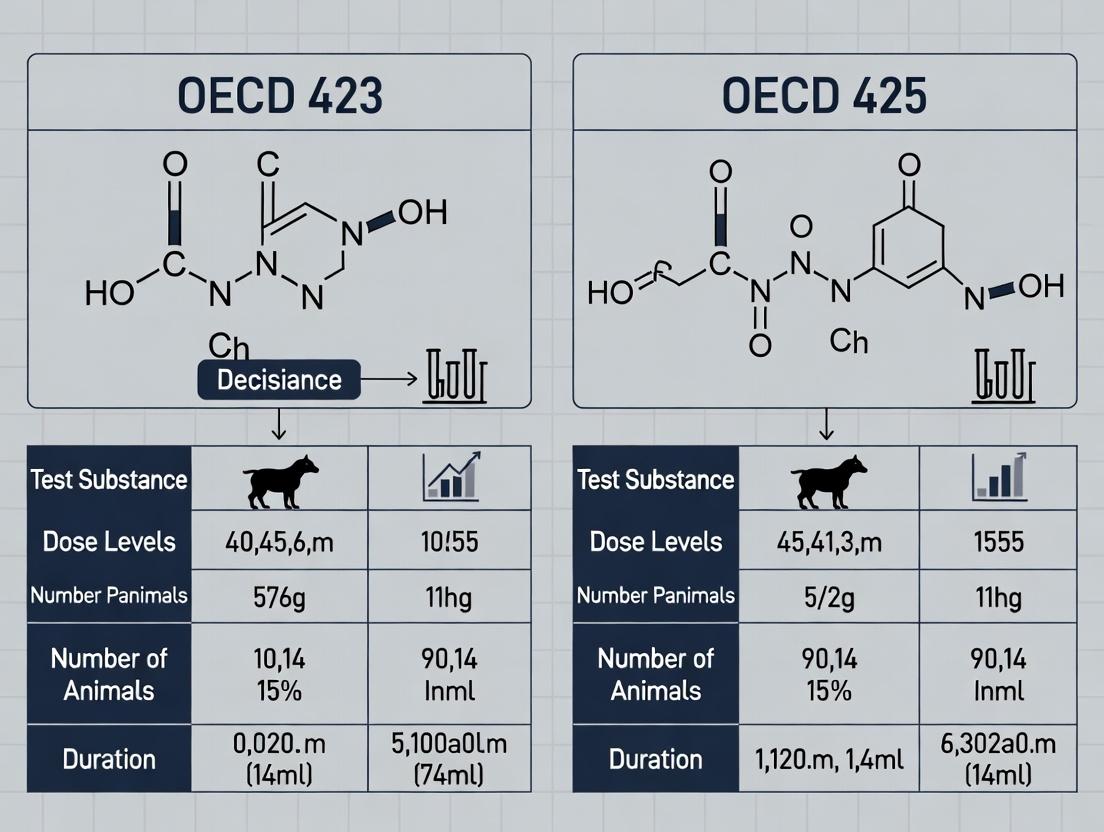
This article provides a comprehensive comparative analysis of OECD Test Guidelines 423 (Acute Toxic Class Method) and 425 (Up-and-Down Procedure) for assessing acute oral toxicity.
OECD 423 vs OECD 425: A Strategic Guide to Selecting Acute Oral Toxicity Test Guidelines
Abstract
This article provides a comprehensive comparative analysis of OECD Test Guidelines 423 (Acute Toxic Class Method) and 425 (Up-and-Down Procedure) for assessing acute oral toxicity. Aimed at researchers and regulatory professionals, it details the foundational principles rooted in the 3Rs (Reduction, Refinement, Replacement), contrasts their stepwise methodologies and statistical approaches, and addresses practical challenges in implementation. The analysis synthesizes validation data to guide test selection based on substance characteristics and regulatory goals, concluding with insights into evolving trends that prioritize animal welfare and scientific robustness in chemical safety assessment [citation:1][citation:4][citation:6].
Redefining the Endpoint: From Classic LD50 to Modern Animal Welfare Principles
Historical Context: From Classic LD50 to the 3Rs Framework
The assessment of acute oral toxicity, defined as adverse effects occurring within a short time of oral administration of a single dose of a substance, has long been a cornerstone of chemical and pharmaceutical safety evaluation [1]. For decades, the primary objective was determining the median lethal dose (LD50), the statistically derived single dose expected to kill 50% of tested animals. Traditional methods, which required large numbers of animals (often 40-60) and used death as a primary endpoint, came under increasing ethical and scientific scrutiny [1].
This scrutiny led to the formalization of the 3Rs principle (Replacement, Reduction, and Refinement) as an ethical imperative. In response, the Organisation for Economic Co-operation and Development (OECD) pioneered alternative test guidelines that significantly advanced these goals. The Fixed Dose Procedure (OECD 420), adopted in 1992, was the first alternative, moving away from mortality as an endpoint to the observation of clear signs of toxicity [1]. It was followed by the Acute Toxic Class (ATC) method (OECD 423) in 1996 and the Up-and-Down Procedure (UDP, OECD 425) [1] [2]. These methods represent a shared evolutionary origin from the classic LD50 test, collectively achieving dramatic reductions in animal use, minimizing suffering, and providing robust data for hazard classification under the Globally Harmonized System (GHS) [1] [3].
Methodology Comparison: OECD 423 vs. OECD 425
This section details the core procedural differences between the two prominent alternative guidelines.
OECD 423: Acute Toxic Class (ATC) Method The ATC method is a stepwise procedure using small groups of animals (typically three of a single gender per step) at fixed doses [1]. The predefined dose levels are 5, 50, 300, and 2000 mg/kg (with 5000 mg/kg as an exceptional option) [1]. The process begins at a dose selected from available information. The outcome (mortality or survival) of one step determines the next action: either stopping the test, testing three more animals at the same dose, or moving to a higher or lower dose [1]. The goal is not to calculate a precise LD50 but to classify the substance into a toxicity band (e.g., very toxic, toxic, harmful) [1].
OECD 425: Up-and-Down Procedure (UDP)
The UDP is a sequential dosing protocol where animals are dosed one at a time [3]. The dose for each subsequent animal is adjusted up or down by a predefined progression factor (typically 3.2, or half-log units) based on the survival or death of the previous animal [3]. A specialized computer program (AOT425StatPgm) is often used to determine dosing sequences, stopping rules, and to calculate a point estimate for the LD50 with confidence intervals [2] [3]. The test continues until a statistically defined stopping criterion is met, which efficiently brackets the lethal dose range [3].
Table 1: Core Methodological Comparison of OECD 423 and OECD 425
| Feature | OECD 423 (Acute Toxic Class) | OECD 425 (Up-and-Down Procedure) |
|---|---|---|
| Primary Objective | Hazard identification and classification into toxicity bands [1]. | Estimation of the LD50 with confidence intervals [3]. |
| Dosing Strategy | Fixed, predefined dose levels (5, 50, 300, 2000 mg/kg) [1]. | Flexible, sequential dosing adjusted by a progression factor (e.g., 3.2) [3]. |
| Animals per Step | Three animals of one gender per step [1]. | One animal at a time [3]. |
| Endpoint | Mortality observed in a group determines next step [1]. | Survival/death of individual animal determines next dose [3]. |
| Statistical Output | Classifies substance into an acute toxicity category [1]. | Calculates a point estimate for LD50 and its confidence interval [2] [3]. |
| Typical Animal Use | Approximately 6-12 animals (2-4 steps) [1]. | Typically 6-10 animals, determined by stopping rules [3]. |
Experimental Protocols and Data Outcomes
Both guidelines require stringent animal care, acclimatization, and observation protocols. Healthy young adult rodents (rats preferred, 8-12 weeks old) are used, with non-pregnant females often selected [1] [3]. Standardized housing (temperature 22°C ± 3°C, humidity 50-60%, 12h light/dark cycle) is mandatory [1] [3]. Animals are fasted prior to dosing, and the test substance is administered via oral gavage in a constant volume, typically not exceeding 1 mL/100g body weight [1] [3]. Post-dosing, animals are observed intensively for the first 24-48 hours and then daily for a total of 14 days for signs of toxicity, body weight changes, and mortality [1] [3].
OECD 423 Workflow and Decision Logic The following diagram outlines the stepwise decision logic of the OECD 423 Acute Toxic Class Method.
OECD 425 Up-and-Down Procedure Workflow The following diagram illustrates the adaptive, sequential dosing logic of the OECD 425 Up-and-Down Procedure.
Supporting Experimental Data and Performance The two methods differ in their statistical approach and output. OECD 423 efficiently sorts substances into hazard classes suitable for labeling. OECD 425 provides a more traditional, precise toxicological point estimate. A key advantage of OECD 425 is the built-in limit test, which can efficiently identify substances of low toxicity (LD50 > 2000 mg/kg) using up to five animals, potentially avoiding the main test altogether [3]. The stopping rules for the main test (e.g., three consecutive survivals at the highest tested dose) are designed to minimize animal use while ensuring statistical reliability [3].
Table 2: Comparative Experimental Outcomes and Performance
| Aspect | OECD 423 (Acute Toxic Class) | OECD 425 (Up-and-Down Procedure) |
|---|---|---|
| Key Data Output | Toxicity classification (e.g., GHS Category 1-5) [1]. | Point estimate of LD50 (mg/kg) with confidence intervals [2] [3]. |
| Animal Use Efficiency | High. Uses few animals (often 6-12); number not predetermined but based on outcome [1]. | Very High. Uses sequential design; typical range 6-10 animals. Limit test uses ≤5 animals [3]. |
| Refinement (Reduced Suffering) | Uses fixed, moderately toxic doses to avoid severe lethality [1]. | Starts below estimated LD50; adaptive dosing avoids massive overdosing [3]. |
| Optimal Use Case | Prioritizing hazard classification for regulatory labeling [1]. | Requiring a quantitative LD50 estimate for risk assessment or research comparisons [3]. |
| Statistical Tooling | Simple decision tree [1]. | Requires specialized software (e.g., AOT425StatPgm) for dosing and calculation [2] [3]. |
The Scientist's Toolkit: Essential Research Reagent Solutions
Successful execution of these guidelines depends on standardized materials and reagents.
Table 3: Key Research Reagent Solutions for Acute Oral Toxicity Testing
| Item | Function & Specification | Guideline Reference |
|---|---|---|
| Vehicle (Water/Corn Oil) | A non-toxic solvent to prepare test substance solutions/suspensions. Aqueous solutions are preferred; corn oil is a common alternative [1] [3]. | OECD 423, 425 |
| Standard Laboratory Rodent Diet | Provides uniform nutrition during acclimatization and testing periods to ensure baseline health and reduce metabolic variability [1] [3]. | OECD 423, 425 |
| Oral Gavage Needle/Cannula | A blunt-ended stainless-steel or flexible tube attached to a syringe for accurate intragastric administration of the test formulation [1] [3]. | OECD 423, 425 |
| AOT425StatPgm Software | Computer program that calculates dosing sequences, determines stopping points, and estimates the LD50 with confidence intervals for the OECD 425 protocol [2]. | OECD 425 |
| Clinical Observation Scoring System | A standardized checklist for recording signs of toxicity (e.g., piloerection, labored breathing, tremors) to ensure consistent and objective observation across studies [1] [3]. | OECD 423, 425 |
OECD Test Guidelines 423 and 425 stand as direct descendants of the traditional LD50 test, fundamentally transformed by the 3Rs imperative. While they share common requirements for animal welfare, observation, and data reporting, their core philosophies diverge: OECD 423 is a hazard classification tool that uses fixed doses and small groups, whereas OECD 425 is a dose-estimation tool that uses an adaptive sequential design. The choice between them is not a matter of superiority but of fitness for purpose. For regulatory classification and labeling, OECD 423 offers an efficient, animal-sparing solution. When a quantitative LD50 value is necessary for research or specific risk assessments, OECD 425 provides a statistically rigorous estimate with a similarly strong commitment to reduction and refinement. Together, they exemplify how a shared origin in traditional toxicology has evolved to meet modern scientific and ethical standards.
The assessment of acute oral toxicity is a fundamental requirement in the safety evaluation of chemicals, pharmaceuticals, and agrochemicals for regulatory classification and labeling [4]. Historically, this assessment was dominated by the determination of the median lethal dose (LD₅₀), a metric that quantifies the dose causing 50% mortality in a test population [4]. This approach, while providing a clear numerical value, necessitated the use of large numbers of animals and caused significant suffering [1] [4].
A major paradigm shift has occurred with the development and adoption of alternative test guidelines by the Organisation for Economic Co-operation and Development (OECD). This shift moves the primary endpoint from observed lethality to the observation of evident toxicity—defined as clear signs that exposure to a higher dose would result in death [5]. This refinement fundamentally changes the objective from quantifying death to identifying a dose that causes clear, non-lethal toxicity, thereby preventing severe suffering and death [1] [5]. This guide objectively compares two pivotal OECD test guidelines—the Acute Toxic Class (ATC) method (OECD 423) and the Up-and-Down Procedure (UDP) (OECD 425)—within the context of this evolving scientific and ethical landscape.
Core Definitions and Foundational Principles
Lethality (as a Primary Endpoint): The occurrence of death in test animals following substance administration. It is the definitive endpoint used to calculate the LD₅₀. Guidelines like OECD 423 and 425 use mortality data to classify substances [1] [6].
Evident Toxicity (as a Primary Endpoint): A refined endpoint defined by the presence of "clear signs that exposure to a higher dose would result in death" [5]. It is the cornerstone of OECD TG 420 (Fixed Dose Procedure), where the goal is to find a dose that produces clear signs of toxicity (e.g., ataxia, labored respiration) without causing lethal effects [1] [5]. This endpoint is designed to prevent animal suffering.
OECD 423 (Acute Toxic Class Method): A stepwise method that uses mortality in small groups of animals (typically three per step) to assign a substance to a predefined "toxicity class" (e.g., based on fixed doses of 5, 50, 300, 2000 mg/kg) rather than calculating a precise LD₅₀ [1] [7]. The outcome is a classification for hazard assessment.
OECD 425 (Up-and-Down Procedure): A sequential dosing method where one animal is dosed at a time. The dose for the next animal is increased or decreased based on the survival or death of the previous one. This method uses a statistical approach to estimate the LD₅₀ and its confidence intervals while minimizing animal use [6].
Table 1: Comparison of Foundational Principles and Regulatory Status
| Feature | OECD 423: Acute Toxic Class (ATC) | OECD 425: Up-and-Down Procedure (UDP) |
|---|---|---|
| Primary Endpoint | Lethality (Mortality) | Lethality (Mortality) |
| Core Objective | To classify a substance into a hazard category (Acute Toxicity Estimate) | To calculate a point estimate of the LD₅₀ with confidence intervals |
| Historical Adoption | Adopted in 1996 as an alternative to TG 401 [1] | Later refinement; adopts a sequential testing design [6] |
| Regulatory Outcome | Classification according to GHS | LD₅₀ value for GHS classification and risk assessment |
| Alignment with 3Rs | Reduction & Refinement: Uses fewer animals than classical tests; avoids extreme suffering by using fixed, spaced doses [1] [4] | Reduction & Refinement: Dramatically reduces animal numbers via sequential design; stopping rules limit exposure [4] [6] |
Comparative Analysis of Methodological Protocols
The experimental workflows for OECD 423 and OECD 425 are structurally distinct, reflecting their different statistical foundations and endpoints.
OECD 423 Experimental Protocol
The ATC method is a fixed-dose, stepwise group approach [1].
- Test System: Typically, non-pregnant female rats (8-12 weeks old) are used. Animals are acclimatized for at least five days under standard conditions (e.g., 22±3°C, 12h light/dark cycle) [1].
- Dose Preparation: The test substance is administered via oral gavage in a constant volume (e.g., 1 mL/100g body weight). It is prepared as a fresh solution/suspension using a non-toxic vehicle like water or corn oil [1].
- Dosing Procedure: A starting dose is chosen from a series of fixed doses (5, 50, 300, or 2000 mg/kg). Three animals of a single gender are dosed simultaneously at this level [1].
- Observation Period: Animals are observed intensively for the first 30 minutes, periodically for 24 hours, and daily for 14 days. Observations include changes in skin, eyes, respiratory and nervous system function, and behavior [1].
- Decision Logic & Step Progression:
- If 0/3 animals die, testing stops at the next higher dose.
- If 1/3 animals die, three additional animals are dosed at the same level. If 1/6 or fewer die overall, testing stops at the next higher dose. If 2/6 or more die, the testing stops, and the dose level is classified.
- If 2/3 or 3/3 animals die, testing stops at the next lower dose [1].
- Outcome: The process results in an Acute Toxicity Estimate (ATE) for classification under the Globally Harmonized System (GHS) [1].
OECD 425 Experimental Protocol
The UDP is a sequential, individual animal approach [6].
- Test System & Preparation: Similar rodent models and housing conditions as OECD 423. Animals are often fasted prior to dosing [1] [6].
- Dose Preparation: Analogous to TG 423, with administration via oral gavage [6].
- Dosing Procedure: Dosing begins with a single animal at a starting dose estimated from prior information. Based on the survival or death of that animal after 48 hours, the dose for the next animal is adjusted:
- If the animal survives, the dose for the next animal is increased.
- If the animal dies, the dose for the next animal is decreased [6].
- Observation Period: A 14-day observation period is followed with detailed clinical observations and necropsy at termination [6].
- Decision Logic & Stopping Rules: The sequential test continues until a predefined stopping rule is met, typically requiring a minimum number of animals (e.g., 5) and ensuring that the sequence of outcomes oscillates around the estimated LD₅₀ [6].
- Outcome Analysis: A maximum likelihood estimation or similar statistical method is applied to the pattern of responses to calculate the LD₅₀ and its confidence intervals [6].
Table 2: Direct Comparison of Experimental Protocols
| Protocol Aspect | OECD 423 | OECD 425 |
|---|---|---|
| Animal Use per Step | 3 animals dosed simultaneously [1] | 1 animal dosed at a time [6] |
| Typical Total Animals | 6-12 animals (avg. 2-4 steps) [1] | 5-10 animals [6] |
| Dosing Strategy | Fixed, predefined doses (5, 50, 300, 2000 mg/kg) [1] | Flexible, sequentially adjusted doses |
| Key Decision Factor | Mortality count in the small group at a fixed dose [1] | Survival/death outcome of the individual preceding animal [6] |
| Statistical Basis | Binomial outcomes (dead/alive) at fixed intervals | Sequential analysis of a dose-response series |
| Final Output | Toxicity Classification (Class/ATE) | Point estimate of LD₅₀ with confidence intervals [6] |
OECD 423 Acute Toxic Class Method Decision Workflow
OECD 425 Up-and-Down Procedure Decision Workflow
Performance Comparison: Evident Toxicity vs. Lethality Endpoints
The choice between evident toxicity and lethality as endpoints has profound implications for animal welfare, testing efficiency, and data utility.
Table 3: Performance Comparison of Endpoint Paradigms
| Performance Metric | Evident Toxicity Endpoint (as in TG 420) | Lethality Endpoint (as in TG 423 & 425) |
|---|---|---|
| Animal Welfare (Refinement) | High. Actively prevents death and severe suffering by design [5]. | Variable. TG 423/425 aim to reduce numbers but still require mortality as an outcome [4]. |
| Predictive Value for Human Hazard | High for Classification. Identifying a toxic but non-lethal dose is sufficient for GHS categorization [5]. | Traditional Standard. LD₅₀ has a long history of use but may be an overly severe metric for classification alone [4]. |
| Endpoint Subjectivity | Perceived as Higher. Relies on expert recognition of clinical signs (e.g., ataxia, labored respiration) [5]. | Low. Death is an objective, unambiguous endpoint. |
| Data for Dose-Setting | Provides a clear Maximum Tolerated Dose (MTD) for subsequent studies. | Provides a Lethal Dose (LD₅₀) which is less directly informative for setting doses in non-lethal studies. |
| Regulatory Acceptance | Fully accepted (OECD 420), but perceived subjectivity may hinder use [5]. | Fully accepted and widely used globally [1] [6]. |
Supporting Experimental Data on Evident Toxicity: A 2023 analysis of historical data provided strong validation for the evident toxicity endpoint. It identified specific clinical signs at a lower dose that are highly predictive of mortality at the next higher dose. For instance, signs like ataxia, labored respiration, and eyes partially closed had a high Positive Predictive Value (PPV) for subsequent death, offering a scientific basis to confidently stop testing at a toxic but non-lethal dose [5].
The Scientist's Toolkit: Essential Reagents and Materials
Table 4: Key Research Reagent Solutions for Acute Oral Toxicity Studies
| Item | Function & Specification | Typical Example/Note |
|---|---|---|
| Test Animal Model | In vivo subject for toxicity assessment. | Young adult, non-pregnant female rats (e.g., Sprague-Dawley, Wistar) [1]. |
| Dosing Vehicle | Medium for solubilizing/suspending the test substance for administration. | Non-toxic vehicles: Water, corn oil, methylcellulose, carboxymethylcellulose [1]. |
| Gavage Equipment | For accurate oral delivery of the test substance directly to the stomach. | Stainless steel or flexible plastic feeding tubes (oral gavage needles) and appropriate syringes. |
| Clinical Observation Checklist | Standardized form for recording signs of toxicity. | Covers skin/fur, eyes, mucous membranes, respiratory, circulatory, autonomic/CNS, and behavior [1]. |
| Pathology Supplies | For terminal necropsy and tissue preservation. | Fixatives (e.g., 10% neutral buffered formalin), dissection tools, cassettes, histology slides. |
| Statistical Software | For data analysis and LD₅₀ calculation (especially for OECD 425). | Software packages capable of probit analysis or maximum likelihood estimation (e.g., OECD 425 analysis tool). |
The evolution from classical LD₅₀ tests to OECD 423 and 425 represents a significant reduction and refinement in animal testing. However, the broader paradigm shift towards evident toxicity as a primary endpoint (exemplified by OECD 420) offers the most substantial advancement in animal welfare by replacing the need for mortality data [5].
Selection Framework for Researchers:
- Choose OECD 420 (Evident Toxicity) when the goal is hazard classification with the highest commitment to the 3Rs, and when your laboratory is trained in recognizing the defined clinical signs of evident toxicity [5].
- Choose OECD 423 (ATC) when a fixed-dose, category-based classification is required, and a small-group, stepwise protocol is preferred.
- Choose OECD 425 (UDP) when a precise LD₅₀ estimate with confidence intervals is explicitly required for quantitative risk assessment beyond classification, and you can accept a sequential testing design.
The future of acute toxicity testing lies in the wider adoption of the evident toxicity endpoint and the continued development of integrated testing strategies that combine in silico, in vitro, and refined in vivo methods to meet regulatory needs while upholding the highest ethical standards [4].
Regulatory Framework and Integration with GHS Classification Systems
The Organisation for Economic Co-operation and Development (OECD) Test Guidelines for acute oral toxicity are internationally recognized standards for assessing the hazardous potential of chemicals, pharmaceuticals, and other substances [8]. These guidelines, particularly OECD 423 (Acute Toxic Class Method) and OECD 425 (Up-and-Down Procedure), serve a critical function within the global regulatory framework by generating data for classifying and labeling substances according to the Globally Harmonized System (GHS) [1]. This comparative analysis, framed within broader research on OECD 423 versus OECD 425, examines the experimental protocols, performance outcomes, and practical applications of both methods. The primary objective is to provide researchers and regulatory professionals with a clear, data-driven guide for selecting an appropriate testing strategy that balances scientific rigor with the ethical principles of reduction and refinement in animal testing (the 3Rs) [4].
The following table provides a high-level comparison of the foundational elements of OECD Test Guidelines 423 and 425, highlighting their distinct approaches to determining acute oral toxicity.
Table 1: Core Comparison of OECD 423 and OECD 425 Test Guidelines
| Feature | OECD 423: Acute Toxic Class (ATC) Method | OECD 425: Up-and-Down Procedure (UDP) |
|---|---|---|
| Primary Objective | To assign a substance to a defined acute toxicity class (GHS category) for classification and labeling [1]. | To estimate the median lethal dose (LD₅₀) with a confidence interval [2]. |
| Testing Principle | A stepwise procedure using fixed, predefined doses aligned with GHS categories [1]. | A sequential dosing procedure where the dose for the next animal depends on the outcome for the previous one [9]. |
| Typical Animal Use | 6-12 animals (3 per step, 2-4 steps on average) [1]. | Typically 6-9 animals, but can vary based on stopping rules [4]. |
| Key Endpoint | Observation of mortality/moribundity to determine progression to next dose level [5]. | Observation of mortality as the primary decision-making endpoint [5]. |
| Dose Selection | Fixed doses: 5, 50, 300, 2000 mg/kg (5000 mg/kg for limit test) [1]. | Doses are adjusted by a constant multiplicative factor (typically 3.2) based on outcome [2]. |
| Statistical Support | Uses predefined decision tables based on fixed outcomes. | Requires computerized statistical program (e.g., AOT425StatPgm) to determine dosing sequence and calculate LD₅₀ [2]. |
| Main Advantage | Simple, requires no complex calculations; directly linked to GHS classification [1]. | Provides a point estimate of LD₅₀ with confidence limits; can be more efficient in animal use for certain toxicity ranges [4]. |
Detailed Experimental Protocols and Methodologies
OECD 423: Acute Toxic Class Method Protocol
The OECD 423 guideline employs a stepwise, binning approach designed to minimize animal use while determining the correct GHS classification band [1].
Animals and Housing: The test uses healthy, young adult non-pregnant female rats, typically 8-12 weeks old [1]. Animals are acclimatized for at least five days under standard conditions (temperature 22±3°C, humidity 55±5%, 12-hour light/dark cycle) with free access to diet and water [1].
Dose Preparation and Administration: The test substance is administered as a single oral dose via gavage [1]. It is prepared in a constant volume, typically 1 mL/100g of body weight for rodents, using a non-toxic vehicle like water or corn oil [1]. Animals are fasted prior to dosing (e.g., 2-4 hours for rats) [1].
Stepwise Testing Procedure:
- Starting Dose Selection: Based on existing information, a starting dose is chosen from the fixed sequence (5, 50, 300, or 2000 mg/kg).
- First Step: Three animals are dosed at the selected starting level.
- Observation and Decision: Animals are observed meticulously for signs of toxicity, moribundity, and death for 14 days [1]. A predefined decision rule is applied:
- If 0/3 animals die, testing may stop if the starting dose was 2000 mg/kg, or a higher dose is tested with three new animals.
- If 1/3 animals die, three additional animals are dosed at the same level. If 1/6 or fewer die, testing stops at that class. If 2/6 or more die, testing proceeds to the next higher dose.
- If 2/3 or 3/3 animals die, testing proceeds to the next lower dose level with three new animals [1].
- The process continues until a classification decision can be made based on the matrix.
OECD 425: Up-and-Down Procedure Protocol
OECD 425 uses a flexible, sequential design aimed at efficiently estimating the LD₅₀ [9].
Animals and Housing: Similar to TG 423, it uses healthy young adult rats (usually females), acclimatized under standard laboratory conditions [9].
Limit Test: If existing data suggest low toxicity, a limit test at 2000 mg/kg or 5000 mg/kg may be performed using up to 5 animals sequentially. If no mortality is observed, the test concludes, classifying the substance as Category 5 or unclassified [9].
Main Test Sequential Dosing:
- A single animal is dosed at a level just below the best estimate of the LD₅₀.
- The animal is observed for 48 hours before the next dosing decision is made. If the outcome is uncertain, observation may extend to 96 hours [9].
- Decision Rule:
- If the animal survives, the dose for the next animal is increased by a factor of 3.2 times the original dose.
- If the animal dies, the dose for the next animal is decreased by the same factor.
- Testing continues until a stopping criterion is met, typically when a predetermined number of reversals (changes in outcome from survival to death or vice versa) occur, or when a set number of animals have been tested. The computerized statistical program determines when to stop and calculates the final LD₅₀ estimate and confidence interval [2].
Observation Parameters: For both guidelines, detailed clinical observations are critical. Animals are monitored for changes in skin and fur, eyes, mucous membranes, respiratory and circulatory function, autonomic and central nervous systems, and somatomotor activity [1]. Body weight is recorded at dosing, weekly, and at death/sacrifice. All findings, including time of death and necropsy observations, are meticulously documented [1].
OECD 423 Acute Toxic Class Method Decision Flow
Performance Analysis and Supporting Data
The selection between TG 423 and TG 425 involves trade-offs between classification certainty, point estimate precision, and animal use.
Animal Use Efficiency and Refinement
Both guidelines represent a significant refinement over classical LD₅₀ tests, but their efficiency varies with the substance's unknown toxicity profile.
Table 2: Comparison of Animal Use and Ethical Refinement
| Aspect | OECD 423 | OECD 425 | Experimental Evidence & Implications |
|---|---|---|---|
| Typical Animal Number | Fixed structure: 3 animals per step. Average 6-12 animals total [1]. | Variable, typically 6-9, but precisely determined by stopping rules [4]. | TG 425 can be more economical for substances with very high or very low toxicity, as it may stop earlier. TG 423 uses a predictable, fixed group size. |
| Endpoint Refinement | Uses mortality/moribundity as the primary endpoint for decision-making [5]. | Uses mortality as the primary endpoint [5]. | Neither method uses the more refined "evident toxicity" endpoint endorsed by OECD 420 [5]. A 2023 analysis of historical data identified clinical signs (e.g., ataxia, labored respiration) that are highly predictive of mortality, which could inform observations in both protocols [5]. |
| Pain & Distress | Aims to use doses causing clear signs of toxicity without severe lethal effects, but mortality is still an expected outcome in some steps [1]. | Sequential design may expose some animals to lethal doses. The 48-hour observation window aims to prevent dosing multiple animals simultaneously at a lethal dose [9]. | Both methods involve less overall suffering than classical tests but do not fully eliminate mortality as an endpoint. |
Accuracy, Precision, and Regulatory Acceptance
Table 3: Comparison of Scientific Output and Regulatory Utility
| Aspect | OECD 423 | OECD 425 | Supporting Data & Analysis |
|---|---|---|---|
| Primary Output | A GHS toxicity category (e.g., Category 3, 4) [1]. | A point estimate of the LD₅₀ with a calculated confidence interval [2]. | TG 425 provides more granular data for quantitative risk assessment. TG 423 provides the exact information needed for mandatory labeling. |
| Statistical Robustness | Based on binomial distribution models and fixed decision tables. Provides a clear classification but no confidence interval on the LD₅₀. | Uses maximum likelihood estimation for LD₅₀ calculation. The statistical program ensures robust, reproducible confidence limits [2]. | The computerized calculation in TG 425 is a strength but also a requirement, adding a layer of procedural complexity [2]. |
| Regulatory Integration | Directly aligned with GHS classification bands. Data can be used immediately for hazard classification and labeling [1]. | The calculated LD₅₀ must be mapped to GHS categories (e.g., LD₅₀ ≤ 300 mg/kg = Category 3) [1]. Provides data useful beyond classification (e.g., risk assessment). | Both are fully accepted under the OECD Mutual Acceptance of Data (MAD) system [8]. Regulatory needs (classification vs. quantification) guide the choice. |
| Reproducibility | High, due to simple, rule-based design with minimal statistical requirement from the tester. | High, when the standardized software and protocol are followed precisely. | Comparative studies indicate both methods produce consistent and reproducible results when performed correctly. |
OECD 425 Up-and-Down Procedure Testing Sequence
The Scientist's Toolkit: Essential Research Reagents and Materials
Table 4: Key Reagents and Materials for Acute Oral Toxicity Testing
| Item | Function in Protocol | Specifications & Notes |
|---|---|---|
| Test Substance | The material whose acute toxicity is being characterized. | Typically ≥20 grams required for a full study to ensure sufficient material for dosing preparations [9]. Purity and stability should be documented. |
| Vehicle (e.g., Water, Corn Oil) | To dissolve or suspend the test substance for consistent oral administration [1]. | Must be non-toxic at the administration volumes used. Choice depends on substance solubility to ensure a homogenous dosing formulation. |
| Laboratory Rodents (Rat) | In vivo model for assessing systemic acute toxicity. | Healthy, young adult non-pregnant females (rat or mouse) are standard [1]. Species and strain should be specified. |
| Gavage Needle/Stomach Tube | For accurate oral administration of the test formulation directly into the stomach. | Correct ball-tip size for the animal's weight to prevent injury and ensure accurate delivery of the constant volume (e.g., 1 mL/100g) [1]. |
| Clinical Observation Checklists | Standardized sheets for recording signs of toxicity. | Based on OECD guidelines, covering skin/fur, eyes, respiration, motor activity, behavior, etc. [1] Critical for consistent data collection. |
| AOT425StatPgm Software | Specific to OECD 425. Determines dosing sequence, stopping points, and calculates LD₅₀ with confidence intervals [2]. | Mandatory for performing OECD 425. Freely available software that ensures statistical validity of the sequential test design [2]. |
The choice between OECD TG 423 and TG 425 is not a matter of superior performance, but of aligning the test method with specific research or regulatory objectives within the GHS framework.
Select OECD 423 (Acute Toxic Class) when the primary need is deterministic hazard classification for labeling. Its strengths are procedural simplicity, direct alignment with GHS categories, and predictable animal group sizes. It is ideal for routine testing where a definitive classification band is the sole requirement.
Select OECD 425 (Up-and-Down Procedure) when a quantitative point estimate (LD₅₀) is needed for quantitative risk assessment, dose-setting for subsequent studies, or when greater efficiency in animal use is anticipated for substances of extreme toxicity. It requires statistical software but provides richer data output.
Both methods are validated, internationally accepted under the OECD MAD system, and represent the application of the 3Rs principles [4] [8]. Recent research into "evident toxicity" provides enhanced observational criteria that can inform clinical assessments in both protocols, promoting further refinement [5]. Ultimately, the decision should be based on the defined data requirements of the regulatory endpoint and the principles of the most ethical and scientifically appropriate testing strategy.
Step-by-Step Protocol Comparison: Experimental Design, Execution, and Reporting
The assessment of acute oral toxicity is a fundamental requirement in the safety evaluation of chemicals, pharmaceuticals, and agrochemicals. Historically, this relied on the classic LD50 test, which required large numbers of animals. In line with the 3Rs principles (Replacement, Reduction, and Refinement), the Organisation for Economic Co-operation and Development (OECD) has developed alternative guidelines. Two pivotal methods are the Acute Toxic Class (ATC) method (OECD Test Guideline 423), which uses fixed-dose cohorts, and the Up-and-Down Procedure (UDP) (OECD Test Guideline 425), which employs a sequential dosing strategy [1] [3]. Both aim to determine a substance's toxicity for classification under the Globally Harmonized System (GHS) while using fewer animals and minimizing suffering, but they achieve this through fundamentally different experimental designs [1] [10].
Core Comparison of Fixed-Dose and Sequential Dosing Strategies
The following table summarizes the key differences in design, execution, and output between the OECD 423 and OECD 425 guidelines.
Table 1: Comparative Overview of OECD TG 423 (Fixed-Dose) and OECD TG 425 (Sequential Dosing)
| Aspect | OECD TG 423: Acute Toxic Class (ATC) Method | OECD TG 425: Up-and-Down Procedure (UDP) |
|---|---|---|
| Core Design | Fixed-dose cohort testing. Animals are tested in groups (cohorts) at predefined dose levels [1]. | Sequential, adaptive dosing. Animals are dosed one at a time, with the dose for the next animal based on the outcome from the previous one [3] [2]. |
| Typical Animal Use | 3 animals per step (cohort), with an average of 2-4 steps (6-12 animals total) [1]. | Variable, typically 6-9 animals. A single animal is used per step, significantly reducing use compared to classical methods [3]. |
| Dose Progression | Fixed doses: 5, 50, 300, and 2000 mg/kg (5000 mg/kg in exceptional cases) [1]. | Flexible. Starts near the estimated LD50, then adjusts by a default progression factor of 3.2 (half-log) based on survival [3]. |
| Primary Endpoint | Mortality or moribund status of the cohort is used to assign a GHS hazard class [1]. | Mortality of individual animals is used to calculate a point estimate of the LD50 and its confidence interval [3] [2]. |
| Key Data Output | Classification into a GHS acute toxicity hazard category (e.g., Category 1-4) [1]. | A statistically robust estimate of the LD50 value with confidence intervals [3] [2]. |
| Main Advantages | Simple, reproducible, uses few animals, avoids death as a necessary endpoint for classification. | Efficient animal use, provides a precise LD50 estimate, adaptive design is flexible for unknown substances. |
| Main Limitations | Provides a classification band, not a precise LD50. Less efficient for defining exact potency. | Requires specialized statistical software. Not ideal for substances with delayed mortality (>48 hours) [3]. |
Detailed Experimental Protocols
OECD TG 423: The Fixed-Dose Cohort Protocol
This protocol is a stepwise procedure using groups of animals at fixed dose levels [1].
- Preparation: Healthy young adult rodents (typically non-pregnant female rats, 8-12 weeks old) are acclimatized for at least 5 days. They are housed under standard conditions (temperature 22±3°C, 55±5% humidity, 12h light/dark cycle) [1].
- Dose Formulation: The test substance is prepared in a constant volume, typically using water or corn oil as a vehicle. The standard administration volume is 1 mL/100g body weight (up to 2 mL/100g for aqueous solutions) [1].
- Study Procedure:
- A sighting study may be conducted with single animals to select an appropriate starting dose for the main study [1].
- In the main study, a cohort of three animals of the same sex is dosed orally at one of the fixed levels (e.g., 300 mg/kg) [1].
- Animals are observed intensively for 14 days for clinical signs of toxicity (e.g., changes in fur, eyes, respiration, motor activity, behavior) [1].
- Based on the outcome (mortality/morbidity), a decision is made:
- If criteria for classification are met, the test stops.
- If not, a new cohort of three animals is dosed at a higher or lower fixed dose.
- This continues until the criterion for classification is fulfilled [1].
OECD TG 425: The Sequential Dosing Protocol
This protocol uses an adaptive, animal-by-animal design to hone in on the LD50 [3] [2].
- Preparation & Formulation: Similar to TG 423, using healthy young adult rodents (often females) under standard housing conditions. Dose formulation principles (constant volume, vehicle use) are identical [3].
- Limit Test: If prior data suggest low toxicity, a limit test is performed. A single animal is dosed at 2000 mg/kg. If it survives, up to four more animals are dosed sequentially at the same level. Survival of three or more animals allows classification as LD50 >2000 mg/kg, ending the test [3].
- Main Test - Sequential Dosing:
- The first animal receives a dose just below the best estimate of the LD50. If no information exists, a starting dose of 175 mg/kg is recommended [3].
- The animal is observed for a defined period (usually 48 hours). If it survives, the dose for the next animal is increased by a factor of 3.2. If it dies, the dose is decreased by the same factor [3].
- Dosing proceeds one animal at a time, with each new dose dependent on the outcome from the previous animal.
- The test continues until a predefined stopping rule is triggered. Common rules include: three consecutive survivors at the highest tested dose, or a specific statistical confidence level reached (determined by accompanying software like AOT425StatPgm) [3] [2].
- Calculation: Upon termination, specialized software uses the sequence of outcomes and doses (via maximum likelihood estimation) to calculate the LD50 value and its confidence intervals [3] [2].
Visualizing the Testing Strategy Decision Logic
The fundamental decision-making pathways for the fixed-dose (OECD 423) and sequential (OECD 425) strategies are distinct. The following diagram contrasts these logical flows.
Diagram: Decision Logic Flow for OECD 423 and OECD 425 Test Strategies.
The Scientist's Toolkit: Essential Research Reagents and Materials
Conducting studies under OECD 423 or 425 requires specific materials and tools. The following table details key items and their functions.
Table 2: Essential Research Reagents and Materials for Acute Oral Toxicity Testing
| Item Category | Specific Examples | Primary Function in Protocol |
|---|---|---|
| Test Substance & Vehicle | Purified chemical, pharmaceutical compound, formulated product; Water, corn oil, methyl cellulose, saline. | The agent whose toxicity is being assessed. The vehicle dissolves or suspends the test substance for accurate oral gavage administration [1] [3]. |
| Animal Model | Healthy young adult rats (Rattus norvegicus, e.g., Sprague-Dawley, Wistar) or mice (Mus musculus). | The biological system for evaluating toxicological response. Females are often preferred due to homogeneity and slight sensitivity [1] [3]. |
| Dosing Equipment | Oral gavage needles (straight or curved, ball-tipped), precision syringes (1 mL), dosing tubes. | Ensures accurate, repeatable, and safe intragastric administration of the test substance formulation [1]. |
| Clinical Observation Tools | Standardized scoring sheets, video recording equipment, thermometer, scales. | Enables systematic, consistent, and objective monitoring of clinical signs of toxicity (e.g., lethargy, ataxia, labored respiration) over the 14-day observation period [1] [5]. |
| Statistical Software | AOT425StatPgm (EPA/OECD), commercial statistical packages (e.g., SAS, R). | Critical for OECD 425: Determines dosing sequence, applies stopping rules, and calculates the final LD50 estimate and confidence intervals [3] [2]. |
Strategic Application and Selection Guidelines
The choice between OECD 423 and OECD 425 depends on the specific regulatory and research objectives.
Choose OECD 423 (Fixed-Dose) when: The primary goal is to determine the hazard classification for labeling and risk assessment (GHS Categories 1-4). It is ideal for screening a large number of chemicals efficiently, as it provides a clear "band" of toxicity with minimal and efficient animal use. Recent data strengthening the definition of "evident toxicity" (a key refinement endpoint) further supports its use to prevent severe suffering [5].
Choose OECD 425 (Sequential Dosing) when: A precise quantitative estimate of the LD50 is required. This is essential for calculating therapeutic indices for pharmaceuticals, performing rigorous comparative potency studies, or fulfilling specific regulatory data requirements that demand a point estimate. It is highly efficient for defining the dose-response curve near the median lethal dose with the fewest possible animals, though it requires statistical software expertise [3] [2].
In summary, both OECD Test Guidelines 423 and 425 represent refined, ethical advancements in acute toxicity testing. The fixed-dose cohort strategy (TG 423) excels in efficient hazard identification and classification, while the adaptive sequential strategy (TG 425) provides statistical rigor for quantitative risk characterization. The selection is not a matter of superiority but of aligning the test design with the defined scientific and regulatory endpoint.
Dosing Regimen, Observation Protocols, and Critical Clinical Signs
This guide provides an objective comparison of two pivotal OECD test guidelines for assessing acute oral toxicity: the Acute Toxic Class Method (OECD 423) and the Up-and-Down Procedure (OECD 425). These guidelines are fundamental for the hazard identification, classification, and labeling of chemicals and pharmaceuticals within the Globally Harmonised System (GHS) [1]. While both aim to determine substance toxicity while refining animal use, they differ fundamentally in their experimental design, dosing strategy, statistical endpoint, and efficiency [1] [11]. This analysis contrasts their dosing regimens, observation protocols, and the critical clinical signs used to determine outcomes, providing a structured framework for researchers to select the appropriate methodology for their testing objectives.
Dosing Regimen Comparison
The core distinction between OECD 423 and OECD 425 lies in their dosing logic and regulatory endpoints. OECD 423 uses a fixed-dose, stepwise approach to categorize substances into toxicity classes, while OECD 425 employs a sequential, adjustable-dose method to calculate a point estimate of the LD50 [1] [11].
Table 1: Comparison of Dosing Regimens and Key Parameters
| Parameter | OECD 423: Acute Toxic Class Method | OECD 425: Up-and-Down Procedure |
|---|---|---|
| Primary Objective | Classification into hazard classes based on mortality ranges [1]. | Estimation of the LD50 with a confidence interval [11]. |
| Dosing Strategy | Fixed, predefined doses (5, 50, 300, 2000 mg/kg; 5000 mg/kg in exceptional cases) [1]. | Sequential dosing of single animals; the dose for the next animal is adjusted up or down based on the previous outcome [11]. |
| Animals per Step | 3 animals of a single gender (normally females) per dose step [1]. | 1 animal per step, dosed sequentially [11]. |
| Decision Logic | Proceed to next step (higher/lower dose or repeat) based on mortality pattern in the group of three [1]. | Decision to increase or decrease dose is made after each individual animal outcome [11]. |
| Typical Test Duration | Requires on average 2-4 steps (6-12 animals) to reach a classification decision [1]. | Continues until a predefined stopping rule is met; more efficient for precise LD50 estimation [11]. |
| Key Endpoint | Identification of the dose range causing mortality (e.g., 0/3, 1/3, 2/3, or 3/3 deaths) [1]. | Calculation of the LD50 using maximum likelihood methods [11]. |
Observation Protocols
Both guidelines mandate rigorous post-administration observation to capture signs of toxicity, morbidity, and mortality, with the core protocol being highly aligned.
Table 2: Comparison of Observation Protocols
| Observation Parameter | OECD 423 Protocol [1] | OECD 425 Protocol [11] |
|---|---|---|
| Initial Critical Period | At least once in the first 30 minutes, special attention during the first 4 hours [1]. | Special attention given during the first 4 hours [11]. |
| First 24 Hours | Periodic observations [1]. | Daily observations thereafter [11]. |
| Total Observation Duration | 14 days post-dosing [1]. | 14 days generally [11]. |
| Body Weight Monitoring | Recorded at dosing, weekly thereafter, and at death/sacrifice [1]. | Determined at least weekly [11]. |
| Clinical Signs | Skin/fur, eyes, mucous membranes, respiratory, circulatory, autonomic and CNS, somatomotor activity, behavior [1]. | Implicitly covered under general observation for signs of toxicity and morbidity. |
| Necropsy | All animals are subjected to gross necropsy; histopathology if available [1]. | All animals should be subjected to gross necropsy [11]. |
Critical Clinical Signs
Observation of clinical signs is paramount in both guidelines to determine the severity of toxic effects and to make humane endpoints decisions. The signs are broadly categorized by the physiological system affected [1].
- Dermal & Mucous Membranes: Changes in skin and fur texture, piloerection, discoloration. Irritation or redness in eyes and mucous membranes.
- Respiratory System: Dyspnea (difficulty breathing), tachypnea (rapid breathing), gasping, or nasal discharge.
- Circulatory & Autonomic Systems: Changes in heart rate, pale or cyanotic (blue) extremities, hypothermia.
- Nervous System & Behavior:
- Central Nervous System (CNS): Tremors, convulsions, seizures, ataxia (loss of coordination), lethargy, hypo- or hyperactivity.
- Somatomotor Activity: Abnormal posture, prostration, weakness, paralysis.
- Behavioral Patterns: Stereotypies (repetitive movements), self-isolation, aggression, or altered grooming.
The onset, severity, and reversibility of these signs are meticulously recorded for each animal [1]. In OECD 423, these observations directly inform whether a dose is considered "toxic" even in the absence of death [1]. In OECD 425, they contribute to the overall assessment of the animal's response preceding mortality or survival [11].
Experimental Protocols
OECD 423: The Acute Toxic Class Method Protocol
The protocol follows a fixed-step decision tree based on group mortality [1].
- Dose Selection: Begin at one of the predefined fixed doses (e.g., 300 mg/kg).
- First Step: Dose three animals sequentially. Observe for 14 days.
- Decision Point:
- If 0 animals die: The testing stops if the dose is 2000 mg/kg (or 5000 mg/kg). Otherwise, test three new animals at the next higher dose.
- If 1 animal dies: Test three additional animals at the same dose.
- If no further death occurs in these three, testing can stop.
- If further deaths occur, the outcome is assessed based on total mortality.
- If 2 or 3 animals die: Test three additional animals at the next lower dose.
- Classification: The pattern of mortality across the steps assigns the substance to an acute toxicity hazard class (e.g., Category 3, 4, or 5 under GHS).
OECD 425: The Up-and-Down Procedure Protocol
This protocol uses sequential dosing of single animals to converge on the LD50 [11].
- Starting Dose: Administer a dose slightly below the estimated LD50 to a single fasted animal.
- Sequential Dosing & Observation: Observe the animal for a predetermined period (typically 48 hours) or until death [11].
- Decision Rule:
- If the animal dies: The dose for the next animal is decreased by one predefined step (e.g., a factor of 1.3-3.2).
- If the animal survives: The dose for the next animal is increased by one step.
- Stopping Rule: Testing continues until a predefined sequence of outcomes is achieved (e.g., a set number of reversals in the dosing direction), which ensures statistical stability.
- LD50 Calculation: The final sequence of outcomes is analyzed using a maximum likelihood statistical method to calculate the LD50 and its confidence interval [11].
Research Reagent Solutions
Table 3: Essential Materials and Reagents for Acute Oral Toxicity Testing
| Item | Function & Specification | Typical Example/Standard |
|---|---|---|
| Test Substance Vehicle [1] | To dissolve or suspend the test compound for accurate oral gavage. Must be non-toxic at administered volumes. | Water, corn oil, methylcellulose, saline. |
| Gavage Needle/Stomach Tube [1] | For precise oral administration of the test substance directly into the stomach. | Stainless steel ball-tip gavage needle of appropriate size for the rodent species. |
| Standard Laboratory Diet [1] | To provide consistent nutrition and avoid dietary confounding of toxicity results. | Certified rodent chow, available ad libitum except during fasting periods. |
| Clinical Observation Scoring Sheet | To systematically record the onset, nature, severity, and duration of all clinical signs of toxicity. | Standardized form listing signs by physiological system [1]. |
| Statistical Analysis Software | To calculate results: classification band (OECD 423) or LD50 with confidence intervals (OECD 425) [11]. | OECD-provided software for TG 425, or standard statistical packages [11]. |
Visualizations
Diagram 1: OECD 423 Acute Toxic Class Method Workflow
Diagram 2: OECD 425 Up-and-Down Procedure Workflow
Data Analysis, LD50 Estimation, and Classification Outcome Determination
The determination of acute oral toxicity is a fundamental requirement in the safety assessment of chemicals and pharmaceuticals, necessitating robust and ethical testing methodologies. The Organisation for Economic Co-operation and Development (OECD) provides standardized Test Guidelines (TGs) to ensure reliable and internationally accepted data. Among these, OECD TG 423 (Acute Toxic Class Method) and OECD TG 425 (Up-and-Down Procedure) represent two refined approaches that have replaced the conventional LD50 test, both aiming to reduce animal usage and suffering while producing classification-ready results [12] [1].
This comparison guide is situated within a broader thesis evaluating the performance, efficiency, and applicability of these two principal guidelines. While OECD TG 420 (Fixed Dose Procedure) introduces the pivotal concept of "evident toxicity" as an endpoint to prevent mortality [5], TG 423 and TG 425 retain lethality as an endpoint but employ sophisticated sequential dosing strategies to minimize the number of animals. The core distinction lies in their analytical output: TG 423 is designed primarily for hazard classification according to the Globally Harmonised System (GHS), whereas TG 425 is optimized for estimating a precise LD50 value with a confidence interval [11] [12]. This guide objectively compares their experimental protocols, data analysis procedures, and resultant outcomes, providing researchers with a clear framework for selecting the most appropriate method based on their specific regulatory and scientific objectives.
Experimental Protocols: A Step-by-Step Comparison
The following section details the standardized methodologies for OECD TG 423 and TG 425, highlighting key procedural differences that dictate their respective applications.
OECD TG 423: Acute Toxic Class (ATC) Method
The ATC method is a sequential, stepwise procedure utilizing pre-defined dose levels aligned with GHS classification boundaries [1]. The goal is to identify the toxicity class rather than a point estimate of the LD50.
- Animal Use and Dosing: The test uses a minimum of three animals of a single gender (typically female rats) per step. Animals are administered the test substance orally at one of the fixed doses: 5, 50, 300, 2000, or 5000 mg/kg [1].
- Sequential Decision Logic: The outcome for a group of three animals determines the next step:
- If no animals die, testing stops at a higher dose or the substance is classified in a less severe category.
- If one animal dies, three additional animals are dosed at the same level. If no further death occurs, the result is defined based on the total mortality at that dose.
- If two or three animals die, testing stops at a lower dose or the substance is classified in a more severe category [1].
- Observation Period: Animals are observed intensively for the first 30 minutes to 4 hours after dosing, then daily for at least 14 days. Clinical signs, body weight, and mortality are recorded [12] [1].
OECD TG 425: Up-and-Down Procedure (UDP)
The UDP is a sequential dosing method for individual animals that efficiently converges on an estimate of the LD50 and its confidence interval [11].
- Animal Use and Dosing: Animals (usually single female rats) are dosed one at a time, with a minimum of 48 hours between doses to observe the outcome [11] [12].
- Dose Progression: The first animal receives a dose just below the estimated LD50. Based on survival or death within 48 hours, the dose for the next animal is increased or decreased by a predefined progression factor (typically 3.2 times the previous dose) [12].
- Stopping Criteria: Testing continues until a predetermined stopping rule is met, which ensures a stable statistical estimate. The test typically requires 6-9 animals on average [12].
- Limit Test: For substances expected to have low toxicity, a limit test at 2000 or 5000 mg/kg can be performed using up to five animals. If no death occurs, the substance can be classified as above that threshold without proceeding to the main test [11] [12].
- Observation and Necropsy: Similar to TG 423, animals are observed for 14 days. All animals undergo a gross necropsy at termination [11].
Diagram 1: Sequential Decision Logic in OECD 423 vs. 425
Diagram 2: Experimental Workflow for Acute Oral Toxicity Testing
Data Analysis and Outcomes: LD50 vs. Classification
The fundamental divergence between TG 423 and TG 425 is evident in their final analytical outputs and the statistical treatment of data.
Data Analysis in OECD TG 423
The ATC method does not calculate a traditional LD50. Its analysis is deterministic, based on the observed mortality pattern at the defined fixed doses. The outcome is a hazard classification bracket (e.g., GHS Category 3: 50 < LD50 ≤ 300 mg/kg). The result is determined by a decision table that uses the number of deaths observed at specific doses to assign the substance to one of the predefined toxicity classes [1].
Data Analysis in OECD TG 425
The UDP employs statistical maximum likelihood methods to analyze the sequence of survival and death outcomes across all dosed animals. The primary outputs are:
The width of the confidence interval indicates the reliability of the estimate; a narrow CI suggests high reliability and low uncertainty, while a wide CI indicates greater uncertainty and may limit the utility of the point estimate [12]. This statistical rigor allows for more precise substance ranking and is valuable for quantitative risk assessment beyond mere classification.
The table below summarizes the key comparative aspects of both guidelines.
Table 1: Comparative Performance of OECD TG 423 and TG 425
| Feature | OECD TG 423: Acute Toxic Class Method | OECD TG 425: Up-and-Down Procedure |
|---|---|---|
| Primary Objective | Hazard identification and GHS classification [1]. | Estimation of the LD50 with a confidence interval [11]. |
| Experimental Design | Sequential groups of 3 animals at fixed doses [1]. | Sequential single animals with adjustable doses [11]. |
| Typical Animal Use | Usually 6-12 animals (2-4 steps of 3 animals) [1]. | Typically 6-9 animals on average [12]. |
| Key Endpoint | Observed mortality at defined dose levels. | Survival/death of individual animals at variable doses. |
| Dose Levels | Fixed (5, 50, 300, 2000, 5000 mg/kg) [1]. | Flexible, based on a progression factor (e.g., 3.2) [12]. |
| Statistical Output | Classification into a toxicity class (range). | Point estimate of LD50 and its confidence interval [11] [12]. |
| Main Advantage | Simple, directly yields a classification result; efficient for categorization. | Provides quantitative LD50 data; can be more animal-efficient for certain LD50 ranges. |
| Main Limitation | Does not provide a precise LD50 value; less informative for risk assessment. | Requires specialized software for calculation; more complex protocol execution. |
| Best Suited For | Screening for hazard classification purposes. | Studies requiring a quantitative potency estimate (e.g., comparative toxicity). |
The Scientist's Toolkit: Essential Research Reagents & Materials
Conducting studies under OECD TG 423 or 425 requires standardized materials to ensure reproducibility and compliance. The following table details key solutions and materials.
Table 2: Essential Research Reagent Solutions for Acute Oral Toxicity Testing
| Item | Function & Specification | Critical Notes |
|---|---|---|
| Test Substance Vehicle | To dissolve or suspend the test chemical for oral gavage. Common vehicles include water, corn oil, methylcellulose, or carboxymethylcellulose suspension [1]. | Must be non-toxic at administered volumes. The toxicological characteristics should be known. Justification for choice is required in the test report [12] [1]. |
| Dosing Formulations | Freshly prepared solutions, suspensions, or emulsions of the test substance at varying concentrations to deliver a constant volume per body weight [1]. | For rodents, the volume should not normally exceed 1 mL/100g of body weight (2 mL/100g for aqueous solutions) [1]. Stability of the formulation under test conditions should be confirmed. |
| Animal Diet & Water | Standard, certified rodent laboratory diet and potable water provided ad libitum, except during specified fasting periods before and after dosing [12]. | Details of food and water quality (diet type/source, water source) must be documented in the test report [12]. |
| Fixatives for Necropsy | Neutral buffered formalin (10%) or similar fixatives for preserving tissues from all animals for potential histopathological examination [12]. | Gross necropsy is mandatory for all animals. Microscopic examination may be considered for organs showing evidence of gross pathology [12]. |
| Clinical Observation Tools | Standardized scoring sheets for clinical signs (e.g., changes in fur, eyes, respiration, motor activity, behavior) [12] [1]. | Based on recent analysis for TG 420, specific signs like ataxia, labored respiration, and eyes partially closed are highly predictive of severe toxicity and can inform observational focus [5]. |
| OECD-Compliant Software | Statistical software packages (e.g., AOT425StatPgm) designed to perform the maximum likelihood estimation of LD50 and confidence intervals for TG 425 [11]. | The OECD provides software for use with TG 425. Its use is critical for obtaining statistically valid results that are compliant with the guideline [11]. |
The choice between OECD TG 423 and TG 425 is not a matter of superiority but of aligning methodology with testing objectives. TG 423 is the more streamlined path for substances that primarily require hazard classification for labeling and regulatory filing. Its fixed-dose, class-based approach is relatively straightforward and consumes a predictable, generally low number of animals.
Conversely, TG 425 is the necessary choice when a quantitative point estimate of acute toxicity is required. It is indispensable for deriving potency comparisons between compounds, establishing precise dose margins for subsequent studies, or fulfilling specific regulatory data requirements that demand an LD50 value. While statistically more complex, its sequential design often makes it more efficient in terms of animal use for defining a specific LD50, especially outside the extreme ends of the toxicity range.
Future directions in acute toxicity testing, as indicated by recent OECD programme updates, emphasize the integration of data from alternative non-animal methods and the collection of supplemental omics data from animal tissues to enhance mechanistic understanding [13]. Furthermore, the ongoing refinement of clinical observation criteria—exemplified by work on "evident toxicity" for TG 420—underscores a continual effort across all guidelines to improve animal welfare and predictive accuracy [5]. Researchers must therefore select the guideline that precisely meets their data needs while remaining cognizant of the evolving landscape toward more humane and informative testing strategies.
Navigating Practical Challenges: Enhancing Reproducibility and Regulatory Acceptance
Addressing Inter-animal Variability and Selecting the Optimal Starting Dose
In the precise science of toxicology, inter-animal variability represents a fundamental challenge, complicating the prediction of chemical hazards and the protection of human health. This biological uncertainty directly impacts the selection of the optimal starting dose, a critical first step that dictates the efficiency, animal welfare outcomes, and success of an entire acute oral toxicity study. The Organisation for Economic Co-operation and Development (OECD) provides two principal guidelines for this purpose: the Acute Toxic Class (ATC) method (OECD 423) and the Up-and-Down Procedure (UDP, OECD 425). While both aim to determine an Acute Toxicity Estimate (ATE) for classification under the Globally Harmonised System (GHS), their philosophical and operational approaches to managing variability differ significantly [1].
This guide provides a structured comparison of OECD 423 and OECD 425, focusing on their experimental designs for handling biological variability and informing the initial dose decision. The objective is to equip researchers with the data and protocols necessary to select the most appropriate testing strategy for their substance, balancing scientific rigor, regulatory acceptance, and the principles of the 3Rs (Replacement, Reduction, and Refinement).
Guideline Comparison: OECD 423 vs. OECD 425
The following table summarizes the core structural differences between the two guidelines, highlighting how each system is designed to navigate the uncertainty of inter-animal response.
Table 1: Comparative Overview of OECD Test Guidelines 423 and 425
| Feature | OECD 423: Acute Toxic Class Method | OECD 425: Up-and-Down Procedure |
|---|---|---|
| Primary Endpoint | Mortality/Moribundity for classification into a "toxic class" [1]. | Lethality (LD50) with a confidence interval [2]. |
| Approach to Variability | Cohort-based stepwise. Uses a fixed number of animals (3) per step to observe a group trend, buffering against individual outlier responses [1]. | Sequential individual dosing. Uses a probabilistic model where the dose for each subsequent animal is determined by the outcome (death/survival) of the previous one [2]. |
| Starting Dose Selection | Based on all available information (e.g., structure-activity relationships). Uses predefined fixed doses (5, 50, 300, 2000 mg/kg) [1]. | Critical and flexible. A sighting study (using 1-5 animals) is strongly recommended to estimate a starting dose near the anticipated LD50, minimizing wasted animals [1]. |
| Experimental Protocol | Stepwise. Dose one group of 3 animals. Outcome dictates next step: stop, repeat dose, or move to next higher/lower fixed dose [1]. | Sequential. Dose one animal. After a defined observation period (typically 48h), the next animal is dosed higher (if it survived) or lower (if it died) [2]. |
| Statistical Foundation | Binomial. Classifies substance into a potency band based on mortality pattern across fixed doses. | Maximum Likelihood Estimation (MLE). A computer program (AOT425StatPgm) calculates a point estimate for the LD50 and its confidence interval in real-time [2]. |
| Typical Animal Usage | 6-12 animals (avg. 2-4 steps of 3 animals) [1]. | Potentially 6-9 animals, but can vary based on substance variability and stopping rules [2]. |
| Key Advantage | Simple, reproducible, uses few animals, and directly aligns with GHS classification tiers [1]. | Provides a precise, traditional LD50 value with confidence limits; can be more efficient for certain potency ranges [2]. |
Experimental Protocols for Managing Variability and Dose Selection
Core Principles and Pre-Test Considerations
Both guidelines require rigorous pre-test planning to mitigate variability. Key standardized conditions include:
- Animals: Healthy, young adult non-pregnant female rats (8-12 weeks old) are preferred [1]. Randomization and acclimatization for at least 5 days are mandatory.
- Housing: Standardized temperature (22±3°C), humidity (55±5%), and 12h light/dark cycles [1].
- Fasting: Animals are fasted prior to dosing (e.g., 2-4 hours for mice, longer for rats) to ensure uniform absorption [1].
- Dose Formulation: Administered via oral gavage in a constant volume (typically 1 mL/100g body weight). The vehicle (e.g., water, corn oil) must be non-toxic [1].
The Pivotal Role of the Sighting Study (OECD 425 Focus)
A major distinction is OECD 425's formal incorporation of a sighting study, which is the primary tool for optimizing the starting dose. This preliminary phase uses 1 to 5 animals dosed sequentially [1]. The goal is not to determine toxicity but to rapidly bracket the lethal dose range. For example, if an animal survives 300 mg/kg, the next might receive 2000 mg/kg. If that animal dies, the main study could logically commence at an intermediate dose like 1000 mg/kg. This iterative process directly accounts for the unknown variability of the new substance and prevents starting the main test at a dose wildly misaligned with the true LD50, which would waste animals and time.
Refining the Endpoint: The "Evident Toxicity" Paradigm
A significant advancement in reducing animal suffering is the concept of "evident toxicity," as defined in OECD 420 (Fixed Dose Procedure) and relevant to humane endpoint application in all studies. It refers to clear clinical signs that predict mortality at a higher dose, allowing an experiment to be stopped before death occurs [5]. Recent analysis of historical data has identified signs with high Positive Predictive Value (PPV) for impending death, including:
- Highly Predictive (PPV >95%): Ataxia, laboured respiration, and eyes partially closed [5].
- Moderately Predictive: Lethargy, decreased respiration, and loose faeces [5]. Training technicians to recognize these signs is a critical refinement strategy that directly addresses welfare concerns arising from inter-animal differences in the timing of toxic response.
Main Study Observation and Analysis
Both guidelines mandate intensive observation, especially in the first 24 hours. Parameters include changes in skin/fur, eyes, mucous membranes, respiratory and circulatory function, and motor activity [1]. For OECD 425, observations are recorded in the AOT425StatPgm software, which uses the sequential outcomes to calculate in real-time when the stopping criterion is met and then computes the final LD50 and confidence interval [2]. OECD 423 analysis is simpler: the pattern of mortality across the dosed cohorts determines the final classification into a GHS toxicity class (e.g., Category 3, 4, or 5) [1].
Visualizing Testing Strategies and Decision Logic
Flowchart: OECD 423 vs 425 Testing Workflows
Decision Logic for Optimal Starting Dose Selection
The Scientist's Toolkit: Essential Research Reagents and Materials
Table 2: Key Reagents, Materials, and Software for Acute Oral Toxicity Testing
| Item | Function/Description | Guideline Relevance & Consideration |
|---|---|---|
| Standardized Test Species | Typically female rats (e.g., Sprague-Dawley, Wistar). Female rats are generally more sensitive and show less aggressive intra-group variability [1]. | Critical for both. Source, age (8-12 weeks), health status, and acclimatization period must be documented to control biological variability. |
| Test Substance Vehicle | Non-toxic solvent or suspending agent (e.g., deionized water, corn oil, methylcellulose solution) [1]. | Critical for both. Must ensure stability and homogeneity of the test substance in the chosen vehicle. The vehicle control is essential for interpreting clinical signs. |
| Dosing Apparatus | Oral gavage needle (straight, ball-tipped) and appropriate syringe. Size is animal weight-dependent. | Critical for both. Proper technique is vital to avoid esophageal injury or lung aspiration, which are confounding sources of morbidity. |
| Clinical Observation Checklist | Standardized sheet for recording signs (e.g., piloerection, ataxia, labored respiration, lethargy) [1] [5]. | Critical for both. Essential for identifying "evident toxicity" [5] and humane endpoints. Digital data capture systems enhance consistency. |
| AOT425StatPgm Software | Official EPA/OECD software for designing and analyzing OECD 425 studies [2]. It calculates dosing sequences, stopping points, and the final LD50 with confidence intervals. | Exclusive to OECD 425. Mandatory for proper protocol execution and statistical analysis. Freely available with user documentation [2]. |
| Histopathology Supplies | Fixatives (e.g., 10% neutral buffered formalin), cassettes, stains (H&E). | Recommended for both. Required if animals are found dead or sacrificed moribund. Provides mechanistic insight and confirms target organs. |
| Reference Control Substance | A substance with a known and stable LD50 profile (e.g., sodium chloride, potassium dichromate). | Best practice for both. Used periodically to verify the performance and responsiveness of the test system. |
Standardizing Clinical Observations to Mitigate Subjective Interpretation of 'Evident Toxicity'
Acute oral toxicity testing is a fundamental component of chemical and pharmaceutical safety assessment, with the primary objective of determining the hazardous properties of a substance for classification and labeling within the Globally Harmonised System (GHS) [1]. For decades, the standard endpoint was the median lethal dose (LD50), requiring the death of animals to generate a statistical estimate. In response to animal welfare principles (the 3Rs—Replacement, Reduction, and Refinement), the Organisation for Economic Co-operation and Development (OECD) developed alternative guidelines. Among these, OECD Test Guideline 420 (Fixed Dose Procedure) introduced the concept of 'evident toxicity' as a humane endpoint intended to replace lethality [5]. 'Evident toxicity' is defined as clear signs that exposure to a higher dose would result in death [5].
However, the inherent subjectivity in interpreting what constitutes "clear signs" has been a barrier to the guideline's consistent application and wider adoption [5]. Conversely, OECD TG 423 (Acute Toxic Class Method) and OECD TG 425 (Up and Down Procedure) still use mortality (or moribund status) as primary endpoints, offering more objective but less humane outcomes [1] [5]. This comparison guide, framed within a broader thesis on OECD 423 versus 425, argues that the strategic standardization of clinical observations is key to mitigating interpretive subjectivity. By doing so, TG 420 can fulfill its promise as a refined alternative, potentially reducing the reliance on the more terminal endpoints of 423 and 425 while maintaining scientific and regulatory rigor [5].
Comparative Methodology: Protocols and Decision Logic
This section details the core experimental protocols for OECD TGs 420, 423, and 425, highlighting their structural differences and the critical role of clinical observation.
OECD TG 420: Fixed Dose Procedure The principle is to identify a dose that causes clear signs of toxicity (evident toxicity) but not severe lethality [1]. The protocol uses a stepwise procedure with fixed doses (5, 50, 300, and 2000 mg/kg). A sighting study on single animals helps select a starting dose for the main study [1]. In the main study, a group of five animals of a single gender (typically female rats) is dosed. If evident toxicity is observed, testing stops at that dose level. If mortality occurs, testing steps down to a lower dose. If no toxicity is seen, testing proceeds to the next higher dose [1]. The endpoint is the identification of a dose causing evident toxicity, not necessarily death.
OECD TG 423: Acute Toxic Class Method This method is a stepwise procedure using three animals per step to classify a substance into a defined toxicity class (e.g., based on GHS categories) [1]. Dosing begins at one of the predefined fixed doses. The decision to stop testing, repeat a dose, or proceed to a higher or lower dose depends solely on the mortality or survival of the animals within 48-96 hours [1]. The presence of toxicity signs informs the judgment of moribund status but the final step decision is based on death.
OECD TG 425: Up and Down Procedure This sequential method uses computer-assisted statistical planning to estimate the LD50 with a confidence interval [2]. A single animal is dosed. If it survives, the dose for the next animal is increased by a factor (e.g., 3.2x). If it dies, the dose for the next animal is decreased by the same factor [2]. This process continues until a pre-defined stopping rule is met. The primary endpoint is mortality, and the subsequent statistical calculation (using software like AOT425StatPgm) determines the LD50 estimate [2].
Table 1: Core Methodological Comparison of OECD Acute Oral Toxicity Guidelines
| Feature | OECD TG 420 (Fixed Dose) | OECD TG 423 (Acute Toxic Class) | OECD TG 425 (Up and Down) |
|---|---|---|---|
| Primary Endpoint | Evident Toxicity | Mortality/Moribund Status | Mortality |
| Animal Use per Step | 5 animals (main study) | 3 animals | 1 animal (sequentially) |
| Dosing Scheme | Fixed doses (5, 50, 300, 2000 mg/kg) | Fixed doses (linked to GHS classes) | Variable, sequentially adjusted |
| Key Decision Basis | Observation of clear clinical signs | Presence/absence of death | Survival/death of previous animal |
| Statistical Output | Hazard classification range | Toxicity class (e.g., GHS Category) | LD50 estimate with confidence interval |
| Software Dependency | No | No | Yes (e.g., AOT425StatPgm) [2] |
The following diagram contrasts the decision logic of the mortality-based TG 423 and TG 425 with the evident toxicity-based logic of TG 420.
Decision Logic in Acute Toxicity Testing
Data Analysis: Quantifying Signs of Evident Toxicity
A pivotal analysis conducted by the NC3Rs and EPAA provides the empirical data needed to standardize 'evident toxicity' [5]. By reviewing historical acute toxicity studies, researchers identified clinical signs observed at a lower dose that reliably predicted death at the next higher dose, calculating their Positive Predictive Value (PPV) [5].
Table 2: Predictive Value of Clinical Signs for Mortality at a Higher Dose [5]
| Clinical Sign (at Lower Dose) | Positive Predictive Value (PPV) | Implication for 'Evident Toxicity' |
|---|---|---|
| Ataxia (incoordination) | Very High | Strong, reliable indicator. |
| Laboured Respiration | Very High | Strong, reliable indicator. |
| Eyes Partially Closed | Very High | Strong, reliable indicator. |
| Lethargy | Appreciable | Supportive indicator, best used in combination. |
| Decreased Respiration Rate | Appreciable | Supportive indicator, best used in combination. |
| Loose Faeces/Diarrhoea | Appreciable | Supportive indicator, but less specific alone. |
The data show that a combination of specific signs—particularly ataxia, laboured respiration, and eyes partially closed—provides high confidence that an animal would not survive a dose escalation [5]. This evidence directly addresses the subjectivity concern by providing a data-driven foundation for observation.
Visualization: A Workflow for Standardized Observation
Standardizing the process requires integrating these data-driven signs into a clear observational workflow. The following diagram outlines a proposed standardized procedure for identifying evident toxicity to support TG 420.
Standardized Evident Toxicity Assessment Workflow
The Scientist's Toolkit: Essential Research Reagents & Materials
Conducting these studies requires specific materials and tools to ensure consistency, compliance, and animal welfare.
Table 3: Essential Research Reagent Solutions for Acute Oral Toxicity Studies
| Item | Function & Specification | Relevance to Guideline |
|---|---|---|
| Test Substance Vehicle | To dissolve/suspend the test compound. Common non-toxic vehicles include water, corn oil, or methylcellulose [1]. Must allow for accurate dosing and not induce toxicity. | All (420, 423, 425) |
| Standard Laboratory Diet & Water | Provides controlled nutrition. Animals are often fasted prior to dosing (e.g., rodents for 2-4 hours) and food may be withheld for a short period after [1]. | All (420, 423, 425) |
| Gavage Equipment | Stomach tubes or ball-tipped needles for accurate oral administration. Dosing volume is typically constant (e.g., 1-2 ml/100g body weight) [1]. | All (420, 423, 425) |
| Clinical Observation Checklist | A standardized sheet listing clinical signs (skin/fur, eyes, respiration, motor activity, behavior) with clear definitions, now enhanced with PPV data [1] [5]. | Critical for TG 420 |
| AOT425StatPgm Software | Computer program required to calculate dosing sequences, stopping points, and the LD50 with confidence intervals for the Up-and-Down Procedure [2]. | Essential for TG 425 |
| Histopathology Supplies | Fixatives, stains, and equipment for tissue processing. Used for necropsy and histopathological examination of organs at study termination [1]. | All (if required) |
Discussion & Recommendations for Practice
The comparative analysis reveals a clear trajectory for refinement in acute toxicity testing. While OECD 425 offers precise LD50 estimates with reduced animal numbers, and OECD 423 provides efficient classification, both rely on mortality as an endpoint [1] [2]. OECD 420 represents the highest degree of refinement by seeking to prevent death, but its adoption has been hindered by the subjective interpretation of its key endpoint [5].
The newly available data on the predictive value of specific clinical signs provides the objective foundation needed to standardize "evident toxicity" [5]. Researchers should adopt the following practices:
- Implement Standardized Observation Protocols: Integrate the PPV data from Table 2 into clinical observation sheets and laboratory Standard Operating Procedures (SOPs). Training should emphasize recognizing high-PPV sign combinations.
- Prefer TG 420 Where Scientifically Justified: For many regulatory classification purposes (GHS), the Fixed Dose Procedure (TG 420) using standardized evident toxicity is sufficient and should be selected over mortality-based methods to align with the 3Rs [5].
- Use TG 425 for Precise LD50 Requirements: When a point estimate of LD50 with confidence intervals is explicitly required for research or specific regulatory calculations, TG 425 remains the appropriate, refined choice over older lethal methods [2].
- Continual Data Sharing: The toxicology community should contribute to shared databases of clinical observations and outcomes to further refine and validate predictive signs across different chemical classes.
In conclusion, within the comparative framework of OECD 423 versus 425, the strategic standardization of clinical observations is not merely an operational detail but a critical step in a paradigm shift. By transforming 'evident toxicity' from a subjective judgment into a data-driven, reproducible endpoint, the scientific community can fully leverage the refined potential of OECD TG 420. This achieves the dual mandate of robust hazard assessment and unwavering commitment to animal welfare.
In the field of regulatory toxicology, the ethical and efficient use of resources is paramount. This guide provides a direct, data-driven comparison of two established OECD test guidelines for acute oral toxicity: the Acute Toxic Class (ATC) method (OECD 423) and the Up-and-Down Procedure (UDP, OECD 425). Both are refined alternatives to traditional tests, designed to determine the hazardous properties of chemicals while adhering to the 3Rs principles (Replacement, Reduction, and Refinement of animal use) [1].
The core challenge in study design is balancing three critical resources: the number of experimental animals, the time to completion, and the amount of test substance required. OECD 423 uses a fixed-dose, stepwise approach with small groups, while OECD 425 employs a sequential, single-animal dosing strategy to estimate a precise LD50. This comparison analyzes their experimental protocols, resource demands, and outcomes to aid researchers in selecting the most appropriate guideline for their specific regulatory and scientific objectives.
Comparative Analysis of Methodologies and Resource Use
The following table summarizes the key methodological features and resource allocation profiles of OECD Test Guidelines 423 and 425.
Table: Comparative Analysis of OECD 423 and OECD 425 Test Guidelines
| Aspect | OECD 423: Acute Toxic Class Method | OECD 425: Up-and-Down Procedure |
|---|---|---|
| Core Principle | Stepwise procedure using fixed doses to classify a substance into an acute toxicity "class" [1]. | Sequential dosing of single animals to estimate a precise LD50 value with a confidence interval [11]. |
| Primary Endpoint | Morbidity (observation of clear signs of toxicity) and mortality; used for classification [1]. | Mortality; used to calculate an LD50 estimate [11]. |
| Typical Animal Number | Usually 6-12 animals (2-4 steps of 3 animals) [1]. | Typically 6-10 animals, but can vary based on substance toxicity [11]. |
| Dosing Regimen | Groups of three animals of a single gender are dosed simultaneously at one fixed dose per step [1]. | Single animals are dosed sequentially, usually at 48-hour intervals [11]. |
| Standard Fixed Dose Levels | 5, 50, 300, and 2000 mg/kg (5000 mg/kg possible) [1]. | Not fixed; doses are selected from a predefined series (e.g., 1.75-fold progression) based on animal outcomes [11]. |
| Study Duration (Active Dosing Phase) | Can be relatively short if early steps are definitive. Dependent on observation intervals between steps. | Can be prolonged due to mandatory 48-hour observation window between dosing decisions [11]. |
| Test Substance Requirement | Generally lower, as testing stops once a toxicity class is determined. | Can be higher, as precise LD50 estimation may require more dose levels and animals. |
| Key Outcome | Classification according to the Globally Harmonised System (GHS) (e.g., Category 1-5) [1]. | Point estimate of the LD50 with a confidence interval, which can then be used for GHS classification [11]. |
| Data Analysis | Based on observed mortality/morbidity at fixed doses to assign a class. | Uses statistical methods (e.g., maximum likelihood estimation), often with dedicated software (e.g., AOT425StatPgm) [11] [2]. |
Detailed Experimental Protocols
OECD 423 Protocol: Acute Toxic Class Method
The OECD 423 guideline follows a stepwise, fixed-dose procedure designed to minimize animal use [1].
- Animal Selection and Housing: The test uses young adult rodents (rats or mice), with non-pregnant females preferred. Animals are acclimatized for at least five days under standard laboratory conditions (temperature 22±3°C, 12h light/dark cycle) before dosing [1].
- Dose Preparation and Administration: The test substance is administered as a single dose via oral gavage, typically in a constant volume (e.g., 1 ml/100g body weight for rodents). It is prepared in a non-toxic vehicle like water or corn oil. Animals are fasted prior to dosing [1].
- Stepwise Testing Procedure: The study begins at one of the predefined dose levels (e.g., 300 mg/kg). Three animals are dosed simultaneously. Based on the mortality observed in this group after a standard observation period, the next step is determined:
- If no animals die: Testing may stop if no toxicity is seen at the highest dose (2000 mg/kg), or three new animals are dosed at the next higher level.
- If one animal dies: Three additional animals are dosed at the same level for confirmation.
- If two or three animals die: Three new animals are dosed at the next lower dose level.
- Observations: Animals are closely monitored for 14 days, with intensive observation in the first 24 hours. Parameters include clinical signs, changes in behavior, body weight, and necropsy findings [1].
- Endpoint and Classification: The pattern of mortality across the dose steps determines the Acute Toxicity Estimate (ATE) and the subsequent GHS classification category [1].
OECD 425 Protocol: Up-and-Down Procedure
The OECD 425 guideline is a sequential, adaptive design focused on efficiently estimating the LD50 [11].
- Initial Dose Selection: The first animal is dosed at a level just below the estimated LD50. If no prior information exists, a limit test (2000 or 5000 mg/kg) can be performed first [11].
- Sequential Dosing Logic: The outcome for each single animal determines the dose for the next:
- If the animal survives: The dose for the next animal is increased by a predefined factor (e.g., 1.75x).
- If the animal dies: The dose for the next animal is decreased by the same factor.
- Observation Interval: A critical feature is the 48-hour waiting period between dosing animals. This allows sufficient time for the previous animal's outcome (survival/death) to be determined before making the next dosing decision [11].
- Stopping Rules: Testing continues until a predefined stopping criterion is met, which ensures statistical reliability. This is often determined by specialized software [2].
- Data Analysis and LD50 Calculation: The sequence of doses and outcomes is analyzed using a maximum likelihood statistical method. The OECD provides and recommends the use of specific software (AOT425StatPgm) to calculate the LD50 value, its confidence interval, and to guide dosing decisions in real-time [11] [2].
Visualizing Testing Strategies and Decision Pathways
The contrasting decision-making logic of the two guidelines is best understood through their workflows.
OECD 423: Fixed-Dose Stepwise Decision Workflow
OECD 425: Sequential Up-and-Down Decision Workflow
The Scientist's Toolkit: Essential Reagents and Materials
Table: Key Research Reagent Solutions for Acute Oral Toxicity Studies
| Item | Function in Protocol | Considerations for OECD 423 & 425 |
|---|---|---|
| Test Substance Vehicle (e.g., Water, Corn Oil, Methyl Cellulose) | To dissolve or suspend the test compound for accurate oral gavage administration [1]. | Must be non-toxic, not react with the test substance, and allow for stable, homogenous formulations. The same vehicle must be used throughout a study. |
| Standard Laboratory Diet | To provide standardized nutrition before and after the fasting period [1]. | Animals are fasted (e.g., overnight) prior to dosing to ensure consistent gastrointestinal absorption [1]. |
| Gavage Equipment (Stomach tube or ball-tipped needle, Syringe) | For the precise oral administration of the test substance directly into the stomach [1]. | Tube size must be appropriate for the animal species to prevent injury or reflux. Accurate dosing volume calculation is critical. |
| Clinical Observation Scoring Sheet | To systematically record signs of toxicity (e.g., piloerection, ataxia, labored respiration) [1] [5]. | Standardized scoring reduces observer subjectivity. Certain signs (e.g., ataxia) are highly predictive of severe toxicity [5]. |
| Statistical Software (e.g., AOT425StatPgm) | To determine dosing sequences, stopping points, and calculate the LD50 with confidence intervals for OECD 425 [11] [2]. | The OECD-referenced software is designed specifically for TG 425 and is critical for compliant study execution and analysis [2]. |
The choice between OECD 423 and OECD 425 hinges on the study's regulatory objective and resource priorities.
Choose OECD 423 (Acute Toxic Class) when the primary need is efficient hazard identification and classification for GHS labeling. It is generally faster in calendar time (as steps can proceed without long mandatory waits) and uses a predictable, small number of animals. It is optimal for screening and classification purposes where a precise LD50 value is not required.
Choose OECD 425 (Up-and-Down Procedure) when a robust, statistically defined LD50 estimate with a confidence interval is required. This is valuable for detailed risk assessments, setting precise dose levels for subsequent studies, or when a quantitative point estimate is needed by regulators. While it may use a comparable or slightly higher number of animals, its main trade-off is a longer study duration due to the sequential, 48-hour interval design.
Ultimately, both guidelines represent significant refinement and reduction over historical methods. By understanding their distinct approaches to balancing animal welfare, time, and test substance, researchers can make informed, ethical, and scientifically sound choices in acute toxicity testing.
Scientific Validation and Comparative Assessment: Decision Matrix for Test Selection
The assessment of acute oral toxicity is a fundamental regulatory requirement for the classification and labeling of chemicals, pharmaceuticals, and other substances [14]. For decades, the determination of the median lethal dose (LD50) was the central objective, often using large numbers of animals [4]. In line with the global push to implement the 3Rs principles (Replacement, Reduction, and Refinement), the Organisation for Economic Co-operation and Development (OECD) has adopted alternative test guidelines that significantly reduce animal use and suffering [15] [4].
Among these, OECD Test Guideline 423 (Acute Toxic Class Method) and OECD Test Guideline 425 (Up-and-Down Procedure) represent two critical, internationally recognized approaches [1]. Both serve the same primary purpose: to estimate a substance's acute oral toxicity range for hazard classification under the Globally Harmonized System (GHS) [1] [11]. However, they achieve this through distinct experimental designs, statistical methodologies, and endpoints, leading to differences in animal use, predictive reliability, and operational complexity. This comparison guide objectively analyzes these two guidelines by examining their validation studies, inherent reliability, predictive value for classification, and current status in regulatory adoption, providing researchers and drug development professionals with a data-driven framework for informed methodological selection.
Methodology Comparison: OECD 423 vs. OECD 425
The core distinction between TG 423 and TG 425 lies in their sequential testing logic and primary endpoint. The following table provides a structured comparison of their key methodological parameters.
Table 1: Methodological Comparison of OECD TG 423 and TG 425
| Parameter | OECD TG 423: Acute Toxic Class Method | OECD TG 425: Up-and-Down Procedure |
|---|---|---|
| Primary Objective | Assign substance to a predefined GHS toxicity class (e.g., Category 1-5, Unclassified) [1] [7]. | Estimate an LD50 value with a confidence interval for GHS classification [11]. |
| Testing Principle | Stepwise, class-based. Three animals of a single gender are dosed simultaneously at one of the defined fixed doses (e.g., 5, 50, 300, 2000 mg/kg) [1]. The outcome (mortality pattern) dictates the next step: no further testing, repeating the dose, or moving to a higher/lower dose class [1]. | Sequential, individual dosing. A single animal is dosed. Based on its survival or death after 48 hours, the dose for the next animal is systematically increased or decreased by a predefined factor (typically 3.2 times) [11]. This continues until a stopping criterion is met. |
| Key Endpoint | Mortality/Moribundity observed within a set period [1] [5]. | Mortality is the primary determinant for dose progression [5] [11]. |
| Typical Animal Use | Moderate and fixed per step. Uses 3 animals per step. On average, 6-12 animals (2-4 steps) are needed for a final classification [1]. | Variable and typically lower. Uses 1 animal at a time. A main test typically requires 6-9 animals on average, while a limit test for low-toxicity substances uses only 5 [11]. |
| Data Output | An Acute Toxicity Estimate (ATE) range corresponding to a GHS category [1]. | A point estimate of the LD50 with a calculated confidence interval [11]. |
| Statistical Basis | Predefined decision criteria based on fixed doses and mortality outcomes [7]. | Maximum likelihood method for calculating the LD50 and its confidence limits from the sequence of doses and responses [11]. |
| Best Application | Efficient hazard classification and screening, where a precise LD50 value is not required [1]. | When a more precise LD50 estimate and its confidence interval are scientifically or regulatorily justified [11]. |
The experimental workflow for each guideline, summarized in the diagrams below, highlights their distinct decision-making pathways.
Analysis of Validation, Reliability, and Predictive Performance
The validation and adoption of TG 423 and TG 425 were based on extensive studies demonstrating their reliability and concordance with traditional tests for the purpose of GHS classification.
Table 2: Performance Metrics from Validation and Comparative Studies
| Performance Aspect | Evidence for OECD TG 423 | Evidence for OECD TG 425 | Comparative Notes |
|---|---|---|---|
| Classification Concordance | Shows high agreement with traditional LD50 tests for assigning GHS categories [1]. High reliability for correct hazard identification. | Provides a precise LD50 estimate; classification derived from this value shows high concordance with other methods [11]. | Both are highly reliable for classification. TG 423 directly targets category, while TG 425 derives it from a point estimate. |
| Predictive Value for Hazard | High positive predictive value for identifying toxic substances based on mortality in a class [1]. | High predictive value, as the sequential design efficiently brackets the lethal dose range [11]. | Both are validated for hazard prediction. The fixed doses in TG 423 may offer more operational simplicity for pure classification. |
| Animal Welfare Refinement | Uses death/moribundity as an endpoint [5]. May cause less suffering than classical tests but more than non-lethal endpoint methods. | Also uses mortality as a primary endpoint [5] [11]. The sequential design may reduce exposure of multiple animals to severe pain if early stopping occurs. | Neither is a refinement alternative in the sense of avoiding lethal endpoints. TG 420 (Fixed Dose Procedure), which uses "evident toxicity," is superior in refinement [5]. |
| Reproducibility | The stepwise procedure with fixed doses is highly reproducible across laboratories [1]. | The standardized stopping rules and statistical calculation promote good inter-laboratory reproducibility [11]. | Both are OECD-adopted, implying proven intra- and inter-laboratory reproducibility as per validation standards [15]. |
| Use in Integrated Strategies | Can be informed by in silico predictions or in vitro cytotoxicity data (e.g., from Neutral Red Uptake assays) to select a rational starting dose [16] [14]. | Well-suited for a WoE-driven starting dose. In vitro cytotoxicity data (e.g., 3T3 NRU assay) is specifically recommended to estimate a starting dose for TG 425 [14]. | Both are compatible with 3R-driven integrated testing strategies that prioritize non-animal information to reduce and refine in vivo testing [16] [14]. |
A significant trend in validation is the move towards Integrated Testing Strategies (ITS) and Weight-of-Evidence (WoE) approaches, where in silico and in vitro data precede and guide the selection and execution of these in vivo guidelines [16] [14]. The validation pathway for these alternative methods is rigorous, as shown in the following diagram.
Regulatory Adoption Status and Practical Application
Both OECD TG 423 and TG 425 are fully accepted and widely used within major international regulatory frameworks for chemical safety assessment [14]. Their adoption signifies that data generated using these guidelines are mutually accepted by OECD member countries, avoiding redundant testing [15].
- Pharmaceuticals: While acute toxicity data were historically required, the ICH M3(R2) guideline has reduced this need for pharmaceuticals, shifting focus to repeated-dose studies [14]. When required, both TGs are applicable.
- Industrial Chemicals (REACH): Both are standard accepted methods under the EU's REACH regulation [14]. Notably, ECHA guidance promotes a Weight-of-Evidence approach that may allow waiving a dedicated acute oral study if sufficient data (e.g., from repeated-dose studies, in vitro cytotoxicity, or in silico predictions) indicate low toxicity (LD50 > 2000 mg/kg) [14].
- Prioritization and Classification: For all sectors, the primary output of both tests enables mandatory GHS classification and labeling, which governs safe handling, transport, and use [1] [14].
The choice between TG 423 and TG 425 in practice often depends on the specific regulatory need and desired data output:
- Use TG 423 for efficient, direct hazard categorization where a band estimate is sufficient.
- Use TG 425 when a more precise LD50 point estimate and confidence interval are scientifically justified, or when testing materials expected to have very low or very high toxicity, as its sequential design can be more efficient in these scenarios.
Detailed Experimental Protocols
OECD TG 423 Protocol Overview:
- Animal Selection & Housing: Healthy young adult rodents (rats, usually non-pregnant females) are acclimatized for at least 5 days. Housing follows standard conditions (temperature 22±3°C, humidity 55±5%, 12h light/dark cycle) [1].
- Dose Preparation: The test substance is prepared in a constant volume (typically 1mL/100g body weight) using a suitable vehicle like water or corn oil [1].
- Sighting Study (Optional): A single animal may be dosed to inform the selection of the starting dose class for the main study [1].
- Main Study - Stepwise Dosing: A group of three animals is dosed orally (gavage) at one of the fixed dose levels (e.g., 5, 50, 300, 2000 mg/kg) [1]. Animals are fasted prior to dosing [1].
- Observation: Animals are closely monitored for 14 days, with special attention during the first 4-24 hours for clinical signs of toxicity and mortality [1].
- Decision & Next Step: Based on the mortality pattern (e.g., 0/3, 1/3, 2/3, or 3/3 dead), the guideline provides a decision table to either stop and classify or to dose a new group of three animals at the same, higher, or lower fixed dose [1].
- Termination & Reporting: Surviving animals are humanely terminated at the end of the observation period. A full report includes individual animal data, clinical observations, body weights, necropsy findings, and the final GHS classification [1].
OECD TG 425 Protocol Overview:
- Initial Dose Selection: The starting dose is selected (ideally just below the estimated LD50) using all available information, including in silico models or in vitro cytotoxicity data [11] [14].
- Sequential Dosing: A single animal is dosed and observed. If it survives for 48 hours, the next animal receives a higher dose (increased by a factor of 3.2). If it dies, the next animal receives a lower dose (decreased by the same factor) [11].
- Stopping Rule: The test continues until a predefined stopping criterion is met, which typically requires a minimum number of animals and ensures the lethal dose range has been adequately bracketed [11].
- LD50 Calculation: The LD50 value and its 95% confidence interval are calculated using the maximum likelihood statistical method prescribed in the guideline [11].
- Limit Test: For substances anticipated to be of low toxicity (LD50 > 2000 mg/kg), a limit test using 5 animals dosed sequentially at 2000 mg/kg can be performed. If no animals die, the test can be concluded without proceeding to the main test [11].
The Scientist's Toolkit: Essential Research Reagent Solutions
Table 3: Key Reagents and Materials for Acute Oral Toxicity Studies
| Item | Function/Description | Guideline Relevance |
|---|---|---|
| Standard Laboratory Rodent Diet | Nutritionally complete feed to maintain animal health before and after the fasting period surrounding dosing [1]. | 423 & 425 |
| Dosing Vehicle (e.g., Water, Corn Oil, Methyl Cellulose) | A non-toxic, physiologically compatible medium to dissolve or suspend the test substance for accurate oral gavage administration at a constant volume [1]. | 423 & 425 |
| Gavage Needles (Oral Stomach Tubes) | Blunt-ended, stainless steel or flexible plastic cannulas of appropriate length and gauge for safe and accurate intragastric administration to rodents [1]. | 423 & 425 |
| Clinical Observation Scoring System | A standardized checklist or sheet for recording detailed clinical signs (e.g., piloerection, ataxia, labored respiration) at specified intervals [1] [5]. Critical for identifying "evident toxicity" in related methods (TG 420) and for monitoring in 423/425. | 423 & 425 |
| Software for LD50 Calculation (for TG 425) | Specialized statistical software (e.g., OECD-provided AOT425StatPgm) to perform the required maximum likelihood estimation of the LD50 and its confidence interval from the sequential dosing data [11]. | 425 |
| In Vitro Cytotoxicity Assay Kits (e.g., 3T3 NRU) | Commercial kits for performing Neutral Red Uptake cytotoxicity assays on mouse fibroblast (3T3) or human keratinocyte (NHK) cells. Used to generate data for predicting a starting dose, thereby reducing and refining animal use [14]. | 423 & 425 (Pre-test) |
| In Silico Prediction Platforms (e.g., Leadscope, CATMoS) | Commercial or public (Q)SAR software suites trained on historical acute toxicity data. Used for hazard profiling, predicting GHS category, and informing starting dose selection as part of a WoE approach [16]. | 423 & 425 (Pre-test) |
Framing the Thesis: The Evolution of Acute Oral Toxicity Testing
The comparison of OECD Test Guidelines 423 (Acute Toxic Class Method) and 425 (Up-and-Down Procedure) is situated within a broader thesis on the scientific and ethical evolution of acute toxicity testing. This evolution represents a paradigm shift from the classical median lethal dose (LD₅₀) test, which used death as a primary endpoint in large numbers of animals, toward modern refinement and reduction alternatives anchored in the 3Rs principles (Replacement, Reduction, and Refinement) [4]. Both guidelines are regulatory-approved, in vivo methods designed to determine a substance's acute oral toxicity for hazard classification and labeling under systems like the Globally Harmonised System (GHS) [1]. The core thesis posits that while sharing a common goal, OECD 423 and 425 embody distinct methodological philosophies—one based on fixed-dose class determination and the other on sequential estimation—leading to divergent profiles in animal use, statistical output, and practical application. This guide provides an objective, data-driven comparison to inform protocol selection in research and regulatory safety assessment.
Detailed Guideline Analysis and Experimental Protocols
OECD Test Guideline 423: Acute Toxic Class Method
OECD Guideline 423 employs a stepwise, fixed-dose procedure using small groups of animals to assign a test substance to a predefined toxicity class rather than calculating a precise LD₅₀ [1]. Its official adoption as an alternative to classical tests dates to March 1996 [1].
- Experimental Protocol:
- Animal Model: Healthy young adult rodents (typically non-pregnant female rats), 8-12 weeks old [1].
- Dosing Design: The test uses a series of fixed doses: 5, 50, 300, and 2000 mg/kg body weight. Testing begins at the most likely dose class based on preliminary information [1].
- Stepwise Procedure: Each step uses three animals of a single gender. The substance is administered via oral gavage to the group [1].
- Decision Logic: After observation, the outcome (mortality/moribundity) dictates the next step:
- No mortality: The test may stop or proceed to a higher dose with three new animals.
- 1-2 mortalities: Three additional animals are dosed at the same level for confirmation.
- 3 mortalities: The test stops, and the substance is classified based on that dose level.
- Observation Period: Animals are monitored intensely for the first 30 minutes, periodically for 24 hours, and then daily for 14 days. Observations include clinical signs, behavioral changes, and body weight [1].
- Endpoint: The outcome is a classification (e.g., Highly Toxic, Harmful) based on the dose level at which clear toxicity or mortality is observed [1].
OECD Test Guideline 425: Up-and-Down Procedure
OECD Guideline 425 utilizes a sequential dosing design to estimate the LD₅₀ with a confidence interval, optimizing dose selection based on the outcome of the previous animal [3]. It is designed to minimize animal use through an adaptive model.
- Experimental Protocol:
- Animal Model: Similar to TG 423, using healthy young adult rodents (often female rats), housed under standardized conditions [3].
- Limit Test: For substances expected to be of low toxicity, a limit test can be performed. Starting at 2000 mg/kg, animals are dosed sequentially. Survival of three or more animals allows classification as LD₅₀ > 2000 mg/kg [3].
- Main Test - Sequential Dosing: If needed, the main test begins with a single animal dosed just below the estimated LD₅₀. The next animal is dosed after a 48-hour observation period [3].
- Dose Progression: A default progression factor of 3.2 (half-log interval) is used. If an animal survives, the dose for the next is increased; if it dies, the dose is decreased [3].
- Stopping Rules: The test terminates based on statistical confidence, meeting criteria such as three consecutive survivals at the highest dose, or after a set number of reversals (e.g., five reversals in six consecutive animals) [3].
- Observation & Analysis: A 14-day observation period is standard. The final LD₅₀ and confidence intervals are calculated using maximum likelihood estimation methods [3].
Direct Comparison of Strengths, Weaknesses, and Performance
The following table synthesizes the core characteristics of both guidelines, highlighting their operational differences.
Table 1: Core Characteristics of OECD 423 vs. OECD 425
| Feature | OECD 423: Acute Toxic Class Method | OECD 425: Up-and-Down Procedure |
|---|---|---|
| Primary Objective | Hazard identification & classification into toxicity classes [1]. | Estimation of the LD₅₀ with confidence intervals [3]. |
| Philosophy | Fixed-dose, stepwise testing using small groups. | Adaptive, sequential dosing of single animals. |
| Typical Animal Use | 6-12 animals (in groups of 3) [1]. | 6-9 animals (sequentially, one at a time) [3]. |
| Dosing Structure | Defined fixed doses (5, 50, 300, 2000 mg/kg). | Flexible doses, adjusted by a progression factor (default 3.2). |
| Key Endpoint | Observation of clear signs of toxicity/mortality for classification [1]. | Survival/death of individual animals for statistical LD₅₀ calculation [3]. |
| Statistical Output | Provides a toxicity class (e.g., GHS Category). | Provides a point estimate of LD₅₀ with confidence intervals. |
| Regulatory Adoption | Adopted 1996 as an alternative to TG 401 [1]. | Adopted later, representing a further refined alternative. |
Experimental performance data, drawn from validation studies and comparative analyses, further distinguishes the guidelines.
Table 2: Comparative Performance Metrics from Experimental Studies
| Performance Aspect | OECD 423 | OECD 425 | Implication for Selection |
|---|---|---|---|
| Average Animals Used | ~8-9 animals [4]. | Typically 6-9, but can be more efficient for very high/low toxicity [4] [3]. | OECD 425 can offer greater reduction when prior information is scarce. |
| Precision of Output | Lower precision (class-based). High reliability for classification [1]. | Higher precision (numeric LD₅₀ with CI). Accuracy depends on stopping rules and progression factor [3]. | TG 425 is superior for quantitative risk assessment; TG 423 for hazard labeling. |
| Susceptibility to Variability | More resilient to outlier deaths due to group testing. | More sensitive to an outlier response, which can influence the dosing path. | TG 423 may be more robust for substances with erratic toxicity. |
| Efficiency (Time/Cost) | Faster, as groups can be dosed concurrently. Requires less computational input. | Longer total duration due to sequential 48-hour intervals. Requires statistical software for analysis [3]. | TG 423 offers faster turnaround; TG 425 requires more time and analytical resources. |
Visualization of Testing Protocols
OECD 423: Fixed-Dose Class Workflow
OECD 425: Sequential Up-and-Down Workflow
The choice between OECD 423 and 425 is not a matter of superiority but of contextual fitness, dictated by the study's primary objective and the nature of the test substance.
Choose OECD 423 (Acute Toxic Class) when:
- The primary need is regulatory hazard classification and labeling (e.g., for GHS categories) [1].
- Testing a substance with poorly characterized toxicity where a class-based result is sufficient.
- Resource efficiency (time, computational) is a higher priority than obtaining a precise LD₅₀ value.
- The laboratory workflow is better suited to managing small groups of animals concurrently.
Choose OECD 425 (Up-and-Down Procedure) when:
- A quantitative LD₅₀ estimate with confidence intervals is required for quantitative risk assessment or comparative potency studies [3].
- Testing substances where preliminary data is very scarce, as its adaptive design efficiently brackets the lethal dose.
- The study can accommodate a longer timeline due to sequential dosing and has access to statistical software for analysis [3].
- The goal is to maximize animal reduction on a per-test basis for substances with extreme (very high or very low) toxicity.
In conclusion, both OECD 423 and 425 are valid, humane advancements beyond classical LD₅₀ testing. OECD 423 serves as a robust, efficient tool for hazard identification, while OECD 425 provides a sophisticated, statistical method for dose-response estimation. Aligning the guideline's inherent strengths with the specific demands of the chemical, the regulatory question, and the laboratory's capabilities is the key to effective and ethical acute toxicity assessment.
The Scientist's Toolkit: Essential Research Reagents and Materials
Table 3: Key Materials for Acute Oral Toxicity Testing
| Item | Function in OECD 423 & 425 Protocols | Typical Example/Note |
|---|---|---|
| Rodent Model | The in vivo test system for assessing systemic toxicity. | Healthy young adult rats (e.g., Sprague-Dawley, Wistar), 8-12 weeks old [1] [3]. |
| Dosing Vehicle | A non-toxic medium to dissolve/suspend the test substance for accurate oral administration. | Water, corn oil, methylcellulose, or other approved vehicles [1] [3]. |
| Oral Gavage Apparatus | Ensures precise intragastric delivery of the test substance. | Stainless steel or flexible plastic dosing needles (gavage tubes) attached to a calibrated syringe. |
| Clinical Observation Checklist | Standardizes the recording of toxicity signs for reproducibility and hazard identification. | Covers skin/fur, eyes, mucous membranes, respiratory, CNS, motor activity, and behavior [1]. |
| Statistical Analysis Software | Essential for OECD 425 to calculate LD₅₀, confidence intervals, and apply stopping rules. | Software implementing the Maximum Likelihood Estimation (MLE) method, such as OECD's own AOT425StatPgm [3]. |
Acute oral toxicity testing serves as a fundamental first tier in the toxicological assessment of chemicals, pharmaceuticals, and natural products. Its primary objective is to determine the adverse effects occurring within a short time after oral administration of a single dose or multiple doses within 24 hours [1]. These tests are designed not only to estimate a lethal dose (LD₅₀) but also to identify target organs, observe clinical signs of toxicity, and provide data for classifying and labeling substances according to globally harmonized systems [1] [11]. Historically, such testing relied heavily on methods that used death as a primary endpoint, often requiring significant numbers of animals.
The evolution of the 3Rs principle (Replacement, Reduction, and Refinement) has driven the development and adoption of alternative Test Guidelines (TGs) by the Organisation for Economic Co-operation and Development (OECD) [5]. Among these, TG 423 (Acute Toxic Class Method) and TG 425 (Up-and-Down Procedure) are two pivotal, internationally recognized standards that achieve a substantial reduction and refinement in animal use compared to conventional protocols [1] [2]. This guide provides a detailed, objective comparison of these two key methodologies. It is framed within the broader thesis that a strategic, weight-of-evidence approach—which integrates findings from these distinct testing strategies with other available data—yields a more robust, reliable, and humane assessment of acute toxic potential than any single test in isolation.
Methodological Comparison: OECD TG 423 vs. OECD TG 425
OECD TG 423 and TG 425 are both stepwise testing procedures that significantly reduce animal use. However, they are founded on different statistical principles and are suited to distinct testing scenarios and data requirements [1] [11].
OECD TG 423: The Acute Toxic Class Method
The core principle of TG 423 is to classify a substance into a defined "toxicity class" rather than to determine a precise LD₅₀ value. It employs a stepwise procedure using small groups of animals (typically three per step) at fixed, predefined doses [1] [17].
- Experimental Protocol: Testing begins at a dose selected from a sequence (e.g., 5, 50, 300, 2000 mg/kg). Based on the survival or mortality of the first group of three animals, a decision tree dictates the next step: either stopping the test, testing another group at the same dose, or moving to a higher or lower predefined dose [1]. The process continues until the toxicity class is reliably determined.
- Primary Endpoint: The method focuses on mortality and moribund status within a set observation period (usually 14 days) to assign the substance to a Globally Harmonized System (GHS) category [17].
- Typical Output: The result is a categorical classification (e.g., GHS Category 2, 3, 4, or 5) or a statement that the LD₅₀ is above a specified limit (e.g., >2000 mg/kg) [1].
OECD TG 425: The Up-and-Down Procedure
TG 425 is a sequential dosing method designed to estimate the LD₅₀ with a confidence interval. It doses animals one at a time, with the dose for each subsequent animal adjusted based on the outcome for the previous animal [11] [2].
- Experimental Protocol: A single animal is dosed, usually starting at a step below the estimated LD₅₀. After a defined observation period (typically 48 hours), the outcome (death or survival) determines whether the next animal receives a higher or lower dose. This process continues until a predefined stopping rule is met [11]. Specialized software (e.g., AOT425StatPgm) is often used to determine dosing sequences and calculate results [2].
- Primary Endpoint: Like TG 423, it uses mortality as the key endpoint. However, its sequential design allows for a point estimate of the LD₅₀ [11].
- Typical Output: The main output is a calculated LD₅₀ value with an associated confidence interval, which allows for more precise classification and risk assessment [11].
Side-by-Side Comparison of Key Parameters
The following table summarizes the fundamental differences between the two test guidelines.
Table 1: Comparative Overview of OECD TG 423 and TG 425
| Parameter | OECD TG 423 (Acute Toxic Class Method) | OECD TG 425 (Up-and-Down Procedure) |
|---|---|---|
| Core Objective | Classification into a toxicity category (GHS). | Estimation of the LD₅₀ with a confidence interval. |
| Testing Principle | Stepwise, using fixed predefined doses. | Sequential, adjustable dosing based on previous outcome. |
| Animals per Step | Small groups (typically 3 animals of one gender). | Single animals dosed sequentially. |
| Primary Endpoint | Mortality/Moribund status. | Mortality. |
| Typical Output | Categorical range (e.g., GHS Category 2) or a limit statement. | Point estimate of LD₅₀ (mg/kg) with confidence interval. |
| Statistical Basis | Decision tree based on binomial outcomes. | Maximum likelihood estimation. |
| Software Requirement | Not mandatory. | Highly recommended/Often required (e.g., AOT425StatPgm) [2]. |
| Average Animal Use | Usually 6-12 animals [1]. | Typically 6-10 animals [11]. |
Visualizing the Testing Workflows
The distinct decision-making pathways of each guideline are best understood through their workflows.
TG 425 Sequential Dosing & Decision Flow
TG 423 Fixed-Dose Class Determination Flow
The Weight-of-Evidence Approach: Integrating TG 423 and TG 425 Data
A weight-of-evidence (WoE) approach involves the structured integration of results from multiple sources to form a conclusion that is stronger than any single piece of evidence. In acute toxicity, data from TG 423 or TG 425 do not exist in isolation.
Complementary Data Streams for Integration
The results from these core tests can be significantly enriched by integration with:
- TG 420 (Fixed Dose Procedure) Data: TG 420 uses "evident toxicity"—clear clinical signs that predict lethality—as its endpoint, avoiding mortality where possible [5]. Recent analyses have identified clinical signs (e.g., ataxia, labored respiration) that are highly predictive of death, providing a bridge between sublethal observations in TG 420 and lethal outcomes in TG 423/425 [5].
- In Silico & In Vitro Predictions: (Q)SAR models and cytotoxicity data can provide preliminary hazard alerts and inform starting dose selection.
- Existing Data on Analogues: Toxicological data from structurally related substances is critical for anticipating effects and planning studies [1].
- Detailed Clinical Observations & Pathology: Both TG 423 and TG 425 require meticulous recording of clinical signs, body weights, and gross necropsy findings [1] [17]. For example, a study on the mycotoxin moniliformin using TG 423 recorded clinical signs like muscular weakness and respiratory distress, which pointed to acute cardiac effects—a finding more informative than mortality alone [17].
- Toxicokinetic Data: Understanding absorption and excretion, as investigated in the moniliformin study where 38% of the dose was excreted in urine within 6 hours, adds a vital kinetic dimension to the static toxicity data [17].
Framework for Integrated Analysis
A WoE assessment synthesizes these strands. For instance, a substance tested under TG 425 may yield an LD₅₀ of 250 mg/kg. If TG 420 data for the same substance shows "evident toxicity" at 300 mg/kg characterized by ataxia and labored respiration—signs known to be highly predictive of death [5]—this strongly corroborates the lethal threshold. Conversely, if a limit test under TG 423 or TG 425 suggests low acute toxicity (LD₅₀ > 2000 mg/kg), but clinical pathology from that study reveals significant liver enzyme alterations (as seen in a study of Saccharum munja extract [18]), the WoE conclusion would highlight the substance's potential for sublethal organ damage despite a high lethal dose.
Integrating Multiple Data Streams in a Weight-of-Evidence Approach
The Scientist's Toolkit: Essential Research Reagents and Materials
Conducting studies according to TG 423 or TG 425 requires careful preparation and standardized materials. The following toolkit details essential components.
Table 2: Essential Research Toolkit for Acute Oral Toxicity Studies
| Item/Category | Function & Specification | Key Considerations |
|---|---|---|
| Test Animals | Healthy, young adult rodents (typically non-pregnant female rats or mice) [1]. | Species/strain should be justified. Animals must be acclimatized for at least 5 days under standard conditions (e.g., 22±3°C, 12h light/dark cycle) [1]. |
| Dosing Vehicles | Substances used to dissolve/suspend the test compound (e.g., water, corn oil, methylcellulose, saline) [1]. | Must be non-toxic at administration volumes. The vehicle should not alter the compound's absorption or toxicity. |
| Formulation Materials | Equipment for preparing homogeneous solutions, suspensions, or emulsions (balances, homogenizers, magnetic stirrers). | Concentration should be accurate and stable for the dosing period. Dosing volume is typically constant (e.g., 10 ml/kg for rats) [1]. |
| Administration Equipment | Oral gavage needles (straight or curved, ball-tipped) and appropriate syringes. | Correct needle size (gauges 16-20 for rats) is critical to avoid esophageal injury and ensure accurate gastric delivery. |
| Clinical Observation Toolkit | Standardized sheets for recording clinical signs (e.g., CNS, PNS, autonomic effects), weighing scales, and potentially non-invasive monitoring tools. | Observations are critical at specified intervals (first 30 min, 4h, 24h, daily for 14 days) [1]. Training in recognizing signs is essential. |
| Software | Statistical program for TG 425 (e.g., AOT425StatPgm developed for the EPA/OECD) [2]. | Required for determining dosing sequences, stopping points, and calculating the LD₅₀ with confidence intervals. |
| Necropsy & Pathology Supplies | Tools for gross necropsy, tissue collection, fixatives (e.g., 10% neutral buffered formalin), cassettes, and materials for histopathology. | Required by both guidelines. Findings can identify target organs and provide mechanistic clues [18] [17]. |
| Sample Collection (for extended analysis) | Equipment for blood collection (e.g., cardiac puncture, retro-orbital), serum separation tubes, and containers for urine/feces if toxicokinetics are studied [18] [17]. | Allows integration of hematology, clinical chemistry, and excretion data into the WoE assessment. |
The choice between OECD TG 423 and TG 425, and the decision to integrate their results into a broader WoE assessment, should be strategic and hypothesis-driven.
Use OECD TG 423 when the primary need is efficient classification for hazard labeling under the GHS. It is particularly suitable for substances where placing them into a defined toxicity band is sufficient for regulatory or early screening purposes. Its fixed-dose, group-based design makes it straightforward to execute without complex statistical software.
Use OECD TG 425 when a precise point estimate of the LD₅₀ and its confidence interval is required. This is valuable for detailed risk assessment, for establishing doses for subsequent subchronic studies, or for making fine distinctions between compounds. It is most efficiently applied to substances where death occurs within a few days [11].
Ultimately, neither guideline is universally superior. The most scientifically defensible and humane approach is to view them as complementary tools within a WoE framework. Data from either test, when combined with prior knowledge, detailed clinical observations, and other toxicological information, leads to a more complete and reliable understanding of a substance's acute toxic potential, fulfilling both scientific and 3R objectives [5].
Conclusion
The choice between OECD TG 423 and TG 425 is not merely procedural but strategic, hinging on the test substance's known properties, the desired precision of the LD50 estimate, and a firm commitment to the 3Rs. While TG 423 offers a streamlined, class-based approach suitable for many classification needs, TG 425 provides a more precise LD50 estimate using a flexible sequential design. Both represent a significant refinement over historical methods. Future directions will likely involve greater integration of these in vivo methods with emerging non-animal alternatives (like in silico and in vitro models) and the continued refinement of clinical sign criteria to further reduce uncertainty and animal distress. Ultimately, a deep understanding of both guidelines empowers scientists to make ethically sound and scientifically defensible decisions in acute toxicity assessment [citation:1][citation:4][citation:6].
References
- 1. OECD 423 GUIDELINES AND COMPARISON WITH THE ... [https://www.slideshare.net/slideshow/oecd-423-guidelines-and-comparison-with-the-420-and-425/276608543]
- 2. Acute Oral Toxicity Up-And-Down-Procedure [https://www.epa.gov/pesticide-science-and-assessing-pesticide-risks/acute-oral-toxicity-and-down-procedure]
- 3. Acute Toxicology Test OECD 425 [https://altogenlabs.com/toxicology/acute-toxicology-test-oecd-425/]
- 4. Advances in acute toxicity testing: strengths, weaknesses ... [https://pmc.ncbi.nlm.nih.gov/articles/PMC6117820/]
- 5. New supporting data to guide the use of evident toxicity in ... [https://www.sciencedirect.com/science/article/pii/S027323002300185X]
- 6. Acute Toxicology Test OECD 425 [https://toxicology-ind.com/acute-toxicology-test-oecd-425/]
- 7. Test No. 423: Acute Oral toxicity - Acute Toxic Class Method [https://www.oecd.org/en/publications/2002/02/test-no-423-acute-oral-toxicity-acute-toxic-class-method_g1gh294f.html]
- 8. Guidelines for the Testing of Chemicals [https://www.oecd.org/en/topics/sub-issues/testing-of-chemicals/test-guidelines.html]
- 9. OECD 425: Acute Oral Toxicity - Up-and-Down Procedure [https://www.nucro-technics.com/services/toxicology/oecd-425-acute-oral-toxicity-up-and-down-procedure/]
- 10. Lethal dose [https://grokipedia.com/page/Lethal_dose]
- 11. Test No. 425: Acute Oral Toxicity: Up-and-Down Procedure [https://www.oecd.org/en/publications/2022/06/test-no-425-acute-oral-toxicity-up-and-down-procedure_g1gh2953.html]
- 12. Acute Toxicity by OECD Guidelines | PPTX [https://www.slideshare.net/slideshow/acute-toxicity-by-oecd-guidelines/257410203]
- 13. OECD Releases 2025 Test Guideline Programme Updates [https://www.icapo.org/news/oecd-releases-2025-test-guideline-programme-updates]
- 14. Acute Toxicity - The Joint Research Centre - EU Science Hub [https://joint-research-centre.ec.europa.eu/projects-and-activities/reference-and-measurement/european-union-reference-laboratories/eu-reference-laboratory-alternatives-animal-testing-eurl-ecvam/alternative-methods-toxicity-testing/validated-test-methods-health-effects/acute-toxicity_en]
- 15. Alternative methods in toxicology: pre-validated and ... [https://pmc.ncbi.nlm.nih.gov/articles/PMC3203912/]
- 16. The performance, reliability and potential application of in ... [https://www.sciencedirect.com/science/article/abs/pii/S0273230020302427]
- 17. Application of OECD Guideline 423 in assessing the acute ... [https://www.sciencedirect.com/science/article/pii/S0278691512008307]
- 18. Acute oral toxicity evaluation of aqueous ethanolic extract ... [https://www.sciencedirect.com/science/article/pii/S2214750017300720]