Mastering the PECO Framework: A Strategic Guide for Formulating Precise Ecotoxicology Research Questions
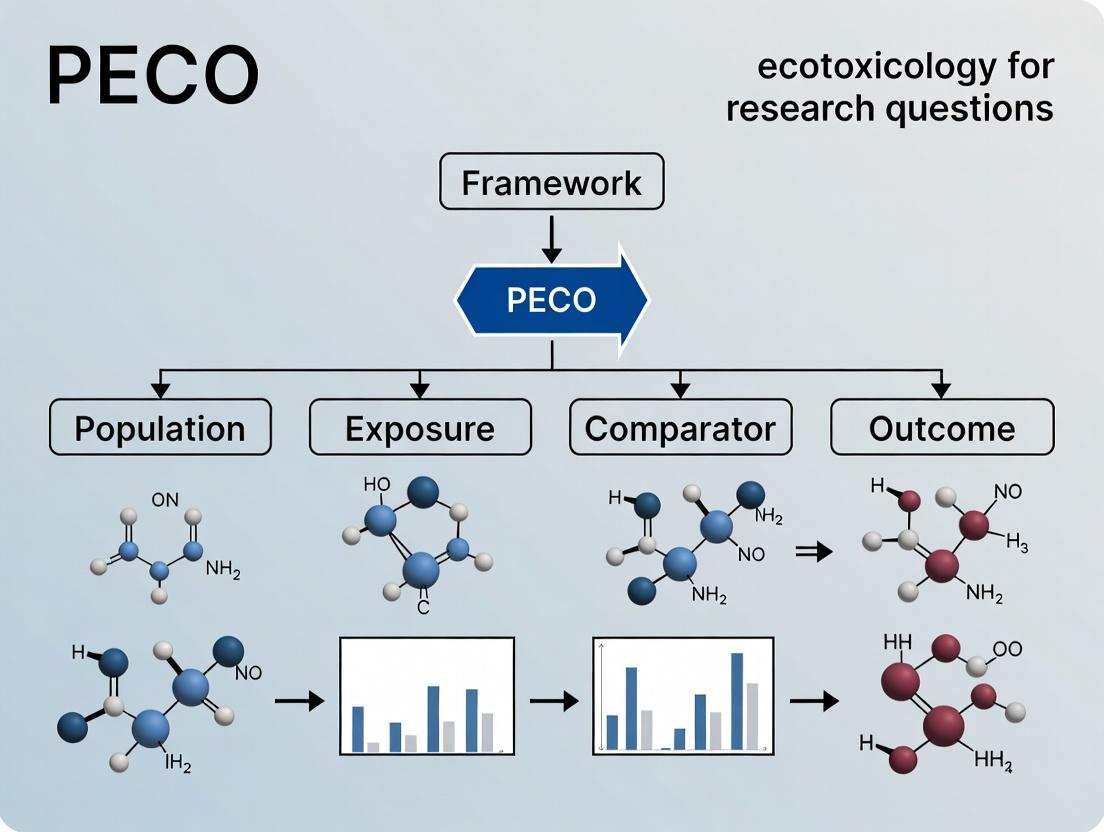
This article provides a comprehensive guide to the PECO (Population, Exposure, Comparator, Outcomes) framework, a critical tool for structuring research questions in ecotoxicology and environmental health.
Mastering the PECO Framework: A Strategic Guide for Formulating Precise Ecotoxicology Research Questions
Abstract
This article provides a comprehensive guide to the PECO (Population, Exposure, Comparator, Outcomes) framework, a critical tool for structuring research questions in ecotoxicology and environmental health. Tailored for researchers, scientists, and drug development professionals, it explores the framework's foundational principles, methodological applications for systematic reviews and primary studies, strategies for troubleshooting common formulation challenges, and methods for validating and comparing evidence. By integrating current methodological guidance and case studies, the article demonstrates how a well-constructed PECO question enhances research clarity, improves study reliability assessment, and strengthens the foundation for chemical risk assessment and regulatory decision-making.
PECO Decoded: Building the Foundation for Robust Ecotoxicology Research
The Population, Exposure, Comparator, Outcome (PECO) framework is a critical methodological tool for formulating precise and answerable research questions in observational and environmental health sciences. This in-depth technical guide details the core components of PECO and its conceptual evolution from the established Population, Intervention, Comparator, Outcome (PICO) framework, situating the discussion specifically within ecotoxicology research. It provides a structured analysis of the five paradigmatic scenarios for PECO question formulation, detailed experimental protocols for integrating PECO into systematic evidence synthesis, and visualizations of its application workflow. The article further presents a curated toolkit of essential resources for researchers, including evidence synthesis registries, specialized software, and critical appraisal tools, to facilitate robust study design and review conduct in ecotoxicology.
Ecotoxicology research, which investigates the effects of toxic chemical, biological, and physical agents on living organisms and ecosystems, fundamentally deals with unintentional exposures. Traditional frameworks for structuring clinical research questions, such as the Population, Intervention, Comparator, Outcome (PICO) model, are optimized for studying deliberate medical interventions. This creates a significant methodological gap when assessing environmental risk factors, where the "exposure" is not a therapeutic action but a hazard [1] [2].
The PECO framework was developed to address this gap, formally replacing "Intervention" with "Exposure" to better suit fields like environmental health, occupational safety, public health, and ecotoxicology [1] [3]. A well-formulated PECO question creates the essential structure for defining research objectives, designing robust studies, conducting systematic reviews, and developing health or environmental guidance [1]. Its explicit focus ensures that research is precisely scoped, minimizes bias, and yields results that are directly applicable to real-world scenarios of contamination and ecological impact, thereby forming a cornerstone of a broader thesis on evidence-based environmental science.
Core Components of the PECO Framework
The strength of the PECO framework lies in the precise definition of its four components, which collectively establish the boundaries of a research inquiry. In ecotoxicology, this precision is paramount for translating complex environmental scenarios into investigable questions.
- P (Population): This defines the group of organisms, ecosystems, or ecological receptors under study. Specification includes species (e.g., Daphnia magna, rainbow trout, soil macroinvertebrate community), life stage (e.g., larval, adult), health status, and relevant habitat descriptors (e.g., benthic, pelagic). A clear population definition ensures biological relevance and dictates the applicability of the findings [1] [4].
- E (Exposure): This is the central element distinguishing PECO from PICO. It refers to the unintentional contact with a chemical, physical, or biological agent [2]. In ecotoxicology, defining exposure requires quantifying the agent's concentration or intensity (e.g., µg/L of pesticide, pH level), duration (acute vs. chronic), frequency, and route (aqueous, dietary, sediment). The exposure is the hypothesized cause or risk factor under investigation [1] [5].
- C (Comparator): The comparator is the reference scenario against which the exposure is evaluated. This is often the most challenging component to define in environmental studies [1]. It can be an unexposed or low-exposure group, a group exposed to a different level of the same agent (e.g., a regulatory threshold), a background environmental level, or a different agent altogether. The choice of comparator directly influences the interpretation of the effect size and risk [1].
- O (Outcome): These are the measurable effects or endpoints used to assess the impact of the exposure. In ecotoxicology, outcomes span multiple levels of biological organization, from molecular (e.g., gene expression, enzyme inhibition) and individual (e.g., mortality, growth inhibition, reproduction) to population and community-level effects (e.g., species abundance, biodiversity indices). Outcomes must be defined as measurable and relevant to the ecological assessment [4].
Table 1: Five Paradigmatic Scenarios for Formulating PECO Questions in Ecotoxicology [1]
| Scenario & Research Context | Approach | Ecotoxicology PECO Example |
|---|---|---|
| 1. Exploring an Association | Explore the shape of the dose-response relationship. | In freshwater zebrafish embryos (P), what is the effect of a 1 mg/L increment in microplastic concentration (E) compared to the full range of lower concentrations (C) on teratogenicity rate (O)? |
| 2. Evaluating an Internal Cut-off | Use exposure cut-offs (e.g., tertiles) defined by the distribution in the identified studies. | In honey bee colonies (P), what is the effect of exposure to neonicotinoid levels in the highest quartile (E) compared to the lowest quartile (C) on colony collapse disorder incidence (O)? |
| 3. Evaluating an External Cut-off | Use exposure cut-offs known from regulations, other populations, or species. | In a freshwater invertebrate community (P), what is the effect of cadmium concentration exceeding the EPA chronic criterion (E) compared to levels below that criterion (C) on species richness (O)? |
| 4. Identifying a Protective Cut-off | Use an existing exposure cut-off associated with a known adverse outcome. | In earthworms (P), what is the effect of exposure to soil copper < 50 mg/kg (E) compared to ≥ 50 mg/kg (C) on reproductive success (O)? |
| 5. Evaluating an Intervention | Select comparator based on cut-offs achievable through a mitigation intervention. | In an agricultural pond ecosystem (P), what is the effect of implementing a riparian buffer strip (E) compared to no buffer (C) on the aqueous concentration of runoff pesticides (O)? |
Evolution from PICO to PECO: A Conceptual Shift
The PECO framework is a direct adaptation of the PICO model, which was introduced in 1995 to structure clinical questions for evidence-based medicine [2]. The evolution from PICO to PECO represents a fundamental conceptual shift from a clinical-interventional paradigm to an observational-exposure paradigm.
- PICO (Clinical-Interventional Paradigm): The "I" stands for a deliberate Intervention—a treatment, therapy, or preventative action (e.g., a drug, surgery, behavioral therapy) administered to a patient or population. The primary question is: "Does this intentional action improve health outcomes?" PICO is the gold standard for structuring questions in clinical trials, randomized controlled trials (RCTs), and interventional systematic reviews [3] [2].
- PECO (Observational-Exposure Paradigm): The "E" stands for Exposure—an unintentional or environmental risk factor that a population encounters (e.g., a pollutant, occupational hazard, dietary component). The primary question is: "Is this exposure associated with a change in health or ecological outcomes?" PECO is designed for observational study designs such as cohort studies, case-control studies, and cross-sectional studies, which are prevalent in environmental science and ecotoxicology [1] [3].
This shift acknowledges that in fields like ecotoxicology, researchers cannot ethically or practically assign organisms to "intervention" groups like a toxicant; instead, they observe and quantify the consequences of existing exposures [1]. Major environmental evidence organizations, including the Collaboration for Environmental Evidence (CEE), the Navigation Guide, and the U.S. EPA's Integrated Risk Information System (IRIS), now emphasize the use of PECO to guide systematic reviews of exposures [1].
Figure 1: The Conceptual Evolution from PICO to PECO Frameworks. This diagram illustrates the paradigm shift from a clinical model centered on deliberate interventions to an environmental model focused on unintentional exposures [1] [3] [2].
Application in Systematic Reviews and Evidence Synthesis
A primary application of the PECO framework is to guide rigorous systematic reviews (SRs) and systematic evidence maps (SEMs) in ecotoxicology. A well-defined PECO question is the essential first step in protocol development, directly informing the eligibility criteria for study inclusion and exclusion [1] [4].
- Protocol Development: The protocol, often registered in a platform like PROSPERO, pre-defines the PECO elements, search strategy, and methods for quality assessment and data synthesis [4]. This prevents bias from altering the review question post-hoc to fit the results found.
- Risk of Bias (RoB) Assessment: For quantitative syntheses (e.g., meta-analyses), assessing the internal validity of included studies is critical. The FEAT principles (Focused, Extensive, Applied, Transparent) provide a framework for fit-for-purpose RoB assessment in environmental SRs [6]. Assessment focuses on systematic errors (bias) from study design and conduct, distinct from precision (random error) or reporting quality. Common bias domains in ecotoxicology include confounding, selection bias, exposure classification, and outcome measurement [6].
- Systematic Evidence Maps (SEMs): For broad topics where a full quantitative synthesis may not be feasible, SEMs use systematic methods to categorize and visualize the available evidence. A PECO-structured question defines the scope, and results are often presented via heatmaps or interactive databases to identify knowledge clusters and gaps, guiding future primary research or targeted SRs [7].
Figure 2: PECO-Driven Workflow for Evidence Synthesis. This flowchart outlines the standard process for conducting a systematic review or evidence map, with the PECO question as the foundational first step [7] [6] [4].
Table 2: The Scientist's Toolkit for PECO-Based Research
| Tool / Resource | Category | Primary Function in PECO Research |
|---|---|---|
| PROSPERO | Protocol Registry | International register for pre-registering systematic review protocols to reduce duplication and bias [4]. |
| CEE Guidelines | Methodology | Guidelines and standards for conducting evidence syntheses in environmental management and ecology [6]. |
| RevMan (Cochrane) | Review Software | Software for preparing and maintaining systematic reviews, including meta-analysis [4]. |
| ROBINS-E Tool | Risk of Bias Tool | Tool for assessing risk of bias in non-randomized studies of exposures (under development). |
| EFSA PECO Guidance | Guidance Document | Framework for applying PECO in food and feed safety risk assessments [1]. |
| EPA IRIS Handbook | Guidance Document | Instructions for developing and evaluating EPA Integrated Risk Information System assessments, which use PECO [1]. |
Experimental Protocols: Implementing PECO in Study Design and Review
Protocol 1: Formulating a PECO Question for an Ecotoxicology Systematic Review
- Identify the Research Context: Determine which of the five scenarios (Table 1) applies. For a novel contaminant, start with Scenario 1 (exploring an association). For a regulated chemical, Scenario 3 or 4 may be appropriate [1].
- Define Each Component Operationally:
- Population: Specify species, life stage, ecosystem type, and any relevant susceptibility factors.
- Exposure: Define the chemical agent, its matrix (water, sediment, tissue), the specific metric (total concentration, bioavailable fraction), and the unit of measure.
- Comparator: Justify the chosen reference. Is it a true zero exposure, a background level, an alternative condition, or a regulatory standard?
- Outcome: Select measurable, ecologically relevant endpoints. Specify the measurement method or assay if critical.
- Articulate the Final Question: Combine components into a clear question. Example (Scenario 3): "In juvenile freshwater mussels (P), what is the effect of exposure to waterborne glyphosate concentrations exceeding 120 µg/L (E) compared to concentrations below 12 µg/L (C) on byssal thread production (O)?"
Protocol 2: Conducting a Risk of Bias Assessment Using FEAT Principles
- Plan (Be Focused & Transparent): Pre-specify in the review protocol which bias domains are critical for the PECO question (e.g., confounding, selective outcome reporting). Select or adapt a tool (e.g., based on ROBINS-E) and justify its use [6].
- Conduct (Be Extensive): Apply the tool to each included study. Assessment should be performed independently by two reviewers, with conflicts resolved by consensus or a third reviewer. Judgment should be based on specific signaling questions about the study's methods, not its results [6].
- Apply (Be Applied): Integrate RoB judgments into the synthesis. This may involve sensitivity analyses (excluding studies with high RoB), presenting stratified analyses, or using RoB as a moderator in meta-regression. The assessment must influence the review's conclusions about the certainty of evidence [6].
- Report (Be Transparent): Clearly present RoB judgments for each study (e.g., via a traffic light plot) and describe how they influenced the data synthesis and final conclusions [6].
The PECO framework represents an essential evolution in research methodology, providing the structured specificity required for the complex causal assessments inherent to ecotoxicology and environmental health. By formally distinguishing exposure from intervention, PECO enables the precise formulation of research questions that reflect real-world scenarios of unintended contamination and ecological risk. Its integration into the systematic review process—from protocol development through risk of bias assessment—enhances the transparency, reproducibility, and utility of synthesized evidence. As the field moves toward greater standardization and the integration of novel computational tools for evidence mapping, mastery of the PECO framework's core components and applications remains foundational for researchers, scientists, and professionals committed to robust, actionable environmental science.
The Critical Role of a Well-Formulated Research Question in Evidence Synthesis
Evidence synthesis represents a methodical and comprehensive process of bringing together information from a range of sources and disciplines to inform debates and decisions on specific issues [8]. In fields such as ecotoxicology and environmental health, it aims to identify and synthesize all scholarly research on a particular topic in an unbiased, reproducible way to provide evidence for practice, policy-making, and to identify research gaps [8]. Unlike a traditional literature review, a systematic evidence synthesis starts with a well-defined research question, attempts to find all existing published and unpublished literature, uses explicit criteria for study selection, systematically assesses the quality of included studies, and bases conclusions on the quality of the evidence [8].
The foundation of any high-quality evidence synthesis is a precisely formulated research question. It creates the structure and delineates the approach to defining objectives, conducting the review, and developing guidance [1]. In environmental and occupational health, the PECO framework—defining Population, Exposure, Comparator, and Outcomes—is increasingly accepted as the standard for structuring questions about the association between exposures and health outcomes [1]. This framework is an adaptation of the PICO (Population, Intervention, Comparator, Outcome) model used in clinical intervention reviews, modified to address the fundamental differences in formulating questions about unintentional exposures, which are central to ecotoxicology [1].
Table 1: Comparison of Traditional Literature Review and Systematic Evidence Synthesis
| Aspect | Traditional Literature Review | Systematic Evidence Synthesis |
|---|---|---|
| Question/Topic | May be broad; goal may be to place own research in context or support a viewpoint [8]. | Starts with a well-defined, focused research question to be answered [8]. |
| Searching | Searches may be ad hoc, not exhaustive or fully comprehensive [8]. | Aims to find all existing published and unpublished literature; process is documented [8]. |
| Study Selection | Often lacks clear reasons for inclusion/exclusion [8]. | Explicit, pre-defined criteria informed by the research question [8]. |
| Quality Assessment | Often does not consider study quality or potential biases [8]. | Systematically assesses risk of bias and overall quality of evidence [8]. |
| Synthesis | Conclusions are more qualitative [8]. | Conclusions are based on study quality and provide actionable recommendations [8]. |
The PECO Framework: A Cornerstone for Ecotoxicology Research
The PECO framework is critical for guiding systematic reviews and primary research in ecotoxicology. It defines the review's objectives and informs the study design, inclusion/exclusion criteria, and the interpretation of findings [1]. A major challenge in environmental health is appropriately identifying the Exposure (E) and Comparator (C), as these differ significantly from the "Intervention" and "Comparator" in therapeutic PICO questions [1]. The Comparator in PECO often involves different levels, durations, or the absence of an environmental exposure, rather than an alternative treatment.
Morgan et al. (2018) developed a framework to formulate PECO questions through five paradigmatic scenarios, which are highly relevant to ecotoxicology research [1]. These scenarios move from exploratory associations to questions designed to inform specific decision-making thresholds.
Table 2: PECO Framework Scenarios for Ecotoxicology Research Questions [1]
| Systematic Review or Research Context | Approach | Example PECO Question (Ecotoxicology Context) |
|---|---|---|
| 1. Explore the dose-effect relationship | Explore the shape/distribution of the exposure-outcome relationship. | Among freshwater fish (P), what is the effect of a 1 mg/L incremental increase in waterborne cadmium (E) compared to baseline (C) on oxidative stress biomarker levels (O)? |
| 2. Evaluate effect of an exposure cut-off (data-derived) | Use cut-offs (e.g., tertiles) defined from the distribution in the identified studies. | In earthworms (P), what is the effect of the highest quartile of soil microplastic concentration (E) compared to the lowest quartile (C) on reproduction rate (O)? |
| 3. Evaluate association using an external cut-off | Use mean cut-offs identified from other populations or regulatory standards. | In honey bees (P), what is the effect of field-realistic neonicotinoid exposure (E) compared to the no-observed-adverse-effect level (NOAEL) (C) on colony survival (O)? |
| 4. Identify an exposure cut-off that ameliorates effects | Use an existing exposure cut-off associated with a known adverse outcome. | Among amphibian populations (P), what is the effect of water pH ≥ 6.5 (E) compared to pH < 6.5 (C) on embryonic malformation rates (O)? |
| 5. Evaluate the effect of an achievable intervention | Select comparator based on exposure cut-offs achievable through an intervention. | In agricultural soils (P), what is the effect of biochar amendment (E) that reduces bioavailable pesticide concentrations by 50% compared to no amendment (C) on microbial diversity (O)? |
A well-formulated PECO question ensures transparency, provides organization and focus for the research team, and requires the definition of key concepts, which is crucial for the subsequent search and screening processes [9]. The choice of scenario depends on the research context and what is already known about the exposure-outcome relationship [1].
Methodological Protocols for Evidence Synthesis in Toxicology
Conducting an evidence synthesis in toxicology and environmental health requires a rigorous, protocol-driven approach to minimize bias and ensure reproducibility. The COSTER recommendations (Conduct of Systematic Reviews in Toxicology and Environmental Health Research) provide a consensus-based set of practices covering 70 items across eight domains, specifically tailored for this field [10]. The key steps are outlined below.
Protocol Development and Registration
Before any search begins, the team must develop and register a detailed protocol. This acts as a blueprint, stating the rationale, hypothesis, and planned methodology [11]. Registration improves transparency, reduces bias, and prevents duplication of effort [11]. The protocol should specify the PECO question, search strategy, inclusion/exclusion criteria, data extraction plan, risk-of-bias assessment tool, and synthesis methods. For environmental health reviews, guidelines like those from the Collaboration for Environmental Evidence (CEE) or COSTER should be followed [9] [10].
Comprehensive Search Strategy and Grey Literature
A comprehensive search is designed to find all relevant evidence. The strategy is built from the core concepts in the PECO question [11]. It involves:
- Using multiple academic databases (e.g., PubMed, Web of Science, Embase, GreenFILE).
- Systematically searching grey literature to mitigate publication bias. This includes government reports, theses, conference proceedings, and unpublished studies from sources like the WHO library database, ProQuest Dissertations & Theses, and preprint servers (e.g., arXiv, bioRxiv) [11].
- Using Boolean operators (AND, OR, NOT) and truncation, with strategies peer-reviewed by a librarian [11].
- Documenting all sources searched, the date of search, and the exact search strings used [11].
Study Screening, Selection, and Data Extraction
Screening is typically performed in two stages (title/abstract, then full-text) by at least two independent reviewers to minimize error and bias [9]. Inclusion and exclusion criteria, derived directly from the PECO, are applied consistently [11]. The process and results are commonly visualized using a PRISMA flow diagram [8]. Data from included studies are then extracted into standardized forms, capturing details on PECO elements, study design, context, and results.
Risk of Bias Assessment and Evidence Synthesis
Each included study's methodological quality and risk of bias is assessed using tools appropriate for observational exposure studies (e.g., ROBINS-E, OHAT's tool) [1] [12]. The synthesis integrates findings, which may be narrative, qualitative, or quantitative (meta-analysis). The overall strength of the evidence is graded, considering factors like risk of bias, consistency, and directness, often using approaches adapted from GRADE for environmental health [1] [12].
Diagram 1: Evidence Synthesis Workflow for Ecotoxicology
Selecting the Appropriate Question Framework
While PECO is primary for exposure questions, researchers must select the framework that best fits their research goal. Different frameworks structure different types of questions.
Diagram 2: Decision Tree for Research Question Framework Selection
Table 3: Research Reagent Solutions for Evidence Synthesis
| Tool / Resource | Function | Application in Ecotoxicology |
|---|---|---|
| PECO Framework [1] | Structures research questions for exposure-outcome relationships. | Foundational step for defining the scope of a systematic review or primary study on chemical effects. |
| COSTER Guidelines [10] | Provides consensus recommendations for conducting systematic reviews in toxicology/environmental health. | Ensures methodological rigor and credibility of the review process from protocol to reporting. |
| Covidence / Rayyan | Web-based software for managing screening and data extraction. | Facilitates blinded duplicate review, conflict resolution, and data management among team members. |
| PRISMA Checklist & Flow Diagram [8] [11] | Ensures transparent and complete reporting of the systematic review. | Used as a reporting standard for manuscripts; the flow diagram maps the study selection process. |
| Grey Literature Databases (e.g., WHO IRIS, ProQuest Dissertations, arXiv) [11] | Provides access to unpublished or non-commercially published studies. | Critical for reducing publication bias by finding negative or neutral studies, theses, and government reports. |
| Risk of Bias Tools (e.g., ROBINS-E, OHAT tool) [1] [12] | Assesses methodological limitations of individual studies. | Allows for critical appraisal of in vivo, in vitro, and observational studies included in the synthesis. |
| GRADE for Environmental Health [1] [12] | Grades the overall certainty or strength of a body of evidence. | Enables clear communication of how much confidence to place in the synthesized findings for decision-making. |
In environmental health and ecotoxicology research, a clearly framed question is the foundational step that structures the entire scientific inquiry [1]. The PECO framework—defining Population, Exposure, Comparator, and Outcome—has emerged as the critical scaffold for formulating these questions, particularly when assessing the association between environmental exposures and health effects [1]. This framework directly informs study design, inclusion criteria, and the interpretation of findings [1].
While defining the population and outcome often draws from established methodologies, the most significant and nuanced challenges lie in rigorously defining the 'E' (Exposure) and the 'C' (Comparator) [1]. Exposure in environmental studies is not a simple binary intervention but a complex continuum involving the type, level, duration, and route of contact with chemical, physical, or biological agents [13] [14]. Consequently, defining an appropriate comparator—a reference point against which exposure is evaluated—becomes a complex exercise in scientific judgment rather than a straightforward selection [1]. This guide delves into these core challenges, providing a technical roadmap for researchers and risk assessors to navigate the intricacies of exposure and comparator definition within the PECO paradigm.
Conceptual Foundations and Core Challenges
Defining Exposure (E): From Contact to the Exposome
Exposure science is the study of contact with environmental factors through ingestion, inhalation, or dermal pathways, and their subsequent effects [13]. A core principle is understanding the source-to-disease pathway, which traces an agent from its source through environmental transport, human contact, internal dose, and ultimately to a biological effect [14].
The modern challenge is capturing the totality of exposures. The concept of the exposome—the comprehensive environmental counterpart to the genome—encompasses all exposures from prenatal life onward, including external factors (chemicals, diet, stress) and internal biological responses [13]. This holistic view is essential because many diseases result from multiple, varied environmental exposures over time and their interactions with genetic factors [13].
Core Challenges in Defining 'E':
- Multiplicity and Complexity: Individuals are exposed to complex mixtures of chemicals simultaneously, not single agents in isolation [13].
- Temporal Dynamics: Exposures can be chronic, acute, or intermittent, with critical windows of susceptibility (e.g., during development) [14].
- Spatial Variability: Exposure levels can differ dramatically between microenvironments (home, school, workplace) [13].
- Quantification: Moving from qualitative presence/absence to quantifying precise internal doses is technically demanding [13].
Defining the Comparator (C): Beyond a Simple Control
The comparator is the reference condition against which the exposure of interest is evaluated [1]. In environmental studies, defining this reference is not trivial. Unlike clinical trials with a placebo, there is often no true "unexposed" group in a polluted world [1]. The comparator must therefore be a defined alternative exposure scenario.
Researchers have identified several paradigmatic scenarios for formulating the 'C' within a PECO question, as summarized in the table below [1].
Table 1: Scenarios for Defining the Comparator (C) in a PECO Framework [1]
| Scenario & Context | Approach to Defining Comparator | Example PECO Question |
|---|---|---|
| 1. Exploring a dose-effect relationship | Compare an incremental increase in exposure to the baseline range. | What is the effect of a 10 µg/m³ increase in PM2.5 on respiratory hospitalizations? |
| 2. Evaluating internal exposure contrasts | Use cut-offs (e.g., tertiles, quartiles) defined by the distribution within the study population. | What is the effect of being in the highest quartile of serum PFAS versus the lowest quartile on child immune response? |
| 3. Comparing to an external reference | Use a mean or threshold from an external population or standard. | What is the effect of occupational noise exposure versus the general population exposure on hearing loss? |
| 4. Testing a regulatory or health-based limit | Use an existing exposure guideline or limit as the cut-off. | What is the effect of exposure to air ozone levels ≥ 70 ppb compared to < 70 ppb on asthma exacerbations? |
| 5. Assessing an intervention's impact | Select the comparator based on what exposure reduction is achievable via an intervention. | What is the effect of an air filtration intervention that reduces indoor PM2.5 by 50% versus no intervention on cardiovascular function? |
Core Challenges in Defining 'C':
- Selection Bias: The choice of comparator (e.g., low-exposure group vs. population average) can dramatically influence the measured effect size and risk conclusions.
- Residual Confounding: Groups differing in exposure levels often differ in other ways (socioeconomics, lifestyle), requiring careful adjustment.
- Dynamic Baselines: Environmental background levels change over time and geography, making a static "control" group difficult to define.
Diagram 1: Logical flow of the PECO framework for structuring an environmental research question.
Quantitative and Experimental Approaches
Ecotoxicity Assessment and Benchmarking
Ecotoxicology evaluates how chemicals affect organisms in the environment, from primary producers to top predators [15]. Hazard assessment relies on toxicity tests using standardized model organisms to estimate effect concentrations [15].
Table 2: Standard Ecotoxicity Test Endpoints for Quantitative Risk Assessment [15] [16]
| Organism Group | Test Type | Common Endpoints (Abbreviation) | Definition & Use |
|---|---|---|---|
| Aquatic (Fish & Invertebrates) | Acute Toxicity | LC50 / EC50 | Concentration lethal to or affecting 50% of test population. Used for screening-level acute risk [16]. |
| Chronic Toxicity | NOEC / LOEC / NOAEC | No/Lowest Observed (Adverse) Effect Concentration. Identifies threshold for longer-term effects [15]. | |
| Terrestrial (Birds & Mammals) | Acute Toxicity | LD50 | Median Lethal Dose (oral or dietary). Used in acute avian/mammalian risk quotients [16]. |
| Chronic Toxicity | NOAEL | No Observed Adverse Effect Level. Used in chronic reproduction risk assessments [16]. | |
| Plants (Terrestrial & Aquatic) | Phytotoxicity | EC25 (e.g., seedling emergence) | Concentration affecting 25% of plants relative to control. Used for non-target plant risk [16]. |
Experimental Protocols:
- Acute Aquatic Toxicity Test (OECD Guideline 203): Groups of fish (e.g., Danio rerio, Oncorhynchus mykiss) are exposed to a minimum of five concentrations of the test chemical in a static or flow-through system for 96 hours. Mortality is recorded daily. The LC50 is calculated using statistical methods (e.g., probit analysis) [15] [16].
- Avian Acute Oral Toxicity Test (OECD Guideline 223): Birds (e.g., Colinus virginianus, Anas platyrhynchos) are administered a single oral dose of the chemical via gavage. Animals are observed for mortality and signs of toxicity over 14 days. The LD50 is calculated based on mortality at each dose level [16].
The Risk Quotient (RQ) Method: Integrating Exposure and Effects
The deterministic Risk Quotient method is a foundational tool for ecological risk characterization used by agencies like the U.S. EPA [16]. It provides a screening-level comparison of exposure and toxicity.
Core Protocol: The Risk Quotient is calculated as: RQ = Exposure Estimate (EEC) / Toxicity Endpoint Value [16]. An RQ > 1 indicates potential risk, triggering further evaluation. The specific formulas vary by organism and exposure route:
- For Aquatic Organisms:
Acute RQ = (Peak Water Concentration) / (Most sensitive LC50 or EC50)[16]. - For Terrestrial Animals via Spray:
Acute Dietary RQ = (Estimated Environmental Concentration in diet) / (LD50)[16]. More refined dose-based RQs adjust for animal body weight and ingestion rates [16].
Diagram 2: The source-to-disease pathway, illustrating the continuum from an environmental source to an adverse health or ecological outcome.
The Scientist's Toolkit: Research Reagent Solutions
Advances in exposure science are driven by innovative tools for measurement and analysis [13]. The table below details key technologies for defining and quantifying the 'E.'
Table 3: Key Research Tools for Exposure Assessment in Environmental Studies [13]
| Tool / Technology | Primary Function | Key Application in Research |
|---|---|---|
| Passive Silicone Wristbands | Absorb and sequester a wide range of hydrophobic organic compounds from the personal air space. | Characterizing individualized exposure to complex mixtures of pesticides, flame retardants, PAHs, and other semi-volatile organics in community studies [13]. |
| MicroPEM (Personal Exposure Monitor) | Measures real-time concentration of particulate matter (PM) and integrates with a accelerometer to estimate inhalation dose. | Quantifying personal exposure to air pollution and evaluating the trade-offs between physical activity benefits and pollution inhalation risks [13]. |
| Automated Microenvironmental Sampler | A wearable device that collects air samples while using sensors (GPS, light) to tag the location/type of exposure. | Linking air pollutant exposure (e.g., ultrafine particles) to specific microenvironments like homes, schools, or commutes to identify key exposure sources [13]. |
| Personal Ozone Monitor | A handheld, UV-based sensor for continuous, real-time monitoring of ambient ozone concentrations. | Assessing personal and occupational exposure to ground-level ozone for health effects studies and industrial hygiene [13]. |
| Lab-on-a-Chip Immunoassay Devices | Portable platforms using antibody-based detection for specific chemicals (e.g., flame retardants, metals). | Rapid, on-site screening of environmental samples (water, soil) or biological fluids for targeted contaminants [13]. |
| High-Resolution Mass Spectrometry (HRMS) | An analytical technique that precisely measures the mass-to-charge ratio of ions to identify and quantify unknown chemicals. | Exposomics: Profiling the broad spectrum of endogenous metabolites and xenobiotics in biological samples (blood, urine) to discover novel exposure biomarkers [13]. |
Data Visualization and Synthesis
Effective synthesis of exposure, comparator, and outcome data is essential for risk characterization and decision-making. The Toxicological Priority Index (ToxPi) is a visualization framework that integrates multiple streams of evidence into a single, graphical profile [15]. Each "slice" of the circular ToxPi represents a different hazard or data domain (e.g., acute aquatic toxicity, persistence, bioaccumulation), with the slice's radius proportional to the score or concern level for that domain [15]. This allows for the visual comparison of the overall hazard profile of multiple chemicals, aiding in the selection of safer alternatives.
For quantitative data analysis, the choice of visualization must match the data type and research question [17] [18]. Continuous exposure data (e.g., concentration levels) are best displayed using box plots or scatterplots to show distribution, central tendency, and relationships [17]. Using simple bar graphs for continuous data can obscure its distribution and lead to misinterpretation [17]. When comparing exposure levels across categorized groups (the 'C'), clustered bar charts or point plots with confidence intervals are effective for displaying summary statistics [18]. The fundamental principle is that visualization should provide a complete and accurate picture of the data supporting the PECO-based conclusions [17].
Five Paradigmatic Scenarios for PECO Question Formulation
The PECO framework (Population, Exposure, Comparator, Outcome) provides a critical structure for formulating precise research questions in environmental health and ecotoxicology [1]. This framework adapts the well-established PICO (Population, Intervention, Comparator, Outcome) model used in clinical research to the specific challenges of exposure science, where researchers investigate unintentional exposures to environmental stressors rather than deliberate therapeutic interventions [1]. A clearly framed PECO question delineates the research approach, defines objectives for systematic reviews, and establishes criteria for study inclusion and evaluation [1]. Within the broader thesis of advancing ecotoxicology research, the PECO framework ensures that questions are structured to produce evidence directly applicable to hazard identification, risk assessment, and the development of health-based guidance values [1] [19].
The need for specialized guidance for exposure questions arises from fundamental differences between evaluating environmental exposures and clinical interventions. Key challenges include properly defining the exposure metric and identifying an appropriate comparator group, which may not be a true "control" but a different level or category of exposure [1]. Authoritative bodies, including the U.S. Environmental Protection Agency's (EPA) Integrated Risk Information System (IRIS), the National Toxicology Program's Office of Health Assessment and Translation (OHAT), and the Collaboration for Environmental Evidence, now emphasize the PECO framework to guide systematic reviews of exposure-outcome relationships [1]. The framework's utility extends to organizing systematic evidence maps (SEMs), which provide visual overviews of available literature to inform problem formulation and priority setting in complex assessments [19].
The Five Paradigmatic PECO Scenarios
The formulation of a PECO question is not a one-size-fits-all process but depends significantly on the research context and what is already known about the exposure-outcome relationship. Morgan et al. (2018) formalized five paradigmatic scenarios to guide researchers in structuring their questions [1]. These scenarios are sequential in logic, often beginning with exploratory research (Scenario 1) and progressing to questions designed for specific decision-making contexts (Scenarios 2-5).
Table 1: The Five Paradigmatic Scenarios for PECO Question Formulation [1]
| Scenario | Systematic-Review or Research Context | Approach | PECO Example |
|---|---|---|---|
| 1 | Calculate the health effect from an exposure; describing the dose-effect relationship. | Explore the shape and distribution of the exposure-outcome relationship. | Among newborns, what is the incremental effect of a 10 dB increase in gestational noise exposure on postnatal hearing impairment? |
| 2 | Evaluate the effect of an exposure cut-off on health outcomes, where the cut-off is informed by the data distribution in the review. | Use cut-offs (e.g., tertiles, quartiles) defined by the distribution in the identified studies. | Among newborns, what is the effect of the highest dB exposure quartile compared to the lowest quartile during pregnancy on postnatal hearing impairment? |
| 3 | Evaluate the association between defined exposure and comparator cut-offs, identified from external populations or standards. | Use mean cut-offs or thresholds derived from external populations or prior research. | Among commercial pilots, what is the effect of occupational noise exposure compared to noise exposure in other occupations on hearing impairment? |
| 4 | Identify an exposure cut-off that ameliorates adverse health outcomes. | Use existing exposure cut-offs associated with known health outcomes of interest (e.g., regulatory standards). | Among industrial workers, what is the effect of exposure to <80 dB compared to ≥80 dB on hearing impairment? |
| 5 | Evaluate the potential effect of a cut-off achievable through an intervention. | Select the comparator based on exposure cut-offs that can be achieved through a specific intervention. | Among the general population, what is the effect of an intervention that reduces noise levels by 20 dB compared to no intervention on hearing impairment? |
Scenario 1 is the foundational, exploratory approach used when little is known about the existence or shape of an association. The objective is to determine if an association exists and characterize its nature (e.g., linear, logarithmic). The comparator is typically an incremental increase in exposure across its entire observed range [1]. An example is a review examining the association between each 10 μg/m³ increase in PM₂.₅ and stroke mortality [1].
Scenarios 2 through 5 apply when some foundational knowledge exists, allowing for questions centered on specific exposure cut-offs. The term "cut-off" broadly refers to thresholds, levels, durations, means, medians, or ranges of exposure [1]. The appropriate scenario is determined by the source of the cut-off value: derived from the study data itself (Scenario 2), from external populations (Scenario 3), from health-based standards (Scenario 4), or from the technical feasibility of an intervention (Scenario 5) [1].
Experimental Protocols and Methodological Implementation
Implementing the PECO framework requires integration into standardized systematic review (SR) and evidence assessment workflows. The following protocols detail how PECO guides study design, literature screening, and analysis.
Protocol for PECO-Driven Systematic Evidence Mapping (SEM)
Systematic Evidence Maps are a key tool for problem formulation, often employed by the U.S. EPA IRIS Program [19]. The PECO statement directly informs the screening criteria.
Define Specific Aims and PECO Criteria: The primary aim is to identify mammalian toxicological and epidemiological studies reporting health effects of a specified exposure [19]. The PECO criteria are kept broad to capture a wide scope of potentially informative studies.
- Population: Human populations or mammalian experimental animals in vivo [19] [20].
- Exposure: The chemical or stressor of interest, with broad inclusion for dose, duration, and route.
- Comparator: Typically, an untreated, vehicle-treated, or differently exposed group.
- Outcome: Any health effect endpoint.
Literature Search and Screening: Develop a search syntax based on PECO components and validate it using a set of known key studies [20]. Searches are executed across multiple databases (e.g., PubMed, Scopus). Records are screened in two phases:
- Title/Abstract Screening: Assess relevance based on PECO.
- Full-Text Screening: Apply definitive eligibility criteria based on the PECO and any preliminary quality screens (e.g., reporting of dose and particle characteristics for microplastics) [20].
Data Extraction and Visualization: For included studies, extract structured data on study design, population, exposure details, and outcomes. Data is synthesized into interactive visualizations (e.g., heat maps, evidence atlases) to show the distribution of research across health effects and study types [19].
Protocol for a Focused Systematic Review on a Specific PECO Question
This protocol is used to answer a precise hazard or dose-response question, as exemplified by a SR on microplastics (MP) [20].
Problem Formulation & PECO Statement: Develop a precise research question. For MP: "What is the hazard and dose-response relationship between exposure to MPs and reproductive and developmental adverse effects in mammals?" [20]. This translates into specific inclusion/exclusion criteria.
Study Evaluation and Risk of Bias Assessment: Each included study undergoes critical appraisal. Tools like the OHAT Risk of Bias Rating or specialized tools like the Nano- and Microplastic Particles Toxicity Screening Assessment Tool (NMP-TSAT) are used [20]. This assesses internal validity across domains such as exposure characterization, blinding, and attrition.
Evidence Synthesis: Studies are grouped by outcome. Findings are synthesized qualitatively, and if feasible (with sufficient, homogenous data), a meta-analysis is performed to quantify the effect. The overall strength of evidence is graded [20].
Protocol for Integrating PECO into Adverse Outcome Pathway (AOP) Development
PECO can structure literature searches to gather empirical evidence for Key Event Relationships (KERs) within an AOP [21].
Define the KER and PECO Statement: To establish a link between a Molecular Initiating Event (MIE) and an early Key Event (KE), formulate a PECO. For example, to link "Increase in Cellular ROS" (MIE) to "Oxidative DNA Damage" (KE):
- Population: Specific in vitro or in vivo test systems.
- Exposure: A chemical stressor known or suspected to induce ROS.
- Comparator: Unexposed control.
- Outcome: Concurrent, quantitative measures of both ROS and oxidative DNA damage (e.g., 8-OHdG) [21].
Iterative, Focused Literature Search: In data-rich fields, a full SR may be impractical. An alternative is to conduct an initial broad search to create a preliminary evidence map, then perform targeted searches for studies using specific, relevant methodologies for measuring the PECO-defined outcomes [21].
Evidence Weighting: Extracted data is evaluated using modified Bradford-Hill criteria (e.g., dose, temporal, and incidence concordance) to weigh the evidence supporting the KER [21].
The Scientist's Toolkit: Essential Research Reagents and Materials
Table 2: Key Research Reagent Solutions for PECO-Informed Ecotoxicology Studies
| Reagent/Material | Function in PECO Context | Example Application |
|---|---|---|
| Defined Test Article | Constitutes the Exposure (E). Must be well-characterized (size, polymer, purity) for reproducibility. | Polystyrene microspheres of defined diameter (e.g., 0.1, 1, 10 μm) for MP studies [20]. |
| Vehicle Control | Serves as the primary Comparator (C). Distinguishes the effect of the test article from the delivery medium. | Corn oil, saline, or 0.1% carboxymethylcellulose in oral gavage studies [20]. |
| Biomarker Assay Kits | Quantify specific Outcomes (O) at molecular/cellular levels. Essential for mechanistic AOP work. | Kits for 8-hydroxy-2'-deoxyguanosine (8-OHdG) to measure oxidative DNA damage [21]. |
| ROS Detection Probes | Measure a common Molecular Initiating Event (MIE) or early Key Event (KE). | DCFH-DA or CellROX probes for quantifying intracellular reactive oxygen species [21]. |
| Reference Toxicant | Positive control to validate experimental system sensitivity. Not a PECO element but critical for quality control. | Methyl methanesulfonate (MMS) for genotoxicity assay validation. |
| Certified Animal Diet | Controls for background exposure and ensures Population (P) health status standardization. | Open-formula, phytoestrogen-controlled rodent diets in reproductive toxicity studies. |
Visualizing the PECO Framework and Workflows
PECO Framework Logic and Scenario Selection Flow
Systematic Review Workflow Driven by PECO Formulation
PECO as the Cornerstone for Problem Formulation in Chemical Risk Assessment
The foundation of a robust chemical risk assessment (CRA) lies in the precise articulation of the research question it seeks to answer. In the domains of environmental health, ecotoxicology, and public health, the PECO framework (Population, Exposure, Comparator, Outcome) has emerged as the critical scaffolding for this task [1]. This structured approach transforms vague inquiries into focused, actionable, and evidence-based research questions, directly informing systematic reviews, primary study design, and, ultimately, risk characterization and regulatory guidance [1] [22]. A well-framed PECO question delineates the scope of an assessment, defines inclusion criteria, and provides a benchmark for evaluating the relevance and directness of the evidence gathered [1].
This whitepaper positions PECO as the indispensable cornerstone for problem formulation within a broader thesis on ecotoxicology research. It provides researchers, scientists, and drug development professionals with an in-depth technical guide to deploying the PECO framework. We detail its systematic application in CRA, elaborate on experimental design and evidence integration, and explore its synergy with modern, pathway-oriented toxicological approaches, thereby bridging classic systematic review methodology with the frontiers of 21st-century risk science.
Foundational Principles and Scenarios of the PECO Framework
The PECO framework deconstructs a research question into four discrete, operational components, ensuring clarity and methodological rigor [1].
- Population (P): The group of interest, which can be a human population (e.g., pregnant individuals, industrial workers), a specific animal species used in toxicological studies, or an ecological receptor (e.g., a fish species in a watershed).
- Exposure (E): The specific chemical agent, mixture, or stressor under investigation. This includes defining the exposure metric, such as dose, concentration, duration, and timing.
- Comparator (C): The reference against which the exposure is evaluated. This is often the most challenging element to define in environmental health, as it can range from a lower exposure level, a background population, a pre-intervention state, or an unexposed control group [1].
- Outcome (O): The health or ecological effect of concern. Outcomes should be defined with specificity, including the type of measurement (e.g., incidence of a tumor, change in enzyme activity, population decline) and the timing of its assessment.
The formulation of the "E" and "C" is particularly nuanced in exposure science compared to clinical "Intervention" and "Comparator." The comparator is not merely "no intervention," but often a different level or scenario of exposure [1]. Research and regulatory contexts demand different PECO formulations. [1] delineates five paradigmatic scenarios, moving from exploratory association to direct risk characterization and intervention planning.
Table 1: PECO Scenarios for Systematic Reviews and Research in Chemical Risk Assessment [1]
| Scenario & Context | Primary Objective | Example PECO Question |
|---|---|---|
| 1. Explore Exposure-Outcome Association | To describe the dose-effect relationship and determine if an association exists. | Among pregnant women (P), what is the effect of a 10 ng/mL increase in serum PFOS (E) compared to a lower level (C) on infant birth weight (O)? |
| 2. Evaluate Defined Exposure Contrasts | To compare health effects between high and low exposure groups identified from available data. | Among manufacturing workers (P), what is the effect of exposure in the highest quartile of urinary benzene (E) compared to the lowest quartile (C) on hematopoietic toxicity (O)? |
| 3. Apply Externally-Defined Standards | To evaluate the effect of exceeding a regulatory or health-based guidance value. | Among the general adult population (P), what is the effect of dietary acrylamide intake above 50 μg/day (E) compared to intake below this level (C) on cancer risk (O)? |
| 4. Identify Protective Exposure Limits | To determine an exposure level that ameliorates adverse health outcomes. | Among factory residents (P), what is the effect of chronic ambient PM2.5 exposure < 10 μg/m³ (E) compared to ≥ 10 μg/m³ (C) on respiratory hospitalizations (O)? |
| 5. Assess Intervention Efficacy | To evaluate the health impact of an intervention that reduces exposure. | Among children (P), what is the effect of an in-home water filtration system (E) compared to no filtration (C) on blood lead levels (O)? |
Diagram 1: PECO Question Formulation Workflow (Max 760px)
Application in Systematic Chemical Risk Assessment
Leading regulatory agencies have institutionalized systematic, evidence-based methods anchored by PECO. The European Food Safety Authority (EFSA) employs a four-step process (Plan, Do, Verify, Report) where the "Plan" phase is dedicated to problem formulation and PECO development [22]. Similarly, the U.S. EPA's Integrated Risk Information System (IRIS) and the Office of Health Assessment and Translation (OHAT) use PECO to guide systematic reviews for hazard identification and dose-response assessment [1] [22].
A critical application is evidence integration for causation. Frameworks like GRADE (Grading of Recommendations, Assessment, Development, and Evaluations) and IARC's monographs use structured protocols that begin with a PECO question to evaluate and synthesize evidence across multiple streams (human, animal, mechanistic) [22]. The PECO framework ensures that the evaluation of evidence strength, consistency, and biological plausibility is tethered to a specific, pre-defined question, reducing bias and enhancing transparency.
Table 2: Key Phases of Evidence Integration in Risk Assessment Frameworks [22]
| Phase | Core Activity | Role of PECO |
|---|---|---|
| 1. Plan & Scope | Define the causal question and criteria for evidence selection. | Provides the explicit, structured question that drives the entire assessment. |
| 2. Gather & Evaluate | Identify, select, and critically appraise individual studies. | Serves as the inclusion/exclusion criteria for selecting relevant evidence. |
| 3. Integrate & Weigh | Synthesize evidence across different lines (e.g., epidemiological, toxicological, mechanistic). | Acts as the common anchor, ensuring all evidence streams address the same population, exposure, comparator, and outcome. |
| 4. Conclude & Characterize | Draw inferences about hazard, risk, and dose-response, characterizing uncertainty. | Provides the context for interpreting the directness and applicability of conclusions. |
Advanced Integration: Pathway-Oriented Thinking and New Approach Methodologies (NAMs)
The PECO framework is highly compatible with and strengthened by modern pathway-oriented thinking. A case study on aluminium antiperspirants and breast cancer risk demonstrated how a conceptual model, integrating Aggregate Exposure Pathways (AEPs) and Adverse Outcome Pathways (AOPs), can be used to map and prioritize PECO questions within a complex risk assessment [23]. This "source-to-outcome" continuum visualizes the links from chemical release to internal exposure (AEP) to molecular initiating event through organismal response (AOP), helping to identify key data gaps and plausible biological mechanisms for specific PECO formulations [23].
This synergy is essential for incorporating New Approach Methodologies (NAMs), such as high-throughput in vitro assays and computational models, into risk assessment. For instance, a study on the obesogen p,p'-DDE used in vitro data to derive an acceptable exposure level [24]. A PECO-style question was implicitly addressed: "In the general population (P), what is the effect of early-life p,p'-DDE exposure (E) compared to a tolerable daily intake (C) on increased childhood adiposity (O)?"
Diagram 2: PECO Integration with Pathway Thinking & NAMs (Max 760px)
Experimental Design and Methodological Toolkit
The PECO question directly dictates experimental design and the choice of methodological tools. For the p,p'-DDE case study [24], the experimental protocol to generate data for risk assessment involved several key steps, translating in vitro findings to a human health protection value.
In Vitro Point of Departure (POD) Selection:
- Activity: Systematically review in vitro studies on p,p'-DDE related to obesogenic endpoints (e.g., adipocyte differentiation, lipid accumulation).
- Method: Apply benchmark dose (BMD) modeling to concentration-response data from the most relevant and reliable human cell-based assay. Select the BMD confidence interval lower bound (BMDL) for a transcriptional endpoint and a phenotypic endpoint.
- Output: Nominal in vitro POD concentrations (e.g., µM).
Mass-Balance Modeling for Cellular Concentration:
- Activity: Convert nominal media concentration to cellular concentration.
- Method: Use a dynamic mass-balance model that accounts for chemical partitioning between culture medium, cells, and plastic, as well as metabolic degradation over the exposure period.
- Output: Lipid-normalized cellular concentration at the POD (ng chemical/g lipid).
Toxicokinetic (TK) Modeling for Human Equivalent Dose:
- Activity: Convert cellular effect concentration to a human external daily dose.
- Method: Use a physiologically based toxicokinetic (PBTK) model for pregnant women. Run the model in reverse (reverse dosimetry) to determine the daily intake of p,p'-DDE required to achieve the critical cellular concentration in the target tissue.
- Output: Estimated human equivalent dose (ng/kg body weight/day).
Application of Uncertainty Factors (UFs) and Derivation of Health-Based Guidance Value:
- Activity: Account for inter-individual variability, intra-species extrapolation, and database deficiencies.
- Method: Apply a composite UF (e.g., 10 x 10 = 100) to the human equivalent dose to derive a Tolerable Daily Intake (TDI).
- Output: TDI (ng/kg/day). This TDI serves as the Comparator (C) in a protective PECO question.
Calculation of Biomonitoring Equivalents (BEs):
- Activity: Translate the TDI into a corresponding biomarker level for comparison with human biomonitoring data.
- Method: Run the PBTK model forward to predict the blood or plasma concentration (lipid-normalized) resulting from continuous exposure at the TDI.
- Output: BE (ng/g lipid). This allows direct comparison of the protective level (C) with measured exposure levels (E) in epidemiological studies.
The Scientist's Toolkit: Essential Research Reagents and Materials
Table 3: Key Research Reagent Solutions for PECO-Informed Risk Assessment Experiments
| Tool/Reagent | Function in Protocol | Application in PECO Context |
|---|---|---|
| Human Primary or Stem Cell-Derived Adipocytes | Biologically relevant in vitro model system for assessing obesogenic effects. | Generates data on the Outcome (O) for a specific human cell type (a surrogate for Population, P). |
| Certified Reference Standard of Target Chemical (e.g., p,p'-DDE) | Provides precise and accurate dosing in in vitro and analytical assays. | Defines the exact nature and concentration of the Exposure (E). |
| High-Content Screening (HCS) Imaging Reagents (e.g., LipidTOX dyes) | Enable quantitative measurement of phenotypic endpoints like lipid droplet accumulation. | Provides the high-throughput data for deriving a Point of Departure (POD) for the outcome. |
| Physiologically Based Toxicokinetic (PBTK) Model Software (e.g., GastroPlus, PK-Sim) | Platform for simulating absorption, distribution, metabolism, and excretion (ADME) of chemicals in humans. | Core tool for IVIVE, bridging the in vitro effect concentration to a human external dose, linking E and C. |
| Benchmark Dose (BMD) Modeling Software (e.g., EPA BMDS, PROAST) | Statistically derives the dose associated with a specified low-level effect from experimental data. | Used to calculate the POD from in vitro or in vivo data, which anchors the quantitative assessment of E. |
The PECO framework is far more than a checklist for structuring a research question. It is the foundational cornerstone for problem formulation that brings coherence, transparency, and scientific rigor to the entire chemical risk assessment enterprise. As demonstrated, it seamlessly integrates with systematic review methodologies mandated by global regulatory bodies, provides the structure for weighing complex evidence for causation, and is inherently compatible with cutting-edge, pathway-oriented approaches and NAMs.
For researchers and assessors, mastery of PECO is non-negotiable. It ensures that investments in sophisticated in vitro models, omics technologies, and computational toxicology are directed at answering precise, decision-relevant questions. By rigorously defining the Population, Exposure, Comparator, and Outcome at the outset, the risk assessment process becomes more efficient, its conclusions more defensible, and its utility for protecting human health and the environment maximized. In the evolving landscape of 21st-century risk science, PECO remains the stable, unifying language for problem formulation.
From Theory to Practice: Applying the PECO Framework in Ecotoxicology Studies
In ecotoxicology, the transition from a broad research interest to a testable, structured investigation is paramount. The PECO framework—defining Population, Exposure, Comparator, and Outcomes—serves as this critical scaffold [1] [25]. It transforms ambiguous questions about environmental hazards into precise, actionable protocols for systematic reviews and primary research [1]. A well-formulated PECO statement establishes clear inclusion and exclusion criteria, directly guides literature search strategies, and determines the plan for data extraction and synthesis [20] [19]. This guide provides a step-by-step methodology for operationalizing the PECO framework, ensuring that ecotoxicology research is built on a foundation of clarity, relevance, and methodological rigor.
Defining the PECO Components: A Foundation for Protocol Development
A robust protocol begins with an explicit definition of each PECO element. This clarity is essential for ensuring the research question is answerable and that the resulting evidence is directly applicable to the problem formulation.
- Population (P): This specifies the biological units under investigation. In ecotoxicology, this extends beyond human cohorts to include model organisms, specific wildlife species, or defined ecological communities. The population must be described with sufficient detail (e.g., species, life stage, sex, health status) to allow for precise identification of relevant studies [20].
- Exposure (E): This is the central element in environmental health questions. It must be defined by the agent (e.g., a specific chemical, mixture, or physical stressor), the route (oral, inhalation, dermal), and the regimen (duration, frequency, and magnitude) [20]. For novel stressors like microplastics, this includes detailed characterization of physicochemical properties such as polymer type, size range, and shape [20].
- Comparator (C): The comparator defines the reference point against which the exposure is evaluated. This is often an unexposed or vehicle-exposed control group [20]. However, in exposure assessment, the comparator can be a different exposure level, duration, or a defined threshold (e.g., a regulatory benchmark) [1]. The choice of comparator dictates the interpretation of the effect.
- Outcome (O): These are the measured effects or endpoints. Outcomes should be specific, measurable, and ecologically relevant. They range from molecular biomarkers and physiological responses to population-level impacts like mortality, reproduction, and growth [20]. Defining primary and secondary outcomes a priori is crucial for a focused synthesis.
The following table illustrates how these components are integrated into inclusion/exclusion criteria for a systematic review protocol, using microplastics as an example [20].
Table 1: Example PECO-Based Inclusion/Exclusion Criteria for a Systematic Review on Microplastics
| PECO Element | Inclusion Criteria | Exclusion Criteria |
|---|---|---|
| Population | Mammalian experimental animals (in vivo); Humans in observational studies (cohort, case-control) [20]. | Non-mammalian models; in vitro, ex vivo, or in silico studies; reviews and editorials [20]. |
| Exposure | Microplastics (0.1 µm – 5 mm) via oral, inhalation, or dermal routes [20]. | Exposures via other routes; studies failing to report dose, duration, or particle characteristics [20]. |
| Comparator | Concurrent untreated or vehicle-exposed negative control group [20]. | Studies without an appropriate comparator; studies using non-concurrent controls [20]. |
| Outcomes | Endpoints related to mammalian male/female reproductive or developmental toxicity [20]. | Outcomes unrelated to reproductive or developmental endpoints [20]. |
A Step-by-Step Protocol Development Workflow
Operationalizing PECO requires a structured process. The following workflow outlines the key stages from initial problem formulation to final protocol registration, integrating the PECO framework at each step.
Diagram Title: PECO-Driven Protocol Development Workflow for Ecotoxicology Reviews
Step 1: Problem Formulation and PECO Definition Begin by drafting the overarching research question. Systematically define each PECO component, using tools like the five paradigmatic PECO scenarios to refine the question's focus [1]. For example, will the review explore the shape of a dose-response relationship (Scenario 1), or evaluate the effect of a specific regulatory exposure cut-off (Scenario 4)? [1]. This stage may involve consulting Subject Matter Experts (SMEs) to ensure relevance [20].
Step 2: Develop a Systematic Search Strategy Translate the PECO into a Boolean search syntax. Use population/exposure terms (e.g., species names, chemical identifiers) and outcome terms. Validate the search string by confirming it retrieves a set of known key publications [20]. Plan for multiple search updates in rapidly evolving fields [20]. Databases like PubMed and Web of Science are standard, while specialized resources like the ECOTOXicology Knowledgebase (ECOTOX) are invaluable for ecotoxicity data [26] [27].
Step 3: Design the Study Screening and Selection Plan Define a two-stage screening process (title/abstract, then full-text) using the PECO-based criteria as the absolute benchmark for inclusion [20]. Use systematic review software (e.g., DistillerSR) to manage the process and require independent screening by two reviewers with conflict resolution procedures [20].
Step 4: Design Data Extraction and Critical Appraisal Create piloted extraction forms to capture detailed study characteristics (e.g., exposure methodology, particle characterization), quantitative results, and risk-of-bias metrics [20] [19]. The appraisal must extend beyond traditional risk of bias to include an assessment of study sensitivity—the ability of a study design to detect a true effect if it exists [28]. Factors like exposure intensity, outcome measurement precision, and statistical power are critical here [28].
Step 5: Plan for Evidence Synthesis and Reporting Pre-specify the methods for synthesizing findings. Will a quantitative meta-analysis be feasible, or will a narrative synthesis be required? Plan subgroup analyses based on PECO elements (e.g., species, exposure route). Adhere to reporting guidelines such as PRISMA.
Step 6: Finalize and Register the Study Protocol Document all decisions from Steps 1-5 in a comprehensive protocol. Register the protocol on a publicly accessible platform like the Open Science Framework (OSF) to ensure transparency and reduce reporting bias [20].
Assessing Study Sensitivity and Risk of Bias
Evaluating the internal validity of included studies is a pillar of systematic review. In ecotoxicology, this requires a dual assessment: Risk of Bias (RoB) and Study Sensitivity [28].
- Risk of Bias assesses the potential for systematic errors (e.g., from confounding, selective reporting) to distort the study's results [28].
- Study Sensitivity assesses whether the study was capable of detecting an effect, even if well-conducted [28]. An insensitive study may yield a false negative conclusion.
The following framework integrates both concepts, which is essential for accurately interpreting null findings and explaining heterogeneity across studies [28].
Diagram Title: Integrated Framework for Study Evaluation: Risk of Bias and Sensitivity
Key Questions for Sensitivity Assessment in Ecotoxicology [28]:
- Exposure: Was the exposure level sufficient and timed during an etiologically relevant window to plausibly cause the measured outcome?
- Outcome Measurement: Were the tools or assays used precise and validated for detecting biologically meaningful changes?
- Statistical Power: Was the sample size adequate to detect a modest, ecologically relevant effect?
- Model Relevance: For animal or in vitro studies, is the model system sufficiently relevant to the population of interest (P in PECO)?
Data Synthesis, Application, and Advanced Tools
Quantitative Data Synthesis Where studies are sufficiently homogeneous in PECO elements, meta-analysis can be performed. For example, a meta-analysis on air pollution calculated a pooled hazard ratio of 1.06 (95% CI: 1.02, 1.11) for breast cancer incidence per 10 µg/m³ increase in PM₂.₅ [26]. Always assess statistical heterogeneity (e.g., using I²) and explore sources of heterogeneity through subgroup analysis based on PECO characteristics [26].
Systematic Evidence Maps (SEMs) For broad problem formulation, a Systematic Evidence Map can be used. An SEM employs a broad PECO to inventory available literature, often tracking supplemental content like in vitro studies or toxicokinetic data [19]. It provides a visual overview of the evidence base, highlighting data clusters and critical gaps to inform future research priorities [19].
Navigating Data Sources and Tools Leveraging curated databases is essential for efficiency and comprehensiveness. The ECOTOXicology Knowledgebase (ECOTOX) is the world's largest curated repository of single-chemical ecotoxicity data, with over one million test results for ecological species [27]. Its systematic curation aligns with review best practices and provides a critical starting point for data gathering [27].
The Scientist's Toolkit: Essential Research Reagent Solutions
Table 2: Key Research Reagent Solutions for PECO-Based Ecotoxicology Protocols
| Tool/Reagent Category | Specific Example(s) | Primary Function in Protocol Development |
|---|---|---|
| Systematic Review Software | DistillerSR, Rayyan | Manages the screening, selection, and data extraction process; ensures audit trail and reviewer consistency [20]. |
| Specialized Toxicity Database | ECOTOXicology Knowledgebase (ECOTOX) [27] | Provides curated, searchable ecotoxicity data to inform PECO scope, identify key studies, and benchmark findings. |
| Study Evaluation Tool | Nano- and Microplastic Particles Toxicity Screening Assessment Tool (NMP-TSAT) [20]; Risk of Bias tools [28] | Provides structured criteria to assess methodological rigor, risk of bias, and sensitivity of studies during critical appraisal. |
| Reference Material & Analytical Standards | Characterized microplastic particles (e.g., defined polymer, size, shape) [20] | Ensures precise definition of Exposure (E) component; critical for reproducibility and comparing findings across studies. |
| Protocol & Data Repository | Open Science Framework (OSF), PROSPERO | Hosts preregistered review protocols and extracted data, fulfilling transparency and reproducibility requirements [20]. |
Application in Ecotoxicology: From Framework to Ecological Realism
Operationalizing PECO addresses core challenges in modern ecotoxicology. The framework forces explicit consideration of ecological relevance when defining Populations and Outcomes, moving beyond standard test species to consider keystone species, community structure, and ecosystem function [29]. It also provides a structured approach to tackle multiple stressors and indirect effects by allowing for the precise definition of complex exposures (E) and comparator scenarios [1] [29].
By following this guide, researchers can develop protocols that yield evidence which is not only methodologically sound but also directly applicable to environmental decision-making, risk assessment, and the protection of ecosystem health.
In environmental health and ecotoxicology research, establishing clear, actionable evidence from observational data presents a significant challenge. The PECO framework (Population, Exposure, Comparator, Outcome) has emerged as a critical tool for structuring research questions and systematic reviews, particularly when investigating the potential health effects of chemical exposures [1]. This framework provides the methodological rigor needed to translate complex exposure-outcome relationships into evidence suitable for risk assessment and public health guidance [1].
This whitepaper presents a detailed case study on the application of the PECO framework to one of the most contentious and clinically relevant questions in modern perinatal epidemiology: the association between prenatal acetaminophen (paracetamol) exposure and neurodevelopmental outcomes in offspring. Acetaminophen is used by over 50% of pregnant women worldwide, making it a near-ubiquitous exposure [30]. The investigation into its potential neurodevelopmental risks exemplifies the complexities of environmental health research, where definitive randomized trials are unethical, and scientists must rely on synthesizing evidence from observational studies [30] [31].
By dissecting this case through the PECO lens, we provide researchers and drug development professionals with a technical guide for applying structured, transparent methodologies to evaluate exposure-related risks. The ensuing debate and synthesis of evidence underscore the framework's utility in navigating conflicting data, assessing bias, and ultimately informing evidence-based decision-making [32] [33].
The PECO Framework: A Structured Approach for Exposure Science
The PECO framework is an adaptation of the PICO (Population, Intervention, Comparator, Outcome) model, tailored for the specific needs of exposure science where "interventions" are often unintentional exposures [1]. Its core function is to impose a standardized structure on a research question, which then directly informs all subsequent steps in a systematic review or primary study, including search strategy, inclusion criteria, and data synthesis [1].
- Population: The group of individuals (or animals, in ecotoxicology) under study. Defining this includes specifying characteristics like species, age, sex, and relevant health status [1].
- Exposure (E): The agent, substance, or environmental factor whose effect is being investigated. A precise definition includes the route, timing, and pattern of exposure [1].
- Comparator (C): The reference against which the exposure is compared. This is a critical and often challenging component in observational research. The comparator can be a different level of exposure (e.g., low vs. high), a non-exposed group, or exposure to an alternative agent [1].
- Outcome (O): The health effect or endpoint of interest. This must be defined with specificity regarding how it is measured, diagnosed, or assessed [1].
Morgan et al. (2018) elaborate that PECO questions can be formulated for different research contexts, moving from simply establishing an association to characterizing dose-response relationships or evaluating specific exposure thresholds [1]. The first and most common scenario asks: "What is the effect of exposure E versus comparator C on outcome O in population P?" [1]. This foundational scenario is directly applicable to the initial investigation of prenatal acetaminophen.
Case Application: Formulating the PECO for Prenatal Acetaminophen
The seminal 2025 systematic review by Prada et al., which applied the Navigation Guide methodology, explicitly used a PECO framework to structure its inquiry [30]. The formulation of this question demonstrates the precision required for a high-quality evidence synthesis.
- Population (P): Offspring of pregnant women assessed for neurodevelopmental outcomes [30].
- Exposure (E): Prenatal acetaminophen (paracetamol) exposure, measured via maternal self-report, biomarkers, or medical records [30].
- Comparator (C): Offspring of pregnant women not exposed to acetaminophen or exposed to alternative analgesics [30].
- Outcome (O): Diagnosis or assessment of neurodevelopmental disorders (NDDs), including Autism Spectrum Disorder (ASD), Attention-Deficit/Hyperactivity Disorder (ADHD), or related symptoms in childhood [30].
This structured question allowed the review team to conduct a targeted systematic PubMed search, screen studies against objective inclusion criteria, and extract comparable data [30]. The PECO framework ensures the research process remains aligned with the original, clearly defined objective.
Diagram: PECO Framework Application Workflow
Methodological Protocols: Navigation Guide and Study Design
The application of PECO is operationalized through specific methodological protocols. The 2025 review by Prada et al. utilized the Navigation Guide methodology, a systematic and transparent process for evaluating environmental health evidence [30].
4.1 Systematic Review Protocol The process followed these key steps [30]:
- Systematic Search: A comprehensive search of PubMed through February 2025, supplemented by Web of Science and Google Scholar. Search terms included combinations of "acetaminophen," "paracetamol," "ADHD," "autism spectrum disorder," and "neurodevelopment."
- Study Screening & Selection: Two independent reviewers screened titles/abstracts against the PECO-based inclusion criteria. Full texts of potentially eligible studies were reviewed. Disagreements were resolved by consensus or a third reviewer.
- Data Extraction: Standardized extraction included study design, sample size, exposure/outcome assessment methods, effect estimates (e.g., risk ratios, hazard ratios), confidence intervals, and adjustment for confounders.
- Risk of Bias & Quality Assessment: Each study was rated for risk of bias using established tools (e.g., a modified GRADE approach), evaluating factors like exposure assessment accuracy, outcome measurement, confounding control, and selective reporting [30].
- Evidence Synthesis: Due to substantial heterogeneity in exposures and outcomes, a qualitative synthesis was performed. Studies were grouped by outcome (ADHD, ASD, other NDDs) and their findings integrated, giving more weight to studies with a lower risk of bias [30].
4.2 Key Analytical Designs in Primary Studies The evidence base synthesized in the review consists primarily of observational studies employing various designs to address confounding, a major challenge in this field [31].
- Prospective Cohort Studies: Large cohorts like the Norwegian Mother, Father, and Child Cohort Study (MoBa) recruit pregnant women, ascertain exposure during pregnancy, and follow children for years to assess neurodevelopmental outcomes. While valuable, they remain susceptible to unmeasured confounding [32] [31].
- Sibling-Matched Analysis: This design, used in high-quality studies like the Swedish nationwide cohort study (Ahlqvist et al., 2024), compares exposed and unexposed siblings within the same family [32] [33]. This method controls for shared genetic and environmental factors (e.g., maternal genetics, socioeconomic status, and household environment) that are difficult to measure otherwise. The Swedish study, which found no significant association after sibling matching, is considered methodologically robust [32] [33].
- Negative Control Exposure Analysis: Some studies use exposure to other analgesics (like ibuprofen) during pregnancy as a negative control. The logic is that if associations are due to confounding by the underlying condition (e.g., pain or inflammation), then other medications used for the same indication should show similar associations [31].
Diagram: Key Biases and Their Relationships in Observational Studies
Synthesis of Quantitative Evidence and Data Gaps
The systematic review by Prada et al. (2025) identified 46 studies for inclusion. A quantitative summary of their findings is presented below [30].
Table 1: Summary of Study Findings from Prada et al. (2025) Systematic Review [30]
| Neurodevelopmental Outcome Category | Number of Studies Included | Studies Reporting Positive Association | Studies Reporting Null Association | Studies Reporting Negative Association |
|---|---|---|---|---|
| ADHD | 18 original human studies | Majority reported positive links | Some reported no significant link | 4 studies indicated protective effects |
| Autism Spectrum Disorder (ASD) | 7-8 original human studies | Majority reported positive links | Some reported no significant link | Not specified |
| Other Neurodevelopmental Deficits | 17-18 original human studies | Majority reported positive links | Some reported no significant link | Not specified |
| TOTAL (All NDDs) | 46 studies | 27 studies | 9 studies | 4 studies |
The review noted that studies rated as higher quality were more likely to report a positive association between prenatal acetaminophen exposure and NDDs [30]. However, critical data gaps and methodological limitations were consistently identified across the literature [30] [32] [31]:
- Exposure Assessment: Heavy reliance on maternal self-report, often years after pregnancy, leading to potential recall bias. Generally poor data on specific dosage, duration, and precise gestational timing of exposure [32] [31].
- Outcome Assessment: Heterogeneous use of diagnostic criteria and assessment tools, ranging from clinical diagnoses to parent- or teacher-reported screening questionnaires [32] [33].
- Confounding Control: Frequent inability to fully control for confounding by the underlying maternal condition (e.g., severe pain, infection with fever) and shared familial genetic and environmental factors [32] [33] [31].
Analysis of Conflicting Evidence and Current Consensus
The evidence synthesis reveals a stark conflict between different bodies of research, largely explained by methodological approach. This highlights the critical role of PECO, particularly the definition of the Comparator (C), in interpreting results.
Table 2: Contrasting Evidence from Different Methodological Approaches
| Study / Review (Year) | Core Methodology | Key Comparator (C) | Main Finding | Strength Noted | Major Limitation Noted |
|---|---|---|---|---|---|
| Prada et al. (2025) [30] | Navigation Guide systematic review of 46 observational studies. | No exposure vs. any reported exposure. | Consistent positive association; higher-quality studies showed stronger links. | Comprehensive inclusion; formal bias assessment. | Cannot resolve confounding by indication or familial factors. |
| Ahlqvist et al. (2024) [32] [33] | Swedish nationwide cohort with sibling-matched analysis. | Unexposed sibling vs. exposed sibling within the same family. | No significant association (HR ~0.98-1.01 for ASD/ADHD). | Controls for shared genetic and environmental confounders. | Potential for non-shared confounding; exposure still self-reported. |
| ACOG Practice Advisory (2025) [32] | Evaluation of the overall evidence base, emphasizing higher-quality designs. | Focus on studies with robust comparators (e.g., sibling designs). | Evidence does not support a causal link; acetaminophen remains first-line therapy. | Prioritizes studies with strongest control for confounding. | Clinical guidance may be conservative relative to emerging hazard signals. |
The current consensus among major obstetric societies (ACOG, FIGO, SMFM) is that acetaminophen remains the safest analgesic and antipyretic for use during pregnancy when used judiciously [32] [33]. They base this on a risk-benefit analysis, emphasizing that untreated pain and fever pose well-established risks to the fetus, including preterm birth and congenital defects [32]. These bodies argue that the most methodologically rigorous studies (using sibling comparisons) show no causal link, and thus no change in clinical practice is warranted [32] [33].
Diagram: Sibling-Matched Study Design Logic
The Scientist's Toolkit: Essential Research Reagents and Materials
Conducting high-quality research in this field requires specific tools to accurately define the PECO elements and mitigate bias.
Table 3: Research Reagent Solutions for Prenatal Acetaminophen Studies
| Item / Reagent | Function in Research | Specification / Example |
|---|---|---|
| Validated Exposure Questionnaires | To accurately capture the Exposure (E). Must minimize recall bias. | Questionnaires with aided recall (e.g., showing drug pictures), detailed questions on indication, dose, duration, and gestational timing. Used in cohorts like MoBa [31]. |
| Biomarkers of Exposure | To objectively measure the Exposure (E) and validate self-report. | Quantification of acetaminophen or its metabolites in bio-specimens (e.g., archived maternal blood, cord blood, or meconium). Helps address exposure misclassification [31]. |
| Clinical Diagnostic Instruments | To precisely define the Outcome (O) according to standard criteria. | Tools like the Autism Diagnostic Observation Schedule (ADOS) or clinical diagnoses from national patient registers (used in Swedish sibling study) [32] [33]. |
| Sibling or Cousin Study Designs | To define a rigorous Comparator (C) that controls for unmeasured confounding. | A methodological "reagent" that uses familial relationships to create a comparison group that shares genetic and environmental background [32] [33]. |
| Negative Control Exposures | To test the specificity of the association and probe for confounding. | Analyzing data on prenatal exposure to other medications (e.g., ibuprofen) used for similar indications. A true association should be specific to acetaminophen [31]. |
| Probabilistic Bias Analysis Software | To quantitatively assess the impact of systematic errors on effect estimates. | Statistical software packages that model the potential influence of measured error in exposure assessment or unmeasured confounding on the reported results [31]. |
The systematic assessment of chemical risks in ecotoxicology and human health is undergoing a fundamental transformation, shifting from observational, apical endpoint-focused approaches to predictive, mechanism-based frameworks. This evolution addresses critical challenges in modern toxicology: the need to evaluate vast numbers of chemicals with limited animal testing, incorporate complex mechanistic data from new approach methodologies (NAMs), and conduct transparent, reproducible assessments for regulatory decision-making [34] [35]. Central to this transformation is the integration of structured problem formulation via the Population, Exposure, Comparator, Outcome (PECO) framework with mechanistic pathway models embodied by the Aggregate Exposure Pathway (AEP) and Adverse Outcome Pathway (AOP) frameworks [23] [36].
This whitepaper posits that the PECO framework serves as the essential bridge between systematic review methodology and pathway-oriented frameworks. It provides the structured, transparent, and iterative process needed to define the scope and relevance of research questions within a broader "source-to-outcome continuum" [23] [37]. This continuum, extending from contaminant sources to organismal or population-level impacts, is comprehensively described by linking AEPs (source to target site exposure) with AOPs (molecular initiating event to adverse outcome) [36]. By formally linking PECO to AEP/AOP constructs, researchers can develop a more holistic, evidence-based, and mechanistically informed approach to ecotoxicology research that enhances the objectivity, transparency, and predictive power of chemical risk assessment [38] [34].
Theoretical Foundations: PECO and Pathway Frameworks
The PECO Framework in Ecotoxicology
The PECO framework is a structured tool for formulating precise research questions within systematic reviews and evidence-based toxicology. It ensures clarity, minimizes bias, and establishes clear inclusion criteria for evidence synthesis [34]. In ecotoxicology:
- Population (P): Defines the organism(s), ecosystem(s), or human sub-population(s) of concern (e.g., small herbivorous mammals, fish species, or women using specific consumer products) [23] [36].
- Exposure (E): Specifies the chemical stressor, its concentration or dose, duration, frequency, and route of exposure (e.g., oral intake of perchlorate-contaminated water) [36].
- Comparator (C): Describes the control or alternative exposure scenario for comparison (e.g., a sham exposure, background exposure level, or an unexposed population).
- Outcome (O): Identifies the measured or adverse effect of interest, which can range from a molecular key event to an apical outcome like reduced reproduction or cancer [23] [35].
The Source-to-Outcome Continuum: AEP and AOP
The source-to-outcome continuum is a conceptual model that integrates exposure and toxicodynamic pathways to provide a complete mechanistic description from chemical source to adverse ecological or human health effect [23] [36].
- Aggregate Exposure Pathway (AEP): An AEP organizes knowledge about the release, environmental fate, transport, and uptake of a chemical. It links a source to a target site exposure (TSE) through a series of measurable Key Exposure States (KESs). AEPs quantify external exposure and, using tools like physiologically based pharmacokinetic (PBPK) models, predict the internal concentration of a stressor at its site of action [36].
- Adverse Outcome Pathway (AOP): An AOP describes a chain of causally linked biological events across levels of biological organization, beginning with a Molecular Initiating Event (MIE)—the interaction of a stressor with a biomolecule—and leading to an Adverse Outcome (AO) relevant to risk assessment. The sequence is composed of intermediate Key Events (KEs) connected by Key Event Relationships (KERs) [38] [35].
The Integrating Thesis
The core thesis is that PECO-based problem formulation directly informs and is informed by the construction and evaluation of AEPs and AOPs. A well-constructed PECO statement defines the specific "slice" of the broader source-to-outcome continuum under investigation. Conversely, existing AEP/AOP knowledge highlights critical data gaps and key measurable events (KESs and KEs) that should be reflected in PECO questions to ensure research addresses the most informative nodes in the pathway [23] [38]. This iterative linkage creates a cohesive, evidence-based research strategy that moves beyond siloed investigations of either exposure or effect.
Table: Comparative Overview of Framework Components
| Framework | Primary Function | Core Components | Key Output/Question |
|---|---|---|---|
| PECO | Problem formulation for evidence synthesis | Population, Exposure, Comparator, Outcome | What is the effect of [E] on [O] in [P] compared to [C]? |
| AEP | Organizing exposure data mechanistically | Source → Key Exposure States → Target Site Exposure | How does a chemical move from its source to a biologically effective internal dose? |
| AOP | Organizing toxicological data mechanistically | Molecular Initiating Event → Key Events → Adverse Outcome | How does a molecular perturbation lead to an adverse effect of regulatory concern? |
| Source-to-Outcome Continuum | Integrative conceptual model | Linked AEP (to MIE) and AOP (from MIE) | What is the complete causal pathway from chemical release to ecosystem or human health impact? |
Core Methodology: Operationalizing the Integration
Integrating PECO with pathway frameworks requires a systematic, stepwise process applicable to both research design and systematic review. The following workflow, derived from case studies [23] [36], details this operationalization.
Step 1: Problem Formulation and Conceptual Modeling Initiate with a broad assessment topic. Develop a conceptual model that maps the potential sources, exposure routes, biological targets, and outcomes [23]. This model visually represents hypotheses and identifies key variables, serving as the foundation for both PECO and pathway development.
Step 2: Draft Initial PECO Statements Based on the conceptual model, draft initial PECO statements. For example, in a study on perchlorate: "In freshwater fish (P), does chronic exposure to waterborne perchlorate ≥ 10 ppb (E), compared to background levels < 1 ppb (C), lead to impaired thyroid hormone synthesis (O)?" [36].
Step 3: Develop or Consult Relevant AEPs and AOPs
- For the AEP: Identify the relevant chemical sources and environmental compartments. Map the KESs (e.g., concentration in water, sediment, diet). Use environmental fate models and PBPK models to estimate the TSE at the organ/tissue relevant to the hypothesized MIE [36].
- For the AOP: Consult the AOP-Wiki or literature to identify established AOPs (e.g., AOP 3: Inhibition of Thyroperoxidase Leading to Impaired Learning & Memory). If an AOP is incomplete, define the putative MIE, KEs, and AO based on existing knowledge [38] [35].
Step 4: Refine PECO Using Pathway Intelligence Pathway analysis refines PECO. The AEP highlights the most relevant exposure metrics and routes (refining 'E' and 'P'). The AOP identifies the most causally informative and measurable key events (refining 'O'). This ensures research targets the most critical nodes in the continuum [23] [38].
Step 5: Execute Systematic Review or Primary Research Conduct a systematic review following the refined PECO protocol [34]. For primary research, design experiments to measure the specific KESs and KEs identified. This phase involves rigorous evidence retrieval, screening, and data extraction.
Step 6: Synthesize Evidence within the Pathway Framework Organize extracted evidence not just by outcome, but by its position within the AEP/AOP structure. Data on environmental concentrations populate the AEP; data on molecular, cellular, and organismal effects are mapped to specific KEs within the AOP [36] [38].
Step 7: Assess Strength of Evidence and Certainty Evaluate the robustness, consistency, and relevance of evidence supporting each KER and the overall pathway linkage. Adapt evidence grading frameworks (e.g., from systematic review or the OECD AOP handbook) to assess the biological plausibility and empirical support for the proposed source-to-outcome continuum [38] [34].
Quantitative Analysis and Data Integration
The integration of PECO with quantitative AEP and AOP (qAOP) models enables predictive risk assessment. A case study on perchlorate at a hypothetical site demonstrated this by linking a transport model (AEP) to a multi-species qAOP network [36].
Table: Summary of Key Quantitative Data from a Source-to-Outcome Case Study [36]
| Model Component | Quantitative Tool/Method | Key Output | Role in Integration |
|---|---|---|---|
| AEP Transport & Transformation | Mass-balance compartment model; Monte Carlo simulation | Estimated concentration of contaminant (ClO₄⁻) in environmental media (water, soil, vegetation) | Generates exposure estimates (for 'E' in PECO) for different species/populations ('P'). |
| External to Internal Exposure | Physiologically Based Pharmacokinetic (PBPK) Models | Predicted Target Site Exposure (TSE) at the thyroid (e.g., plasma or thyroidal perchlorate concentration) | Links AEP output (external dose) to AOP input (MIE dose). Refines exposure assessment for PECO. |
| Dose-Response for AOP KEs | Quantitative AOP (qAOP) network models; Published in vivo dose-response data | Species-specific effective concentrations (ECs) for key events like reduced thyroxine (T4) | Provides quantitative thresholds for 'O' in PECO. Enables cross-species extrapolation. |
| Source Apportionment | Network analysis of AEP model fluxes | Percentage contribution of each contamination source (atmospheric, groundwater, runoff) to total exposure for each receptor | Informs risk management by identifying dominant exposure pathways, refining 'E' and mitigation strategies. |
This quantitative approach allows researchers to move from qualitative linkages to predictive models that can estimate the likelihood of an adverse outcome given a specific source release, thereby directly answering PECO-informed risk questions.
The Scientist's Toolkit: Essential Research Reagents and Materials
Table: Key Research Reagent Solutions for Pathway-Oriented Investigations
| Category | Item/Reagent | Primary Function in Pathway Research | Example Use Case |
|---|---|---|---|
| Exposure Assessment & AEP Tools | Passive sampling devices (e.g., POCIS, SPMD) | Integrative measurement of time-weighted average concentrations of contaminants in water. | Quantifying Key Exposure States (KES) for hydrophobic or hydrophilic chemicals in aquatic AEPs [36]. |
| Stable isotope-labeled chemical analogs | To trace the environmental fate and bioaccumulation of the contaminant of interest with high specificity. | Refining AEP transport parameters and quantifying uptake in organisms for source apportionment [36]. | |
| Physiologically Based Pharmacokinetic (PBPK) Model Software (e.g., GastroPlus, Simcyp) | To simulate absorption, distribution, metabolism, and excretion (ADME) and predict Target Site Exposure (TSE). | Linking external exposure (AEP output) to internal dose at the MIE (AOP input) for cross-species extrapolation [36]. | |
| Toxicity Mechanistics & AOP Tools | Recombinant receptor/reporter gene assays (e.g., ERα, AR CALUX) | High-throughput screening for specific Molecular Initiating Events (MIEs), such as nuclear receptor activation. | Populating and testing the initial key event in endocrine-disruptor AOPs; used in IATA [38] [35]. |
| CRISPR-Cas9 gene editing kits | To create in vitro or in vivo models with knockouts or mutations in genes encoding proteins hypothesized as MIEs or critical KEs. | Establishing the essentiality of a specific protein for the progression of an AOP (biological plausibility) [38]. | |
| Multiplex immunoassay panels (e.g., Luminex) | To quantify multiple protein biomarkers (cytokines, hormones, phosphoproteins) from limited sample volumes. | Measuring multiple intermediate Key Events (KEs) in a pathway simultaneously from a single exposed organism or cell culture sample [35]. | |
| Data Integration & Analysis | AOP-KB and AOP-Wiki (aopwiki.org) | Central repository for collaborative development, sharing, and searching of established AOPs and their components. | Finding existing AOP knowledge to inform problem formulation and PECO development [38] [34]. |
| Systematic Review Management Software (e.g., Rayyan, Covidence) | To manage the literature screening, selection, and data extraction process in a systematic, transparent, and collaborative manner. | Implementing the evidence-based methodology for assembling and evaluating pathway-supporting data [23] [34]. | |
| Network Analysis & Visualization Software (e.g., Cytoscape) | To map, visualize, and analyze complex interactions in AOP networks or AEP source-receptor matrices. | Identifying critical nodes, shared KEs, and potential modulating factors in linked pathway frameworks [36] [38]. |
Experimental Protocols for Key Investigations
Protocol 1: Systematic Review for Evaluating a Key Event Relationship (KER)
Objective: To transparently and systematically assess the empirical evidence supporting a hypothesized causal link between two Key Events (e.g., "Increased Oxidative Stress" leads to "Hepatocyte Apoptosis") within an AOP.
- PECO Formulation: Define a PECO statement for the KER. Example: In primary hepatocytes from mammalian models (P), does experimental induction of oxidative stress (E), compared to non-induced controls (C), lead to an increase in markers of apoptosis (O)?
- Protocol Registration: Publish an a priori review protocol detailing search strings, databases (e.g., PubMed, Web of Science, Scopus), inclusion/exclusion criteria, and risk-of-bias assessment tool (e.g., adapted from OHAT) [34].
- Evidence Retrieval & Screening: Execute search, deduplicate, and screen titles/abstracts and full texts against PECO criteria using systematic review software.
- Data Extraction & Mapping: Extract data on study design, model system, exposure details, effect size, and direction for the specified KER. Map study findings to the relevant KE nodes.
- Evidence Synthesis & WoE Assessment: Synthesize data qualitatively or via meta-analysis. Apply a Weight of Evidence (WoE) framework (e.g., Bradford Hill considerations) to evaluate the strength, consistency, and biological plausibility of the KER [38] [35].
Protocol 2: Quantifying an AEP and Linking to an AOPIn Vivo
Objective: To characterize the AEP for a chemical in a model ecosystem and link it to early KEs in a relevant AOP using a small fish model (e.g., zebrafish or fathead minnow).
- System Design: Establish a controlled aquatic microcosm with water, sediment, and aquatic plants. Introduce a stable isotope-labeled chemical to a defined source.
- AEP KES Measurement: Sequentially sample media (water, sediment, plants) and organisms over time. Use LC-MS/MS to quantify chemical concentrations in each compartment, constructing a mass-balance based AEP and calculating uptake rates [36].
- TSE & MIE/KE Measurement: Sacrifice fish at intervals. Analyze tissues via:
- Analytical chemistry to determine TSE in target tissue (e.g., liver concentration).
- Transcriptomics/qPCR and enzyme activity assays to measure molecular and cellular KEs from a putative AOP (e.g., Cyp1a induction, oxidative stress markers).
- Data Integration: Use a simple PBPK model to relate water concentration to internal TSE. Employ statistical modeling (e.g., regression, pathway analysis) to establish quantitative relationships between TSE and the magnitude of molecular KEs, providing data for a qAOP [36].
The integration of PECO with pathway-oriented thinking is being accelerated by technological and computational advancements. Artificial Intelligence and Machine Learning (AI/ML) show promise for mining vast literature and data repositories to identify potential KERs, fill AEP/AOP knowledge gaps, and even suggest novel pathway connections [34] [39]. Furthermore, the expansion of high-throughput exposure (HTE) and toxicity (HTT) screening data allows for the empirical testing and refinement of quantitative pathway models across thousands of chemicals [35].
In conclusion, linking the structured query logic of PECO with the mechanistic causality of AEP/AOP frameworks creates a powerful, iterative engine for modern ecotoxicology research. This integration fosters transparency, enhances the use of mechanistic data in risk assessment, and ultimately supports more predictive and efficient chemical safety evaluations. Researchers are encouraged to adopt this combined framework to formulate sharper questions, design more informative experiments, and synthesize evidence in a way that directly elucidates the continuum from chemical source to adverse ecological outcome.
Designing Studies for Dose-Response and Exposure Cut-off Analysis
The systematic investigation of how biological systems respond to varying levels of a chemical or stressor is a cornerstone of toxicological research and drug development. Designing robust studies for dose-response and exposure cut-off analysis is critical for identifying hazard thresholds, understanding biological mechanisms, and informing regulatory decisions. This process must be anchored in a precisely formulated research question to ensure the study design, execution, and analysis are fit for purpose [1].
The PECO framework (Population, Exposure, Comparator, Outcome) provides this essential structure for framing research questions in environmental health and ecotoxicology [1] [12] [25]. It guides researchers in explicitly defining the subjects under study (Population), the agent or condition of interest (Exposure), the reference point for comparison (Comparator), and the measured effects (Outcome) [1]. Within this framework, the nature of the Exposure and Comparator is particularly crucial for dose-response studies, as it determines whether the goal is to explore a continuous relationship or to test a specific protective threshold [1]. A well-constructed PECO question directly informs the experimental design, the statistical analysis plan, and the interpretation of results, ensuring the research outputs are relevant for risk assessment and decision-making [1].
Framing the Research Question: PECO Scenarios for Dose-Response
The formulation of the PECO question is not one-size-fits-all; it depends on the research phase and the existing knowledge about the exposure-outcome relationship. Morgan et al. (2018) outline five paradigmatic PECO scenarios, which range from exploratory association to evaluating defined intervention targets [1]. The choice of scenario fundamentally shapes the study design for dose-response and cut-off analysis.
Table 1: PECO Scenarios for Dose-Response and Cut-off Analysis [1]
| Scenario | Research Context & Goal | PECO Example (Ecotoxicology Context) |
|---|---|---|
| 1. Explore Dose-Effect | Calculate the health effect across an exposure range; describe the dose-response relationship for risk characterization. | P: Daphnia magna neonates.E: Incremental increase in chemical concentration.C: A defined lower exposure level (e.g., control).O: Inhibition of reproductive output. |
| 2. Evaluate Data-Driven Cut-offs | Evaluate the effect of an exposure cut-off on outcomes, where cut-offs are informed by the distribution in the study data (e.g., tertiles). | P: Fathead minnows.E: Exposure concentrations in the highest quartile.C: Exposure concentrations in the lowest quartile.O: Incidence of spinal deformity. |
| 3. Apply External Cut-offs | Evaluate association between an exposure cut-off and a comparator cut-off identified from other populations or standards. | P: Benthic invertebrate community.E: Sediment contaminant level at or above the Probable Effect Concentration (PEC).C: Sediment contaminant level below the Threshold Effect Concentration (TEC).O: Loss of species diversity. |
| 4. Identify Protective Cut-offs | Identify an exposure cut-off that ameliorates effects on health outcomes (e.g., defining a NOAEL). | P: Laboratory rats.E: Oral dose below a hypothesized threshold.C: Oral dose at or above that threshold.O: Histopathological changes in liver tissue. |
| 5. Evaluate Intervention Targets | Evaluate the effect of a cut-off achievable through an intervention (e.g., pollution control technology). | P: Fish population in a watershed.E: Effluent concentration after installation of a new filter (< target level).C: Effluent concentration before filter installation (≥ target level).O: Biomarker of endocrine disruption in plasma. |
Scenarios 1 and 4 are most directly relevant to classic dose-response study design. Scenario 1 is exploratory, seeking to model the shape of the relationship across a broad range. Scenario 4 is confirmatory, aiming to test or identify a specific point (like a No-Observed-Adverse-Effect Level, or NOAEL) on that continuum [1].
Study Design and Statistical Considerations
The transition from a PECO question to a concrete experimental plan requires careful decisions in three interconnected areas: biological considerations, statistical design, and statistical analysis [40]. A 2023 review of dose-response analyses in leading toxicology journals highlights common practices and gaps in the literature [40].
Table 2: Key Design Decisions for Dose-Response Experiments [40]
| Decision Area | Key Considerations | Recommendations |
|---|---|---|
| Biological Considerations | Type of Assay: Viability, gene expression, enzymatic, in vivo, etc.Type of Exposure: Concentration, dose, time, frequency. | Choose an assay and endpoint (Outcome) directly relevant to the PECO question. The exposure metric must be quantifiable and accurately delivered. |
| Statistical Design | Number of Conditions: Dose groups plus control.Dose Spacing: Linear, logarithmic, etc.Sample Size (n): Replicates per group.Range-Finding: Preliminary tests to define the full-range for definitive assay. | Use at least 5-6 non-control concentrations to reliably fit models [40]. Use logarithmic spacing to characterize the full curve efficiently. Justify sample size via power analysis; small n (<3) is common but limits detection [40]. |
| Statistical Analysis | Display: Barplot, scatter, modeled curve.Goal: Pairwise comparison vs. control, model fitting, alert concentration.Method: ANOVA/Dunnett's, nonlinear regression, benchmark dose (BMD). | Move beyond simple barplots to show individual data points and fitted curves [40]. Pre-specify analysis goal: hypothesis testing (e.g., NOAEL) or modeling (e.g., EC50, BMD). |
A critical finding from the literature is a heavy reliance on simple pairwise comparisons to a control (e.g., using Dunnett's test) and barplot visualizations, often without employing model-fitting approaches that can interpolate between tested doses and provide more robust estimates of effect concentrations [40]. Furthermore, many studies use a limited number of dose groups or low replication, which reduces the precision and reliability of the results [40].
Data Analysis and Interpretation
The analysis of dose-response data aims to either statistically compare responses at specific doses to the control or to fit a mathematical model to the entire dataset. The choice depends on the PECO scenario and analysis goal.
1. Alert Concentration Determination: Alert concentrations summarize the dose-response relationship into a single value, such as the concentration causing a 50% effect (EC50) or a statistically significant change from control. Different methods have varying statistical properties and interpretations.
Table 3: Common Alert Concentrations in Dose-Response Analysis
| Metric | Definition | Calculation Method | Advantages/Limitations |
|---|---|---|---|
| NOAEL/LOAEL | No- or Lowest-Observed-Adverse-Effect Level. The highest tested dose without/with a statistically significant adverse effect. | Based on pairwise statistical tests (e.g., Dunnett's) between each dose and the control [40]. | Simple, intuitive. Highly dependent on the doses tested, sample size, and statistical power [40]. |
| ECx | Effective Concentration producing x% of the maximum effect (e.g., EC10, EC50). | Derived by fitting a parametric model (e.g., log-logistic, Weibull) to the data and interpolating [40]. | Efficiently uses all data; allows interpolation. Requires model choice and fit; EC50 may not reflect low-effect thresholds. |
| Benchmark Dose (BMD) | The dose that produces a predetermined change in response (Benchmark Response, BMR), such as a 10% extra risk. | Model-averaging from a suite of plausible dose-response models. Estimates a lower confidence limit (BMDL). | Accounts for model uncertainty; BMDL provides a conservative risk assessment point. Computationally intensive. |
2. Quantitative Analysis Techniques:
- Descriptive Statistics: Mean, standard deviation/error for each dose group are essential for displays and input for tests.
- Inferential Statistics: Hypothesis testing (e.g., one-way ANOVA followed by Dunnett's post-hoc test) is used for NOAEL determination [40]. Regression analysis (linear and nonlinear) is used to model the relationship and estimate parameters like ECx and slopes [18]. Correlation analysis may assess the strength of monotonic relationships.
- Model Fitting: Nonlinear models (e.g., 4-parameter log-logistic) are standard for sigmoidal dose-response data. Model selection should be based on biological plausibility and goodness-of-fit criteria [40].
Experimental Protocols for Key Assays
The following protocols outline general methodologies for common dose-response assays in ecotoxicology, aligned with the biological considerations in [40].
Protocol 1: In Vitro Cytotoxicity/Viability Assay (e.g., AlamarBlue, MTT)
- Objective: To determine the concentration range that reduces cell viability by 0-100% (Scenario 1) or to identify a NOAEL for cytotoxicity (Scenario 4).
- Materials: Cell line/relevant primary cells, test compound, cell culture plates, viability assay reagent, plate reader.
- Procedure:
- Seed cells at optimized density in a multi-well plate and allow to adhere.
- Prepare a logarithmic serial dilution (e.g., 1:3 or 1:10) of the test compound, typically covering 6-8 concentrations plus a vehicle control (0 concentration).
- Expose cells to the compound dilutions for a predetermined time (e.g., 24, 48, 72h).
- Add the viability reagent according to the manufacturer's protocol and incubate.
- Measure fluorescence or absorbance using a plate reader.
- Normalize data: (Mean of treated group / Mean of control group) * 100%.
- Analyze: Fit normalized response data vs. log(concentration) to a 4-parameter model to calculate EC50 and other ECx values.
Protocol 2: Aquatic Acute Toxicity Test (e.g., Daphnia magna Immobilization)
- Objective: To determine the LC50/EC50 of a chemical to a standard test organism over a short duration (e.g., 48h).
- Materials: Cultured D. magna neonates (<24h old), test chemical, reconstituted standard water, test vessels.
- Procedure:
- Prepare a geometric series of at least 5 concentrations of the test chemical in standard water, plus a negative control.
- Randomly assign 10-20 neonates to each test vessel, with multiple replicates per concentration.
- Expose organisms under controlled light and temperature without feeding.
- Record the number of immobilized (non-motile) organisms at 24h and 48h.
- Calculate percent immobilization for each concentration.
- Analyze: Use probit analysis or logistic regression to estimate the LC50/EC50 and its 95% confidence interval.
Protocol 3: Gene Expression Analysis (qPCR) in Exposed Tissue
- Objective: To model the transcriptional dose-response of a target gene to a chemical stressor.
- Materials: Tissue samples from exposed organisms, RNA extraction kit, cDNA synthesis kit, qPCR reagents, primers for target and reference genes.
- Procedure:
- Expose model organisms (e.g., fish, invertebrates) to a graded concentration series of the chemical.
- Harvest target tissue (e.g., liver, gill) and homogenize. Extract total RNA and assess quality.
- Synthesize cDNA from equal amounts of RNA.
- Perform qPCR reactions for target genes of interest and stable reference genes.
- Calculate relative gene expression (e.g., via the 2^(-ΔΔCt) method) for each sample relative to the control group mean.
- Analyze: Model the fold-change expression as a function of log(concentration). Responses may be linear, biphasic, or sigmoidal, requiring appropriate model selection.
The Scientist's Toolkit: Research Reagent Solutions
Table 4: Essential Reagents and Materials for Dose-Response Studies
| Item | Function in Dose-Response Studies | Example/Notes |
|---|---|---|
| Cell-Based Viability Assay Kits | Quantify metabolic activity or membrane integrity as a proxy for live cell number after chemical exposure. | AlamarBlue (resazurin reduction), MTT (formazan formation), ATP-lite assays. Critical for in vitro cytotoxicity screening [40]. |
| qPCR Master Mix & Primers | Enable quantitative measurement of transcriptional changes (gene expression) in response to exposure, a sensitive outcome. | SYBR Green or TaqMan chemistry. Requires validated primers for target (e.g., oxidative stress genes) and reference genes (e.g., actb, gapdh). |
| Standard Test Organisms | Provide biologically relevant and reproducible models for whole-organism toxicity testing. | Daphnia magna (water flea), Danio rerio (zebrafish embryo), Lemna minor (duckweed). Culturing supplies are essential. |
| Positive Control Compounds | Validate experimental system responsiveness and benchmark test results. | Sodium dodecyl sulfate (SDS) for acute fish/Daphnia tests, rotenone for mitochondrial inhibition, benz[a]pyrene for AHR activation. |
| Statistical Analysis Software | Perform specialized dose-response modeling, curve fitting, and calculation of alert concentrations. | R packages (drc, BMD) are standard for modeling [40]. GraphPad Prism offers a user-friendly GUI for common analyses. |
Visualization of Concepts and Workflows
PECO Framework Drives Dose-Response Study Design
Generalized Dose-Response Experimental Workflow
Simplified Signaling Pathway for Mechanistic Dose-Response
Using PECO to Structure Systematic Reviews and Evidence Mapping
In the field of ecotoxicology, where researchers investigate the harmful effects of chemical, physical, and biological agents on living organisms and ecosystems, formulating a precise research question is the critical first step for any robust evidence synthesis. The PECO framework—defining Population (or ecosystem), Exposure, Comparator, and Outcomes—has emerged as the gold standard for structuring questions that explore the association between environmental exposures and health or ecological outcomes [1] [25]. This framework provides the essential scaffolding for systematic reviews and systematic evidence maps (SEMs), which are methodological tools designed to systematically categorize and visualize the breadth of existing research, identify trends, and pinpoint critical knowledge gaps [7] [41].
A well-constructed PECO question directly shapes all subsequent phases of an evidence synthesis. It determines the inclusion and exclusion criteria for studies, guides the development of a comprehensive search strategy, and facilitates the interpretation of how directly the assembled evidence answers the original query [1]. For ecotoxicology professionals, mastering PECO is indispensable for producing syntheses that can reliably inform risk assessments, regulatory guidelines, and future research priorities. This guide details the technical application of the PECO framework within the methodologies of systematic reviews and evidence mapping, providing a practical roadmap for researchers.
Deconstructing the PECO Framework for Ecotoxicology
The PECO framework adapts the established PICO (Population, Intervention, Comparator, Outcome) model used in clinical research to the unique context of environmental and occupational health, where the focus is often on unintentional exposures [1]. Its components must be defined with precision to ensure a focused and answerable research question.
- Population (P): This specifies the biological entity of interest. In ecotoxicology, this can range from a specific species or strain (e.g., Daphnia magna, fathead minnow) and its life stage, to a defined human cohort (e.g., agricultural workers, a geographically exposed community), or even a broader ecosystem type (e.g., freshwater benthic communities) [1].
- Exposure (E): This defines the agent or stressor under investigation. It should include the specific chemical or physical agent (e.g., glyphosate, microplastic particles, elevated temperature), its form or matrix (e.g., technical grade, environmental mixture), and the route and duration of exposure (e.g., dietary, waterborne, chronic 21-day exposure) [42].
- Comparator (C): This is a frequently challenging yet crucial element. The comparator represents the alternative against which the exposure is evaluated. It can be a lower level of exposure, a different chemical agent, a background or control condition, or a specific regulatory threshold [1]. For example, a comparator could be "no exposure," "exposure below a detection limit," or "exposure to a reference toxicant."
- Outcome (O): This details the measurable effects or endpoints. In ecotoxicology, outcomes span multiple levels of biological organization, from molecular and biochemical responses (e.g., gene expression, enzyme inhibition) and physiological effects (e.g., growth inhibition, respiration rate), to population-level impacts (e.g., mortality, reproduction) and ecosystem services (e.g., nutrient cycling) [1].
The table below contrasts the application of PECO in an ecotoxicological systematic review versus an evidence map, highlighting the framework's versatility.
Table 1: Application of PECO in Different Evidence Synthesis Types
| PECO Component | Role in a Systematic Review (Effect-Focused) | Role in a Systematic Evidence Map (Landscape-Focused) |
|---|---|---|
| Population (P) | Precisely defined to limit heterogeneity for meta-analysis (e.g., a single model species). | May be broadly defined to capture all relevant populations (e.g., all aquatic invertebrates). |
| Exposure (E) | Narrowly specified (e.g., a single compound at defined concentrations). | Often broader to map a class of compounds or a stressor category (e.g., all neonicotinoid insecticides). |
| Comparator (C) | Essential for calculating effect sizes (e.g., solvent control vs. treatment groups). | Still defined but may be used to categorize study types (e.g., studies with/without a control group). |
| Outcome (O) | Specific, pre-defined endpoints for data extraction and synthesis (e.g., EC50 for immobility). | Categorized into groups for mapping (e.g., endpoints: mortality, behavior, reproduction, genotoxicity). |
Formulating PECO Questions: Scenarios and Protocols
Research questions in ecotoxicology are not monolithic. The PECO framework can be operationalized through different paradigmatic scenarios, each suited to a specific research or decision-making context [1]. The choice of scenario dictates the methodology for defining the Exposure and Comparator.
Table 2: Five Paradigmatic Scenarios for PECO Question Formulation [1]
| Scenario | Research Context | Approach to Exposure/Comparator | Ecotoxicology Example |
|---|---|---|---|
| 1. Dose-Response Characterization | Estimate the effect per unit increase in exposure. | Explore the shape of the exposure-outcome relationship across the full range of reported data. | Among Daphnia pulex, what is the effect of a 1 mg/L incremental increase in waterborne copper concentration on 48-hour mortality? |
| 2. Comparative Effect of Exposure Extremes | Evaluate the effect of high vs. low exposure levels. | Define comparator groups based on statistical distribution within the identified studies (e.g., top vs. bottom quartile). | In freshwater mesocosms, what is the effect of the highest tertile of nitrate contamination compared to the lowest tertile on macroinvertebrate species richness? |
| 3. Comparison to an External Standard | Evaluate against a known benchmark from other populations/settings. | Use a cut-off value derived from external sources (e.g., another species, regulatory limit). | In zebrafish embryos, what is the effect of bisphenol-A exposure at the EPA predicted no-effect concentration (PNEC) compared to exposure at the LC50 level on developmental malformations? |
| 4. Evaluate a Protective Exposure Limit | Test if staying below a specific threshold ameliorates effects. | Use an existing, pre-defined exposure cut-off as the comparator. | Among estuarine fish populations, what is the effect of chronic exposure to < 5 µg/L of PCBs compared to ≥ 5 µg/L on hepatic biomarker induction? |
| 5. Evaluate an Intervention to Reduce Exposure | Assess the potential benefit of a mitigation strategy. | Select comparators based on achievable exposure levels post-intervention. | In agricultural soils, what is the effect of implementing a bioremediation intervention that reduces petroleum hydrocarbon concentrations by 50% compared to no intervention on earthworm reproduction? |
Protocol for Implementing Scenario 1 (Dose-Response): This foundational scenario is employed when the relationship between an exposure and outcome is not well characterized. The protocol involves [1]:
- Defining a continuous, incremental unit of exposure (e.g., 1 mg/kg, 10% increase).
- Conducting a systematic search for all studies reporting quantitative exposure and outcome data for the defined P and O.
- Extracting all relevant dose-response data points.
- Using statistical models (e.g., linear, logistic, non-linear regression) to synthesize data across studies and characterize the overall relationship, if feasible.
Protocol for Implementing Scenario 4 (Protective Limit): This scenario is critical for risk assessment. The protocol involves [1]:
- Identifying a relevant protective threshold (T) from regulatory guidelines, previous risk assessments, or consensus statements.
- Formulating the PECO with the comparator as exposure below (T).
- Systematically reviewing studies that report outcomes for groups exposed above and below (T).
- Synthesizing the evidence to evaluate the magnitude of effect reduction associated with exposure levels below the threshold.
From PECO to Evidence Map: A Methodological Workflow
Systematic Evidence Maps (SEMs) use the PECO framework to chart the available evidence in a field. They prioritize breadth over depth, categorizing studies by their PECO characteristics and other metadata to create a visual landscape of research [7] [41]. The following workflow, adapted from established methodologies, details the process [41] [43].
Ecosystem evidence synthesis workflow.
1. Define Scope and PECO Question: The process begins with a broad stakeholder-informed need. The PECO question for a map is typically broader than for a review (see Table 1). For example: "What evidence exists on the effects (O) of pharmaceutical compounds (E) on freshwater invertebrate populations (P) compared to control conditions (C)?" [41] [43].
2. Develop and Register a Protocol: A detailed a priori protocol is mandatory. It must specify the PECO-based eligibility criteria, search strategy, databases, coding framework, and planned visualization methods. Registration on platforms like PROSPERO or the Open Science Framework ensures transparency [41] [43].
3. Systematic Literature Search: A comprehensive, reproducible search is executed across multiple bibliographic databases (e.g., Web of Science, Scopus, PubMed, Environmental Sciences and Pollution Management) and grey literature sources. Search strings are built using PECO terms and their synonyms [43].
4. Screening: Studies are screened in two phases (title/abstract, then full-text) against the PECO-based criteria. Dual independent screening with conflict resolution is the gold standard to minimize bias [43].
5. Data Coding and Categorization: This is the core activity of mapping. A standardized coding sheet is used to extract metadata from each included study. Key coding categories, directly derived from PECO, include [41] [44]: * Population descriptors: Taxonomy, life stage, habitat. * Exposure descriptors: Chemical name, class, concentration, duration, route. * Study design descriptors: Comparator type, laboratory/field setting. * Outcome descriptors: Endpoint category (e.g., acute mortality, chronic reproduction, biochemical), measurement method. * Other metadata: Publication year, geographic location, funding source.
6. Data Visualization and Map Creation: Coded data are visualized to reveal patterns. Evidence Gap Maps (EGMs) are a common output, often displayed as heatmaps where rows represent exposures or populations and columns represent outcomes; cells indicate the volume (and sometimes quality) of evidence [7] [41]. Interactive online dashboards are increasingly used for dissemination.
7. Interpret and Report: The final step involves interpreting the visualizations to describe the evidence landscape: identifying well-studied areas (clusters of cells), critical knowledge gaps (empty cells), and trends over time or geography. This directly informs priorities for future primary research or targeted systematic reviews [41].
From PECO to Systematic Review: Synthesis and Risk of Bias
For systematic reviews aiming to estimate effect sizes, the PECO framework guides a more intensive synthesis process. The initial steps of defining the question, protocol development, searching, and screening are identical in rigor to an evidence map but with narrower PECO criteria [43]. The subsequent phases diverge into deeper analysis.
Data Extraction Protocol: Beyond coding metadata, reviewers extract quantitative outcome data necessary for calculating effect sizes. This requires a detailed, pilot-tested extraction form. For each comparison (E vs. C) within a study, data such as mean outcome value, measure of variance (standard deviation, error), and sample size for each group are recorded [44]. Data may need to be extracted from graphs using software (e.g., WebPlotDigitizer), and authors may be contacted for missing data [44].
Risk of Bias (RoB) Assessment Protocol: Assessing the internal validity of individual studies is paramount. Generic RoB tools may not suit ecotoxicology. The RoB-SPEO tool (Risk of Bias in Studies estimating Prevalence of Exposure to Occupational risk factors), while developed for human studies, offers a domain-based model adaptable to ecotoxicology [42]. Key assessment domains include:
- Selection bias: Was the allocation of test organisms to exposure groups random and appropriate?
- Exposure classification bias: Was exposure accurately measured and characterized?
- Outcome assessment bias: Were outcome assessors blinded, and were measurements objective?
- Attrition bias: Was there selective loss of organisms from the study, and how was it handled?
- Selective reporting bias: Are all pre-specified outcomes reported? Each domain is judged as "low," "high," or "unclear" risk of bias [42].
Data Synthesis Protocol: The choice of synthesis method depends on the homogeneity of the extracted data. For similar outcomes (e.g., LC50 values), a meta-analysis may be performed. This involves transforming study-specific data into a common effect size metric (e.g., log odds ratio, standardized mean difference, hazard ratio), statistically pooling them using weighted models (fixed- or random-effects), and assessing statistical heterogeneity (e.g., I² statistic) [44]. Where quantitative pooling is inappropriate, a narrative synthesis is conducted, summarizing findings structured by PECO elements and exploring reasons for heterogeneity [43].
Conducting rigorous evidence syntheses requires specialized tools and resources. The following table details key items in the methodological toolkit for ecotoxicology researchers.
Table 3: Research Reagent Solutions for Evidence Synthesis
| Tool/Resource Category | Specific Item/Software | Primary Function in Synthesis |
|---|---|---|
| Protocol & Reporting Guidelines | PRISMA (Preferred Reporting Items for Systematic Reviews and Meta-Analyses), ROSES (Reporting Standards for Systematic Evidence Syntheses) | Provide checklists to ensure complete and transparent reporting of the review/map process and findings. |
| Systematic Review Software | Rayyan, Covidence, EPPI-Reviewer [41] | Platforms for managing the screening process (title/abstract, full-text), facilitating dual-reviewer workflows, and resolving conflicts. |
| Data Extraction & Management | Custom-designed spreadsheets (Excel, Google Sheets), systematic review software modules | Structured forms for consistent coding of study metadata (for maps) and extraction of quantitative outcome data (for reviews). |
| Risk of Bias Assessment Tools | RoB-SPEO (adapted) [42], SYRCLE's RoB tool for animal studies | Structured frameworks to critically appraise the internal validity of individual studies, identifying potential sources of systematic error. |
| Data Synthesis & Analysis | R (metafor, meta packages), Stata, RevMan | Statistical software for performing meta-analysis, calculating effect sizes, assessing heterogeneity, and generating forest plots. |
| Visualization & Mapping | EPPI-Mapper [41], Tableau, R (ggplot2, shiny), Python (plotly) | Tools to create interactive Evidence Gap Maps, heatmaps, and other visual representations of the coded evidence landscape. |
| Literature Search Databases | Web of Science, Scopus, PubMed, Environment Complete, TOXLINE | Comprehensive bibliographic databases for executing reproducible systematic searches across multidisciplinary literature. |
The PECO framework is the foundational schema that brings rigor, clarity, and relevance to evidence synthesis in ecotoxicology. Its disciplined application ensures that systematic reviews and evidence maps are built upon a precisely formulated question, directly linking the objectives of the synthesis to the needs of risk assessors, regulators, and the research community. By mastering the scenarios of PECO question formulation and adhering to the detailed methodological workflows for mapping and reviewing—from protocol development through data coding, risk of bias assessment, and synthesis—researchers can generate high-quality, actionable evidence. These syntheses not only consolidate existing knowledge but also powerfully illuminate the path forward by definitively showing where critical gaps in our understanding of ecotoxicological effects remain.
Navigating Complexities: Troubleshooting Common PECO Formulation Challenges
In ecotoxicology, the fundamental challenge is to establish causal links between exposure to chemical stressors and adverse outcomes in populations and ecosystems. Ambiguity in defining and quantifying the "Exposure" component undermines the reliability of research, hinders reproducibility, and limits the utility of findings for environmental risk assessment. The PECO framework (Population, Exposure, Comparator, Outcome) provides the essential scaffold for formulating precise, answerable research questions in this domain [1]. Unlike its clinical counterpart PICO, which focuses on intentional interventions, PECO is specifically adapted for environmental health, where exposures are often unintentional, complex in nature, and difficult to characterize [1] [2].
This guide details advanced strategies to operationalize the "E" and "C" within PECO, moving beyond qualitative descriptions to robust, quantitative definitions. Precision here is critical not only for primary research but also for the systematic reviews and meta-analyses that inform regulatory standards. A well-defined exposure allows for the correct identification of a comparator (e.g., low vs. high dose, exposed vs. background), enabling a clear assessment of effect size and dose-response relationships [1]. As the field evolves to consider sub-lethal endpoints like behavior [45] and cumulative exposures to multiple stressors [46], the methodologies for exposure quantification must become correspondingly more sophisticated and transparent.
The PECO Framework: A Foundational Tool for Structuring Inquiry
The PECO framework is the critical first step in transforming a broad research interest into a structured, investigable question. Its components guide every subsequent methodological choice [47]:
- Population: The organism, species, or ecological assemblage under study.
- Exposure: The specific chemical or physical agent, its concentration/duration, and the route of exposure.
- Comparator: The reference scenario against which the exposure is evaluated (e.g., a control dose, a background level, or a different exposure scenario).
- Outcome: The measured effect or endpoint.
The complexity of exposure scenarios in ecotoxicology necessitates moving beyond a single generic PECO question. Research can be designed to answer different types of questions depending on the state of knowledge and the regulatory or scientific need [1].
Table 1: PECO Scenarios for Complex Exposure Questions in Ecotoxicology [1]
| Scenario | Research Context & Goal | Approach to Defining Exposure & Comparator | Ecotoxicology Example |
|---|---|---|---|
| 1. Dose-Response Characterization | Explore the shape of the relationship between exposure and outcome. | Comparator is an incremental increase in exposure. Analyze the continuous relationship. | What is the effect of a 10 µg/L increase in neonicotinoid concentration on the foraging activity of honeybees? |
| 2. Comparative Effect of Exposure Extremes | Evaluate the effect of high versus low exposure levels identified within the data. | Use data-derived cut-offs (e.g., tertiles, quartiles). Comparator is the lowest exposure group. | Among fish in a contaminated estuary, what is the effect of being in the highest quartile of sediment PCB concentration compared to the lowest quartile on reproductive success? |
| 3. Benchmarking to External Standards | Evaluate an exposure against a known standard or another population. | Use cut-offs from regulations or other studied populations. | What is the effect of waterborne copper at the national regulatory limit compared to concentrations found in reference streams on mayfly nymph survival? |
| 4. Threshold Identification | Determine if exposure above a specific threshold leads to adverse outcomes. | Use a pre-defined health-based or biological threshold as the cut-off. | What is the effect of microplastic ingestion above 1000 particles/day compared to below this level on gut histopathology in seabirds? |
| 5. Intervention Assessment | Evaluate the potential effect of an intervention to reduce exposure. | Select a comparator based on an achievable reduction via an intervention. | What is the effect of installing a wastewater treatment upgrade that reduces effluent estrogenicity by 80% compared to current levels on vitellogenin induction in downstream fish? |
Diagram 1: The Iterative PECO Question Formulation Workflow (Max 760px).
Core Methodologies for Exposure Quantification
Quantifying exposure requires selecting an appropriate strategy based on the research scenario, available resources, and the required level of precision.
Direct Measurement and Monitoring
Direct measurement is often considered the most accurate approach and is essential for validating predictive models [48].
- Environmental Monitoring: Measuring contaminant concentration in relevant media (water, sediment, soil, air, diet). Protocols require strict quality assurance/quality control (QA/QC), including use of standardized methods (e.g., ASTM, EPA), field blanks, duplicates, and calibration with certified reference materials [48].
- Biomonitoring & Bioaccumulation: Measuring the concentration of a substance or its metabolites in an organism's tissues (e.g., fish liver, bird eggs). This integrates exposure across multiple routes and sources. A key protocol is the determination of bioconcentration factors (BCF) or bioaccumulation factors (BAF) under controlled laboratory or field conditions.
- Behavioral & Biomarker Monitoring: For sub-lethal outcomes, exposure can be linked to early biological effects. The EthoCRED framework provides robust reporting criteria for behavioral studies, emphasizing the need to document exposure conditions (concentration, renewal, vehicle) with the same rigor as the behavioral endpoint itself [45].
Indirect Estimation and Scenario Evaluation
When direct measurement is impractical, indirect methods using models and scenarios are employed. The U.S. EPA defines this as "scenario evaluation" [49].
- Process: An exposure scenario is constructed using data or assumptions about: 1) Source & Release, 2) Fate & Transport (through air, water, soil), 3) Exposure Point Concentration, 4) Receptor Population & Behavior, and 5) Intake/Uptake Rates [49].
- Key Models: Tools like EPA's Exposure and Fate Assessment Screening Tool (E-FAST) and Chemical Screening Tool for Exposures and Environmental Releases (ChemSTEER) are used to generate screening-level estimates [48]. For more refined assessments, pharmacokinetic (PBPK) models can estimate internal dose from external exposure [46].
- Protocol: The core protocol involves problem formulation (defining purpose, scope, boundaries), conceptual model development (a diagram of source-pathway-receptor linkages), and model selection/execution with clearly documented input parameters and assumptions [49].
Cumulative and Aggregate Exposure Assessment
Traditional single-chemical assessment is increasingly seen as insufficient. Cumulative Risk Assessment (CRA) evaluates combined risks from multiple chemicals and stressors sharing a common mechanism of toxicity [46].
- Methodology: This involves identifying a chemical category (e.g., phthalates, organophosphate pesticides), developing relative potency factors for each member compared to an index chemical, and summing the adjusted exposures to estimate a cumulative dose [46] [50].
- Challenge: A major challenge is defining similarity for grouping, which must extend beyond chemical structure to include toxicokinetic and toxicodynamic similarity [50]. Uncertainty characterization at each step is mandatory [50].
Table 2: Research Reagent Solutions for Exposure Quantification
| Tool / Resource | Function in Exposure Quantification | Key Application Notes |
|---|---|---|
| Certified Reference Materials (CRMs) | Provide a known concentration of an analyte to calibrate analytical instruments and validate methods. | Essential for ensuring accuracy in chemical analysis of environmental or tissue samples [48]. |
| Passive Sampling Devices (e.g., SPMDs, POCIS) | Integrate and concentrate hydrophobic or hydrophilic contaminants from water over time, providing a time-weighted average concentration. | Overcomes limitations of grab sampling; useful for measuring bioavailable fractions [49]. |
| Stable Isotope-Labeled Analogs | Used as internal standards in mass spectrometry to correct for matrix effects and analyte loss during sample preparation. | Critical for achieving high precision and accuracy in biomonitoring of complex samples. |
| Environmental DNA (eDNA) Sampling Kits | Allow for the collection and stabilization of genetic material from water or soil to identify species presence. | Used to characterize the exposed Population (P) in field studies, especially for rare or elusive species. |
| Behavioral Assay Platforms (e.g., DanioVision, Noldus EthoVision) | Automated tracking systems that quantify movement, activity, and other behavioral endpoints in model organisms. | When used, the EthoCRED reporting guidelines should be followed to ensure exposure conditions are fully documented alongside behavioral data [45]. |
| Occupational Exposure Banding (OEB) Systems | A hazard-based categorization scheme that assigns chemicals to bands based on potency, informing safe handling procedures. | Used in occupational ecotoxicology (e.g., research lab safety) for novel substances lacking formal OELs; can be adapted for field crew safety [51]. |
| Exposure Factor Databases (e.g., EPA ExpoFIRST) | Provide standardized data on intake rates (e.g., food, water, soil), body weight, and activity patterns for various species. | Provide critical default parameters for ecological scenario evaluation and modeling [48] [49]. |
Advanced Strategies for Defining Complex Exposures
Addressing Mixtures and Combinatorial Exposures
Moving beyond a single chemical requires new experimental designs.
- Full Factorial Designs: Test all possible combinations of chemicals at multiple levels. While comprehensive, they become prohibitively large with more than a few chemicals.
- Fractional Factorial or Mixture Ray Designs: Statistically efficient designs that allow for the detection of main effects and key interactions without testing every combination. Protocols involve defining the mixture ratio (e.g., based on environmental concentration ratios) and testing along a total dose gradient.
Integrating Omics into Exposure Assessment
Omics technologies can define exposure by its biological effect, providing a signature of "biological exposure."
- Protocol for Exposure Biomarker Discovery: 1) Expose model organisms to a graded series of the chemical stressor. 2) Perform transcriptomic, metabolomic, or proteomic analysis on target tissues. 3) Use bioinformatics to identify dose-responsive genes/metabolites. 4) Validate specific biomarkers in independent exposure experiments and, if possible, in field-collected specimens.
Read-Across and QSAR for Data-Poor Substances
For chemicals with no toxicity data, read-across and Quantitative Structure-Activity Relationship (QSAR) models are used to predict exposure potency and effects based on similarity to data-rich "source" chemicals [50].
- Protocol for Structured Read-Across: 1) Define the target chemical (data-poor). 2) Form a chemical category with one or more source chemicals (data-rich). 3) Justify similarity (structural, metabolic, mechanistic). 4) Fill the data gap by predicting the target property. 5) Characterize uncertainty in the prediction [50]. Tools from the OECD QSAR Toolbox facilitate this process.
Diagram 2: Conceptual Model for Cumulative Exposure Assessment (Max 760px).
A Framework for Decision-Making: Selecting the Right Strategy
Choosing the appropriate quantification strategy depends on the research phase and context defined by the PECO scenario.
- Exploratory Research (PECO Scenario 1): Initial studies often rely on standardized laboratory tests with measured aqueous concentrations. The goal is to establish a basic dose-response. Simpler models (E-FAST) can provide initial exposure estimates for study design.
- Hypothesis-Testing & Risk Assessment (PECO Scenarios 2-5): Requires higher-tier methods. Environmental monitoring and biomonitoring are used to ground-truth field exposures. Refined scenario evaluation using more complex fate models (e.g., IGEMS [48]) and PBPK modeling for internal dose are employed. For mixtures, fractional factorial designs or CRA approaches are necessary.
- Regulatory Submission & Systematic Review: Demands the highest level of rigor and transparency. Data must comply with OECD Test Guidelines or equivalent. EthoCRED is recommended for evaluating behavioral studies [45]. All modeling inputs and uncertainty analyses must be fully documented. Read-across arguments require a structured, justified assessment of similarity and uncertainty [50].
Ultimately, reducing ambiguity in exposure quantification is an iterative process that strengthens the entire PECO framework. By applying these strategies, researchers can generate more definitive, reproducible, and policy-relevant ecotoxicological evidence.
In ecotoxicology, the precision of a research question dictates the validity and relevance of its answers. The PECO framework—Population, Exposure, Comparator, and Outcomes—provides the foundational structure for formulating such questions within environmental health research [1]. While all elements are critical, the Comparator (C) is uniquely pivotal. It defines the reference point against which the effect of an exposure is measured, directly shaping the study's design, interpretation, and ultimate utility for risk assessment and regulatory decision-making.
The selection of an appropriate comparator transcends a simple methodological choice; it determines the type of inference that can be drawn. A comparator can range from an unexposed or low-exposure background group, which establishes the existence of a hazard, to a specific alternative intervention or exposure scenario, which informs comparative risk and the effectiveness of mitigation strategies [1]. Misalignment between the comparator and the research objective is a primary source of confounding and bias, potentially rendering results uninterpretable or misleading [52]. This guide provides a technical roadmap for navigating the critical decision of comparator selection within ecotoxicology, framed by the PECO approach.
The PECO Framework: A Scaffold for Ecotoxicology Research Questions
The PECO framework adapts the clinical PICO (Population, Intervention, Comparator, Outcome) model for environmental and occupational health, where "Intervention" is replaced by "Exposure" [1]. In ecotoxicology, this translates to:
- Population (P): The defined group of organisms, species, or ecological community under study (e.g., Daphnia magna neonates, a population of fathead minnows, soil macroinvertebrate community).
- Exposure (E): The specific contaminant, stressor, or mixture of interest, including its magnitude, duration, and route (e.g., 96-hour aqueous exposure to 10 μg/L chlorpyrifos).
- Comparator (C): The reference condition for comparison. This is the focus of this guide.
- Outcome (O): The measured endpoint reflecting effect, from molecular biomarkers (e.g., CYP1A enzyme activity) to population-level impacts (e.g., reproductive success, mortality).
A well-constructed PECO question ensures the research addresses a clear, answerable, and decision-relevant inquiry. For example: "In juvenile rainbow trout (Oncorhynchus mykiss) (P), what is the effect of a 21-day dietary exposure to 500 mg/kg microplastic particles (E) compared to a contaminant-free control diet (C) on hepatic oxidative stress biomarkers and growth rate (O)?"
A Taxonomy of Comparators: Strategies and Applications
The choice of comparator is dictated by the research phase and the specific question being asked. The framework outlined by Morgan et al. (2018) provides five paradigmatic scenarios, which can be adapted to ecotoxicology [1].
Table 1: Comparator Strategies within the PECO Framework for Ecotoxicology
| Scenario & Research Objective | Comparator Strategy | Ecotoxicology Example (PECO Format) | Key Methodological Considerations |
|---|---|---|---|
| 1. Establishing AssociationTo describe the dose-effect relationship. | Incremental exposure gradients. The comparator is the entire range of tested exposures. | (P) In zebrafish embryos, (E) what is the effect of each 10 mg/L increment in triclosan concentration, (C) across a gradient from 0 to 50 mg/L, (O) on teratogenicity score and 96-hr mortality? | Requires multiple exposure levels. Analysis focuses on trend (linear, non-linear). The "zero" dose is one point in the gradient [1]. |
| 2. Evaluating Relative Risk (Internal Cut-offs)To compare high vs. low exposure groups within the study. | Distribution-based cut-offs (e.g., top vs. bottom quartile of exposure). | (P) In a field population of earthworms, (E) what is the effect of residing in soil with cadmium concentrations in the highest quartile, (C) compared to the lowest quartile, (O) on body burden and reproduction rate? | Cut-offs are defined post-hoc based on the observed exposure distribution in the study population [1]. |
| 3. Evaluating Risk Against an External StandardTo assess effect against a known benchmark. | Fixed, externally-defined cut-offs (e.g., regulatory limits, ecological screening values). | (P) In benthic invertebrate communities, (E) what is the effect of sediment lead concentrations exceeding the EPA Probable Effect Concentration (PEC), (C) compared to sediments below the Threshold Effect Concentration (TEC), (O) on taxonomic richness and abundance? | Uses pre-existing, toxicologically derived benchmarks. Provides direct regulatory relevance [1]. |
| 4. Identifying a Protective ThresholdTo define an exposure level that ameliorates effects. | Threshold-based comparison (e.g., No Observed Adverse Effect Level - NOAEL). | (P) In laboratory-reared honey bees, (E) what is the effect of chronic oral exposure to a neonicotinoid at the suspected NOAEL (e.g., 10 ng/bee/day), (C) compared to a negative control (0 ng/bee/day), (O) on foraging behavior and hive strength? | Aims to identify a "safe" or minimally effective level. Requires precise dose-response data to define the threshold [1]. |
| 5. Evaluating an InterventionTo assess the effect of a mitigation action. | Intervention-based comparator (achievable through a management action). | (P) In an agricultural pond ecosystem, (E) what is the effect of installing a 20-meter vegetated filter strip, (C) compared to no filter strip, (O) on downstream pesticide concentrations and aquatic insect emergence? | The comparator is an actionable intervention. Focuses on effectiveness of risk management [1]. |
Comparative Effectiveness Research (CER) Principles in Ecotoxicology
The principles of Comparative Effectiveness Research (CER), as applied in healthcare, are highly relevant to advancing beyond simple hazard identification in ecotoxicology. The core tenet is that the comparator should reflect a clinically—or ecologically—meaningful alternative [52].
- Minimizing Bias via Similarity: The most methodologically robust comparisons are often between similar entities. Comparing two pesticides with the same agricultural use pattern, or two remediation technologies for the same contaminant, minimizes confounding by indication (where the choice of exposure is linked to other factors influencing the outcome) [52]. For instance, comparing the toxicity of two alternative herbicides to a non-target plant species is less confounded than comparing an herbicide to a heavy metal.
- The Role of "Active Comparators": In some cases, a "no treatment" or "unexposed" control is not feasible or relevant. An "active comparator"—a group exposed to a different, neutral agent—can be used. In a study on pharmaceutical pollution, fish exposed to the drug of interest might be compared to fish exposed to a different, pharmacologically inert compound administered via the same vehicle, ensuring any observed effects are due to the drug's activity and not the exposure methodology [52].
- Operationalizing the Comparator: Precise definition is crucial. This includes the initiation period, exposure window, and dose intensity for both the exposure and comparator groups [52]. In a mesocosm study comparing a pulsed vs. constant contaminant exposure, the total load, water chemistry, and temporal dynamics must be explicitly defined and justified for both regimes.
Experimental Protocol: A Standardized Workflow for Comparator-Based Design
The following protocol outlines a systematic approach for designing an ecotoxicology study with a rigorously selected comparator.
Protocol Title: Systematic Design and Implementation of Comparator Groups in Aquatic Acute Toxicity Testing. Objective: To determine the 48-hour acute lethal toxicity (LC50) of a novel fungicide (Compound X) to Daphnia magna using a tiered comparator approach.
1. PECO Formulation:
- P: Neonatal Daphnia magna (<24-hr old), from a certified laboratory culture.
- E: Aqueous exposure to Compound X at five logarithmic concentrations (e.g., 0.1, 1.0, 10, 100, 1000 μg/L).
- C: (a) Negative Control: Reconstituted standard hard water (no solvent). (b) Vehicle Control: Reconstituted water with the maximum concentration of solvent used (e.g., 0.01% acetone). (c) Reference Toxicant Control: Reconstituted water with a known toxicant (e.g., 5 mg/L KCl) to confirm organism sensitivity.
- O: Immobility (lack of movement upon gentle prodding) at 24 and 48 hours.
2. Experimental Setup:
- Design: Fully randomized, static non-renewal test in 50-mL glass beakers.
- Replicates: 4 beakers per concentration and per comparator type (Negative, Vehicle, Reference).
- Organisms: 5 neonates per beaker (n=20 per concentration/comparator).
- Conditions: 20°C ± 1°C, 16:8 hour light:dark cycle, no feeding.
3. Procedure:
- Prepare all test solutions, including comparator media, from certified stock solutions.
- Randomly assign beakers to positions in the environmental chamber.
- Randomly allocate neonates to beakers.
- At 24 and 48 hours, record the number of immobile organisms in each beaker.
- Measure and record water quality parameters (pH, dissolved oxygen, temperature) at test initiation and termination.
4. Data Analysis:
- Calculate mean percent immobility for each concentration and comparator group.
- Validate test acceptability: Immobility in Negative Control must be ≤10%. Immobility in Reference Toxicant Control must be within the laboratory's historical control range.
- Correct for background effects (if any) in the Vehicle Control using Abbott's formula.
- Use probit or logistic regression analysis on corrected data to determine the 48-hr LC50 and its 95% confidence interval for Compound X.
The Scientist's Toolkit: Essential Research Reagent Solutions
Table 2: Key Reagents and Materials for Comparator-Based Ecotoxicology Studies
| Item | Function & Rationale | Example in Use |
|---|---|---|
| Certified Reference Material (CRM) | Provides a substance with a precisely known concentration and purity. Serves as the gold-standard basis for preparing accurate exposure and comparator stock solutions, ensuring traceability and reproducibility. | Preparing a 1000 mg/L cadmium stock solution from a CRM for a metal toxicity study. |
| High-Purity Solvent/Vehicle | Used to dissolve hydrophobic test substances. The vehicle control is a critical comparator to isolate effects of the chemical of interest from artifacts caused by the solvent itself (e.g., acetone, dimethyl sulfoxide). | Using high-performance liquid chromatography (HPLC)-grade acetone to create a vehicle control for a polycyclic aromatic hydrocarbon (PAH) test. |
| Reference Toxicant | A standard chemical with well-characterized toxicity (e.g., potassium chloride, sodium lauryl sulfate). A reference toxicant control validates the health and sensitivity of the test organisms, serving as a quality control comparator. | Periodic testing of Ceriodaphnia dubia with a KCl reference toxicant to monitor culture health over time. |
| Artificial/Synthetic Test Medium | A chemically defined water, sediment, or soil medium. Provides a consistent, reproducible, and contaminant-free negative control baseline. Eliminates variability and unknown exposures from natural matrices. | Using OECD-recommended reconstituted freshwater for fish embryo toxicity tests. |
| Positive Control Compound | A substance known to induce a specific biomarker or sub-lethal response. Used as a comparator to confirm the functional responsiveness of the assay system. | Using benzo[a]pyrene as a positive control to induce CYP1A activity in an EROD assay with fish hepatocytes. |
Diagram 1: PECO Framework and Comparator Selection Workflow
Diagram 2: Confounding Bias in Comparator Selection
Refining Population Definitions for Ecological Receptors and Human Subgroups
In ecotoxicology and environmental health research, the precision of a study question dictates the validity and applicability of its findings. The PECO framework—structuring research around Population, Exposure, Comparator, and Outcome—provides the foundational scaffold for formulating such questions [1]. Within this structure, a meticulously defined Population (encompassing ecological receptors or human subgroups) is not merely a starting point but a critical determinant of the study's direction, relevance, and interpretability. A poorly characterized population introduces confounding variability, obscures true exposure-outcome relationships, and limits the generalizability of results.
This guide details advanced methodologies for refining population definitions, moving beyond broad categorizations (e.g., "aquatic invertebrates" or "European adults") to construct precise, biologically relevant, and hypothesis-driven cohorts. This refinement is essential for transitioning from exploratory research (e.g., "Is there an association?") to definitive, decision-grade science (e.g., "What exposure level in this specific subpopulation leads to this adverse outcome?") [1]. We situate these methodologies within the PECO paradigm, emphasizing how a refined P directly informs the characterization of E and C, and enables the accurate measurement of O.
Foundational Concepts: Population Variables and Characterization
Precise population definition requires the systematic characterization of variables that describe its members. These variables, which can be intrinsic (e.g., genetics, life stage) or extrinsic (e.g., habitat, diet), must be carefully selected, measured, and classified [53].
Table 1: Classification and Application of Population Variables in Ecological and Human Studies
| Variable Type | Subtype | Definition | Ecological Receptor Example | Human Subgroup Example |
|---|---|---|---|---|
| Categorical | Dichotomous/Binary | Two mutually exclusive categories [53]. | Sex (Male/Female); Survival post-exposure (Yes/No). | Disease status (Case/Control); Genotype carrier (Yes/No). |
| Nominal | >2 categories with no inherent order [53]. | Species (Daphnia magna, Chironomus riparius); Habitat type (Wetland, River, Lake). | Ethnicity; Geographic region of ancestry. | |
| Ordinal | >2 categories with a logical order [53]. | Life stage (Egg, Larva, Pupa, Adult); Severity score (None, Mild, Severe). | Socioeconomic status (Low, Medium, High); Exposure quartile. | |
| Numerical | Discrete | Integer counts; cannot be meaningfully subdivided [53]. | Number of offspring; Count of a specific biomarker in a tissue sample. | Parity (number of births); Pack-years of smoking. |
| Continuous | Can take any value within a range; infinitely divisible [53]. | Body length; Enzyme activity rate; Chemical concentration in blood. | Age; Blood pressure; Serum vitamin D level (ng/mL). |
The choice between presenting these variables as continuous or categorical has significant implications for statistical power and insight. While categorization can simplify analysis and presentation, it often discards information. For instance, treating age as a continuous variable preserves its full information content, whereas binning it into groups (e.g., 20-29, 30-39) may obscure non-linear trends [53]. The guiding principle should be to collect data at the highest resolution feasible and transform down for specific analyses as needed.
Refining Populations in Ecological Ecotoxicology
Beyond the Species Level: Intraspecific Population Definitions
Defining a population as a species is often inadequate. Key intraspecific factors that must be specified include:
- Genetic Population Structure: Populations with distinct genetic lineages may exhibit differential susceptibility. Defining populations by haplotype or allelic frequency at key loci (e.g., pesticide resistance genes) is crucial.
- Life Stage and Age: Sensitivity to toxicants can vary dramatically. Embryos, juveniles, and adults must be distinguished, as their metabolic pathways, behavior, and exposure routes differ.
- Habitat and Ecotype: Populations of the same species from different habitats (e.g., a metal-contaminated river vs. a clean lake) may represent adaptively diverged ecotypes with distinct tolerance mechanisms.
Experimental Protocol: Population Genomics for Defining Adaptive Ecotypes
Objective: To delineate genetically distinct, locally adapted subpopulations of a sentinel species (e.g., a fish or benthic invertebrate) from contaminated and reference sites. Methodology:
- Sample Collection: Obtain tissue samples from individuals across a gradient of exposure (high, medium, low, reference) from multiple geographic locations.
- Genotyping: Perform high-throughput sequencing (e.g., RAD-seq, whole-genome resequencing) to identify single nucleotide polymorphisms (SNPs).
- Population Genetic Analysis:
- Use software like STRUCTURE or ADMIXTURE to assign individuals to genetic clusters based on allele frequencies.
- Perform a Principal Component Analysis (PCA) to visualize genetic differentiation.
- Calculate FST (fixation index) values for each SNP to identify loci with exceptionally high divergence between contaminated and reference sites, indicating potential selective pressure.
- Validation: Correlate allele frequencies at candidate outlier loci with environmental metal concentrations. Conduct common-garden or laboratory toxicity assays to confirm differential phenotypic tolerance between defined genetic groups.
Refining Human Subpopulations for Environmental Health Research
From Demographics to Mechanistic Subgrouping
Traditional demographic categories (age, sex, ethnicity) are proxies for underlying biological, behavioral, and social variables. Refinement involves deconstructing these proxies into more direct measures:
- Genetic/Genomic Subgroups: Defined by functional polymorphisms in exposure-relevant pathways (e.g., GST genes for phase II detoxification, CYP450 genes for metabolism).
- Physiological/Developmental Stages: Pregnant women, neonates, adolescents, and the elderly represent distinct physiological states with unique pharmacokinetics and susceptibilities.
- Exposure-Vulnerable Subgroups: Defined by co-exposures (e.g., smokers), comorbidities (e.g., pre-existing asthma), or social determinants (e.g., populations with nutritional deficiencies that alter toxicokinetics) [54].
Experimental Protocol: Systems Vaccinology Approach to Identify Immune-Relevant Subgroups
Objective: To define human subgroups based on pre-vaccination ("baseline") immune states that predict the outcome (e.g., antibody titer, cell-mediated response) following an exposure modeled by vaccination [54]. Methodology:
- Cohort & Baseline Profiling: Enroll a large, diverse cohort. Prior to exposure (vaccination), collect high-dimensional data:
- Transcriptomics: RNA-seq of peripheral blood mononuclear cells (PBMCs).
- Proteomics/Cytokines: Measure serum levels of key signaling proteins.
- Cell Population Phenotyping: High-parameter flow cytometry to quantify immune cell subsets.
- Genotyping: GWAS or targeted SNP arrays.
- Controlled Exposure & Outcome Measurement: Administer a standardized vaccine. Measure quantitative outcome(s) at defined times post-exposure (e.g., day 28 IgG titer).
- Computational Analysis:
- Use unsupervised machine learning (e.g., clustering on baseline multi-omics data) to identify distinct immune endotypes.
- Apply supervised machine learning (e.g., regularized regression, random forests) to build a model using baseline features to predict the outcome magnitude.
- Validate the model and the defined subgroups in an independent cohort.
- Subgroup Definition: Populations are refined into subgroups such as "high responder" vs. "low responder" endotypes, each characterized by a specific baseline molecular signature.
Diagram Title: Iterative Population Refinement within the PECO Framework
Table 2: Key Research Reagent Solutions for Population Definition Studies
| Reagent/Tool Category | Specific Example | Function in Population Refinement |
|---|---|---|
| Genomic Analysis | Whole-genome sequencing kits; SNP genotyping arrays; TaqMan assays. | Identifies genetic population structure, adaptive alleles, and functional polymorphisms that define susceptible/resistant subgroups. |
| Transcriptomic & Epigenetic Profiling | RNA-seq library prep kits; DNA methylation arrays (e.g., Illumina EPIC). | Characterizes baseline molecular states (immune endotypes) and exposure-induced gene expression changes specific to subpopulations. |
| High-Parameter Phenotyping | Multiplex cytokine/chemokine panels; Metal-tagged antibodies for CyTOF. | Quantifies proteomic profiles and immune cell subsets to define physiological states and functional responses of subgroups. |
| Bioinformatics Software | PLINK/STRUCTURE (population genetics); Seurat/Scanpy (single-cell omics); LIMMA/DESeq2 (differential expression). | Analyzes high-dimensional data to cluster individuals into subgroups and identify defining features. |
| Reference Materials | Certified environmental matrices; Standard Reference Materials for biomonitoring. | Ensures accurate, comparable measurement of exposure biomarkers across different population studies. |
Integrating Refined Populations into PECO Question Formulation
A refined population directly shapes the formulation of the Exposure (E) and Comparator (C). The five PECO scenarios, as outlined by [1], demonstrate this interdependence.
Table 3: Application of Refined Populations Across PECO Scenarios
| PECO Scenario | Core Question | Role of Refined Population (P) | Impact on Exposure/Comparator (E/C) |
|---|---|---|---|
| 1. Dose-Response | What is the effect of an incremental increase in exposure? [1] | A homogeneous population reduces noise, allowing precise estimation of the exposure-outcome curve shape. | E: Continuous dose gradient. C: Implicitly the lower dose within the gradient. |
| 2. Internal Comparison | Effect of highest vs. lowest exposure in the studied population? [1] | Population variability is used to define comparison groups (e.g., quartiles). | E & C: Defined by distribution cut-offs (e.g., top vs. bottom quartile) within the characterized population. |
| 3. External Comparison | Effect of occupational vs. other exposure? [1] | Populations are defined by exposure source (e.g., pilots, factory workers). | E & C: Defined by different exposure sources or levels across distinct, pre-defined populations. |
| 4. Benchmark Dose | Effect of exposure above vs. below a health-based threshold? [1] | Focuses on a population relevant to the threshold (e.g., sensitive life stage like newborns). | C: A fixed, health-based cut-off (e.g., 80 dB noise). E: Exposure above that cut-off. |
| 5. Intervention | Effect of an exposure-reducing intervention? [1] | Defines the target population for the intervention (e.g., general public, sensitive subgroup). | E & C: The C becomes the pre-intervention exposure state; E is the post-intervention state in the same population. |
Diagram Title: Analysis Pathway from Broad to Refined Population Stratification
Refining population definitions from vague categories to mechanistically characterized subgroups is a prerequisite for advanced, actionable ecotoxicology and environmental health research. By leveraging modern tools in population genomics, systems biology, and high-dimensional phenotyping, researchers can deconstruct heterogeneity and define populations with greater biological relevance. This precision ensures that the P in PECO is a robust pillar, leading to more accurate definition of E and C, clearer interpretation of O, and ultimately, scientific findings that can more effectively inform risk assessment and public health decision-making [1] [54]. The iterative process of population refinement, as illustrated, transforms the PECO framework from a static checklist into a dynamic engine for scientific discovery.
Within the discipline of ecotoxicology, the formulation of a precise research question is not merely a preliminary step but the foundational act that determines the validity, applicability, and efficiency of the entire scientific investigation [1]. The PECO framework (Population, Exposure, Comparator, Outcome) has emerged as the definitive structure for crafting these questions, particularly for studies assessing the association between environmental exposures and health outcomes in populations or ecological receptors [1]. However, a significant methodological gap exists: research often proceeds with a static PECO question, formulated a priori with limited information, which can lead to reviews and studies that are misaligned with the available evidence or decision-making needs [1].
This whitepaper introduces and formalizes a process of Iterative Refinement for PECO question development. Borrowed from computer science and optimization theory, where it describes a process of progressively enhancing a solution through successive cycles of feedback and adjustment [55], iterative refinement in this context is a systematic, evidence-informed methodology. It involves using preliminary evidence—such as that gathered from scoping searches or Systematic Evidence Maps (SEMs)—to sharpen, focus, and sometimes radically redefine the components of a PECO question [7]. This approach directly addresses the common pitfall where over half of systematic reviews may not adequately define their core components [1], ensuring that the final research question is both answerable and optimally configured to inform environmental risk assessment and policy.
Core Concepts: PECO and Iterative Refinement
The PECO Framework in Ecotoxicology
The PECO framework structures a research question into four pillars [1]:
- Population: The organisms, ecosystem, or human cohort under study (e.g., Daphnia magna, freshwater fish populations, pregnant women).
- Exposure: The environmental agent, stressor, or contaminant of interest (e.g., glyphosate, microplastics, PM2.5).
- Comparator: The reference scenario against which exposure is evaluated. This is often the most challenging element to define and can range from a different exposure level, an alternative substance, or a non-exposed group [1].
- Outcome: The measured effect, endpoint, or health consequence (e.g., mortality, reproductive impairment, biomarker change, incidence of disease).
The formulation of these components dictates the search strategy, study inclusion criteria, and ultimately, the directness and applicability of the evidence synthesized [1].
The Principle of Iterative Refinement
Iterative refinement is a fundamental process of progressive improvement through repeated cycles of execution, evaluation, and adjustment [55]. In software development and machine learning, it allows models to evolve from a basic starting point to an optimized solution via feedback loops [55] [56]. Translated to evidence synthesis, this means treating the initial PECO question not as a fixed mandate but as a prototype.
The refinement cycle is driven by preliminary evidence, which reveals realities such as: the available metrics for an exposure, the feasible comparators used in primary research, the heterogeneity of outcomes measured across studies, and the sub-populations for which data exist. This process aligns with the recognition that the optimal PECO question is context-dependent and influenced by what is known about the exposure-outcome relationship at a given time [1].
The Iterative Refinement Workflow for PECO Development
The following workflow outlines a structured, five-phase process for refining a PECO question, integrating the general iterative model [57] with specific evidence synthesis methodologies [1] [7].
Diagram: Iterative Refinement Workflow for PECO Questions
Table 1: Phases of Iterative PECO Refinement with Key Activities and Outputs [1] [7] [57]
| Phase | Key Activities | Tools & Methods | Primary Output |
|---|---|---|---|
| 1. Planning & Initial Formulation | Define broad topic, stakeholder engagement, draft initial PECO components. | Stakeholder workshops, preliminary literature scan. | A prototype PECO question and review protocol draft. |
| 2. Evidence Gathering & Landscape Analysis | Conduct scoping search or Systematic Evidence Map (SEM). Extract data on PECO elements as they appear in literature. | SEM methodology [7], bibliographic databases (PubMed, Scopus, Web of Science), screening tools (Rayyan [58]), data extraction forms. | An evidence landscape report quantifying metrics, populations, comparators, and outcomes used in existing research. |
| 3. PECO Component Re-evaluation | Analyze landscape data to identify feasible, meaningful definitions for E, C, and O. Select PECO scenario (see Table 2). | Data visualization (heatmaps, bar charts), statistical description of exposure ranges and outcome measures. | A refined, evidence-anchored PECO question with operational definitions for each component. |
| 4. Testing Against Inclusion Criteria | Apply the refined PECO as inclusion/exclusion criteria to a sample of studies. Assess clarity and yield. | Pilot screening exercise by multiple reviewers, calculate inter-rater agreement (Cohen’s kappa). | A validated PECO question and finalized study eligibility criteria for the full review. |
| 5. Protocol Finalization | Document the refinement process, finalize and register the systematic review protocol. | Protocol registration (PROSPERO), detailed methodology write-up. | A publicly available, pre-registered research protocol. |
PECO Scenarios: Informing the ‘E’ and ‘C’ Through Evidence
The core challenge in PECO formulation lies in meaningfully defining the Exposure (E) and Comparator (C) [1]. Preliminary evidence is critical for selecting the most appropriate PECO scenario. These scenarios represent different research intents and are directly informed by what the initial evidence reveals about the exposure-outcome relationship [1].
Table 2: PECO Scenarios for Exposure-Outcome Questions, Informed by Preliminary Evidence [1]
| Scenario & Research Context | Role of Preliminary Evidence | Refined PECO Example (Ecotoxicology Context) |
|---|---|---|
| 1. Explore Association & Dose-ResponseTo characterize the relationship when little is known. | Reveals the range and distribution of exposure levels measured in literature, and common outcome metrics. | In freshwater benthic invertebrates (P), what is the effect of a 1 µg/L incremental increase in sediment concentration of pyrene (E) on mortality (O) across the studied exposure range (C)? |
| 2. Compare Exposure QuantilesTo evaluate effects of high vs. low exposure, using data-driven cut-offs. | Provides the distribution of exposure values to define meaningful quantiles (e.g., top vs. bottom quartile). | In laboratory rats (P), what is the effect of dietary glyphosate exposure in the highest quartile of reported studies (E) compared to the lowest quartile (C) on hepatotoxic pathology scores (O)? |
| 3. Apply an External StandardTo evaluate health effects against a regulatory or biological benchmark. | Confirms whether published studies report data relevant to the benchmark (e.g., studies around the EPA water quality criterion). | In juvenile Atlantic salmon (P), what is the effect of aqueous copper concentrations exceeding the EPA chronic criterion (E) compared to sub-criterion concentrations (C) on growth inhibition (O)? |
| 4. Identify a Mitigating Exposure ThresholdTo find an exposure level below which significant effects are ameliorated. | Informs the selection of a biologically plausible cut-off value to test. | In honey bee colonies (P), what is the effect of exposure to neonicotinoid insecticides at sub-lethal doses documented to impair foraging (< 10 ng/bee) (E) compared to negligible exposure (0-1 ng/bee) (C) on colony collapse incidence (O)? |
| 5. Evaluate an InterventionTo assess the health outcome benefit of a specific exposure-reducing intervention. | Identifies studies that have measured outcomes both pre- and post-intervention, or in comparable intervened vs. non-intervened settings. | In a human population living near a lead smelter (P), what is the effect of soil remediation intervention (E) compared to pre-remediation exposure (C) on children’s blood lead levels (O)? |
The choice of scenario moves the research from a general question (Scenario 1) to one with direct decision-making relevance (Scenarios 3-5), a transition made possible and defensible through the evidence gathered during iterative refinement [1].
Diagram: Relationship Between PECO Components and Refinement Inputs
Experimental Protocols: Generating Preliminary Evidence
Conducting a Systematic Evidence Map (SEM)
An SEM is the recommended methodology for the evidence-gathering phase (Phase 2) [7]. It provides a visual and tabular overview of the research landscape without undertaking a full synthesis.
Detailed Protocol:
- Define Scope & Develop Protocol: Based on the initial PECO, define the objectives of the SEM. Register the protocol publicly.
- Systematic Search: Execute a comprehensive, reproducible search across multiple bibliographic databases (e.g., PubMed, Scopus, Embase, Web of Science, TOXLINE). Use controlled vocabulary (MeSH, Emtree) and free-text terms for all PECO components. Do not apply study design filters at this stage.
- Study Screening: Import references into a tool like Rayyan [58]. Conduct title/abstract and full-text screening in duplicate, based on broad eligibility criteria focused on the core topic. The goal is to capture a representative body of literature, not to be overly restrictive.
- Data Extraction & Coding: Design a data extraction form to capture key characteristics of each study, including:
- Population Details: Species, life stage, sample characteristics.
- Exposure Metrics: Specific agent, measured medium (water, soil, tissue), concentration/dose units, duration.
- Comparator Definition: As reported in the study (e.g., control group, reference dose, baseline period).
- Outcome Measures: Specific endpoints and measurement methods (e.g., LC50, gene expression, histopathology score).
- Study Design: Laboratory, field, cohort, etc.
- Analysis & Visualization: Use descriptive statistics to summarize the data. Create heatmaps to show the volume of research across population-exposure or exposure-outcome pairs. Generate frequency charts for exposure metrics and outcome measures. This analysis directly informs the re-evaluation of PECO components [7].
Pilot Screening for PECO Validation
This protocol tests the refined PECO question from Phase 4.
Detailed Protocol:
- Sample Selection: Randomly select 50-100 studies from the SEM database that are near the eligibility threshold.
- Blinded Screening: Two independent reviewers apply the refined eligibility criteria (based on the final PECO) to the title/abstract of each study in the sample.
- Calculate Agreement: Compute inter-rater reliability using Cohen’s kappa (κ). A κ > 0.6 indicates substantial agreement and suggests the PECO criteria are clear and operational.
- Resolve Discrepancies: Reviewers discuss all conflicts. If disagreements stem from ambiguous PECO definitions, further refinement is required before proceeding to the full review.
Diagram: Systematic Evidence Map (SEM) Workflow for Preliminary Evidence
Table 3: Research Reagent Solutions for Iterative PECO Refinement
| Tool / Resource | Category | Primary Function in Refinement | Application Example |
|---|---|---|---|
| Rayyan (rayyan.ai) | Screening Software | Facilitates collaborative, blinded screening of references during SEM and pilot testing [58]. | Managing the de-duplication and dual-reviewer screening of thousands of citations in the evidence-gathering phase. |
| CADIMA (cadima.info) | Evidence Synthesis Platform | A comprehensive open-access tool for planning, conducting, and documenting systematic reviews and maps, supporting the entire workflow. | Protocol writing, data extraction form creation, and reporting for the SEM and final review. |
| JBI Sumari (jbi.global/sumari) | Review Production Software | Supports the entire systematic review process, including risk of bias assessment and data synthesis. Useful for moving from the refined PECO to the full review. | Extracting quantitative data for meta-analysis after the final PECO and inclusion criteria are locked. |
| EPA ECOTOX Knowledgebase | Disciplinary Database | A curated database summarizing ecotoxicological effects data from peer-reviewed literature. Ideal for scoping exposure-outcome pairs. | Quickly identifying the range of tested concentrations and reported endpoints for a specific chemical and species during initial planning. |
| WebPlotDigitizer (automeris.io) | Data Extraction Tool | Extracts numerical data from published graphs and figures, crucial when preliminary evidence lacks raw data tables. | Obtaining precise exposure and outcome values from older studies included in the SEM to quantify exposure distributions. |
R packages (metafor, robvis) |
Statistical & Visualization Software | Enable quantitative analysis of the evidence landscape and create professional visualizations (forest plots, risk-of-bias plots). | Analyzing the distribution of effect sizes in the SEM to decide if a quantitative synthesis (meta-analysis) is feasible for the refined PECO. |
The traditional linear model of research question formulation is inadequate for the complex evidence landscapes of modern ecotoxicology. The iterative refinement process formalized here provides a robust, transparent, and efficient methodology to ensure that PECO questions are not static assumptions but dynamic hypotheses shaped by the reality of existing science. By systematically employing preliminary evidence through tools like Systematic Evidence Maps, researchers can confidently navigate the five PECO scenarios, defining exposures and comparators that are both scientifically meaningful and pragmatically viable.
This approach mitigates the risk of commissioning unanswerable reviews, enhances the utility of research for decision-makers, and ultimately leads to more precise, reproducible, and impactful ecotoxicological syntheses. Adopting iterative refinement is a critical step toward maturing the methodology of evidence-based environmental health science.
In environmental health and ecotoxicology, the transition from scientific research to regulatory action and public health guidance is a critical pathway. The foundation of this transition is a precisely formulated research question. The PECO framework—defining Population, Exposure, Comparator, and Outcomes—has emerged as the accepted standard for structuring questions about the association between exposures and health effects in fields like environmental, occupational, and nutritional health [1]. A well-constructed PECO question creates the necessary structure for defining research objectives, conducting systematic reviews, and ultimately developing actionable health guidance [1].
This technical guide explores the alignment of the PECO framework with the concrete goals of regulatory science and public health protection. Moving beyond merely identifying associations, we detail how strategically formulated PECO questions can directly inform risk characterization, support the derivation of safety thresholds, and evaluate the potential impact of interventions. This alignment is essential for ensuring that ecotoxicology research delivers evidence that is not only scientifically robust but also immediately relevant and applicable for decision-makers tasked with chemical safety assessments and public health policy [59].
Core Principles of the PECO Framework
The PECO framework deconstructs a research question into four interdependent pillars. The Population (or species in ecotoxicology) and the health or ecological Outcomes of interest are often the most straightforward components to define [1]. The crucial nuance for environmental questions lies in the precise definition of the Exposure and the Comparator [1].
- Exposure (E): This must be quantifiable. In ecotoxicology, it refers to a specific chemical or stressor, characterized by its dose, concentration, duration, timing, and route.
- Comparator (C): This is the reference point against which the exposure is evaluated. It can be a different level of exposure (e.g., lower dose, background level), an alternative exposure, or a scenario following a mitigating intervention.
The power of PECO is demonstrated through its adaptability to different research and regulatory phases. The framework can be operationalized through five distinct scenarios, progressing from exploratory analysis to direct decision-support [1].
Table 1: Strategic PECO Scenarios for Decision-Relevant Research [1]
| Scenario & Context | Strategic Approach | Example PECO Question |
|---|---|---|
| 1. Dose-Response CharacterizationExplore the shape of the exposure-outcome relationship. | Analyze the incremental effect of exposure across its observed range. | Among freshwater Daphnia magna, what is the effect of a 1 mg/L incremental increase in chemical X concentration on 48-hour mortality? |
| 2. Comparative Risk EvaluationEvaluate effects based on data-driven exposure extremes. | Compare health outcomes between the highest and lowest observed exposure groups (e.g., quartiles). | Among fathead minnows, what is the effect of exposure to the highest quartile of effluent concentration compared to the lowest quartile on reproductive success? |
| 3. Benchmarking Against External StandardsEvaluate an exposure against a known reference from other populations. | Use a comparator defined by external data or safety standards from other contexts. | Among soil invertebrates, what is the effect of lead contamination at a Superfund site compared to background soil levels found in undisturbed regions? |
| 4. Safety Threshold ValidationTest the protective value of an existing exposure limit. | Use a regulatory or health-based guidance value as the exposure cutoff. | Among juvenile rainbow trout, what is the effect of chronic exposure to atrazine at concentrations below the EPA aquatic life benchmark compared to concentrations at or above it on growth rate? |
| 5. Intervention Impact AssessmentEvaluate the potential benefit of a risk management action. | Define the comparator as the exposure level achievable through a specific intervention. | In an agricultural watershed, what is the effect of implementing riparian buffer zones (reducing pesticide Y runoff by 50%) compared to conventional practice on acute toxicity in aquatic communities? |
The following diagram illustrates the logical workflow for selecting and applying these PECO scenarios within a research or assessment pipeline.
PECO Scenario Selection Workflow for Research and Assessment
Integrating PECO with Regulatory Data Pipelines and Systematic Review
For regulatory decisions, evidence must be compiled transparently and systematically. The PECO question is the essential first step in a systematic review (SR), dictating the inclusion/exclusion criteria and search strategy [1]. This SR process is institutionalized in resources like the ECOTOXicology Knowledgebase (ECOTOX), the world's largest curated ecotoxicity database, maintained by the U.S. Environmental Protection Agency [59].
ECOTOX employs a rigorous, SR-aligned pipeline to identify, curate, and deliver toxicity data. Its methodology embodies the application of PECO in a regulatory context [59]:
- Chemical & Question Definition: A chemical of regulatory interest is identified, implicitly framing a PECO question (e.g., "What are the toxic effects of chemical Z on aquatic invertebrates?").
- Systematic Literature Search: Comprehensive searches of published and "grey" literature are conducted using standardized terms.
- Screening & Eligibility: Titles, abstracts, and full texts are screened against pre-defined eligibility criteria derived from the PECO elements (e.g., specific species, exposure durations, measured endpoints).
- Data Extraction & Curation: Relevant study details—chemical, species, test conditions, and results (dose-response data, LC50, NOEC)—are extracted into a controlled vocabulary database.
- Data Dissemination: Curated data is made publicly accessible to support risk assessments, modeling, and the derivation of predictive thresholds like Species Sensitivity Distributions (SSDs) [59].
Table 2: ECOTOX Knowledgebase: Scale and Regulatory Utility [59]
| Metric | Volume | Regulatory Application |
|---|---|---|
| Number of Chemicals | >12,000 | Supports screening and prioritization of chemicals under laws like TSCA. |
| Number of Ecotoxicity Test Results | >1,000,000 | Provides the empirical data foundation for quantitative risk characterization. |
| Number of References | >50,000 | Ensures assessments are based on a comprehensive evidence base. |
| Data Curation Pipeline | Quarterly updates | Maintains an "evergreen" resource with current science for timely decisions. |
The ECOTOX pipeline ensures that the evidence synthesized is Findable, Accessible, Interoperable, and Reusable (FAIR), directly translating the specificity of a PECO question into actionable regulatory intelligence [59].
Experimental Protocols for Generating PECO-Aligned Evidence
Systematic Review for Evidence Synthesis
Objective: To transparently identify, evaluate, and synthesize all available ecotoxicity studies relevant to a specific PECO question [59]. Protocol:
- Protocol Registration: Pre-register the review plan, detailing the PECO question and methods.
- Search Strategy: Develop search strings combining chemical names/synonyms (Exposure) and taxonomic groups/species (Population) across multiple databases (e.g., PubMed, Scopus, Web of Science, specialized environmental indexes).
- Study Screening: Two independent reviewers screen titles/abstracts, then full texts, against eligibility criteria based on PECO.
- Risk of Bias Assessment: Use validated tools (e.g., SciRAP, OHAT) to evaluate the reliability ("acceptability") of individual studies based on reporting of test methods, controls, and statistical analysis.
- Data Extraction: Extract quantitative outcome data (e.g., mortality, growth, reproduction) and key study characteristics (exposure regimen, species life stage, endpoint type) into a standardized form.
- Evidence Integration: Synthesize data narratively or via meta-analysis. For dose-response, fit appropriate models to extract benchmark doses (BMDs) or point estimates.
Standardized Aquatic Toxicity Testing (OECD Test Guideline 202)
Objective: To generate new, decision-grade data on the acute toxicity of a chemical to Daphnia sp., fulfilling data gaps for PECO scenarios 1 or 4. Protocol:
- Test Organisms (Population): Use young, healthy Daphnia magna (<24 hours old) from an established, clonal culture.
- Exposure & Comparator (E/C): Prepare a geometric series of at least five concentrations of the test chemical and a control (clean dilution water). Use solvents only if necessary, with a solvent control.
- Test Design: Assign 10 daphnids per concentration, with four replicates. Place individuals in separate vessels with 50-100 mL of test solution.
- Exposure Conditions: Maintain at 20°C ± 1°C with a 16:8 hour light:dark cycle. Do not feed during the 48-hour test.
- Outcome (O) Measurement: Assess immobility (failure to resume swimming after gentle agitation) at 24 and 48 hours. Record the number of immobile organisms in each replicate.
- Data Analysis: Calculate the percentage immobility per concentration. Determine the 48-hour EC50 (effective concentration for 50% immobility) using probit or logistic regression analysis.
Data Visualization and Interpretation for Decision-Making
Effective communication of PECO-aligned evidence requires visualizations that highlight relationships critical for decision-making. Two key diagrams are essential.
Pathway from PECO to Regulatory Endpoints: This diagram maps how a well-formulated question flows through analysis to inform specific regulatory actions.
Pathway from PECO Question to Regulatory Endpoints
ECOTOX Systematic Review Data Pipeline: This workflow details the specific steps used by the ECOTOX database to generate its curated, decision-ready data [59].
ECOTOX Systematic Review and Data Curation Pipeline
Table 3: Research Reagent Solutions for PECO-Aligned Ecotoxicology
| Tool/Reagent | Function in PECO Context | Example & Specification |
|---|---|---|
| Standard Test Organisms | Defines the Population (P). Provides reproducible, biologically relevant models for toxicity. | Daphnia magna (OECD TG 202), Danio rerio (zebrafish embryos, OECD TG 236), Pseudokirchneriella subcapitata (algae, OECD TG 201). |
| Analytical Grade Chemicals & Reference Toxicants | Defines the Exposure (E). Ensures precise dosing and allows for laboratory quality control. | Potassium dichromate (K₂Cr₂O₇) as a reference toxicant for validating Daphnia test performance. Certified chemical standards for spiking experiments. |
| Environmental Matrices | Provides contextually relevant Exposure (E) media for higher-tier testing. | Standardized natural soils (e.g., LUFA), synthetic freshwater (e.g., ISO/EPA reconstituted water), collected surface waters. |
| Endpoint Detection Kits | Quantifies the Outcome (O). Enables measurement of sub-lethal, mechanistic endpoints. | Commercial kits for oxidative stress (e.g., lipid peroxidation TBARS assay), enzymatic activity (e.g., acetylcholinesterase), or genotoxicity (comet assay reagents). |
| Systematic Review Software | Manages the evidence synthesis process triggered by the PECO question. | DistillerSR, Rayyan, CADIMA. Platforms for managing literature screening, data extraction, and risk of bias assessment. |
| Curated Ecotoxicity Database | Provides existing evidence to inform PECO development and fill data gaps. | ECOTOX Knowledgebase: Source for curated historical data on chemical effects on species [59]. |
| Statistical Analysis Software | Analyzes dose-response and comparative data to answer the PECO. | R packages (drc for dose-response modeling, ssdtools for SSD fitting), GraphPad Prism. |
Assessing Reliability and Evolution: Validating PECO-Based Evidence and Framework Comparisons
Introducing the Ecotoxicological Study Reliability (EcoSR) Framework for Quality Assessment
Theoretical Foundations: Integrating EcoSR within the PECO Framework for Systematic Ecotoxicology
The Ecotoxicological Study Reliability (EcoSR) Framework is designed to operate within and enhance a systematic, evidence-based approach to environmental health research. Its development and application are fundamentally anchored in the PECO framework (Population, Exposure, Comparator, Outcome), which provides the essential structure for formulating precise, answerable research questions in ecotoxicology and environmental risk assessment [1] [12].
The PECO framework defines the core elements of an investigation: the Population (the organism or ecosystem of interest), the Exposure (the chemical or stressor), the Comparator (the baseline or alternative exposure scenario), and the Outcome (the measured ecological or toxicological effect) [1]. A well-constructed PECO question is the critical first step in any systematic review or risk assessment, as it directly informs study design, inclusion criteria, and the interpretation of findings [25] [23]. For ecotoxicology, this moves beyond simply asking if an exposure is associated with an outcome, to more nuanced questions about dose-response relationships, effect thresholds, and the efficacy of potential interventions [1].
The EcoSR Framework acts as the essential quality control mechanism that validates the evidence used to answer the PECO question. Once a PECO question is defined—for example, "Among freshwater daphnids (P), what is the effect of chronic exposure to pharmaceutical compound X (E) compared to a clean water control (C) on reproductive rate and mortality (O)?"—the subsequent step is to gather and evaluate the available scientific literature. The reliability, or inherent scientific quality, of each identified study determines its utility in answering the question and developing toxicity benchmarks for risk assessment [60]. The EcoSR Framework provides a standardized, transparent tool for this critical appraisal, ensuring that the synthesis of evidence rests on a foundation of trustworthy data.
Table 1: PECO Framework Scenarios for Ecotoxicological Research Questions [1]
| Systematic Review or Research Context | PECO Question Approach | Example Ecotoxicology Application |
|---|---|---|
| 1. Explore Dose-Effect Relationship | Explore the shape of the relationship between exposure and outcome. | Among fathead minnows, what is the incremental effect of a 1 µg/L increase in herbicide concentration on swimming performance? |
| 2. Evaluate Identified Exposure Contrasts | Use exposure groups (e.g., tertiles, quintiles) identified within the reviewed studies. | Among sediment-dwelling worms, what is the effect of the highest quartile of metal contamination compared to the lowest quartile on biomass? |
| 3. Apply Known External Exposure Cut-offs | Use thresholds or levels defined from other populations or regulations. | Among avian species, what is the effect of dietary lead concentrations ≥ 2 ppm compared to < 2 ppm on eggshell thickness? |
| 4. Identify Protective Exposure Levels | Use an existing toxicity benchmark or predicted no-effect concentration (PNEC) as the comparator. | Among aquatic algae, what is the effect of exposure below the PNEC compared to exposure above the PNEC on growth inhibition? |
| 5. Evaluate an Intervention Scenario | Select a comparator based on an exposure level achievable through a mitigation intervention. | In a contaminated lake, what is the effect of a remediation technology that reduces pollutant concentration by 50% compared to no intervention on fish population diversity? |
Conceptual modelling and pathway-oriented thinking are advanced methods that strengthen the PECO problem formulation phase. By mapping the source-to-outcome continuum—from chemical release and environmental fate to exposure, key toxicity pathways within an organism, and ultimate adverse ecological outcomes—researchers can identify the most relevant populations, exposures, and biological endpoints for their PECO question [23]. This model then serves as a decision tool to prioritize which studies are most relevant, and subsequently, which require rigorous reliability assessment using the EcoSR Framework [23].
Diagram 1: Integrated PECO and EcoSR Workflow for Systematic Ecotoxicology. This diagram illustrates the logical sequence from problem formulation using the PECO framework and conceptual modelling to the evaluation of evidence quality using the tiered EcoSR Framework, culminating in evidence synthesis for risk assessment [60] [1] [23].
The EcoSR Framework: A Tiered Methodology for Reliability Assessment
The EcoSR Framework is a comprehensive, two-tiered system designed to standardize the critical appraisal of ecotoxicological studies [60]. It was developed to address a significant gap: the lack of a universally accepted tool that adequately considers the full range of biases specific to ecotoxicology for evaluating internal validity (reliability) [60] [61]. The framework synthesizes and builds upon existing approaches, including the Klimisch method and the Criteria for Reporting and Evaluating Ecotoxicity Data (CRED), while incorporating principles from systematic review to enhance objectivity and transparency [60] [62].
Table 2: Comparison of Key Ecotoxicological Study Reliability Assessment Frameworks
| Framework | Primary Approach | Key Strengths | Noted Limitations |
|---|---|---|---|
| Klimisch et al. (1997) | Categorical scoring (Reliable, Reliable with Restrictions, Not Reliable, Not Assignable). Simple and widely recognized [63] [64]. | User-friendly, provides a quick overall judgment. | Lacks transparency in criteria weighting, can be overly subjective, may bias towards GLP studies [61] [63]. |
| CRED (Criteria for Reporting & Evaluating Ecotoxicity Data) | Checklist of 20 reliability and 13 relevance criteria with detailed guidance [63]. | More transparent, detailed, and systematic than Klimisch. Separates reliability from relevance. | Can be time-consuming; the large number of criteria may be complex for routine use [63]. |
| Multi-step Workflow (LaPlaca et al., 2022) | Tiered process: 1) Minimum reporting standards, 2) Critical appraisal with modified CRED criteria [62]. | Integrates systematic review principles. Emphasizes key criteria (controls, test performance, exposure characterization). | A newer approach requiring broader validation and uptake [62]. |
| EcoSR Framework (Kennedy et al., 2025) | Two-tiered: Optional screening (Tier 1) followed by full reliability assessment (Tier 2). A priori customization for assessment goals [60]. | Promotes transparency and consistency. Flexible and adaptable to various chemical classes and assessment contexts. Explicitly addresses ecotoxicology-specific biases [60]. | As a newly proposed framework, practical application case studies in the public literature are currently limited [60]. |
Tier 1: Preliminary Screening
The optional first tier serves as a high-throughput filter to identify studies that are clearly unsuitable for further, more resource-intensive evaluation. It assesses whether a study meets basic, minimum standards for reporting and conduct that are necessary for any meaningful scientific interpretation [60] [62]. Criteria for failure at this stage are typically binary and may include:
- Lack of essential test substance identification (e.g., chemical purity, formulation details).
- Absence of a concurrent control group.
- Complete lack of quantitative data on exposure concentrations.
- Missing critical information on test organisms (e.g., species, life stage). Studies failing Tier 1 are excluded from the reliability assessment, while those passing proceed to Tier 2 [60].
Tier 2: Full Reliability Assessment
This is the core of the EcoSR Framework, involving a detailed, criterion-by-criterion appraisal of a study's internal validity. It evaluates the methodological soundness and reporting clarity to determine the risk of bias in the study's results [60]. The framework recommends a priori customization of the assessment criteria based on the specific goals of the review (as defined by the PECO question) and the chemical class being assessed [60]. Key domains evaluated in Tier 2 include [60] [62]:
- Test Substance Characterization: Adequate description of identity, purity, stability, and dosing formulation.
- Test Organism: Specification of species, source, health status, life stage, and acclimation.
- Experimental Design & Controls: Justification of study design, description of control groups (negative, solvent, positive), and demonstration of control group health/performance.
- Exposure Regime: Detailed reporting of exposure route, duration, frequency, media, renewal, and measured concentrations (including analytical verification).
- Endpoint Measurement: Objectivity, validity, and clarity in defining and measuring outcomes. Appropriate statistical analysis of results.
- Reporting & Data Presentation: Completeness and transparency in reporting methods, results (including raw data where possible), and conclusions.
Diagram 2: EcoSR Tier 2: Full Reliability Assessment Domains. This diagram details the six core methodological domains evaluated in the full reliability assessment, leading to a final judgment on the study's reliability and risk of bias [60] [62].
The outcome of the Tier 2 assessment is a judgment on the study's reliability, often categorized as "Reliable" (low risk of bias), "Reliable with Restrictions" (moderate/unclear risk of bias), or "Not Reliable" (high risk of bias) [60]. This graded reliability is then a key input for the weight-of-evidence analysis, where higher-reliability studies are given greater influence in deriving toxicity values (e.g., Predicted No-Effect Concentrations, or PNECs) and formulating risk assessment conclusions [62] [61].
Experimental Protocols and Application of the EcoSR Criteria
The EcoSR Framework is applied through a structured review of study methodology as reported in the literature. The following protocols outline how key experimental elements are evaluated against EcoSR's reliability criteria, using both standard guideline and non-standard research studies as contexts.
Protocol for Assessing Chronic Aquatic Toxicity Tests (e.g., Fish Early Life Stage, Daphnia Reproduction)
This protocol is critical for evaluating studies used to derive long-term toxicity values.
- Exposure Verification (Aligned with EcoSR Domain 4):
- Criterion: Exposure concentrations must be measured analytically, not just nominal.
- Method: Review the "Materials and Methods" section for details on chemical analysis (e.g., HPLC, GC-MS). The reported results should include measured concentrations for control and all treatment levels, preferably with measures of variability (mean ± standard deviation) and percentage of nominal concentration.
- Reliability Rating: A study reporting measured concentrations with low variability (< ±20% of nominal) is more reliable. Studies relying solely on nominal concentrations or showing high variability/poor recovery are downgraded [62] [64].
Control Group Performance (Aligned with EcoSR Domain 3):
- Criterion: Control groups must demonstrate acceptable organism health and performance.
- Method: Examine results for control groups. For fish tests, acceptable survival is typically > 90%. For daphnia reproduction, control offspring production should be within the laboratory's historical control range. The presence of a solvent control (if used) and its performance relative to the negative control must be assessed.
- Reliability Rating: A study with healthy controls meeting benchmark performance criteria is reliable. Studies with poor control performance (e.g., high control mortality) are considered less reliable or not reliable for benchmark derivation [62].
Endpoint Specificity and Statistical Power (Aligned with EcoSR Domains 5 & 6):
- Criterion: The primary endpoint (e.g., growth, reproduction, survival) must be clearly defined, and the statistical test must be appropriate with clear reporting of sample size (n), effect size, and variability.
- Method: Review the statistical analysis section. The test used (e.g., ANOVA, regression) should match the data structure. The number of replicates per treatment and organisms per replicate should be stated. The method for deriving effect concentrations (e.g., EC10, NOEC) should be transparent.
- Reliability Rating: Studies using appropriate statistical methods with sufficient replication (e.g., n ≥ 4) and full reporting of data are rated higher. Studies using incorrect tests, lacking sample size information, or omitting key results are downgraded [63] [64].
Case Study Application: Evaluating Non-Standard Endocrine Disruption Data
Non-standard studies (e.g., mechanistic assays, gene expression studies) are vital for understanding specific modes of action but pose a unique evaluation challenge [64]. The EcoSR Framework's flexibility allows for tailored assessment.
- Scenario: Assessing studies on the endocrine effects of ethinylestradiol (EE2) on fish vitellogenin (VTG) induction, a non-standard biomarker endpoint [64].
- EcoSR Application:
- Domain 2 & 5 - Test Organism and Endpoint Relevance: Evaluate if the fish species and life stage (e.g., juvenile or adult) are appropriate for VTG measurement. Confirm the analytical method for VTG (e.g., ELISA, immunoassay) is described and validated.
- Domain 3 - Positive Control: A critical reliability criterion is the inclusion and response of a positive control group (e.g., exposed to a known estrogen like 17β-estradiol). This demonstrates the test system's responsiveness.
- Outcome: A study demonstrating a clear, dose-dependent VTG induction with a responsive positive control and a non-responsive negative control would be rated as "Reliable" for that specific endpoint, even though it is a non-standard test. This reliable non-standard data can be highly valuable, as seen with EE2 where non-standard VTG assays are vastly more sensitive than standard mortality or growth tests [64].
The Scientist's Toolkit: Essential Research Reagent Solutions for EcoSR-Informed Ecotoxicology
Conducting ecotoxicological research that meets high reliability standards requires careful selection of materials and methods. This toolkit details essential reagents and their functions, aligned with the key criteria emphasized by the EcoSR Framework.
Table 3: Research Reagent Solutions for Reliability Ecotoxicology
| Item Category | Specific Examples & Standards | Primary Function in Experiment | Role in Supporting EcoSR Reliability Criteria |
|---|---|---|---|
| Reference Toxicants | Potassium dichromate (for daphnia), Sodium chloride (for algae), Copper sulfate (for fish) [64]. | Used in periodic positive control tests to verify the sensitivity and health of the test organism population. | Domain 3: Controls. Provides evidence that the test system is capable of responding to a toxic insult, supporting the validity of concurrent negative controls in a study. |
| Analytical Grade Test Substances | Certified reference materials (CRMs) from suppliers like NIST, Sigma-Aldrich (with Certificate of Analysis detailing purity, identity). | Provides the exact exposure material with known composition. | Domain 1: Test Substance Characterization. Enables accurate reporting of chemical identity and purity, a fundamental reliability criterion. Allows for the preparation of accurate stock solutions. |
| Solvent Controls | Reagent-grade acetone, methanol, dimethyl sulfoxide (DMSO). | Used as a vehicle control when the test substance must be dissolved in a carrier solvent. | Domain 3: Controls. Isolates the effect of the solvent from the effect of the test substance. Its use and the absence of solvent effects in the control are critical for internal validity. |
| Culture Media & Reference Waters | Reconstituted standard media (e.g., EPA, OECD, ISO formulated waters), Commercial algal or daphnia media. | Provides a consistent, defined chemical environment for culturing test organisms and conducting exposures. | Domain 2 & 4: Test Organism & Exposure Regime. Supports organism health and ensures exposure is not confounded by unknown water chemistry variables. Enhances reproducibility. |
| Analytical Chemistry Standards | Internal standards (e.g., deuterated analogs for LC-MS), Calibration standards for target analytes. | Used to quantify the actual exposure concentration in test media via analytical chemistry (e.g., GC, HPLC, ICP-MS). | Domain 4: Exposure Regime. The single most important tool for reliability. Moves the study from nominal to measured exposure, directly addressing the critical bias of exposure misclassification [62] [64]. |
| Vital Stains & Health Indicators | Neutral Red (for cell viability), Methylene Blue (for microbial activity), specific pathogen screening assays. | Assesses the baseline health and viability of test organisms or cells prior to and during exposure. | Domain 2 & 3: Test Organism & Controls. Provides objective data on the health status of the test population, supporting the acceptability of control group performance. |
Evaluating Risk of Bias and Internal Validity in PECO-Informed Studies
In ecotoxicology and environmental health, the PECO framework (Population, Exposure, Comparator, Outcome) provides the essential structure for formulating precise, answerable research questions [1]. This framework is a critical adaptation of the PICO (Population, Intervention, Comparator, Outcome) model, explicitly designed to address questions concerning unintentional environmental exposures—such as chemical contaminants, noise, or air pollutants—rather than clinical interventions [1] [3]. A well-constructed PECO question defines the scope of a study or systematic review, guiding all subsequent methodological steps, from literature search to data synthesis [1] [65].
The internal validity of a study—the degree to which its design and conduct can support an unbiased estimate of the true effect—is the cornerstone of credible evidence [6]. In the context of PECO-informed research, internal validity determines whether an observed association between an exposure and an outcome can be interpreted as causal, or if it is likely distorted by systematic error (bias). Assessing the risk of bias (RoB) is the formal process of evaluating internal validity, and it is a non-negotiable component of high-quality evidence synthesis [6] [60]. Despite its importance, empirical surveys reveal a significant gap in practice: approximately 64% of published environmental systematic reviews omit a RoB assessment entirely, and those that include one often fail to address key sources of bias [6]. This whitepaper, framed within a broader thesis on the PECO framework, provides an in-depth technical guide to evaluating risk of bias and internal validity, equipping researchers with the principles, protocols, and tools necessary to strengthen the foundation of ecotoxicological evidence.
Foundational Concepts: From PECO Formulation to Bias Assessment
The PECO Framework: Structuring the Research Question
The PECO framework deconstructs a research question into four definitive components, which subsequently inform study design and bias assessment [1]:
- Population (P): The group of interest, which can be a human cohort, an animal species, or an ecological community.
- Exposure (E): The environmental agent, condition, or stressor under investigation.
- Comparator (C): The reference against which the exposure is compared (e.g., a lower exposure level, a different chemical, or an unexposed group).
- Outcome (O): The measured health or ecological endpoint.
The formulation of the 'E' and 'C' components presents particular challenges in environmental research. Unlike clinical interventions, exposures are often unintentional, difficult to quantify precisely, and involve complex mixtures [1]. The comparator is not a placebo but a realistic alternative exposure scenario. Guidance suggests five paradigmatic scenarios for PECO formulation, moving from exploratory association to targeted risk management questions [1].
Table 1: Scenarios for PECO Question Formulation in Exposure Science [1]
| Scenario | Systematic-Review Context | Approach | Example PECO Question |
|---|---|---|---|
| 1 | Calculate the health effect; describe dose-response. | Explore the shape of the exposure-outcome relationship. | Among newborns, what is the incremental effect of a 10 dB increase in gestational noise exposure on postnatal hearing impairment? |
| 2 | Evaluate effect of an exposure cut-off informed by the review data. | Use cut-offs (e.g., tertiles) defined by the distribution in identified studies. | Among newborns, what is the effect of the highest vs. lowest tertile of gestational noise exposure on hearing impairment? |
| 3 | Evaluate association using cut-offs known from other populations. | Use mean cut-offs from external populations or research. | Among commercial pilots, what is the effect of occupational noise exposure compared to noise in other occupations on hearing impairment? |
| 4 | Identify an exposure cut-off that ameliorates health effects. | Use existing regulatory or health-based exposure limits. | Among industrial workers, what is the effect of exposure to <80 dB compared to ≥80 dB on hearing impairment? |
| 5 | Evaluate the effect of an achievable intervention. | Select comparator based on exposure cut-offs achievable via intervention. | Among the general population, what is the effect of an intervention reducing noise by 20 dB vs. no intervention on hearing impairment? |
Internal Validity, Risk of Bias, and Confounding Constructs
Internal validity is compromised by systematic error, which consistently skews results away from the truth [6]. RoB assessment is the methodological judgment of how susceptible a study is to such error. This is distinct from precision, which is affected by random error and reflected in confidence intervals [6]. A study can be precise but biased, leading to confidently wrong conclusions.
Critical to RoB assessment in observational exposure studies is the concept of confounding. A confounder is a variable associated with both the exposure and the outcome, creating a spurious association. A key principle of RoB assessment is comparing the real-world study against a hypothetical "target experiment"—an idealized, perfectly unbiased study that would answer the same PECO question [66]. For environmental exposures, this is often a hypothetical randomized controlled trial (RCT) where exposure levels are randomly assigned, which would automatically control for confounding. The RoB assessment judges how far the actual study design deviates from this ideal [66].
Core Principles for Risk of Bias Assessment: The FEAT Framework
To ensure RoB assessments are robust and meaningful, they should adhere to four core principles encapsulated by the acronym FEAT: Focused, Extensive, Applied, and Transparent [6].
Table 2: The FEAT Principles for Risk of Bias Assessment [6]
| Principle | Description | Key Actions for Review Teams |
|---|---|---|
| Focused | Assessments must target internal validity (risk of bias), not conflate it with other quality constructs like precision, reporting completeness, or ethical rigor. | Clearly distinguish signaling questions related to bias from those related to other study features. Use tools designed specifically for RoB. |
| Extensive | Assessments must cover all key domains of bias relevant to the study designs included in the review. | Pre-define bias domains (e.g., confounding, selection, exposure classification, outcome measurement). Ensure the assessment is comprehensive, not a checklist. |
| Applied | The results of the RoB assessment must actively inform the data synthesis and conclusions of the review. | Use RoB judgments to weight studies in narrative synthesis, exclude studies with fatal flaws, conduct sensitivity analyses, or structure meta-regressions. |
| Transparent | All methods, judgments, and justifications must be fully documented and reported. | Publish the review protocol with the planned RoB tool. In the final report, detail individual judgments for each study and each bias domain. |
Diagram: FEAT Principles in the Risk of Bias Workflow. This flow illustrates how adherence to the four FEAT principles guides the planning and execution of a risk of bias assessment, leading to more credible review conclusions [6].
Methodological Protocols for Bias Assessment
The Modified ROBINS-I Protocol for Exposure Studies
The Risk Of Bias In Non-randomized Studies - of Interventions (ROBINS-I) tool provides a rigorous foundation for assessing observational studies. It has been adapted for environmental exposure studies through a formal modification process [66]. The protocol centers on comparison with a "target randomized experiment."
Experimental Protocol: Three-Step ROBINS-I Adaptation for Exposure Studies [66]
Step 1: Define the PECO and Ideal Target Experiment
- Action: The review team explicitly states the PECO question. They then describe the hypothetical "target experiment" (an ideal RCT) that would answer it. This includes specifying how exposure would be randomly assigned, what the comparator would be, and how blinding would be implemented.
- Rationale: This creates the unbiased benchmark against which all included studies will be judged.
Step 2: Describe the Eligible Study
- Action: For each included primary study, reviewers extract key design features: the actual population, how exposure was assigned or measured, the comparator group, outcome measurement, follow-up time, and strategies for handling confounding.
- Rationale: This provides the factual basis for the subsequent domain-specific bias judgment.
Step 3: Conduct Domain-Based Bias Judgment
- Action: Reviewers assess bias across seven core domains by answering detailed signaling questions. Key modifications for exposure studies include:
- Bias due to confounding: Emphasis on identifying a priori known confounders specific to the exposure-outcome relationship.
- Bias in classification of exposures: Critical evaluation of exposure assessment methods (e.g., direct measurement, models, biomarkers) and potential for misclassification (differential vs. non-differential).
- Bias due to departures from intended exposures: Considers changes in exposure status over time (e.g., a subject's exposure level varies during follow-up).
- Judgment: For each domain, the study is rated as "Low," "Moderate," "Serious," or "Critical" risk of bias, based on its deviation from the target experiment.
- Rationale: Structured, domain-specific judgment replaces global quality scores, increasing transparency and reliability.
- Action: Reviewers assess bias across seven core domains by answering detailed signaling questions. Key modifications for exposure studies include:
Diagram: ROBINS-I Adaptation Workflow for Exposure Studies. This diagram outlines the three-step process for adapting the ROBINS-I tool, culminating in domain-specific judgments that feed into evidence synthesis [66].
The Ecotoxicological Study Reliability (EcoSR) Framework
Tailored specifically for ecotoxicology, the EcoSR framework integrates traditional RoB assessment with reliability criteria relevant to laboratory and field ecotoxicity studies used for toxicity value development [60].
Experimental Protocol: Two-Tier EcoSR Assessment [60]
Tier 1: Preliminary Screening (Optional)
- Purpose: To rapidly exclude studies with fatal flaws that preclude reliable interpretation.
- Method: Apply a limited set of critical "knock-out" criteria (e.g., lack of a control group, exposure concentrations not measured or verifiable, outcome measurements fundamentally unsuited to the endpoint).
- Outcome: Studies passing Tier 1 proceed to full assessment. Failed studies are excluded with documented rationale.
Tier 2: Full Reliability and Risk of Bias Assessment
- Purpose: To perform a comprehensive evaluation of internal validity and study sensitivity.
- Method: Assess multiple domains, with special emphasis on:
- Test Substance Characterization: Purity, formulation, verification of exposure media concentrations.
- Test Organism Information: Source, life stage, health status, genetic identity.
- Experimental Design & Conditions: Appropriate controls, randomization, blinding, replication, adherence to standard test guidelines (e.g., OECD, EPA), environmental parameter control (temperature, pH, light).
- Outcome Measurement & Analysis: Appropriateness and validity of statistical methods, handling of replicates, reporting of variability.
- Judgment: Studies are categorized (e.g., "Reliable," "Reliable with Restrictions," "Not Reliable") based on the cumulative assessment across domains. This judgment directly informs the weight given to the study's data in deriving toxicity benchmarks.
The Scientist's Toolkit: Essential Reagents for Rigorous Assessment
Conducting a rigorous RoB assessment requires specific methodological "reagents"—frameworks, tools, and guidelines. The following table details key resources for researchers.
Table 3: Research Reagent Solutions for Risk of Bias and Validity Assessment
| Item Name | Type/Function | Brief Explanation of Use in PECO Studies |
|---|---|---|
| ROBINS-E (adapted from ROBINS-I) | Risk of Bias Assessment Tool | The primary instrument for judging internal validity in non-randomized exposure studies by comparison to a target experiment [66]. |
| Ecotoxicological Study Reliability (EcoSR) Framework | Discipline-Specific Assessment Framework | A two-tiered framework for appraising the reliability and risk of bias in laboratory and field ecotoxicology studies, crucial for toxicity value development [60]. |
| FEAT Principles | Methodological Guiding Principles | A set of four principles (Focused, Extensive, Applied, Transparent) that ensure any RoB assessment is fit-for-purpose and rigorously implemented [6]. |
| PECO Scenario Framework | Question Formulation Guide | A structured guide (see Table 1) for developing the research question, which is the essential first step that determines the scope of the RoB assessment [1]. |
| COSTER Recommendations | Conduct Standards | A comprehensive set of 70 recommendations for planning and conducting systematic reviews in toxicology and environmental health, providing overarching standards [10]. |
| GRADE Framework | Evidence Certainty Grading System | A system for rating the overall certainty of a body of evidence (High to Very Low), where RoB assessment of individual studies is a primary input [65] [66]. |
| PRISMA 2020 Checklist | Reporting Guideline | An evidence-based minimum set of items for reporting systematic reviews, ensuring transparent reporting of the RoB assessment process and results [65]. |
Diagram: Logic Flow for PECO Scenario Selection. This decision tree guides researchers in selecting the appropriate PECO formulation scenario based on the known scientific context and research goals [1].
Application in Synthesis and Reporting
The ultimate value of a RoB assessment lies in its application. Following the FEAT principle, judgments must be Applied to the evidence synthesis [6]. This can be achieved by:
- Stratified Analysis or Sensitivity Analysis: Grouping studies by RoB judgment (e.g., low vs. high risk) and comparing their results. Formally testing whether excluding studies with high RoB changes the overall conclusion.
- Weighting in Meta-analysis: Incorporating RoB judgments as a weighting factor in statistical synthesis.
- Structuring the Narrative Synthesis: Using the RoB profile to explain heterogeneity in findings across studies and to temper conclusions based on the strength of the underlying evidence.
- Informing GRADE Assessments: RoB at the study level is a key domain that lowers the certainty of the overall body of evidence in the GRADE framework [65] [66].
Reporting must be Transparent. The final systematic review should include a table summarizing the RoB judgment for each study across all domains, the rationale for key judgments, and a clear description of how these judgments influenced the synthesis [6] [65].
Evaluating the risk of bias and internal validity is not a bureaucratic step but a fundamental scientific activity that dictates the credibility of evidence generated from PECO-informed studies. By rigorously formulating the research question using the PECO framework, systematically assessing deviations from an ideal target experiment using tools like ROBINS-E or EcoSR, and adhering to the FEAT principles, researchers can produce syntheses that truly inform sound environmental management, public health policy, and future research. As the field advances, the development and adoption of these standardized, rigorous methodologies are essential for building a more reliable and actionable evidence base in ecotoxicology and environmental health.
In ecotoxicology and environmental health research, synthesizing evidence from diverse studies to inform risk assessment and regulatory decision-making presents a significant challenge. Studies often vary in their design, population, exposure metrics, and measured outcomes, leading to inconsistencies that complicate evidence integration. The PECO framework—defining Population, Exposure, Comparator, and Outcomes—emerges as a critical tool to address this challenge by providing a standardized structure for formulating precise research questions and ensuring consistency across studies [1] [25]. This systematic approach is foundational for conducting transparent systematic reviews and developing reliable toxicity factors, which are essential for ecological and human health risk assessments [67] [60].
The need for such a framework is underscored by evaluations of existing research. For example, a review found that over half of 313 research studies did not adequately report the four key components analogous to PECO [1]. This lack of structured reporting hinders the comparability and synthesis of scientific evidence. Regulatory bodies like the U.S. Environmental Protection Agency's (EPA) Integrated Risk Information System (IRIS) and the Texas Commission on Environmental Quality (TCEQ) have therefore integrated PECO into their formal guidelines for systematic review and toxicity value development to enhance transparency and consistency [67] [68].
This article details how the PECO framework operates as the backbone of systematic evidence synthesis. It provides a technical guide for researchers on implementing PECO to align study designs, enable meaningful cross-study comparison, and ultimately support robust, evidence-based decision-making in ecotoxicology.
The PECO Framework: A Structural Foundation for Research Questions
The PECO framework is an adaptation of the PICO (Population, Intervention, Comparator, Outcome) model used in clinical research, specifically tailored for fields dealing with environmental exposures, ecotoxicology, and occupational health. Its core function is to deconstruct a broad research inquiry into four discrete, explicit components, thereby creating a structured and answerable question [1] [25].
- Population (P): This specifies the group of interest, which can include human populations (defined by age, health status, occupation) or ecological receptors (specific animal species, taxonomic groups, or ecosystems). Clarity on the population is vital for determining the relevance and applicability of evidence.
- Exposure (E): This component defines the agent or stressor under investigation, such as a chemical, physical agent (e.g., noise), or mixture. It should detail the specific metric, including the agent's form, duration, frequency, and route of exposure (e.g., inhalation, ingestion).
- Comparator (C): A clearly defined comparator is essential for estimating effect. In exposure research, this is often a different level of the same exposure (e.g., low dose vs. high dose), an alternative exposure, or a non-exposed/unexposed group. Defining the "C" is frequently noted as a particular challenge in environmental health studies [1].
- Outcome (O): This defines the specific health or ecological effects measured. Outcomes should be clinically or ecologically relevant and measurable, such as the incidence of a specific cancer, a change in reproductive success, a biochemical marker, or mortality.
The power of PECO lies in its flexibility to address different research phases and decision-making contexts. Research can progress from exploring whether any association exists to defining specific exposure thresholds that trigger adverse outcomes. The framework accommodates this through distinct paradigmatic scenarios, as outlined in the table below [1].
Table 1: Five Paradigmatic PECO Scenarios for Research and Systematic Reviews
| Scenario & Context | Approach | Example PECO Question |
|---|---|---|
| 1. Explore a dose-effect relationship – Little is known about the association. | Explore the shape of the exposure-outcome relationship across the observed range. | Among newborns, what is the incremental effect of a 10 dB increase in noise during gestation on postnatal hearing impairment? [1] |
| 2. Evaluate an exposure cut-off informed by the data – Data exists to define high vs. low exposure groups. | Use cut-offs (e.g., tertiles, quartiles) derived from the distribution within the identified studies. | Among newborns, what is the effect of the highest dB exposure quartile compared to the lowest quartile during pregnancy on hearing impairment? [1] |
| 3. Evaluate a cut-off known from other populations – Relevant exposure thresholds are established elsewhere. | Apply cut-offs (e.g., regulatory limits, levels from other populations) to the population of interest. | Among commercial pilots, what is the effect of occupational noise exposure (≥85 dB) compared to exposure in other occupations (<85 dB) on hearing impairment? [1] |
| 4. Identify an exposure level that ameliorates effects – A health-based benchmark is the primary interest. | Use an existing health-based exposure limit or guideline value as the comparator. | Among industrial workers, what is the effect of exposure to <80 dB compared to ≥80 dB on hearing impairment? [1] |
| 5. Evaluate the effect of an intervention – The focus is on a mitigation strategy. | Select the comparator based on exposure levels achievable through a specific intervention. | Among a general population, what is the effect of a noise barrier intervention that reduces levels by 20 dB compared to no intervention on hearing impairment? [1] |
PECO as the critical first step linking a broad need to a structured evidence synthesis process.
The Role of PECO in Systematic Reviews and Meta-Analysis
Systematic reviews are the gold standard for synthesizing evidence to answer specific research questions, and a well-constructed PECO statement is their indispensable starting point. It directly informs every subsequent step of the systematic review process, transforming it from a loosely structured literature summary into a rigorous, reproducible, and minimally biased investigation [67] [68].
The process formalized by bodies like the EPA's IRIS Program and the TCEQ demonstrates this systematic progression from a PECO statement to a completed assessment [67] [68].
Table 2: Systematic Review Process Driven by PECO
| Stage | Key Activities | Role of the PECO Statement |
|---|---|---|
| 1. Problem Formulation & Scoping | Engage stakeholders, define programmatic needs, draft broad PECO. | Converts broad needs into a structured research question. Initial PECO is refined iteratively [68]. |
| 2. Protocol Development | Develop detailed methodology for search, screening, and synthesis. | Directly dictates the search strategy, study eligibility (inclusion/exclusion) criteria, and data extraction fields [68]. |
| 3. Literature Search & Screening | Execute searches in multiple databases, screen titles/abstracts/full texts. | Each component (P, E, C, O) provides keywords and filters for searching and acts as criteria for study selection [69] [68]. |
| 4. Data Extraction & Quality Appraisal | Extract relevant data from studies, assess risk of bias/study reliability. | Ensures extracted data (population details, exposure metrics, outcomes) are consistent and comparable. Guides appraisal by clarifying ideal study design [69] [60]. |
| 5. Evidence Synthesis & Integration | Statistically combine data (meta-analysis) or narratively synthesize findings. | Enables grouping of comparable studies. Explains heterogeneity when studies with different PECO elements yield different results [69]. |
| 6. Confidence Rating & Reporting | Rate overall confidence in evidence (e.g., GRADE, OHAT), report findings. | Provides the framework for assessing the directness and applicability of the assembled evidence to the original question [1] [69]. |
A pivotal stage where PECO ensures consistency is study quality appraisal. Tools like the Health Assessment and Translation (OHAT) framework or the Newcastle-Ottawa Scale (NOS) evaluate risk of bias across domains such as participant selection, exposure measurement, and outcome assessment [69]. A clear PECO allows reviewers to apply these tools consistently by defining what constitutes adequate selection, precise exposure characterization, and relevant outcome measurement for the specific question at hand. For ecotoxicology, specialized frameworks like the Ecotoxicological Study Reliability (EcoSR) framework have been developed to appraise reliability based on criteria relevant to ecological studies, all of which are clarified by a well-defined PECO [60].
How each PECO component directly informs the major stages of a systematic review.
Case Study: Applying PECO to a Contemporary Ecotoxicology Review
A 2025 systematic review and meta-analysis investigating the association between environmental pollutants and cervical cancer risk provides a concrete example of PECO in action [69].
- Research Question: "What is the association between exposure to environmental pollutants and the risk of cervical cancer among adult women?" [69]
- PECO Application:
- Population (P): Female individuals aged 18 years or older.
- Exposure (E): Any exposure to environmental pollutants (ambient air pollution, smoking, PAHs, VOCs, heavy metals), assessed via environmental monitoring or biomonitoring (blood, urine).
- Comparator (C): Comparison between groups with different exposure levels (e.g., exposed vs. not exposed, high vs. low exposure) or between cervical cancer cases and healthy controls.
- Outcome (O): Diagnosis of cervical cancer.
Methodology & Protocol: The reviewers followed PRISMA guidelines. Their search strategy in Scopus, PubMed, and Web of Science was built directly from the PECO terms [69]. Eligibility screening was performed by two independent researchers using the PECO criteria as the definitive checklist. From 2,802 initial articles, only 11 met the precise PECO criteria, with 4 included in the final meta-analysis. This rigorous filtering highlights how PECO prevents the inclusion of off-topic or methodologically mismatched studies.
Data Synthesis & Analysis: The review employed a random-effects model for meta-analysis, calculating pooled standardized incidence ratios (SIR). A key finding was the substantial heterogeneity (I² = 80.44%) among the studies [69]. The pre-specified PECO framework was crucial for exploring this heterogeneity through subgroup analysis. For instance, analysis revealed a higher risk estimate for ambient air pollution (SIR = 2.80) compared to other pollutant types, demonstrating how dissecting the "Exposure" component can uncover important patterns that are masked in a broader analysis.
Quality Appraisal: Study quality was assessed using the Newcastle-Ottawa Scale (NOS), and risk of bias was evaluated with the OHAT tool [69]. The PECO framework structured this appraisal; for example, the "Exposure" domain in OHAT assessed whether pollutant exposure was accurately measured, a key concern in environmental studies. This consistent appraisal allowed the reviewers to interpret the strength of the overall evidence (a slight but significant SIR of 1.01) with appropriate caution, noting variability in exposure assessment methods as a likely contributor to heterogeneity [69].
Practical Implementation and the Scientist's Toolkit
Successfully implementing the PECO framework requires attention to common challenges and the use of standardized tools. A major hurdle is the precise definition of the Exposure and Comparator, particularly for complex or poorly quantified environmental mixtures. Solutions include using biomarkers of exposure, standardized environmental monitoring units, or adopting established regulatory thresholds as comparators [1].
For the Quality Appraisal stage, selecting the right tool is essential. For human observational studies, tools like OHAT or the Newcastle-Ottawa Scale are recommended [69]. For ecotoxicological studies, the newly developed EcoSR framework provides a tailored, tiered approach to assess reliability, emphasizing criteria specific to laboratory and field ecotoxicity studies [60].
The Scientist's Toolkit: Key Reagents and Materials for Ecotoxicology Research
Implementing PECO-informed research requires specific tools for exposure characterization and outcome measurement.
| Tool / Reagent Category | Function in PECO Context | Examples & Notes |
|---|---|---|
| Passive Sampling Devices | Measures the "E" (Exposure) in environmental media (water, air). Provides time-weighted average concentrations of contaminants. | Chemcatcher, POCIS, SPMD. Critical for quantifying bioavailable fractions. |
| Biomarkers of Exposure & Effect | Quantifies internal "E" dose or early biological "O" (Outcome) in the "P" (Population). Links external exposure to biological response. | DNA adducts, metallothionein levels, CYP450 enzyme induction, stress proteins (e.g., HSP70). |
| Reference/Standard Materials | Serves as the "C" (Comparator) in analytical chemistry and lab toxicity tests. Ensures accuracy and allows comparison across studies. | Certified reference materials (CRMs) for chemicals in soil/water/tissue. Vehicle controls (e.g., acetone, DMSO) in lab assays. |
| In vitro Bioassays & Cell Lines | Investigates mechanism of action and dose-response ("E"-"O" relationship) for screening. | YES assay (estrogenic activity), Ames test (mutagenicity). Fish cell lines (e.g., RTgill-W1) for cytotoxicity. |
| Analytical Chemistry Standards | Precisely quantifies the nature and level of "E" in experimental samples. | Pure analyte standards for calibration in GC-MS, LC-MS/MS, ICP-MS. Internal standards for recovery correction. |
| Taxon-Specific Culturing Systems | Maintains standardized "P" (test organisms) for reproducible laboratory toxicity testing. | Algal cultures, Daphnia magna cultures, standard fish diets, artificial sediments. |
Ultimately, the PECO framework's value is realized in evidence integration. A clear PECO allows assessors to create evidence tables that align studies by their PECO elements, visually highlighting consistencies and discrepancies. It forms the basis for assessing the directness of the evidence—how closely the studies in the review match the PECO question of interest—which is a key factor in determining the overall confidence in the evidence and the strength of subsequent risk assessment conclusions [1] [68].
The PECO framework is far more than an acronym for structuring a research question. It is the fundamental architecture for ensuring methodological consistency, transparency, and reproducibility in ecotoxicology and environmental health research. By compelling researchers to explicitly define the Population, Exposure, Comparator, and Outcomes at the outset, PECO creates a common language and a standardized set of criteria that guide every step of the research and synthesis process—from initial study design to the final integration of evidence in systematic reviews and risk assessments.
As demonstrated by its adoption by major regulatory agencies like the U.S. EPA and its critical role in contemporary meta-analyses, PECO is indispensable for navigating the inherent complexity and variability of environmental science. It transforms disparate studies into a coherent body of evidence, enabling scientists and decision-makers to draw more reliable, defensible, and impactful conclusions about the effects of environmental exposures on human and ecological health. For any researcher aiming to contribute to or synthesize evidence in this field, mastery of the PECO framework is not optional; it is a core component of rigorous scientific practice.
The integration of New Approach Methodologies (NAMs) into ecotoxicology and regulatory science necessitates a fundamental evolution of the PECO framework (Population, Exposure, Comparator, Outcome). This whitepaper provides a technical guide for adapting PECO to structure research questions and systematic reviews using non-animal data. We detail the conceptual translation of each PECO element for in vitro, in silico, and in chemico systems, present a taxonomy of validated NAMs for ecotoxicological endpoints, and offer standardized experimental protocols. Furthermore, we analyze current regulatory acceptance and present a practical toolkit for researchers to implement this integrated approach, which enhances human relevance, reduces animal reliance, and strengthens the scientific basis for chemical risk assessment [1] [70] [71].
The PECO framework is an established, systematic tool for formulating precise research questions in environmental health and toxicology, designed to assess associations between exposures and outcomes [1]. Its core strength lies in defining the Population (or biological system), the Exposure, a Comparator, and the Outcomes of interest, thereby guiding study design, data synthesis, and evidence evaluation [1] [2].
Concurrently, a paradigm shift is underway in toxicity testing. New Approach Methodologies (NAMs)—encompassing in vitro assays, computational models, and other non-animal techniques—are being developed and validated to replace, reduce, and refine (the 3Rs) animal use [72] [71]. Regulatory agencies like the U.S. FDA and EPA are actively promoting their integration to modernize safety assessments and accelerate product development [70] [73]. However, a significant gap exists: traditional PECO is implicitly designed for whole-organism, mammalian studies, creating a mismatch with the nature of NAMs data [70].
This disconnect hinders the systematic review and application of NAMs data in risk assessment. Therefore, adapting the PECO framework is not merely an academic exercise but a practical necessity to unlock the potential of NAMs. An adapted PECO-NAM framework ensures non-animal data is generated and evaluated with the same rigor, clarity, and relevance to the ultimate research question—protecting human and environmental health [1] [70].
Adapting the PECO Framework for NAM-Based Research
Effectively applying PECO to NAMs requires a nuanced reinterpretation of each component to align with the characteristics of non-animal systems. The table below outlines the traditional definition, its adaptation for NAMs, and an illustrative example.
Table 1: Adaptation of PECO Framework Components for New Approach Methodologies (NAMs)
| PECO Component | Traditional Definition (Animal/Human Studies) | Adapted Definition for NAMs | Example for an In Vitro Ecotoxicology Study |
|---|---|---|---|
| Population (P) | A defined group of organisms (e.g., species, strain, life stage) [1]. | The biological test system and its relevant characteristics. | RTgill-W1 cell line derived from rainbow trout (Oncorhynchus mykiss) gill epithelium [72]. |
| Exposure (E) | The agent, magnitude, duration, and route of exposure experienced by the population [1]. | The test article and its treatment conditions in the experimental system. | 48-hour exposure to silver nanoparticles (AgNPs) at a concentration range of 0.1-10 mg/L in Leibovitz's L-15 medium. |
| Comparator (C) | A reference group for comparison (e.g., unexposed, differently exposed) [1]. | The appropriate control or benchmark for the experimental system. | Cells exposed to vehicle control (medium only) and a benchmark chemical (e.g., ZnSO₄) for assay validation. |
| Outcome (O) | The health or functional endpoints measured in the population [1] [2]. | The measured endpoint(s) in the test system, with a defined link to an adverse outcome pathway (AOP) or apical effect. | Cell viability measured via alamarBlue assay (OECD TG 249), linked to acute fish lethality via a defined AOP [72]. |
Key Considerations for Application:
- Defining the Comparator (C): In NAMs, the comparator is critical for establishing assay performance and context. It extends beyond negative controls to include positive controls (to confirm assay responsiveness) and benchmark chemicals (to calibrate response against known in vivo effects) [1].
- Linking Outcome (O) to Relevance: The measured molecular or cellular outcome must be contextualized within a broader biological framework, such as an Adverse Outcome Pathway (AOP). This establishes its predictive value for higher-level organismal or population effects [74] [70].
- Exposure Quantification: For NAMs, precise characterization of the nominal vs. measured concentration, exposure medium composition, and bioavailability is paramount, as these factors heavily influence dose-response relationships [1].
Classification and Regulatory Status of Key NAMs for Ecotoxicology
A wide array of NAMs has achieved regulatory acceptance for specific endpoints. The following table categorizes prominent methodologies relevant to ecotoxicological research and their current status.
Table 2: Classification and Regulatory Acceptance of Select NAMs for Ecotoxicology Endpoints
| NAM Category | Method Name (Example) | Toxicity Area / Endpoint | Key Principle | Regulatory Acceptance |
|---|---|---|---|---|
| In Vitro (Cell-Based) | Fish Cell Line Acute Toxicity - RTgill-W1 [72] | Acute aquatic toxicity (replacement) | Mortality surrogate via cytotoxicity in a fish gill cell line. | OECD TG 249 (2021), accepted in U.S. & EU [72]. |
| In Vitro (Cell-Based) | In vitro immunotoxicity: IL-2 Luc assay [72] | Immunotoxicity (replacement/reduction) | Measures T-cell activation via luciferase reporter in a human cell line. | OECD TG 444A (2023, updated 2025), accepted in U.S. & EU [72]. |
| In Chemico / Biochemical | Defined Approaches for Skin Sensitization [72] | Skin sensitization (replacement) | Combines data from in chemico (DPRA) and in vitro assays in a prediction model. | OECD GD 497 (2021), accepted in U.S. & EU [72]. |
| In Silico (Computational) | (Q)SAR Models & AI-Based Simulations [73] | Multiple toxicities | Predicts toxicity based on chemical structure and properties. | Accepted on a case-by-case basis; encouraged in FDA roadmap for mAbs [73]. |
| Lower Organism / Embryo | EASZY assay - Detection of endocrine active substances [72] | Endocrine disruption (reduction/replacement) | Uses transgenic zebrafish embryos to detect estrogenic activity. | OECD TG 250 (2021), accepted in U.S. & EU [72]. |
Detailed Experimental Protocols for Validated NAMs
Protocol: RTgill-W1 Cell Line Assay for Acute Aquatic Toxicity (Based on OECD TG 249)
This protocol outlines the procedure for assessing the acute toxicity of chemicals to fish cells, serving as a replacement for the acute fish lethality test [72].
1. Principle: The assay measures the reduction in cell viability after 24-48 hours of exposure to a test chemical, using the permanent cell line RTgill-W1 from rainbow trout gill. Cell viability is quantified via fluorescent dyes (e.g., alamarBlue, CFDA-AM).
2. Materials & Reagents:
- RTgill-W1 cell line (certified, passage number controlled).
- Leibovitz's L-15 medium, supplemented with fetal bovine serum (FBS) and antibiotics.
- Test chemical of known purity and solubility.
- Vehicle controls (e.g., water, DMSO <0.1% v/v).
- Positive control (e.g., 3,5-dichlorophenol).
- Viability indicator: alamarBlue resazurin solution.
- Equipment: Laminar flow hood, CO₂ incubator, fluorescence plate reader.
3. Procedure:
- Cell Culture: Maintain RTgill-W1 cells in L-15 medium at 19°C without CO₂.
- Exposure Plate Preparation: Seed cells into 96-well plates and allow to attach for 24 hours.
- Chemical Exposure: Prepare a dilution series of the test chemical in exposure medium. Replace cell culture medium with exposure solutions. Include vehicle control and positive control wells.
- Incubation: Expose cells for 24 or 48 hours at 19°C.
- Viability Measurement: Add alamarBlue reagent and incubate for a specified period (e.g., 3 hours). Measure fluorescence (Ex 530-560 nm / Em 590 nm).
- Data Analysis: Calculate percent viability relative to the vehicle control. Generate a dose-response curve and determine the IC50 (concentration causing 50% inhibition of viability).
Protocol: IL-2 Luc Reporter Gene Assay for Immunotoxicity (Based on OECD TG 444A)
This protocol describes a method to identify chemicals that may stimulate an inappropriate immune response by activating the IL-2 pathway in Jurkat T cells [72].
1. Principle: A human Jurkat T cell line, stably transfected with a luciferase reporter gene under the control of the IL-2 promoter, is exposed to a test substance. Substances that activate the T-cell receptor signaling pathway induce IL-2 promoter activity, leading to luciferase expression, which is quantified via luminescence.
2. Materials & Reagents:
- IL-2 Luc Reporter Jurkat Cell Line.
- RPMI 1640 medium with supplements.
- Positive control: Phorbol 12-myristate 13-acetate (PMA) and Ionomycin.
- Luciferase assay substrate (e.g., D-luciferin).
- Luminometer or luminescence-capable plate reader.
3. Procedure:
- Cell Preparation: Culture IL-2 Luc Jurkat cells in complete RPMI medium.
- Chemical Exposure: Seed cells into 96-well plates. Add test chemical dilutions, vehicle control, and positive control (PMA/Ionomycin).
- Incubation: Incubate plate for 20-24 hours at 37°C, 5% CO₂.
- Luciferase Measurement: Add luciferase assay reagent to each well. Measure luminescence intensity.
- Data Analysis: Calculate fold-induction of luminescence relative to the vehicle control. A substance is considered positive if it meets or exceeds a predefined threshold (e.g., statistically significant induction above baseline).
Diagram: IL-2 Luc Assay Signaling Pathway. The diagram visualizes the key molecular steps from test substance exposure to the luminescent readout in the IL-2 Luc immunotoxicity assay [72].
Case Studies: PECO-NAM in Regulatory and Research Applications
Case Study 1: Streamlining Biosimilar Development
Context: The U.S. FDA has moved to eliminate unnecessary comparative clinical efficacy studies for certain biosimilars, relying instead on highly sensitive comparative analytical assessments and in vitro biological assays [75].
- P (Population): The proposed biosimilar and reference biological product (highly purified monoclonal antibodies from clonal cell lines).
- E (Exposure): Not applicable in the traditional sense. Replaced by extensive analytical characterization (e.g., primary structure, higher-order structure, glycosylation, functional in vitro assays).
- C (Comparator): The reference (originator) biologic product.
- O (Outcome): Demonstration of biosimilarity through analytical equivalence, comparable pharmacokinetics (PK), and equivalent immunogenicity profile. Impact: This NAM-driven, PECO-informed approach can reduce development time by 1-3 years and save approximately $24 million per application, accelerating patient access to lower-cost therapies without compromising scientific rigor [75].
Case Study 2: Integrated Approach to Skin Sensitization Assessment
Context: The Defined Approach (DA) for skin sensitization under OECD GD 497 is a paradigm for completely replacing the traditional guinea pig or mouse tests [72].
- P (Population): A battery of non-animal test systems: in chemico peptide reactivity assay (DPRA), in vitro keratinocyte assay (KeratinoSens), and in vitro dendritic cell-like assay (h-CLAT).
- E (Exposure): The test chemical at specified concentrations in each assay system.
- C (Comparator): Concurrent solvent/vehicle controls and historical data for benchmark sensitizers and non-sensitizers.
- O (Outcome): Predictions of skin sensitization potency (1A, 1B, or non-classified) generated by a fixed data interpretation procedure (DIP) that integrates results from the battery. Impact: This integrated testing strategy provides a human-relevant, mechanistic-based classification without animal use and is fully accepted by major regulatory authorities [72].
The Researcher's Toolkit: Essential Reagents and Platforms
Table 3: Key Research Reagent Solutions for NAMs Implementation
| Reagent / Platform | Category | Primary Function in NAMs | Example Use Case |
|---|---|---|---|
| Reconstructed Human Tissues (EpiDerm, EpiOcular) | In Vitro 3D Model | Mimics organ-specific architecture and barrier function for corrosion/irritation testing. | Ocular corrosion assessment per OECD TG 492, replacing rabbit Draize test. |
| Organ-on-a-Chip Platforms | Microphysiological System (MPS) | Emulates dynamic tissue-tissue interfaces, fluid flow, and mechanical forces for advanced toxicity modeling. | Assessing hepatotoxicity or cardiotoxicity in a more physiologically relevant context [74]. |
| Metabolically Competent Cell Systems | In Vitro Model | Incorporates key xenobiotic-metabolizing enzymes (e.g., cytochrome P450s) to generate toxic metabolites. | Screening for drug-induced liver injury (DILI) potential. |
| High-Content Screening (HCS) Assay Kits | Analytical Toolbox | Multiparametric imaging and analysis of cell health endpoints (morphology, organelle integrity, oxidative stress). | Mechanistic toxicity profiling and screening in cell-based NAMs. |
| qPCR Arrays for Toxicogenomics | Molecular Endpoint | Quantifies expression changes in panels of genes related to specific toxicological pathways (e.g., DNA damage, oxidative stress). | Mode-of-action identification and potency ranking within an AOP framework. |
Diagram: PECO-NAM Integrated Research Workflow. This flowchart illustrates the iterative process of using an adapted PECO framework to guide the selection, execution, and interpretation of NAMs experiments for application in risk assessment [1] [70].
The future of PECO in the NAMs era lies in dynamic integration and continuous refinement. Key directions include:
- Development of Quantitative In Vitro to In Vivo Extrapolation (QIVIVE) Models: A critical research frontier is strengthening the "O" link by developing robust models to translate in vitro concentration-response data into predicted in vivo doses and human health risks [70].
- Standardized PECO Statements for NAMs in Systematic Reviews: As recommended by the National Academies, regulatory agencies should lead the development of guidance for defining PECO statements specifically for NAMs studies, enabling their formal inclusion in evidence-based assessments [70].
- Embracing Artificial Intelligence and Integrated Data Strategies: AI will be pivotal in analyzing complex NAMs data streams, identifying patterns, and refining PECO questions. The future involves integrated testing strategies (ITS) that combine multiple NAMs within a PECO framework to address complex endpoints like systemic or developmental toxicity [74] [73].
Conclusion The adaptation of the PECO framework is essential for harnessing the scientific and ethical advantages of New Approach Methodologies. By redefining its core elements for non-animal systems, researchers can generate more relevant, mechanistic, and reliable data for chemical safety assessment. This evolved PECO-NAM paradigm, supported by validated protocols, a growing toolkit, and increasing regulatory acceptance, represents a foundational step toward a more predictive, human-relevant, and animal-sparing future in ecotoxicology and biomedical research.
Benchmarking PECO Against Other Question Formulation Frameworks in Toxicological Sciences
The formulation of a precise and answerable research question is the critical first step in any scientific investigation, directing the entire trajectory of study design, methodology, and evidence synthesis. In toxicological sciences, this step dictates the relevance and applicability of research to regulatory decision-making, risk assessment, and public health protection. The Population, Exposure, Comparator, Outcome (PECO) framework has emerged as a pivotal tool specifically designed to structure questions concerning the association between environmental or occupational exposures and health outcomes [1] [25]. Its development addresses a fundamental gap in environmental health research, where traditional frameworks like PICO (Population, Intervention, Comparator, Outcome), designed for clinical interventions, were often a poor fit for assessing unintentional exposures [1].
This whitepaper provides a technical benchmark of the PECO framework against other established question formulation models within the specific context of modern ecotoxicology and regulatory toxicology. Ecotoxicology has progressively evolved from studying conventional pollutants to addressing complex emerging contaminants like pharmaceuticals, personal care products, and microplastics, which pose subtle ecological risks [76]. This expansion demands rigorous, structured approaches to question formulation. The core thesis posits that PECO is not merely an adaptation of PICO but a specialized framework whose explicit focus on exposure characterization and comparator definition makes it uniquely suited for toxicological sciences, particularly in systematic reviews and risk assessments where clarity and reproducibility are paramount [1] [6].
Comparative Analysis of Major Question Formulation Frameworks
A range of mnemonics exist to structure research questions, each tailored to different study types and epistemological approaches. The following table provides a comparative analysis of the most relevant frameworks for toxicological research.
Table 1: Benchmarking of Question Formulation Frameworks in Toxicological Sciences
| Framework | Core Components | Primary Domain & Use Case | Key Advantages | Key Limitations for Toxicology |
|---|---|---|---|---|
| PECO [1] [2] [3] | Population, Exposure, Comparator, Outcome | Observational studies, exposure-outcome association, environmental health systematic reviews. | Explicitly designed for exposure science. Forces precise definition of the comparator (e.g., low-exposure group, background level) [1]. Facilitates risk of bias assessment in evidence synthesis [6]. | Less intuitive for interventional or clinical therapy questions. Requires careful consideration of exposure metrics and cut-offs [1]. |
| PICO [2] [3] [77] | Population, Intervention, Comparator, Outcome | Clinical trials, interventional research, therapeutic efficacy. | Gold standard for clinical questions. Widely understood and accepted in medical literature. | The "Intervention" component is misaligned with unintentional exposures, leading to awkward question formulation for etiological studies [1] [3]. |
| PEO [77] | Population, Exposure, Outcome | Qualitative or descriptive questions about associations. | Simpler structure for exploratory research. Useful for scoping a field of study. | Lack of a defined Comparator severely limits its utility for comparative quantitative synthesis and causal inference, which are central to toxicological risk assessment. |
| PCC [77] | Population, Concept, Context | Scoping reviews, mapping broad evidence fields, especially for complex concepts. | Excellent for defining the scope of a broad topic and understanding contextual factors. | Not designed for focused, answerable questions suitable for quantitative synthesis. Lacks explicit outcome and comparator. |
| SPIDER [77] | Sample, Phenomenon of Interest, Design, Evaluation, Research type | Qualitative and mixed-methods evidence synthesis. | Incorporates study design and research type, aiding in filtering qualitative evidence. | Overly complex for standard quantitative toxicology questions. Not optimized for PECO/PICO-type systematic reviews. |
As evidenced, PECO fills a distinct niche. While PICO is ideal for "Does treatment A work better than B?" and SPIDER suits "What are the experiences of...?", PECO is explicitly engineered for "Is exposure A associated with outcome B compared to C?" [3]. This alignment is critical in toxicology, where the "intervention" is often a harmful agent, and the comparator is a baseline or alternative exposure level. The framework's strength lies in its operational guidance for defining the "E" and "C," which are the most challenging components in environmental questions [1].
The PECO Framework: Core Principles and Operational Scenarios for Ecotoxicology
The PECO framework provides structured guidance for formulating questions where the Exposure is a potentially harmful agent or condition. Its operationalization is guided by five paradigmatic scenarios, which are highly applicable to ecotoxicological research [1].
Table 2: Operational Scenarios for Applying the PECO Framework in Ecotoxicology [1]
| Scenario | Research Context | PECO Formulation Approach | Ecotoxicology Example |
|---|---|---|---|
| 1. Dose-Response Characterization | Estimate the effect of incremental exposure increases. | Comparator is the entire range of exposures; explores shape of relationship (linear, logarithmic). | In zebrafish embryos (P), what is the effect of a 1 mg/L increase in nanoplastic concentration (E) on teratogenicity rate (O) across a concentration gradient (C)? |
| 2. Comparative Effect of Exposure Extremes | Evaluate effect of high vs. low exposure, using data-driven cut-offs. | Comparator is high vs. low exposure groups (e.g., top vs. bottom quartile from available data). | In freshwater mussels Mytilus spp. (P), what is the effect of high oxidative stress (E; top tertile) compared to low oxidative stress (C; bottom tertile) on lysosomal membrane stability (O)? [76] |
| 3. Defined Exposure Cut-off vs. Comparator | Evaluate a specific exposure level against a known alternative. | Uses pre-defined, justified exposure thresholds (e.g., regulatory limits, biological benchmarks). | Among bivalves Ruditapes philippinarum (P), what is the effect of a diet of BPA-exposed microalgae (E) compared to a diet of unexposed microalgae (C) on reproductive biomarker expression (O)? [76] |
| 4. Identifying Protective Exposure Limits | Identify an exposure level that ameliorates adverse outcomes. | Comparator is a harmful threshold vs. a safer level (e.g., above vs. below a known effect threshold). | In industrial workers (P), what is the effect of exposure to noise ≥85 dB (E) compared to exposure <85 dB (C) on hearing impairment (O)? [1] |
| 5. Evaluating an Intervention to Reduce Exposure | Assess the effect of an intervention that mitigates exposure. | Comparator is the presence vs. absence of a specific exposure-reducing intervention. | In a lake ecosystem (P), what is the effect of applying a biochar remediation intervention (E) compared to no intervention (C) on aqueous PFAS concentrations (O)? [76] |
These scenarios provide a logical progression from initial exploratory questions (Scenario 1) to questions directly informing risk management and policy (Scenarios 4 & 5). The framework emphasizes that defining the comparator is as vital as defining the exposure itself, moving beyond simplistic "exposed vs. unexposed" dichotomies to more nuanced and informative comparisons [1].
Diagram: Logical Flow of PECO Formulation Scenarios (Based on [1])
Experimental Protocols and Reagent Solutions in Modern Ecotoxicology
Recent ecotoxicology research provides concrete examples of PECO in action, employing advanced models and techniques. The following experimental protocols illustrate the application of the framework.
Protocol 1: Assessing Nanoplastic Toxicity in Marine Embryos
- PECO Question: In chorionated and dechorionated embryos of the ascidian Phallusia mammillata (P), what is the effect of exposure to 50 nm polystyrene nanoplastics (E) compared to filtered seawater controls (C) on developmental abnormality rates and gene expression profiles (O)? [76]
- Methodology: Embryos are exposed to a gradient of nanoplastic concentrations (e.g., 1-100 μg/mL). Dechorionation is performed enzymatically to assess the protective role of the chorion. Outcomes are quantified via microscopy for morphological defects (teratogenicity) and RNA sequencing for pathway analysis. This protocol directly addresses the comparative effect (Scenario 3) between exposed groups and a clean control.
Protocol 2: Evaluating Combined Stressor Effects in Bivalves
- PECO Question: In the mussel Mytilus galloprovincialis (P), what is the effect of exposure to the rare-earth element Europium under high salinity stress (E) compared to Europium under normal salinity (C) on a suite of cellular health biomarkers (O)? [76]
- Methodology: Mussels are acclimated and then exposed to a factorial design of Europium concentration and salinity level. Outcomes include lysosomal membrane stability, oxidative stress markers (e.g., lipid peroxidation, catalase activity), and metallothionein expression. This protocol exemplifies a complex exposure definition within PECO, where "E" is a combination of a chemical and an abiotic stressor.
Protocol 3: Estrogenicity Screening Using 3D Hepatocyte Models
- PECO Question: In three-dimensional spheroid cultures of brown trout (Salmo trutta) primary hepatocytes (P), what is the effect of exposure to environmentally relevant concentrations (ng/L) of 17α-ethinylestradiol (EE2) (E) compared to solvent vehicle control (C) on the expression of vitellogenin and estrogen receptor genes (O)? [76]
- Methodology: Hepatocytes are cultured to form stable spheroids, which better mimic in vivo liver architecture and function. Exposure is conducted in a flow-through or static system. Quantitative PCR is used to measure mRNA levels of estrogen-responsive genes. This advanced in vitro model reduces animal testing and aligns with PECO's applicability to animal populations.
Table 3: Research Reagent Solutions for Advanced Ecotoxicology Studies
| Reagent/Model | Function in Experiment | Example Application from Literature |
|---|---|---|
| 3D Fish Hepatocyte Spheroids | Provides a more physiologically relevant in vitro model for liver toxicity, endocrine disruption, and metabolism studies compared to 2D cultures. | Used to assess estrogenic potency of EE2 in brown trout [76]. |
| Nanoplastics (e.g., 50 nm PS beads) | Model particle for investigating the biological fate and toxic mechanisms (e.g., oxidative stress, physical damage) of plastic pollution. | Used to study developmental toxicity in ascidian (Phallusia mammillata) embryos [76]. |
| Bamboo-Derived Biochar | Acts as a sorbent material in exposure experiments to test remediation strategies for sequestering pollutants like PFAS. | Proposed as a scalable remediation technique for persistent organic pollutants [76]. |
| Specific Molecular Probes (e.g., for GABA receptors) | Used to elucidate the mechanistic neurotoxicity of chemicals at the cellular and receptor level. | Applied to study the impact of legacy PFOS/PFOA on GABA receptor-mediated currents in neuron-like cells [76]. |
| Rare-Earth Element (REE) Salts (e.g., Europium) | Used to investigate the ecotoxicity of emerging contaminants associated with electronic waste and new technologies. | Studied in combination with salinity stress on mussel health biomarkers [76]. |
Integration with Systematic Review and Risk of Bias Assessment
A primary application of PECO is in structuring questions for systematic reviews (SRs) and meta-analyses in toxicology. A well-formulated PECO question is the foundation for a transparent, reproducible, and focused SR protocol [1] [6]. It directly informs the eligibility criteria (inclusion/exclusion) and search strategy.
Crucially, the PECO structure seamlessly integrates with the risk of bias (RoB) assessment for individual studies within an SR. RoB assessment evaluates the internal validity of a study—the degree to which its design and conduct are likely to prevent systematic error (bias) [6]. The FEAT principles (Focused, Extensive, Applied, Transparent) guide robust RoB assessment [6]. Each PECO component links to specific bias domains:
- Population (P): Bias in selection of participants (e.g., non-random sampling in field studies).
- Exposure/Comparator (E & C): Bias in measurement of exposure (e.g., imprecise exposure quantification) and bias due to deviations from intended exposures (e.g., contamination of control groups).
- Outcome (O): Bias in measurement of the outcome (e.g., non-blinded outcome assessment) and bias in selection of the reported result.
A PECO-defined SR workflow ensures that the RoB assessment is tailored to the specific question, increasing the review's validity and credibility.
Diagram: PECO's Role in a Systematic Review Workflow with Integrated Risk of Bias Assessment [1] [6]
Discussion: Current Challenges and Future Directions
The application of PECO in toxicology faces ongoing challenges and innovations, as highlighted in recent discourse from the 2025 Society of Toxicology (SOT) Annual Meeting [78].
Iterative PECO Formulation: A key insight is the potential for an iterative approach to PECO. If initial screening of literature reveals, for example, that a chemical is primarily studied as a positive control at high doses, the PECO criteria might be refined to exclude such studies if the review's goal is to find a low-dose point of departure for risk assessment [78]. This "right-sizing" maintains scientific rigor while improving efficiency.
Artificial Intelligence (AI) Integration: The use of AI in systematic review screening presents both opportunities and pitfalls. AI tools can accelerate the screening of large volumes of studies against PECO-based inclusion criteria. However, experts caution that a "human-in-the-loop" model is essential [78]. AI performance is best with highly focused PECO criteria; overly broad questions can confuse AI models, requiring more manual oversight. Furthermore, AI may struggle to identify "negative data" (the absence of an effect reported in text), a task at which human reviewers excel [78].
Avoiding "Dueling Systematic Reviews": A significant problem in regulatory science is the emergence of SRs on the same chemical that reach conflicting conclusions. Panelists at SOT 2025 attributed this primarily to (1) differences in the initial problem formulation and PECO questions, (2) lack of transparency in PECO criteria and screening methods, and (3) inconsistent use of the term "systematic review" [78]. This underscores the non-negotiable need for explicit, pre-defined, and transparent PECO statements as the bedrock of review methodology.
The future of PECO will involve its deeper integration with Adverse Outcome Pathways (AOPs) and other mechanistic frameworks. A well-constructed PECO can help identify key event relationships within an AOP that require empirical testing or evidence synthesis. Furthermore, as toxicology moves towards new approach methodologies (NAMs), the "P" in PECO will expand beyond whole organisms to include cellular and computational models, requiring careful definition within the framework.
Benchmarking confirms that the PECO framework occupies a critical and distinct niche in toxicological sciences. Its specialized focus on exposure and comparator definition makes it superior to PICO, PEO, and other models for formulating questions central to hazard identification, dose-response analysis, and environmental risk assessment. When rigorously applied within systematic reviews—following FEAT principles for risk of bias assessment and integrated with emerging tools like AI—PECO promotes transparency, reduces ambiguity, and enhances the reliability of evidence synthesis [1] [78] [6].
The ongoing evolution of ecotoxicology, marked by complex emerging contaminants and advanced testing models [76], demands the structured thinking that PECO provides. Its capacity to be iteratively refined and to interface with AOPs and NAMs positions it not as a static checklist, but as a dynamic foundational tool. For researchers, assessors, and decision-makers, mastering the PECO framework is therefore not merely an academic exercise but a practical necessity for generating credible, actionable science to protect human and environmental health.
Conclusion
The PECO framework is an indispensable, versatile tool that brings essential structure and clarity to ecotoxicology research. From foundational question formulation to guiding complex systematic reviews and reliability assessments, a well-defined PECO establishes a direct line from research design to actionable scientific and regulatory conclusions. As the field evolves with the integration of New Approach Methodologies (NAMs) and pathway-oriented models, the principles of PECO remain central for integrating diverse data streams and ensuring human and ecological relevance. Future progress hinges on the continued refinement and standardized application of this framework, fostering more transparent, reproducible, and decision-relevant science for environmental and biomedical research.
References
- 1. Identifying the PECO: A framework for formulating good ... [https://pmc.ncbi.nlm.nih.gov/articles/PMC6908441/]
- 2. How to use the PICO Framework to Aid Critical Appraisal [https://casp-uk.net/pico-framework/]
- 3. PICO vs PECO: Choosing the Right Framework for Your ... [https://www.linkedin.com/posts/adane-etore_publichealth-diseasesurveillance-emergencypreparedness-activity-7348942388247089152-Hg4m]
- 4. Doing a systematic review: Step 1: creating a protocol ... [https://libguides.reading.ac.uk/systematic-review/protocol]
- 5. Clinical Questions: PICO and PEO Research | Elsevier Blog [https://scientific-publishing.webshop.elsevier.com/research-process/clinical-questions-pico-and-peo-research/]
- 6. Principles and framework for assessing the risk of bias for ... [https://environmentalevidencejournal.biomedcentral.com/articles/10.1186/s13750-022-00264-0]
- 7. Guidance to undertaking systematic evidence maps [https://www.sciencedirect.com/science/article/pii/S0160412025005781]
- 8. LibGuides: A Guide to Evidence Synthesis [https://guides.library.cornell.edu/evidence-synthesis/intro]
- 9. Evidence Synthesis: Step 1: Preparation [https://guides.lib.unc.edu/evidence-synthesis/preparation]
- 10. Recommendations for the conduct of systematic reviews in ... [https://www.sciencedirect.com/science/article/pii/S016041202031881X]
- 11. Steps in an Evidence Synthesis [https://www.utc.edu/library/services/instruction/evidence-synthesis/guide-evidence-synthesis/steps-evidence-synthesis]
- 12. Identifying the PECO: A framework for formulating good ... [https://pubmed.ncbi.nlm.nih.gov/30166065/]
- 13. Exposure Science | National Institute of Environmental Health ... [https://www.niehs.nih.gov/health/topics/science/exposure]
- 14. Exposure science [https://en.wikipedia.org/wiki/Exposure_science]
- 15. Assessment of Ecotoxicity - A Framework to Guide ... - NCBI [https://www.ncbi.nlm.nih.gov/books/NBK253975/]
- 16. Technical Overview of Ecological Risk Assessment [https://www.epa.gov/pesticide-science-and-assessing-pesticide-risks/technical-overview-ecological-risk-assessment-risk]
- 17. Scientific Data Presentation: a Picture Is Worth a Thousand ... [https://www.aje.com/arc/scientific-data-presentation-picture-worth-thousand-words]
- 18. Top 6 Visualizations for Quantitative Data Analysis Methods [https://chartexpo.com/blog/quantitative-data-analysis-methods]
- 19. Systematic evidence map (SEM) template [https://pmc.ncbi.nlm.nih.gov/articles/PMC12044641/]
- 20. Systematic review of potential developmental and ... [https://pmc.ncbi.nlm.nih.gov/articles/PMC12469196/]
- 21. A Case Study on Integrating a New Key Event Into an ... [https://www.frontiersin.org/journals/toxicology/articles/10.3389/ftox.2022.827328/full]
- 22. Development of an Evidence-Based Risk Assessment ... [https://pmc.ncbi.nlm.nih.gov/articles/PMC10080579/]
- 23. A case study applying pathway-oriented thinking to ... [https://www.sciencedirect.com/science/article/pii/S0160412019349591]
- 24. Using in vitro data to derive acceptable exposure levels for ... [https://www.sciencedirect.com/science/article/pii/S0160412025006506?dgcid=rss_sd_all]
- 25. Identifying the PECO: A framework for formulating good ... [https://ui.adsabs.harvard.edu/abs/2018EnInt.121.1027M/abstract]
- 26. Association between long-term ambient air pollution ... [https://www.sciencedirect.com/science/article/pii/S0147651324015483]
- 27. A Curated Database of Ecologically Relevant Toxicity Tests to ... [https://academic.oup.com/etc/article/41/6/1520/7730623]
- 28. Evaluating the ability to detect effects in systematic reviews ... [https://www.sciencedirect.com/science/article/abs/pii/S0160412016300988]
- 29. Ecotoxicology: The Challenges for the 21 st Century [https://www.mdpi.com/2305-6304/1/1/18]
- 30. Evaluation of the evidence on acetaminophen use and ... [https://pmc.ncbi.nlm.nih.gov/articles/PMC12351903/]
- 31. Associations between prenatal acetaminophen exposure ... [https://pmc.ncbi.nlm.nih.gov/articles/PMC7259542/]
- 32. Acetaminophen Use in Pregnancy and ... [https://www.acog.org/clinical/clinical-guidance/practice-advisory/articles/2025/09/acetaminophen-use-in-pregnancy-and-neurodevelopmental-outcomes]
- 33. Paracetamol (acetaminophen) use during pregnancy and ... [https://www.figo.org/paracetamol-acetaminophen-use-during-pregnancy-and-autism-risk-evidence-does-not-support-causal]
- 34. Applying Evidence-Based Methods to the Development ... [https://pmc.ncbi.nlm.nih.gov/articles/PMC9394185/]
- 35. The Adverse Outcome Pathway: A Multifaceted Framework ... [https://pmc.ncbi.nlm.nih.gov/articles/PMC5906804/]
- 36. A quantitative source-to-outcome case study ... [https://pmc.ncbi.nlm.nih.gov/articles/PMC12128091/]
- 37. A case study applying pathway-oriented thinking to ... [https://pubmed.ncbi.nlm.nih.gov/32387853/]
- 38. Evidenced-Based Approaches to Support the Development ... [https://www.frontiersin.org/journals/toxicology/articles/10.3389/ftox.2021.787017/full]
- 39. An AI Approach to Generating MIDD Assets Across the ... [https://link.springer.com/article/10.1208/s12248-023-00838-x]
- 40. Guidance for statistical design and analysis of toxicological ... [https://pmc.ncbi.nlm.nih.gov/articles/PMC10474994/]
- 41. Methodology for mapping reviews, evidence maps, and gap ... [https://pmc.ncbi.nlm.nih.gov/articles/PMC12527509/]
- 42. Towards a framework for systematic reviews of the ... [https://link.springer.com/article/10.1186/s12940-022-00878-4]
- 43. Evidence Synthesis: Process [https://library.noaa.gov/evidencesynthesis/process]
- 44. 6. Data Coding and Data Extraction [https://environmentalevidence.org/information-for-authors/6-data-coding-and-data-extraction/]
- 45. EthoCRED: a framework to guide reporting and evaluation of ... [https://pmc.ncbi.nlm.nih.gov/articles/PMC11885694/]
- 46. Growing Need for Cumulative Exposure and ... [https://toxstrategies.com/2025/08/growing-need-for-cumulative-exposure-and-cumulative-risk-assessment/]
- 47. Evidence Synthesis & Systematic Reviews for Non-Health ... [https://guides.library.duke.edu/systematicreviews/process1]
- 48. Using Predictive Methods to Assess Exposure and Fate ... [https://www.epa.gov/tsca-screening-tools/using-predictive-methods-assess-exposure-and-fate-under-tsca]
- 49. Exposure Assessment Tools by Approaches - Indirect ... [https://www.epa.gov/expobox/exposure-assessment-tools-approaches-indirect-estimation-scenario-evaluation]
- 50. A strategy for structuring and reporting a read-across ... [https://www.sciencedirect.com/science/article/pii/S0273230015001154]
- 51. Occupational hygiene risk assessment at light speed—a ... [https://www.frontiersin.org/journals/public-health/articles/10.3389/fpubh.2025.1559588/full]
- 52. Comparator Selection - NCBI - NIH [https://www.ncbi.nlm.nih.gov/books/NBK126184/]
- 53. Presenting data in tables and charts - PMC [https://pmc.ncbi.nlm.nih.gov/articles/PMC4008059/]
- 54. Utilizing population variation, vaccination, and systems ... [https://www.sciencedirect.com/science/article/pii/S1471490615001520]
- 55. Iterative Refinement - an overview | ScienceDirect Topics [https://www.sciencedirect.com/topics/computer-science/iterative-refinement]
- 56. Iterative Refinement in AI Reasoning | by Padmajeet Mhaske [https://mhaske-padmajeet.medium.com/iterative-refinement-in-ai-reasoning-40ce2c601239]
- 57. The Iterative Process: A Guide to Creating, Refining and ... [https://blog.harvestr.io/iterative-process]
- 58. Performance evaluation of Machine Learning models in ... [https://www.sciencedirect.com/science/article/pii/S0959804925005544]
- 59. The ECOTOXicology Knowledgebase: A Curated Database of ... [https://pmc.ncbi.nlm.nih.gov/articles/PMC9408435/]
- 60. An integrated ecotoxicological study reliability framework ... [https://pubmed.ncbi.nlm.nih.gov/39873747/]
- 61. A critical review of frameworks used for evaluating ... [https://www.sciencedirect.com/science/article/abs/pii/S0160412016302690]
- 62. Multi-step integration of ecotoxicological study reliability in ... [https://toxstrategies.com/publications/multi-step-integration-of-ecotoxicological-study-reliability-in-ecological-risk-assessment/]
- 63. [PDF] Assessing the reliability of ecotoxicological studies [https://www.semanticscholar.org/paper/Assessing-the-reliability-of-ecotoxicological-An-of-Moermond-Beasley/8566bf54bdfc422023529367d9b1c3e542a225c2]
- 64. Comparison of four different methods for reliability evaluation ... [https://enveurope.springeropen.com/articles/10.1186/2190-4715-23-17]
- 65. Methodological Standards for Conducting High-Quality ... [https://pmc.ncbi.nlm.nih.gov/articles/PMC12383630/]
- 66. Evaluation of the risk of bias in non-randomized studies ... [https://www.sciencedirect.com/science/article/abs/pii/S0160412017321967]
- 67. Guidelines for performing systematic reviews in the ... [https://www.sciencedirect.com/science/article/pii/S0273230017303100]
- 68. 3 Planning Assessments | Review of U.S. EPA's ORD Staff ... [https://nap.nationalacademies.org/read/26289/chapter/5]
- 69. Exposures to environmental pollutants and risk of cervical ... [https://link.springer.com/article/10.1186/s12302-025-01142-5]
- 70. New report calls for expanding the risk assessment toolbox [https://www.niehs.nih.gov/news/factor/2023/9/science-highlights/guidelines-for-nams-risk-assessment]
- 71. New Approach Methodologies (NAMs) [https://www.washington.edu/aco3rs/2025/07/18/nams-2/]
- 72. Alternative Methods Accepted by US Agencies [https://ntp.niehs.nih.gov/whatwestudy/niceatm/accept-methods]
- 73. FDA Announces Plan to Phase Out Animal Testing ... [https://www.fda.gov/news-events/press-announcements/fda-announces-plan-phase-out-animal-testing-requirement-monoclonal-antibodies-and-other-drugs]
- 74. Incorporating new approach methodologies into regulatory ... [https://pubmed.ncbi.nlm.nih.gov/36692187/]
- 75. The Tests They Are A-Changing: FDA Takes Action on ... [https://www.thefdalawblog.com/2025/11/the-tests-they-are-a-changing-fda-takes-action-on-biosimilars/]
- 76. Feature Papers in Ecotoxicology - PMC [https://pmc.ncbi.nlm.nih.gov/articles/PMC12101430/]
- 77. Question frameworks (e.g PICO) - Systematic Reviews [https://plymouth.libguides.com/systematicreviews/question]
- 78. 2025 Annual Meeting Report: Transparency and AI ... [https://toxchange.toxicology.org/blogs/kel-deshong/2025/05/01/2025-annual-meeting-report-transparency-and-ai-and]