Benchmark Dose vs. NOAEL: A Scientific Paradigm Shift in Modern Risk Assessment
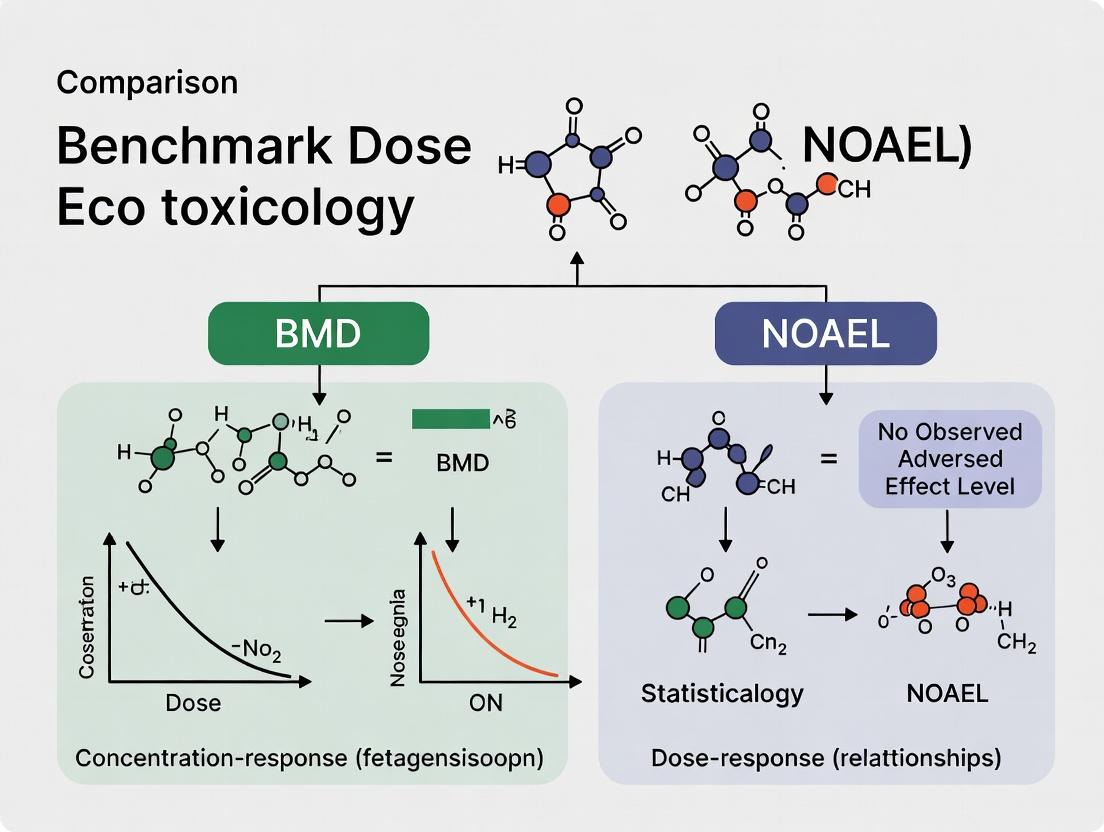
This article provides a comprehensive analysis of the Benchmark Dose (BMD) methodology as a superior alternative to the traditional No-Observed-Adverse-Effect-Level (NOAEL) approach.
Benchmark Dose vs. NOAEL: A Scientific Paradigm Shift in Modern Risk Assessment
Abstract
This article provides a comprehensive analysis of the Benchmark Dose (BMD) methodology as a superior alternative to the traditional No-Observed-Adverse-Effect-Level (NOAEL) approach. Tailored for researchers, scientists, and drug development professionals, it explores the foundational scientific principles underpinning the shift from NOAEL to BMD, detailing its core statistical and conceptual advantages. The article delivers a practical guide to modern methodological implementation, including software tools like BMDS and PROAST, Bayesian model averaging, and application in drug safety evaluation. It addresses common troubleshooting challenges in data analysis and model selection, and presents a robust validation of the BMD approach through comparative analyses with NOAEL in regulatory and pharmaceutical contexts. The scope concludes with a synthesis of future directions, including the integration of epidemiological data and next-generation toxicological frameworks, providing a holistic resource for advancing risk assessment practices.
Beyond NOAEL: Understanding the Scientific Paradigm Shift to Benchmark Dose Modeling
Core Concepts and Definitions
In toxicological risk assessment, the No-Observed-Adverse-Effect Level (NOAEL) and the Lowest-Observed-Adverse-Effect Level (LOAEL) are fundamental, experimentally derived values. The NOAEL is defined as the highest tested dose at which there is no statistically or biologically significant increase in the frequency or severity of adverse effects, while the LOAEL is the lowest tested dose at which such adverse effects are observed [1]. These values are identified directly from the experimental doses used in a study [1].
The Benchmark Dose (BMD) approach represents a more sophisticated, model-based methodology. The BMD is a dose or concentration that produces a predetermined change in the response rate of an adverse effect, known as the Benchmark Response (BMR) [2]. Common default BMRs are a 10% extra risk for quantal data (e.g., tumor incidence) and a 5% or 10% change for continuous data (e.g., body weight) [2]. To account for statistical uncertainty, the Benchmark Dose Lower confidence limit (BMDL) is typically used as a conservative Point of Departure (POD) for risk assessment [2]. The BMDL is the lower bound (usually the 95% lower confidence limit) of the BMD estimate.
Table 1: Core Concepts in Dose-Response Assessment
| Concept | Full Name | Definition | Primary Use |
|---|---|---|---|
| NOAEL | No-Observed-Adverse-Effect Level | The highest experimentally tested dose at which no adverse effects are observed [1]. | Traditional POD for deriving health-based guidance values (e.g., ADI, RfD). |
| LOAEL | Lowest-Observed-Adverse-Effect Level | The lowest experimentally tested dose at which adverse effects are observed [1]. | Used as POD when a NOAEL cannot be determined, typically with an additional uncertainty factor. |
| BMD | Benchmark Dose | The dose estimated by a model to produce a specified, low-level change in response (the BMR) [2]. | Model-derived estimate of a dose associated with a defined risk. |
| BMDL | Benchmark Dose Lower Limit | The lower confidence bound (e.g., 95%) of the BMD estimate [2]. | Conservative POD for risk assessment, accounting for statistical uncertainty. |
| BMR | Benchmark Response | The predetermined change in response (e.g., 10% extra risk) used to calculate the BMD [2]. | Defines the effect level for benchmark dose calculation. |
Comparative Performance: BMD/BMDL vs. NOAEL/LOAEL
The choice between the traditional NOAEL/LOAEL approach and the BMD methodology has been a central topic in toxicology. Regulatory bodies like the U.S. EPA and the European Food Safety Authority (EFSA) now favor the BMD approach as a scientifically advanced method, though the NOAEL remains widely used in practice [3] [4].
Table 2: Empirical Comparison of PODs from BMDL and NOAEL Approaches
| Study Focus & Source | Key Comparative Finding | Implication for Risk Assessment |
|---|---|---|
| Carcinogenicity of Pesticides [5] | Analysis of 193 tumor datasets showed 48–62% of BMDLs fell between the NOAEL and LOAEL. BMDLs were strongly correlated with NOAELs when dose-response was clear. | For studies with a clear monotonic dose-response, BMDL and NOAEL often provide similar PODs, supporting a transition to BMD. |
| Carcinogenicity of Pesticides [5] | Bayesian BMD software generated fewer calculation failures or extreme low BMDLs compared to frequentist software for problematic datasets (e.g., sporadic responses). | Bayesian methods may offer more robust POD estimates for ambiguous data, aligning with latest EFSA guidance [4]. |
| General Subchronic/Chronic Studies [2] [6] | The BMDL value can be higher or lower than the NOAEL. It tends to be higher than the NOAEL with large sample sizes, and lower with small sample sizes. | BMDL explicitly accounts for sample size and statistical power, while the NOAEL does not. |
| Regulatory Context [3] | The theoretical advantages of BMD are often weighed against practical disadvantages (complexity, need for consensus on models/BMR). | Pragmatic barriers can slow full adoption, leading to recommendations for complementary use: NOAEL for routine screening, BMD for critical studies [3]. |
Table 3: Advantages and Limitations of Each Approach
| Aspect | NOAEL/LOAEL Approach | BMD/BMDL Approach |
|---|---|---|
| Basis & Dependence | Depends entirely on the doses, dose spacing, and sample sizes selected for the study [2]. | Uses a mathematical model to fit all dose-response data; less dependent on experimental design choices [2]. |
| Use of Dose-Response Data | Ignores the shape and slope of the dose-response curve; only uses data from the single dose group defining the NOAEL [2]. | Incorporates the entire dose-response curve, providing information on the slope and allowing for extrapolation [2]. |
| Statistical Uncertainty | Does not quantitatively account for variability or statistical power [2]. A NOAEL from a small, poorly powered study is treated the same as from a large study. | Quantifies uncertainty via confidence intervals (e.g., BMDL). Results reflect study quality and sample size [2]. |
| Interpretation & Comparison | Does not correspond to a consistent level of risk across studies [2]. | BMD is explicitly tied to a consistent, predefined level of risk (BMR), enabling more meaningful comparison across chemicals and studies [2]. |
| Practical Application | Simple, familiar, and can be determined from studies with limited dose groups or unclear trends [3] [2]. | Requires more data (minimum 3 dose groups + control), specific software, and statistical expertise; can fail with poorly behaved data [5] [2]. |
Experimental Protocols and Methodologies
Protocol for Determining NOAEL and LOAEL
The determination of NOAEL and LOAEL is based on the statistical and biological evaluation of raw experimental data.
- Study Design: Conduct a standard toxicity study (e.g., subchronic 28/90-day) with at least one control group and three dose groups. Dose selection should aim to elicit a clear range of effects from no adverse effect to obvious toxicity.
- Data Collection: Collect endpoint-specific data (clinical pathology, histopathology, organ weights, etc.) for all animals.
- Statistical Analysis: For each endpoint, compare each dose group to the concurrent control using appropriate statistical tests (e.g., ANOVA with Dunnett's test for continuous data, Fisher's exact test for incidence data).
- Biological Significance Assessment: Statistically significant differences are evaluated by an expert toxicologist to determine if they are adverse. Factors considered include magnitude of change, dose-related trend, and biological plausibility [7].
- Identification of NOAEL/LOAEL: The NOAEL is the highest dose at which no adverse effects are observed. The LOAEL is the lowest dose at which adverse effects are observed [1]. These are always one of the experimental doses tested.
Protocol for BMD/BMDL Modeling
BMD modeling is a computational process applied to study data that shows a dose-related trend [2] [8].
- Data Suitability Check: Ensure data is suitable for modeling: a clear dose-response trend, sufficient dose groups (minimum 3 + control), and adequate data format (quantal or continuous) [2].
- Define the Benchmark Response (BMR):
- For quantal data (e.g., tumor incidence), a default BMR of 10% extra risk is commonly used [2] [8].
- For continuous data (e.g., liver weight), a BMR of 1 standard deviation (SD) from the control mean or a 5-10% relative change is used [2] [8]. Biologically significant changes (e.g., 10% decrease in body weight) can also define the BMR.
- Model Fitting and Selection:
- Fit a suite of mathematical dose-response models (e.g., Hill, Exponential, Polynomial) to the data using software like EPA's BMDS or RIVM's PROAST [8].
- Assess model fit using goodness-of-fit p-values (p > 0.1), visual inspection, and scaled residuals [8].
- From adequately fitting models, select the optimal model. Current best practice, as per EFSA, is Bayesian Model Averaging (BMA), which weights and combines multiple models [4]. A frequentist method is to select the model with the lowest Akaike’s Information Criterion (AIC), or the model with the lowest reliable BMDL if BMDLs vary widely (>3-fold) [8].
- Derive BMD and BMDL: The software calculates the BMD (the dose corresponding to the BMR) and its confidence/credible interval. The lower bound of this interval is the BMDL, which serves as the POD [2] [8].
Diagram 1: BMD Modeling Workflow and Key Concepts (96 characters)
The Scientist's Toolkit: Essential Research Reagent Solutions
Table 4: Essential Tools for Dose-Response Analysis
| Tool / Reagent | Type | Primary Function & Application |
|---|---|---|
| EPA Benchmark Dose Software (BMDS) | Software | The U.S. EPA's flagship software for BMD modeling. It provides a suite of frequentist models for quantal and continuous data, guiding users through fitting, evaluation, and BMDL selection [2] [8]. |
| PROAST Software (RIVM) | Software | Developed by the Dutch National Institute for Public Health. A powerful tool for BMD analysis that supports both frequentist and, more recently, Bayesian approaches, as endorsed by EFSA [5] [4]. |
| Bayesian Benchmark Dose (BBMD) Software | Software | Implements Bayesian methods for BMD modeling. Studies show it can be more robust than frequentist methods for datasets with unclear dose-response relationships [5]. |
| R4EU Platform (EFSA) | Online Platform | EFSA's web-based platform for Bayesian BMD modeling using the PROAST engine. Facilitates the application of the latest EFSA guidance, including model averaging [4]. |
| Akaike’s Information Criterion (AIC) | Statistical Metric | Used to compare the relative quality of multiple statistical models fit to the same data. The model with the lowest AIC is often preferred in frequentist BMD analysis [8]. |
| In Vivo Mutagenicity Assays (TGR, Pig-a) | Biological Assay | Provide quantal or continuous dose-response data for genotoxicity endpoints. Recent research aims to establish standardized BMRs (e.g., 50%) for such endpoints to enable consistent BMD analysis [9]. |
| Standardized Toxicity Test Guidelines (OECD, EPA) | Protocol | Guidelines (e.g., OECD 407, 408) ensure studies are conducted with appropriate dose selection, group sizes, and endpoints, generating data suitable for both NOAEL determination and BMD modeling [4]. |
Diagram 2: Relationship of Core Concepts to Dose-Response Data (86 characters)
The determination of a point of departure (POD) is a fundamental step in toxicological risk assessment and drug safety evaluation. For decades, the No-Observed-Adverse-Effect Level (NOAEL) has served as the cornerstone for this process. Its definition is straightforward: the highest tested dose at which no statistically or biologically significant adverse effects are observed [10]. However, a substantial body of contemporary research and regulatory guidance identifies profound inherent limitations in the NOAEL approach, primarily its acute dependence on the specific design of individual studies and its failure to utilize all available dose-response data [4] [3]. This has catalyzed a shift toward the Benchmark Dose (BMD) approach, which is now recognized by major regulatory bodies like the European Food Safety Authority (EFSA) and the U.S. Environmental Protection Agency (EPA) as a "scientifically more advanced method" [4] [10].
This comparison guide synthesizes current evidence to objectively analyze the performance of the NOAEL against the BMD alternative. The core thesis is that the BMD method provides a more robust, consistent, and informative basis for risk assessment by explicitly modeling the dose-response relationship, thereby overcoming the key weaknesses of the NOAEL that stem from experimental design artifacts and the discarding of valuable data.
Core Conceptual and Methodological Comparison
The fundamental difference between the two approaches lies in how they derive a POD from experimental data.
- The NOAEL Approach: This is a study-defined value. It identifies a single dose level from the experiment (the highest dose with no significant adverse effect) and designates it as the NOAEL. Its value is inherently tied to the doses selected and the statistical power (group size) of that specific study [11] [3]. A different study design will likely yield a different NOAEL.
- The BMD Approach: This is a model-derived estimate. It fits mathematical models to all the dose-response data from a study to estimate the dose corresponding to a predetermined, low-level benchmark response (BMR), such as a 5% or 10% increase in adverse incidence. The lower confidence limit of this estimate (the BMDL) is typically used as the POD [4] [12]. This process utilizes the full dataset and explicitly accounts for the shape of the dose-response curve and data variability.
The following workflow illustrates the procedural and philosophical differences between the two methods in deriving a point of departure for risk assessment.
Quantitative Performance Comparison
Dependence on Study Design: Simulation Evidence
The NOAEL's value is not a stable biological constant but a function of experimental choices. A 2024 simulation study starkly illustrates this and the subsequent risk in cross-species translation for drug development [11]. Researchers simulated animal toxicology experiments under varied conditions of interspecies sensitivity and pharmacokinetic variability. The human trial risk was then assessed if the clinical dose was capped at the exposure associated with the animal NOAEL.
Table 1: Uncertainty in NOAEL Translation from Animals to Humans (Simulation Data) [11]
| Scenario | Between-Subject Variability in Sensitivity (CV%) | Human vs. Animal Sensitivity Ratio | Risk of Toxicity in Human Trial at ≤ NOAEL Exposure (%) | Implication |
|---|---|---|---|---|
| 1 | 30 | 1 (Same) | 19 - 32 | High risk even assuming equal sensitivity. |
| 2 | 30 | 0.2 (Human 5x more sensitive) | 48 - 66 | Unacceptably high toxicity risk. |
| 3 | 30 | 5 (Human 5x less sensitive) | 6 - 10 | High risk of under-dosing, compromising efficacy. |
| 8 | 70 | 0.2 (Human 5x more sensitive) | 46 - 65 | High variability compounds risk. |
Key Finding: Even under the idealistic assumption that humans and animals are equally sensitive (Scenario 1), limiting clinical exposure to the animal NOAEL carried a 19-32% risk of causing toxicity in the human trial. This risk escalates dramatically with realistic differences in species sensitivity. The study concludes that reliance on the NOAEL alone provides an unreliable safety guardrail and can undermine a drug's therapeutic potential [11].
Utilizing Data for Robustness: Experimental Case Studies
In contrast, the BMD approach leverages all data to produce more stable and informative rankings. A 2020 experimental study on metal oxide nanoparticles demonstrated this effectively [12]. Researchers exposed two human lung cell lines (BEAS-2B and A549) to five nanoparticles and measured eight toxicity endpoints. They calculated BMD values for the most sensitive endpoint in each case.
Table 2: Toxicity Ranking of Nanomaterials Using BMD Analysis (Experimental Data) [12]
| Nanomaterial | Most Sensitive Endpoint (BEAS-2B cells) | BMD (µg/mL) | Toxicity Rank | Key Mechanistic Insight from Full Dataset |
|---|---|---|---|---|
| Zinc Oxide (ZnO) | Membrane Integrity | 0.95 | 1 (Most Toxic) | Rapid dissolution of ions causing acute cytotoxicity. |
| Copper Oxide (CuO) | Oxidative Stress (GSH depletion) | 5.1 | 2 | Sustained ion release leading to oxidative stress and mitochondrial damage. |
| Titanium Dioxide (TiO₂) | Lysosomal Function | 24.5 | 3 | Low solubility; effects likely from particle-cell interactions. |
| Zirconium Dioxide (ZrO₂) | Cell Membrane Integrity | 73.5 | 4 | Very low solubility and reactivity. |
| Cerium Dioxide (CeO₂) | Mitochondrial Membrane Potential | >100 | 5 (Least Toxic) | Antioxidant properties observed at low doses. |
Key Finding: The BMD analysis produced a clear, quantitative toxicity ranking. More importantly, by modeling the complete dose-response curves across multiple endpoints, the study supported hypotheses on the mode of action (e.g., ion dissolution vs. particle effects), a level of insight inaccessible to the binary NOAEL/LOAEL determination [12].
Addressing Data Scarcity with New Approach Methodologies (NAMs)
A major practical limitation of the NOAEL is its absence for thousands of chemicals due to a lack of animal studies. Machine learning (ML) models are emerging as NAMs to predict NOAELs, but their performance highlights the challenge. A 2024 study curating data from multiple sources achieved a best R² value of 0.43 for chronic NOAEL prediction using advanced ML models like XGBoost [13]. While promising, this level of explained variance underscores the inherent noise and variability in the underlying NOAEL data itself, much of which originates from its dependence on study design. In contrast, BMD modeling, which provides a more consistent and mechanistic POD, is increasingly integrated into such computational assessment frameworks [13] [14].
Detailed Experimental Protocols
This protocol is designed to quantify the statistical and translational uncertainty of the NOAEL.
Define Pharmacokinetic (PK) and Pharmacodynamic (PD) Parameters:
- Establish a PK model (e.g., linear clearance) for the animal species.
- Define a dose-limiting toxicity PD model using a sigmoidal Emax function relating the probability of an adverse event to systemic exposure (AUC).
- Set key parameters:
A50(exposure producing 50% probability),E0(background incidence), andEmax. - Incorporate between-subject variability (BSV) on clearance and
A50as log-normal distributions.
Simulate Animal Toxicology Studies:
- For a given scenario (e.g., specific BSV, human:animal
A50ratio), run 500+ virtual trials. - Each trial simulates an experiment with a control group and dose groups (e.g., 10 animals/group) at half-log increments.
- For each animal, simulate an individual AUC (from dose and PK) and
A50, then determine the binary toxicity outcome based on the PD model.
- For a given scenario (e.g., specific BSV, human:animal
Determine the NOAEL for Each Virtual Study:
- Apply the standard regulatory definition: The NOAEL is the highest dose at which there is no statistically significant increase (e.g., p≥0.05 in Fisher's exact test) in adverse events compared to the control group.
Simulate Human Exposure and Assess Risk:
- For each animal study's derived NOAEL exposure, simulate a cohort of human subjects.
- Apply allometric scaling from animal PK to human PK, including prediction uncertainty.
- Calculate the probability of toxicity in humans exposed at or below the animal NOAEL exposure.
- Aggregate results across all virtual trials to estimate the distribution of human toxicity risk.
This protocol details the application of BMD modeling to high-throughput in vitro data.
Cell Culture and Exposure:
- Culture relevant cell lines (e.g., BEAS-2B bronchial epithelial cells, A549 alveolar epithelial cells).
- Prepare nanoparticle suspensions in biologically relevant medium (e.g., simulated lung fluid).
- Expose cells to a wide, logarithmic concentration range (e.g., 0.4 – 100 µg/mL) of each test substance. Include vehicle controls.
Multiplexed Endpoint Assessment:
- At assay endpoint, measure a battery of toxicity markers reflecting different modes of action. Example endpoints include:
- Membrane Integrity: Lactate dehydrogenase (LDH) release.
- Oxidative Stress: Intracellular glutathione (GSH) levels, reactive oxygen species (ROS).
- Mitochondrial Function: Mitochondrial membrane potential (JC-1 assay).
- Metabolic Activity: Resazurin reduction (cell viability).
- Lysosomal Function: Neutral red uptake.
- Use plate readers or high-content imaging for quantification.
- At assay endpoint, measure a battery of toxicity markers reflecting different modes of action. Example endpoints include:
Data Processing and BMD Modeling:
- Normalize all endpoint data to the vehicle control (0% = control response, 100% = maximum possible effect).
- For each endpoint-substance combination, fit a suite of predefined dose-response models (e.g., exponential, Hill, probit models). Software like EPA's BMDS or EFSA's PROAST is used [4] [10].
- Select the best-fitting model based on statistical criteria (e.g., lowest Akaike Information Criterion, goodness-of-fit p-value > 0.1).
- Define the Benchmark Response (BMR). For continuous data, a 10% relative change from the control mean is commonly used (BMR=10). For quantal data, an extra risk of 10% (BMR=0.1) is standard.
- Calculate the BMD (dose at the BMR) and its 95% confidence interval (BMDL, BMDU).
Sensitivity Ranking and Mechanistic Analysis:
- For each test substance, identify the lowest BMDL across all measured endpoints. This represents the most sensitive adverse outcome and is used for potency ranking.
- Compare BMD profiles across endpoints to infer primary modes of action (e.g., a substance with low BMDs for oxidative stress endpoints but high BMDs for membrane integrity primarily acts via oxidative pathways).
The Scientist's Toolkit: Essential Research Reagents & Solutions
Table 3: Key Reagents and Tools for Dose-Response Analysis and BMD Modeling
| Item | Function/Description | Application Context |
|---|---|---|
| PROAST Software | Web-based software for BMD analysis, endorsed and developed by EFSA. Supports Bayesian model averaging, the current recommended method [4]. | Regulatory Risk Assessment: Primary tool for BMD modeling in food and chemical safety for EFSA and aligned agencies. |
| EPA BMDS (Benchmark Dose Software) | Desktop software suite from the U.S. EPA for fitting dose-response models and calculating BMDs/BMDLs under a frequentist framework [10]. | Environmental & Chemical Risk: Widely used in U.S. regulatory assessments and academic research. |
| Simulated Lung Fluid (SLF) | A physiologically relevant exposure medium designed to mimic the composition of pulmonary lining fluid [12]. | Nanotoxicology & Inhalation Studies: Provides more realistic in vitro dosing conditions for nanoparticles and inhaled substances compared to standard cell culture media. |
| Multiplexed In Vitro Assay Kits | Commercial kits allowing simultaneous measurement of multiple endpoints (e.g., viability, cytotoxicity, apoptosis, oxidative stress) from a single sample well. | High-Throughput Screening & Mechanistic Toxicology: Enables efficient generation of rich dose-response datasets necessary for robust BMD analysis and mode-of-action identification. |
| Informatics Platforms (e.g., R4EU) | EFSA-hosted servers providing access to computational tools, including for BMD analysis, and training resources for dose-response modeling [4]. | Data Analysis & Researcher Training: Supports consistent application of advanced methodologies across the scientific community. |
The evidence from simulation, experimental, and regulatory sources converges on a clear conclusion: the traditional NOAEL approach is fundamentally limited by its genesis in study design artifacts and its inefficient use of data [11] [3]. These limitations introduce significant and quantifiable uncertainty into safety decisions, whether for environmental chemicals or first-in-human drug doses.
The BMD approach represents a superior methodological paradigm. By modeling the entire dose-response continuum, it:
- Reduces dependence on arbitrary study design factors (dose spacing, group size).
- Quantifies uncertainty through confidence intervals (BMDL/BMDU).
- Extracts more mechanistic information from the same dataset, supporting toxicity ranking and mode-of-action analysis [4] [12].
- Facilitates cross-species and cross-study comparisons by providing a consistent metric (the dose at a defined BMR).
While the NOAEL may retain utility as a simple summary statistic for non-critical studies [3], the trajectory of modern toxicology and regulatory science is firmly aligned with the BMD. Its integration with New Approach Methodologies—including high-throughput in vitro data and computational models—offers a path toward more predictive, mechanistic, and efficient risk assessment [13] [14]. For researchers and drug developers, adopting the BMD framework is no longer just an option; it is a best practice for deriving robust, defensible, and informative points of departure.
For decades, the No-Observed-Adverse-Effect Level (NOAEL) served as the cornerstone for determining the Point of Departure (PoD) in toxicological risk assessment. This approach identifies the highest experimental dose at which no statistically or biologically significant adverse effect is observed [15]. However, its well-documented limitations—including high dependency on study design, dose selection, and sample size—have driven the scientific community toward a more robust and quantitative methodology [16] [2].
The Benchmark Dose (BMD) approach represents a fundamental conceptual leap. Instead of relying on a single, often arbitrary, data point from an experiment, the BMD method utilizes the entire dose-response curve to estimate a dose corresponding to a predefined, low-level change in response, known as the Benchmark Response (BMR) [2] [10]. The lower confidence bound of this estimate (BMDL) is then typically used as the PoD [4] [17]. Major regulatory bodies, including the European Food Safety Authority (EFSA) and the U.S. Environmental Protection Agency (U.S. EPA), now recognize the BMD approach as a scientifically more advanced method for deriving a reference point compared to the traditional NOAEL approach [4] [18] [10].
This guide provides a comparative analysis of the BMD and NOAEL methodologies, supported by experimental data and detailed protocols. It is framed within the broader thesis that the BMD approach offers superior precision, statistical robustness, and utility for modern risk assessment and drug development.
Conceptual and Methodological Comparison
The core difference between the NOAEL and BMD approaches lies in how they extract information from experimental data. The following table outlines their fundamental methodological distinctions.
Table 1: Fundamental Methodological Differences Between NOAEL and BMD Approaches
| Aspect | NOAEL Approach | BMD Approach |
|---|---|---|
| Basis of Determination | Relies on identifying a specific dose group from the experiment where no significant adverse effect is observed [15]. | Fits mathematical model(s) to the entire dose-response dataset to estimate the dose at a predefined BMR [2] [10]. |
| Use of Data | Uses only the data from the NOAEL and LOAEL dose groups, ignoring the shape of the dose-response curve [16]. | Leverages all experimental data points, accounting for the dose-response trend and variability [4]. |
| Statistical Power | Highly dependent on sample size and dose spacing; a small study may yield an inaccurately low NOAEL [2]. | Quantifies uncertainty via confidence/credible intervals (BMDL-BMDU), directly accounting for study quality and sample size [17] [16]. |
| Result Consistency | Values are limited to one of the experimental doses tested, making comparisons across studies difficult [2]. | Produces a consistent response level (the BMR) across studies and chemicals, enabling more reliable comparisons [19]. |
| Handling of Poor Data | May result in a LOAEL as PoD if all doses show effects, requiring additional uncertainty factors [10]. | Modeling may fail or produce wide uncertainty intervals if data is insufficient, providing a transparent metric of data adequacy [4]. |
A critical step in BMD analysis is selecting an appropriate Benchmark Response (BMR). This is a small, but measurable, change in response relative to the background level. Standards for BMR selection vary slightly between agencies, as summarized below.
Table 2: Default Benchmark Response (BMR) Standards by Agency
| Response Data Type | Description & Examples | EFSA Default BMR | U.S. EPA Default BMR |
|---|---|---|---|
| Quantal (Dichotomous) | Data where an effect is either present or absent (e.g., tumor incidence, mortality) [2]. | 10% extra risk [4] | 10% extra risk [2] |
| Continuous | Data measured on a continuum (e.g., organ weight, enzyme activity) [2]. | 5% change in response relative to control [4] | 10% change relative to control (1 SD) [19] |
The shift from a frequentist to a Bayesian paradigm, as recommended in EFSA's latest guidance, marks a significant evolution in BMD methodology. The Bayesian approach attaches probability distributions to model parameters, reflecting uncertainty in knowledge and allowing for the incorporation of prior information, which can mimic a learning process as data accumulates [4] [18].
Comparative Analysis of Experimental Data and Outcomes
Direct Comparisons in Regulatory Assessments
Recent applications in regulatory settings provide direct evidence of how BMD-derived values compare with traditional NOAELs. The European Chemicals Agency (ECHA) has implemented BMD modeling for setting Occupational Exposure Limits (OELs). In a comparative analysis of ten carcinogenic substances, ECHA found that BMDL values generally yielded more conservative risk estimations than the T25 method (a cancer-specific analog to NOAEL) [20]. This analysis also confirmed that different software tools (PROAST and EFSA's platform) produced comparable BMDL results, supporting the reproducibility of the method [20].
A key advantage of BMD is its ability to produce a PoD that is not constrained by the experimental doses. In practice, the calculated BMDL can be higher or lower than the experimental NOAEL. When study quality is high (e.g., large sample size, optimal dose spacing), the BMDL may be higher than the NOAEL, rewarding a better study design. Conversely, with limited or suboptimal data, the BMDL is often lower than the NOAEL, providing a more protective PoD [2].
Application in New Alternative Methods (NAMs)
The BMD approach is particularly valuable for standardizing data analysis in New Alternative Methods (NAMs), such as zebrafish testing. A comparative study applying BMD analysis to zebrafish developmental toxicity data found high concordance with traditional LOAEL classifications, but with greater sensitivity and objectivity [15]. The BMD approach allows for the extrapolation of results from alternative models to humans and facilitates comparison across different laboratories, which is crucial for validation and regulatory acceptance of NAMs [15].
Detailed Experimental Protocols
Protocol for Traditional Animal Study BMD Analysis
This protocol outlines the steps for applying BMD modeling to data from standard toxicology studies (e.g., rodent 28-day or chronic studies), based on EFSA and U.S. EPA guidance [4] [16] [10].
- Endpoint Selection & Data Preparation: Identify the critical adverse effect for assessment. Compile data on response per dose group, including group size, mean response (continuous), or incidence (quantal), and measures of variability (standard deviation) [16].
- Data Suitability Check: Verify the dataset is suitable for modeling. Criteria include: a minimum of three dose groups plus a control, a clear dose-response trend, and sufficient data to characterize curve shape [2].
- BMR Selection: Choose an appropriate BMR based on the data type (quantal or continuous) and relevant regulatory default (e.g., 10% extra risk for quantal, 5% change for continuous per EFSA) [4] [2].
- Model Fitting & Selection: Fit a suite of predefined mathematical models (e.g., exponential, Hill, polynomial) to the data. Evaluate model fit using statistical criteria (e.g., p-value > 0.1 for goodness-of-fit, Akaike Information Criterion [AIC]) [17].
- BMD/BMDL Estimation (Model Averaging): The preferred method is Bayesian model averaging. Instead of selecting a single "best" model, this method computes a weighted average of the BMD estimates from all plausible models, yielding a more robust and stable estimate and credible interval (BMDL-BMDU) [4] [18].
- PoD Determination & Reporting: The BMDL is typically selected as the PoD. The full results, including the BMDU, the BMDU/BMDL ratio (indicating uncertainty), and details of the modeling exercise, should be transparently reported [17].
Protocol for Zebrafish Developmental Toxicity BMD Analysis
This protocol adapts the BMD approach for use with zebrafish embryo data, a validated NAM for developmental toxicity [15].
- Assay Execution: Conduct a Dose Range Finding (DRF) study followed by a definitive developmental toxicity assay. Expose zebrafish embryos to a range of test substance concentrations shortly after fertilization [15].
- Endpoint Assessment: At specified time points (e.g., 2 and 5 days post-fertilization), assess morphological endpoints indicative of developmental toxicity (e.g., craniofacial malformations, pericardial edema, body axis curvature). Record the incidence of each malformation per concentration [15].
- Data Compilation: For each endpoint, compile data on the number of affected embryos vs. total number exposed per concentration.
- BMD Modeling: Input the quantal incidence data into BMD software. Use a BMR of 10% extra risk. Follow a model averaging approach to calculate the BMD and BMDL for each adverse endpoint.
- Integration & Interpretation: The lowest BMDL across the suite of relevant adverse endpoints can be considered the critical PoD for the substance. This value informs the assessment of teratogenic potential and can be used for screening and prioritization [15].
Visualizing Key Concepts and Workflows
BMD vs. NOAEL Determination Workflow
The following diagram contrasts the fundamental decision-making processes for identifying a Point of Departure using the NOAEL and BMD approaches.
Zebrafish Experimental Workflow for BMD Analysis
This diagram illustrates the integrated experimental and computational workflow for applying BMD analysis in a zebrafish developmental toxicity assay.
The Scientist's Toolkit: Essential Research Reagent Solutions
Successfully implementing BMD analysis requires both specialized software and rigorous experimental materials. The following table details key components of the modern BMD research toolkit.
Table 3: Essential Toolkit for BMD-Based Risk Assessment Research
| Tool Category | Specific Item / Software | Function & Purpose in BMD Analysis |
|---|---|---|
| Regulatory Software Platforms | EFSA BMD Platform (Open Analytics) [4] | Hosted platform implementing EFSA's updated Bayesian guidance for unified BMD analysis [4] [20]. |
| U.S. EPA BMDS (Benchmark Dose Software) [16] | Widely used desktop software suite for frequentist BMD analysis, supporting diverse model types [16] [2]. | |
| RIVM PROAST (Web or R package) [20] [10] | Powerful tool for both frequentist and Bayesian BMD modeling, used by EFSA and ECHA [20]. | |
| Statistical Foundation | Model Averaging Algorithms (Bayesian/Frequentist) [4] [18] | Core methodology to combine estimates from multiple models, reducing reliance on a single "best" fit and providing more robust uncertainty estimates [4] [19]. |
| Akaike Information Criterion (AIC) [17] | Statistical criterion used to compare the relative goodness-of-fit of different mathematical models to the same dataset [17]. | |
| Experimental Models (NAMs) | Zebrafish Embryo Model [15] | A validated New Alternative Method for developmental toxicity screening. Provides high-content data suitable for BMD analysis, enabling human-relevant PoD estimation from an alternative model [15]. |
| Standardized Zebrafish Lines (e.g., AB wild-type) | Essential for ensuring reproducibility and comparability of toxicity endpoints (malformations) across experiments and laboratories [15]. | |
| Assay Reagents & Standards | Developmental Endpoint Markers | Vital dyes or morphological criteria for consistently scoring specific malformations (e.g., pericardial edema, yolk sac absorption) in zebrafish assays [15]. |
| Positive Control Substances | Reference chemicals with known toxicological profiles (e.g., valproic acid for teratogenicity). Used to validate the performance of the biological assay and the BMD modeling workflow [15]. |
For decades, the No-Observed-Adverse-Effect-Level (NOAEL) approach served as the cornerstone of toxicological risk assessment, used to derive reference points for setting health-based guidance values [17]. However, this method is fundamentally limited by its dependence on the specific dose levels selected for a study and its failure to account for the shape of the entire dose-response curve [16]. In response, the Benchmark Dose (BMD) approach was proposed as a more scientifically robust alternative, utilizing mathematical models to fit all experimental data and estimate the dose corresponding to a predefined, low level of adverse effect, known as the Benchmark Response (BMR) [21] [16].
The adoption of the BMD approach represents a significant paradigm shift in regulatory science. While the U.S. Environmental Protection Agency (EPA) was an early advocate, incorporating BMD into its guidelines in the 1990s [22], the European Food Safety Authority (EFSA) has now become a leading proponent [18]. In its 2022 guidance, EFSA's Scientific Committee explicitly "reconfirms that the benchmark dose (BMD) approach is a scientifically more advanced method compared to the NOAEL approach" [18] [4]. This guide details this transition, compares the methodologies, and presents the experimental data underpinning the global regulatory endorsement of BMD.
Comparative Analysis: BMD vs. NOAEL
The transition from NOAEL to BMD is driven by well-documented scientific and statistical advantages, as summarized in the table below.
Table: Core Comparative Advantages of the BMD over the NOAEL Approach
| Aspect | NOAEL Approach | BMD Approach | Implication for Risk Assessment |
|---|---|---|---|
| Data Utilization | Uses only data from the NOAEL dose and the control group. | Fits a model to the entire dose-response dataset. | BMD incorporates more biological information, leading to a more reliable point of departure [17] [21]. |
| Dose Selection Dependence | Highly dependent on the spacing and selection of test doses. | Relatively independent of study design; interpolates between doses. | BMD produces more consistent results across studies with different experimental designs [16]. |
| Statistical Power & Sample Size | The NOAEL does not explicitly account for statistical power or sample size. | The confidence/credible interval (BMDL-BMDU) quantifies uncertainty, with narrower intervals from larger studies. | Encourages better study design and provides a transparent measure of reliability [17] [16]. |
| Quantification of Uncertainty | Does not provide a quantitative measure of uncertainty. | Provides a confidence (frequentist) or credible (Bayesian) interval (BMDL-BMDU). | Allows risk managers to understand the precision of the estimated reference point [18] [4]. |
| Definition of Effect Level | Defined by the study's ability to detect a statistically significant effect, which varies. | Based on a consistent, predefined Benchmark Response (BMR) (e.g., 10% extra risk). | Standardizes the level of effect across different studies and endpoints, improving comparability [21]. |
Historical Progression of Regulatory Endorsement
The journey toward BMD as a preferred method has been evolutionary, marked by key publications and methodological refinements from major regulatory bodies.
Table: Timeline of Key Regulatory Milestones for the BMD Approach
| Year | Agency/Event | Key Development | Significance |
|---|---|---|---|
| 1984 | Academic Proposal | Crump first proposes the BMD concept as an alternative to NOAEL. | Introduced the foundational statistical framework. |
| 1995 | U.S. EPA | EPA's Risk Assessment Forum publishes initial guidance on BMD for noncancer risk [22]. | First major regulatory body to formalize the approach. |
| 2000-2009 | U.S. EPA | Development and public release of Benchmark Dose Software (BMDS) versions 1.x and 2.x [22]. | Provided a critical, accessible tool to facilitate widespread adoption by risk assessors. |
| 2009 | EFSA | EFSA Scientific Committee publishes its first guidance on using the BMD approach [17] [4]. | Marked Europe's official adoption, recommending BMD over NOAEL for deriving Reference Points. |
| 2017 | EFSA | EFSA updates guidance, recommending model averaging as the preferred method and introducing a standardized workflow [17] [23]. | Addressed model uncertainty by averaging results from multiple viable models. |
| 2022 | EFSA | EFSA releases major update, transitioning from a frequentist to a Bayesian paradigm and unifying models for all data types [18] [4]. | Represented a state-of-the-art shift, embracing a framework that incorporates prior knowledge and better quantifies uncertainty. |
| 2023-2025 | U.S. EPA | Launch of BMDS Online, BMDS Desktop, and pybmds, transitioning to a web- and Python-based platform [22]. |
Modernized software delivery to meet contemporary computational and collaborative research needs. |
The convergence of methodologies is notable. A 2018 comparison highlighted that while differences existed (e.g., in default models and parameter restrictions), there were continued efforts by EPA and EFSA toward harmonization of BMD methods [24]. The 2022 EFSA guidance was explicitly aligned with internationally agreed concepts from the WHO/IPCS to further this global harmonization [4].
Experimental Data and Protocol: Empirical Comparison of BMD and NOAEL
A pivotal 2022 study provides concrete, large-scale experimental data comparing outputs from BMD software to traditional NOAELs [5].
Experimental Protocol
The study was designed to validate the BMD approach using real regulatory data and compare results from different software tools [5].
- Data Source: Researchers extracted 193 tumor incidence datasets from carcinogenicity studies on 50 pesticides. These studies, conducted in rats or mice, were published in risk assessment reports by Japan's Food Safety Commission (FSCJ) [5].
- Software & Methods: Each dataset was analyzed using four different analytical approaches across three major software platforms:
- PROAST (EFSA's frequently used tool).
- BMDS (U.S. EPA's software, frequentist approach).
- BBMD (Software featuring Bayesian inference). Model averaging, as recommended by EFSA, was applied where available [5].
- Comparison Metric: The primary output, the BMD Lower confidence limit (BMDL), was compared to the NOAEL and LOAEL (Lowest-Observed-Adverse-Effect-Level) identified from the same studies [5].
- Analysis: The ratio of BMDL to NOAEL was calculated for each dataset. The study also analyzed instances where BMD modeling failed to produce a result.
Key Experimental Findings
The results offer strong support for the BMD approach while highlighting the importance of data quality and methodological choices.
Table: Summary of Experimental Results Comparing BMDL and NOAEL for Carcinogenicity [5]
| Software/Approach | % of BMDLs between NOAEL and LOAEL | Key Observation |
|---|---|---|
| PROAST | 61.7% | Produced the highest proportion of BMDLs in the expected range (between NOAEL and LOAEL). |
| BMDS (Frequentist) | 48.2% | More prone to failed calculations or producing extremely low BMDLs compared to other software. |
| BBMD (Bayesian) | ~55% (estimated) | Produced fewer failures and extreme values than frequentist approaches. |
| Overall Trend | -- | For datasets with a clear dose-response relationship, the BMDL was generally similar to or slightly higher than the NOAEL. Failed or extreme BMDLs were strongly associated with unclear, non-monotonous dose-response data. |
The study concluded that the BMD approach provides a point of departure similar to the NOAEL when data quality is good, but offers a more robust and quantifiable framework. It also validated the EFSA-recommended shift, noting that Bayesian approaches (like BBMD) were more stable than frequentist ones when dealing with challenging data [5].
The Modern BMD Analytical Workflow
The following diagram illustrates the integrated, Bayesian-informed workflow as prescribed in the latest EFSA guidance.
BMD Bayesian Analytical Workflow
Comparative Software Analysis Workflow
Regulators and researchers often compare outputs from multiple software tools to ensure robustness, as demonstrated in the experimental study [5].
Multi-Software BMD Comparison Process
Table: Key Research Reagent Solutions for BMD Analysis
| Tool Category | Specific Tool / Solution | Primary Function & Purpose | Regulatory Association |
|---|---|---|---|
| Core Software | BMDS / BMDS Online [22] | EPA's primary platform for running frequentist BMD models on quantal, continuous, and nested data. | U.S. EPA |
| Core Software | PROAST | A powerful tool for dose-response analysis, frequently used in European assessments and supporting model averaging [24]. | EFSA / RIVM |
| Core Software | BBMD | Software designed specifically for Bayesian BMD analysis, implementing the paradigm shift recommended by EFSA [5]. | Academia / Regulatory |
| Statistical Framework | Bayesian Model Averaging | The preferred method per EFSA 2022. It combines estimates from multiple models, weighted by their statistical support, to produce a more robust BMD estimate [18] [4]. | EFSA |
| Guidance Document | EFSA Guidance (2022) | The definitive technical guide for applying the Bayesian BMD approach, covering model selection, prior specification, and reporting [18] [4]. | EFSA |
| Guidance Document | EPA BMDS Technical Guidance | Provides model-specific instructions and policy on applying BMD methods within the U.S. regulatory context [22]. | U.S. EPA |
The endorsement of the BMD approach by EFSA as a "scientifically more advanced method" than NOAEL [18] [4] marks the culmination of a global regulatory evolution. Empirical studies confirm that BMD provides reliable and health-protective reference points, especially when using modern Bayesian methods to manage uncertainty [5].
The future of the field points toward increased harmonization and sophistication. Key recommendations from regulatory bodies include:
- Training & Expertise: Continued training for risk assessors in dose-response modeling is crucial [17] [4].
- Guideline Modernization: There is a firm, reiterated call to reconsider traditional toxicity test guidelines to optimize study design for BMD analysis (e.g., more dose groups with fewer animals per group) [18] [17] [21].
- Human Data Application: Developing specific guidance for applying BMD to observational epidemiological data is a recognized next frontier [17] [4].
The transition from EPA's early preference to EFSA's full endorsement underscores a broader scientific consensus: the Benchmark Dose approach, particularly within a Bayesian framework, represents the current gold standard for quantitative dose-response assessment and a more robust foundation for protecting public health.
Implementing the BMD Framework: A Practical Guide to Methodology and Application
The determination of a Point of Departure (POD) for human health risk assessment has traditionally relied on the No-Observed-Adverse-Effect-Level (NOAEL) approach [25]. This method identifies the highest experimental dose at which no statistically or biologically significant adverse effects are observed. However, the NOAEL approach is subject to well-defined, substantial limitations: it is strictly dependent on the often-arbitrary selection and spacing of test doses and the sample size of the specific study, and it fails to utilize information on the shape of the dose-response curve [25] [26].
The Benchmark Dose (BMD) methodology, proposed as a superior alternative, addresses these shortcomings by applying mathematical models to the full dose-response data [25]. It estimates the dose corresponding to a predefined Benchmark Response (BMR), such as a 10% increase in adverse effect incidence. The statistical lower confidence limit of this dose, the BMDL, is then used as the POD [4]. This approach is less dependent on experimental design, quantifies uncertainty, and makes more efficient use of experimental data [25] [5].
The latest evolution in this field is the shift from frequentist to Bayesian statistical paradigms [4]. Bayesian methods allow for the formal incorporation of prior knowledge (e.g., from historical control data) and provide results in more intuitive probabilistic terms, offering a powerful framework for complex analyses and data-integration challenges common in toxicology and drug development [27] [28]. This guide objectively compares the leading software tools that enable researchers to implement these advanced methodologies.
Comparative Analysis of BMD Software Platforms
The adoption of the BMD approach has been facilitated by the development of specialized, user-friendly software. The U.S. Environmental Protection Agency's Benchmark Dose Software (BMDS) and the Dutch National Institute for Public Health and the Environment's PROAST are the two most established platforms [29]. Recently, Bayesian BMD (BBMD) and other flexible Bayesian platforms have emerged as powerful tools recommended by major regulatory bodies like the European Food Safety Authority (EFSA) [4] [5].
Table 1: Core Comparison of Major BMD Software Platforms
| Feature | U.S. EPA BMDS | RIVM PROAST | Emerging Bayesian Platforms (e.g., BBMD, R packages) |
|---|---|---|---|
| Core Methodology | Frequentist; Bayesian module under development/available [30]. | Frequentist & Bayesian capabilities [26]. | Bayesian paradigm is foundational [4]. |
| Statistical Paradigm | Primarily confidence intervals (frequentist) [25]. | Supports both confidence and credible intervals [26]. | Credible intervals; probabilistic statements about parameters [27] [4]. |
| Model Averaging | Not standard in main workflow. | Available. | Recommended preferred method (Bayesian Model Averaging) [4] [5]. |
| Key Advantage | Regulatory standard in U.S.; extensive guidance & validation [25] [30]. | Ability to include covariates in analysis [29]; unified models for quantal/continuous data [4]. | Handles complex data (small samples, nested designs) [27]; integrates historical information [31] [28]. |
| Data Type Handling | Dichotomous, continuous, nested dichotomous [30]. Count data via classes [26]. | Dichotomous, continuous. | Highly flexible; can model multivariate, clustered, and missing data [27]. |
| Distribution Assumption | Primarily normal distribution for continuous data [26]. | Lognormal distribution for continuous data [26]. | Agnostic; specified by the user-defined model. |
| User Accessibility | Standalone desktop and online versions; guided workflow [30] [29]. | Runs within R/S-PLUS environment; requires more statistical knowledge [29]. | Often requires significant statistical expertise for model/prior specification [27] [26]. |
Performance and Practical Application: BMDL vs. NOAEL
A large-scale comparative study of 193 tumorigenicity datasets from pesticide evaluations provides critical performance data [5]. The study calculated BMDLs using PROAST (frequentist), BMDS, and BBMD (Bayesian), comparing them to established NOAELs.
Table 2: Performance Comparison of BMDL vs. NOAEL from a Tumorigenicity Study (193 Datasets) [5]
| Software (Approach) | BMDL between NOAEL & LOAEL (%) | Calculation Failure/Extreme Low BMDL Rate | Key Context for Failures/Extreme Values |
|---|---|---|---|
| PROAST (Frequentist) | 48.2% | Higher | Primarily with unclear, non-monotonous dose-response data. |
| BMDS (Frequentist) | 61.7% | Higher | Primarily with unclear, non-monotonous dose-response data. |
| BBMD (Bayesian) | 54.9% | Fewer | More robust to problematic data shapes. |
| Overall Implication | The BMD approach provides a POD similar to NOAEL when the dose-response is clear. Bayesian approaches show greater computational robustness with challenging datasets. |
The study concludes that expert review of the dose-response plot shape remains essential. Bayesian software demonstrated a practical advantage by producing fewer computational failures or extreme low BMDLs when faced with sporadic or non-monotonic data, a common challenge in real-world toxicology [5].
Experimental Protocols for Advanced BMD Modeling
Protocol: Integrating Historical Control Data via Bayesian Methods
Objective: To formally integrate historical control or previous study data to improve the reliability and reduce the uncertainty of BMD estimates for a current study [31] [28]. Background: Toxicological studies are often underpowered. Historical data provides a prior distribution for background response rates or model parameters, allowing the current data to "shrink" toward a more stable, evidence-based estimate [27] [31]. Methodology Comparison: Shao (2012) compared three Bayesian integration methods using historical and current data on TCDD-induced liver tumors in rats [31].
Table 3: Comparison of Methods for Integrating Historical Information in BMD Analysis [31]
| Method | Description | Impact on Current BMD Estimate | Key Consideration |
|---|---|---|---|
| Pooled Data Analysis | Combines raw data from historical and current studies into a single dataset for analysis. | Largest impact. Can strongly shift the BMD. | Statistically and biologically flawed if study designs or conditions differ significantly. Use is not recommended [31]. |
| Bayesian Hierarchical Model (BHM) | Models parameters as coming from a common distribution (hyperprior). Explicitly accounts for between-study variability. | Mild, stabilizing influence. Improves estimate precision. | Biologically valid; robust to moderate heterogeneity. Preferred for combining related studies [31]. |
| Power Prior | Historical data is used to construct an informative prior, weighted by a power parameter (α, 0-1). | Little influence if data are incompatible. Allows control over borrowing strength. | Provides a conservative, tunable approach. Useful when historical data relevance is uncertain [31]. |
Procedure:
- Define & Extract Historical Data: Systematically gather historical control data from standardized repositories (e.g., SEND datasets) [28]. Define relevance criteria (species, strain, route, endpoint).
- Assess Compatibility: Statistically and graphically compare the distribution of historical and current control group responses.
- Select & Implement Integration Method:
- For BHM, specify a model where study-specific parameters (e.g., background tumor rate) are drawn from a common normal distribution. Use MCMC sampling (e.g., in OpenBUGS or
rstan) to estimate the posterior distribution [31]. - For Power Prior, construct an informative prior from the historical data likelihood and apply a discounting factor (α). A value of α=1 gives the historical data equal weight to the current data; α=0 ignores it completely.
- For BHM, specify a model where study-specific parameters (e.g., background tumor rate) are drawn from a common normal distribution. Use MCMC sampling (e.g., in OpenBUGS or
- Perform Bayesian Model Averaging (BMA): Fit multiple dose-response models (e.g., log-logistic, multistage) using the chosen integration method. Calculate the posterior probability weight for each model based on fit. Derive the final model-averaged BMD and BMDL as a probability-weighted sum across all models [4] [31].
- Sensitivity Analysis: Re-run the analysis with different priors (e.g., less informative) or integration weights to assess the stability of the BMDL estimate [27].
(Diagram 1: Workflow for Integrating Historical Data in Bayesian BMD Analysis. Width: 760px.)
Protocol: Benchmark Dose Analysis of a Rodent Carcinogenicity Study
Objective: To derive a BMDL for a tumor incidence endpoint from a chronic rodent bioassay and compare it to the NOAEL [5]. Background: This protocol reflects a standard, frequentist-based regulatory analysis using established software, forming a basis for comparison with more advanced Bayesian workflows. Procedure:
- Data Preparation: Compile tumor incidence data (number of animals with lesions, total animals per dose group). Include at least three dose groups plus a vehicle control [5].
- Software-Specific Modeling:
- BMDS: Select appropriate dichotomous models (e.g., Multistage, Log-Logistic). Run the model suite. The software provides a BMDL from the best-fitting model (lowest AIC) or the model with the lowest BMDL among those that pass goodness-of-fit criteria [25] [5].
- PROAST: Fit dose-response models. The user can select models and assess fit. PROAST may apply model averaging by default in some versions, providing a weighted BMDL [5].
- Comparison to NOAEL: Identify the NOAEL and LOAEL from the same dataset using standard statistical testing (e.g., Fisher's Exact or Cochran-Armitage trend test). Compare the numerical value of the BMDL to the NOAEL and LOAEL [5].
- Expert Review: Critically examine the dose-response plot. Determine if a calculated extremely low BMDL or model failure is due to a sporadic, non-monotonic response pattern. In such cases, the Bayesian approach may be more appropriate, or a weight-of-evidence judgment may be required [5].
(Diagram 2: Experimental Protocol for BMD vs. NOAEL Comparison. Width: 760px.)
The Scientist's Toolkit: Essential Research Reagent Solutions
Modern BMD analysis requires a suite of software and data resources.
Table 4: Essential Toolkit for Advanced BMD Modeling
| Tool / Resource | Function | Key Utility |
|---|---|---|
| U.S. EPA BMDS (Desktop/Online) | Performs standard frequentist BMD modeling. | The regulatory benchmark for straightforward analyses; extensive documentation and validation [30] [29]. |
| RIVM PROAST (R Package) | Performs frequentist and Bayesian BMD modeling within R. | Enables covariate adjustment and access to a broader statistical environment for customization [4] [29]. |
Bayesian BMD Software (BBMD, R packages: brms, rstan) |
Implements Bayesian model averaging and hierarchical modeling. | Essential for integrating historical data, handling complex study designs, and deriving probabilistic estimates [4] [31] [5]. |
| R Statistical Environment | Platform for running PROAST, BBMD, and custom Bayesian models. | Provides ultimate flexibility for data manipulation, visualization, and implementing published novel methodologies [27]. |
| SEND-Format Historical Data Repository | Standardized database of control animal data from previous studies. | Provides the empirical prior information required for Bayesian borrowing-strength analyses [28]. |
| Statistical Collaboration | Partnership with a statistician experienced in Bayesian methods. | Critical for success. Ensures appropriate model/prior specification and valid interpretation of complex outputs [27]. |
(Diagram 3: Evolution from NOAEL to Bayesian BMD Analysis. Width: 760px.)
The progression from NOAEL to BMD, and now toward Bayesian BMD methodologies, represents a significant advancement in the science of quantitative risk assessment. While established tools like BMDS and PROAST remain vital for standard analyses, the future lies in the flexible, probabilistic framework of Bayesian platforms. These tools offer robust solutions for real-world data challenges—such as small sample sizes, correlated endpoints, and the integration of historical knowledge—thereby providing more reliable and informative points of departure for protecting human health. Researchers are encouraged to develop familiarity with both frequentist and Bayesian paradigms, leveraging the appropriate tool from the modern BMD software arsenal to match the complexity of their data and the regulatory context of their work.
Within toxicology and drug development, the paradigm for determining safe exposure levels has progressively shifted from the traditional No-Observed-Adverse-Effect Level (NOAEL) approach to the more quantitative Benchmark Dose (BMD) methodology [32]. The BMD framework offers significant advantages, including more efficient use of dose-response data, quantification of uncertainty, and reduced dependency on study-design-specific dose spacing [32]. Central to implementing a robust BMD analysis is the critical task of choosing and fitting an appropriate mathematical model to the experimental data. This decision profoundly influences the derived point of departure (POD) and, consequently, the final exposure limit, such as a Reference Dose (RfD) or Reference Concentration (RfC) [32].
The nature of the biological response data—whether dichotomous (e.g., presence or absence of a lesion) or continuous (e.g., body weight change, enzyme activity)—dictates the initial family of models to be considered [33] [34]. For dichotomous data, common in toxicological studies, models like the logistic, probit, and quantal-linear are applied [33]. For continuous data, linear and nonlinear regression models are standard [34]. A persistent, problematic practice in some fields, including earlier toxicological assessments, has been the dichotomization of continuous data (e.g., converting a measured biochemical change into a simple "affected/not affected" classification). This practice discards valuable information, increases standard errors, reduces statistical power, and can lead to inaccurate significance tests and diminished effect size estimates [35].
Given the inherent uncertainty in selecting a single "best" model from a set of plausible candidates, model averaging has emerged as a powerful advanced technique. Instead of relying on one model, model averaging computes a weighted average of the BMD estimates from multiple models, where the weights reflect each model's statistical support from the data [33]. This approach provides a more robust and stable POD that accounts for model uncertainty, moving risk assessment toward a more probabilistic framework [32]. This guide objectively compares modeling approaches, supported by experimental data, to inform best practices in BMD analysis for researchers and risk assessors.
Comparative Analysis of Modeling Approaches for Dose-Response Assessment
The choice of model type and fitting function is not merely a statistical exercise; it directly impacts the derived health-protective limits. The following tables compare the performance of different models and data types based on recent research and established methodologies.
Table 1: Performance of Probabilistic BMD Modeling Using Subacute/Subchronic Data vs. Traditional Methods [32]
| Chemical & Endpoint | Study Duration | Probabilistic POD Range (BMD-like) | Traditional POD (NOAEL/LOAEL/BMD) | Derived Exposure Limit | Comparison to Regulatory Benchmark |
|---|---|---|---|---|---|
| Benzo[a]pyrene (B[a]P)(Oral, Tumorigenicity) | 5 weeks (Subacute) | 0.01 – 6.94 mg/kg-day | 0.06 – 5.2 mg/kg-day | RfD: 7.0×10⁻⁶ – 1.1×10⁻³ mg kg⁻¹ day⁻¹ | Aligns with and supports established values |
| Benzo[a]pyrene (B[a]P)(Oral, Tumorigenicity) | 13 weeks (Subchronic) | Similar to 5-week range | 0.06 – 5.2 mg/kg-day | RfD: 7.0×10⁻⁶ – 1.1×10⁻³ mg kg⁻¹ day⁻¹ | Aligns with and supports established values |
| Naphthalene (NA)(Inhalation, Toxicity) | 5 weeks (Subacute) | 0.02 – 12.9 ppm | Traditional NOAEL | RfC: 0.06 – 52.6 µg m⁻³ day⁻¹ | Comparable to regulatory benchmarks |
| Naphthalene (NA)(Inhalation, Toxicity) | 13 weeks (Subchronic) | 0.03 – 14.0 ppm | Traditional NOAEL | RfC: 0.06 – 52.6 µg m⁻³ day⁻¹ | Comparable to regulatory benchmarks |
Table 1 demonstrates that a probabilistic modeling framework incorporating alternative fitting functions (e.g., sigmoid, hyperbolic tangent) can derive health-protective exposure limits from shorter-duration studies that align with limits derived from chronic data and traditional methods [32]. A key finding was that the mathematical form of the fitting function contributed more to overall uncertainty in the dose-response model than the exposure duration or data quality itself [32].
Table 2: Model Selection Methods: Traditional vs. Regularization Approaches [36]
| Selection Method | Core Principle | Key Advantage | Key Disadvantage | Suitability for BMD Context |
|---|---|---|---|---|
| Exhaustive Search (All Subsets) | Fits all possible model combinations and selects best via criterion (AIC, BIC). | Guarantees finding the best model within the considered set. | Computationally intensive; risk of overfitting with many variables. | Useful when the set of plausible dose-response models is small and pre-defined. |
| Forward Selection | Starts with intercept, iteratively adds most significant variable. | Simple, efficient with large number of potential variables. | May ignore multicollinearity; cannot remove variables once added. | Less common for core dose-response shape, but may be used for covariate selection. |
| Backward Elimination | Starts with full model, iteratively removes least significant variable. | Considers all variables initially. | Once a variable is removed, it cannot be reconsidered. | Less common for core dose-response shape. |
| Stepwise Selection | Combines forward/backward; allows re-evaluation of variables. | More flexible than pure forward or backward. | Can be prone to overfitting; p-value thresholds are arbitrary. | Common in some automated workflows but requires careful validation. |
| Ridge Regression | Adds penalty on the sum of squared coefficients (L2). | Handles severe multicollinearity well; coefficients shrink but never reach zero. | Does not perform variable selection; all variables remain in model. | Can stabilize parameter estimates in complex models with correlated predictors. |
| LASSO Regression | Adds penalty on the sum of absolute coefficients (L1). | Performs variable selection by forcing some coefficients to zero. | Tends to select one variable from a correlated group arbitrarily. | Potentially useful for high-dimensional biomarker data alongside dose. |
| Elastic Net | Combines L1 (LASSO) and L2 (Ridge) penalties. | Balances variable selection and group handling; robust to multicollinearity. | Introduces two penalty parameters to tune. | A robust modern approach for complex datasets with many covariates. |
| Model Averaging | Averages estimates (e.g., BMD) from multiple models, weighted by model support (AIC, BIC). | Explicitly accounts for model uncertainty; produces more stable estimates. | Computationally intensive; requires defining a model set and weighting scheme. | Increasingly recommended for BMD analysis to reduce reliance on a single model [33]. |
Experimental Protocols for Benchmark Dose Modeling
This protocol outlines the methodology used to derive probabilistic exposure limits from subacute and subchronic studies, validating the BMD approach against traditional chronic data.
- Mode of Action (MOA) Analysis and Pathway Construction: Define the adverse outcome pathway (AOP) or key events leading to the toxicological endpoint. This biological framework guides the selection of plausible mathematical functions to describe the dose-response relationship.
- Data Curation and Preparation: Collect subacute (e.g., 5-week) and subchronic (e.g., 13-week) animal bioassay data. The dataset must include dose levels, group sizes, and incidence data for dichotomous endpoints or summary statistics (mean, standard deviation) for continuous endpoints.
- Incorporation of Alternative Fitting Functions: Extend the modeling framework beyond standard functions (e.g., logistic) by integrating activation functions such as the sigmoid, hyperbolic tangent (tanh), and arctangent. These functions offer different shapes for the transition from background to response.
- Probabilistic Modeling Execution:
- Fit each candidate model to the dose-response data.
- Propagate uncertainty in model parameters (e.g., using Markov Chain Monte Carlo methods) to generate a distribution of potential responses at each dose.
- Derive a probabilistic POD distribution by identifying the dose corresponding to a specified benchmark response (BMR), such as a 10% extra risk.
- Derivation of Exposure Limits: Apply uncertainty factors to the probabilistic POD (e.g., the lower confidence bound) to calculate a probabilistic RfD or RfC.
- Validation: Compare the probabilistic RfDs/RfCs and the range of PODs derived from short-term data to established regulatory values derived from chronic studies and traditional NOAEL/LOAEL/BMD methods. Consistency validates the framework.
The U.S. EPA's BMDS Online software provides a standardized workflow for BMD analysis. This protocol details the steps for modeling dichotomous data.
- Create a New Analysis: Navigate to BMDS Online and create a new analysis. The system generates a unique, shareable URL for the session.
- Configure Analysis Settings:
- Specify an analysis name and description.
- Select "Dichotomous" as the model type. Continuous and dichotomous data cannot be mixed in a single analysis.
- Select the models to include. Users can choose default maximum likelihood models and/or Bayesian dichotomous model averaging models.
- Define the Benchmark Response (BMR), typically set at 10% extra risk.
- Input Data:
- Add a new dataset on the Data tab.
- Manually enter or paste from Excel the dose, sample size (N), and incidence counts.
- The software automatically updates a plot of the data.
- Execute Analysis and Review Results:
- Run the analysis. BMDS fits all selected models.
- Review the results table. The software applies logic criteria to recommend a best-fitting model (highlighted in blue).
- Examine model-specific details (parameter estimates, goodness-of-fit p-values, BMD, and BMDL) by clicking on a model name.
- For model averaging results, select the "Model Average" link to view the weighted curve and combined BMD estimate.
- Model Selection and Documentation:
- Accept the recommended model or manually select an alternative from the picklist based on expert judgment.
- Critically, document the rationale for the final model selection in the "Selection notes" field. This is a key step for transparency and reproducibility.
- Download and Share: Download the complete analysis as a Word report, Excel file, or JSON package for sharing and archiving.
Visualizing Modeling Workflows and Relationships
Model Selection and BMD Workflow
The Scientist's Toolkit: Essential Reagents & Resources for BMD Modeling
| Tool/Resource | Primary Function in BMD Analysis | Key Notes & Examples |
|---|---|---|
| BMDS Software (Online/Desktop) [33] | The U.S. EPA's benchmark software suite for performing standardized BMD modeling on dichotomous, continuous, and nested data. | BMDS Online enables sharing and collaboration; BMDS Desktop and pybmds offer local, scriptable analysis. Supports model averaging. |
| Statistical Software (R, SAS, Python) | Provides a flexible environment for custom data preparation, advanced or non-standard model fitting, and visualization. | Packages like drc in R are widely used for dose-response analysis. Essential for implementing regularization methods (LASSO, Ridge) [36]. |
| Model Averaging Algorithms | Computes a weighted average of BMD estimates from multiple models to account for model uncertainty. | Weights are typically based on information criteria (AIC, BIC). Implemented in BMDS and other statistical packages [33] [36]. |
| Information Criteria (AIC, BIC) [36] | Metrics to compare models, balancing goodness-of-fit with model complexity (penalizing extra parameters). Lower values indicate better relative support. | Used for both selecting a single best model and for calculating weights in model averaging. A difference < 2 suggests substantial model uncertainty. |
| Benchmark Response (BMR) | The predetermined level of adverse response change (e.g., 10% extra risk, 1 standard deviation change) used to calculate the BMD. | Defines the level of effect deemed biologically significant. Must be justified and held constant when comparing models. |
| Goodness-of-Fit Tests (p-value) | Assesses how well a model's predictions match the observed data. A low p-value (e.g., <0.1) indicates a poor fit. | A primary filter in BMDS logic; models with significant lack-of-fit are not recommended [33]. |
| Visualization Tools (Fitted Line Plots) [34] | Graphs showing the observed data points overlaid with the fitted model curve(s). | Critical for qualitative assessment of fit, identification of outliers, and communication of results. |
| Cross-Validation Procedures [36] | A validation technique where data is split into training and testing sets to check a model's predictive performance and guard against overfitting. | Especially important when using automated model selection or regularization methods with many variables. |
The transition from the No-Observed-Adverse-Effect Level (NOAEL) to the Benchmark Dose (BMD) approach represents a fundamental shift toward more quantitative and informative hazard characterization in toxicological risk assessment [10]. At the core of the BMD methodology lies the Benchmark Response (BMR), a predefined, low but measurable change in a toxicological endpoint used to calculate the corresponding dose (BMD) from a fitted dose-response model [10]. The selection of the BMR value is therefore a critical decision point, balancing statistical robustness, biological relevance, and protective public health policy.
Traditionally, regulatory bodies have provided default BMR values (e.g., 5% or 10% extra risk) for standardization [37]. However, a growing scientific consensus advocates for a case-specific justification of the BMR, particularly for endpoints like genotoxicity where background variability is high [38]. This guide objectively compares these two paradigms—default values versus scientific justification—framed within the broader thesis on the advantages of BMD over NOAEL. It provides researchers and risk assessors with experimental data, protocols, and tools to inform this essential component of dose-response analysis.
Comparative Analysis of BMR Determination Approaches
The Regulatory Default Paradigm (5%, 10%)
Default BMR values are prescribed by regulatory guidelines to ensure consistency and simplify application across a wide range of substances and endpoints.
Key Regulatory Positions:
- EFSA (European Food Safety Authority): For ecological risk assessment (ERA) of birds and mammals, a default BMR of 10% is recommended for deriving reproductive toxicity endpoints [37]. For continuous endpoints in human health risk assessment (e.g., organ weights), a default BMR of 5% has been historically used, though recent guidance supports deviation based on biological justification [38].
- General Practice: A BMR of 10% extra risk is commonly used for dichotomous data (e.g., tumor incidence), while a change of 1 standard deviation (1SD) from the control mean is a default for continuous data [38].
Advantages and Limitations: The primary advantage is consistency and regulatory efficiency. It provides a uniform benchmark for comparing BMD values across different studies and chemicals. However, a major limitation is its lack of biological basis. A one-size-fits-all value may not reflect the specific variability or toxicological significance of an endpoint. For instance, a 5% change may be within the normal physiological range for a highly variable endpoint, rendering it insensitive, while for a very stable endpoint, it might be overly conservative [38].
Table 1: Overview of Common Default BMR Values and Applications
| Default BMR Value | Typical Application Context | Key Advocating Authority/Context | Primary Rationale |
|---|---|---|---|
| 10% Extra Risk | Dichotomous data (e.g., tumor incidence in carcinogenicity studies) | Common regulatory practice for tumor data [5] | Historical use; considered a low but detectable level of effect. |
| 5% Change from Control | Continuous data (e.g., organ weight, clinical chemistry) | EFSA's 2017 guidance [38] | Standardized low-level effect for cross-endpoint comparisons. |
| 1 Standard Deviation (1SD) | Continuous data with no biologically justified BMR | US EPA guidance [38] | Accounts for inherent variability of the specific endpoint in the study. |
The Scientific Justification Paradigm (Effect Size Theory)
This paradigm determines a BMR specific to the endpoint's biological and statistical characteristics. The Effect Size (ES) theory, formalized by Slob (2017), is a leading method for this justification [38].
Core Principle: The BMR should be set at a level that corresponds to a biologically relevant effect size, which is discernible from the background noise (natural variability) of the endpoint. This is calculated based on the endpoint's maximum response (c) and its within-group variance (var) [38].
Application to Genotoxicity: Research applying ES theory to in vivo mutagenicity endpoints (Transgenic Rodent (TGR) and Pig-a assays) has determined that default values like 5% or 10% are too low. The typical within-group variance (var) for the TGR endpoint is 0.19 and for Pig-a is 0.29 [38]. Using these parameters, the scientifically justified BMRs are substantially higher:
- TGR endpoint: Recommended BMR = 50% (calculated values: 47% using
var, 33% using control SD) [38]. - Pig-a endpoint: Recommended BMR = 50-60% (calculated values: 60% using
var, 58% using control SD) [38].
Advantages and Limitations:
The key advantage is biological and statistical relevance. It produces a BMR tailored to the endpoint's variability, leading to a more reliable and meaningful BMD. The limitation is the requirement for robust historical or control data to estimate var and c, which may not be available for all novel endpoints. The process is also more resource-intensive than applying a default.
Table 2: Scientifically Justified BMRs for In Vivo Mutagenicity Endpoints (Based on Effect Size Theory)
| Toxicological Endpoint | Typical Within-Group Variance (var) | Calculated BMR (using var) | Calculated BMR (using control SD) | Literature-Recommended BMR |
|---|---|---|---|---|
| In Vivo Transgenic Rodent (TGR) Mutation | 0.19 | 47% | 33% | 50% [38] |
| In Vivo Pig-a Mutation (Erythrocytes) | 0.29 | 60% | 58% | 50-60% [38] |
Experimental Protocol for Justifying BMR via Effect Size Theory:
- Database Curation: Compile a historical database of dose-response studies for the specific endpoint (e.g., TGR mutation frequency). Data must include concurrent control group means and variances [38].
- Parameter Estimation: For each study, fit suitable dose-response models (e.g., exponential, Hill) to estimate the maximum response parameter (
c) and the within-group variance (var) [38]. - Variance Analysis: Investigate the dependence of
varon experimental factors (e.g., tissue, route, laboratory). Ifvaris consistent, calculate a typicalvarfor the endpoint [38]. - BMR Calculation: Apply the ES theory formula:
BMR = (z * sqrt(2*var)) / c, wherezis a constant (often 1.645 for 95% confidence). Alternatively, use the distribution of control group standard deviations [38]. - Benchmarking & Recommendation: Compare calculated BMRs with default values and those used in recent literature. Propose a justified BMR range or value for regulatory application [38].
Impact Analysis: Case Studies in Risk Assessment
The choice of BMR paradigm has a direct and measurable impact on the derived BMD/BMDL, which serves as the Point of Departure (PoD) for safety guidelines.
Case Study 1: Cadmium Nephrotoxicity A review of BMD modeling for cadmium exposure used scientifically justified BMRs for various kidney effect indicators (e.g., N-acetyl-β-D-glucosaminidase (NAG) excretion). The resulting BMDLs for early kidney effects were found to be 0.95%, 1.34%, and 3.24% of the existing threshold based on β2-microglobulin [39]. This demonstrates that a BMD approach with appropriate BMRs can identify PoDs significantly more sensitive than those derived from traditional NOAEL-based thresholds, potentially leading to stricter exposure guidelines.
Case Study 2: Pesticide Carcinogenicity A large-scale comparison of BMDLs and NOAELs for 50 pesticides found that when data exhibited a clear dose-response, BMDLs (calculated with software-specific defaults) were generally similar to or higher than the corresponding NOAELs [5]. However, for datasets with unclear dose-responses, some software using frequentist methods failed or produced extremely low BMDLs [5]. This underscores that the interaction between data quality, software algorithm, and the implicit BMR is crucial. Expert review of the dose-response plot is essential to ensure the appropriateness of the model and, by extension, the derived BMDL [5].
Case Study 3: Silica Particle Cytotoxicity An in vitro study defined BMDLs for crystalline silica micro- and nanoparticles based on A549 cell viability. Using standard BMD software (v3.2) and its modeling defaults, the study found BMDLs for nanoparticles (0.85-0.97 µg/mL) were lower than for microparticles (1.17-2.26 µg/mL) for equivalent exposure times, highlighting the impact of particle size [40]. This BMD-derived data was then converted into a proposed occupational exposure limit (OEL), showcasing the direct pipeline from a justified experimental BMD to a protective regulatory standard [40].
Table 3: Impact of BMR/BMD Approach on Derived Points of Departure in Case Studies
| Case Study | Endpoint | BMR / Modeling Approach | Key Finding (BMDL Impact) | Implication for Risk Assessment |
|---|---|---|---|---|
| Cadmium Exposure [39] | Kidney toxicity biomarkers (NAG, proteinuria) | Endpoint-specific BMR justification | BMDLs were 1-4% of the old NOAEL-based threshold. | Suggests current exposure guidelines may be insufficiently protective. |
| Pesticide Carcinogenicity [5] | Tumor incidence in rodents | Defaults within PROAST, BMDS, BBMD software | BMDLs were similar to or higher than NOAELs for clear dose-responses. | Supports BMD as a reliable PoD; justifies expert review for ambiguous data. |
| Silica Particles [40] | In vitro cell viability (MTT assay) | Exponential models in BMDS v3.2 | Nanoparticle BMDLs were 2-3x lower than microparticle BMDLs. | Provides a quantitative basis for setting stricter OELs for nanoforms. |
Table 4: Key Research Reagent Solutions and Software for BMD/BMR Analysis
| Tool Name | Type | Primary Function | Key Feature / Note |
|---|---|---|---|
| BMDS (Benchmark Dose Software) | Software | EPA's tool for BMD modeling using frequentist statistics. | Widely used; includes model averaging in recent versions. Can be sensitive to data structure [5]. |
| PROAST | Software | RIVM/EFSA's tool for dose-response analysis (frequentist & Bayesian). | Supports both frequentist and Bayesian approaches; recommended by EFSA [5] [10]. |
| BBMD (Bayesian Benchmark Dose) | Software | Software implementing Bayesian model averaging. | Reduces incidences of failed or extreme BMD calculations compared to frequentist methods [5]. |
| Effect Size (ES) Theory Framework | Statistical Methodology | Provides a formula for justifying BMR based on endpoint variance & maximum response. | Method of choice for scientific justification of BMR, especially for variable endpoints [38]. |
| Historical Control Database | Data Resource | Curated database of control group responses for an endpoint. | Essential for calculating endpoint-specific variance (var) for ES theory [38]. |
Visualizing Workflows and Relationships
Decision Workflow for Selecting a BMR Determination Strategy
Endpoint-Specific BMR Derivation Using Effect Size Theory [38]
The development of new pharmaceuticals is a high-stakes endeavor characterized by significant financial investment, lengthy timelines, and considerable risk of failure. Recent analyses indicate the average likelihood of a drug candidate progressing from Phase I trials to first approval is approximately 14.3%, with rates varying widely (8%–23%) across leading companies [41]. A substantial portion of these failures, approximately 17%, is attributed to safety concerns that emerge during clinical trials [42]. The cost of bringing a new biopharmaceutical to market is estimated at several billion dollars, with process development and manufacturing for clinical trials alone accounting for 13–17% of the total R&D budget from pre-clinical to approval [43]. In this context, robust safety assessment methodologies are not merely scientific exercises but critical tools for managing portfolio risk, protecting patient welfare, and making efficient use of resources.
This guide is framed within a critical examination of the Benchmark Dose (BMD) methodology as a modern alternative to the traditional No-Observed-Adverse-Effect Level (NOAEL) approach. The core thesis is that while the NOAEL has been the regulatory mainstay for decades, the BMD approach offers a more scientifically advanced, data-driven framework for determining a Point of Departure (POD) for risk assessment [4]. The European Food Safety Authority (EFSA) has reconfirmed the BMD as a superior method, noting a major shift toward the Bayesian paradigm for its ability to quantify uncertainty and reflect the accumulation of knowledge over time [4]. This comparison guide will objectively evaluate the performance of these two approaches through the lens of practical application, supported by case studies and experimental data, to inform researchers and drug development professionals.
Case Study Analysis: Real-World Safety Assessment Scenarios
Case Study 1: Tysabri (Natalizumab) and Progressive Multifocal Leukoencephalopathy (PML) The case of Tysabri, a monoclonal antibody for multiple sclerosis (MS) and Crohn's disease, is a landmark example of post-marketing safety assessment and risk management [44].
- The Safety Crisis: Four months after its 2004 accelerated approval, two fatal cases of PML, a rare brain infection, were reported, leading to a voluntary market withdrawal [44].
- The Assessment Protocol: The sponsor conducted a comprehensive safety reassessment of clinical trial subjects. Out of approximately 3,000 exposed patients, three confirmed PML cases were identified, suggesting a risk on the order of 1 in 1,000 [44].
- Risk-Benefit Decision-Making: The FDA faced profound uncertainty regarding risk factors (e.g., concomitant immunosuppressant use, John Cunningham virus (JCV) status, treatment duration). Despite this, the drug's substantial efficacy benefit—it was significantly more effective at reducing relapse rates than existing therapies—was weighed against the quantified risk. In 2006, an advisory committee unanimously recommended re-marketing with strict risk management [44].
- Risk Management & Evolution of Understanding: Reintroduction was conditional on a restricted distribution program (TOUCH), a boxed warning, and a post-marketing study (TYGRIS) [44]. Subsequent data collection revealed that risk was stratified by factors such as JCV antibody status, prior immunosuppressant use, and treatment duration exceeding 24 months, allowing for more nuanced patient selection and monitoring [44].
Table 1: Tysabri PML Risk Stratification (as of 2013) [44]
| Anti-JCV Antibody Status | Prior Immunosuppressant Use | Treatment Duration | Estimated PML Risk (per 1,000 patients) |
|---|---|---|---|
| Negative | Irrelevant | Any | ≤ 0.1 |
| Positive | No | 1–24 months | 0.6 |
| Positive | No | 25–48 months | 4.6 |
| Positive | Yes | 1–24 months | 1.7 |
| Positive | Yes | 25–48 months | 17.0 |
Case Study 2: Proactive Pharmacovigilance and Signal Detection Beyond pivotal crises, continuous pharmacovigilance is essential. Modern practices integrate Adverse Event Monitoring, Signal Detection algorithms, and Risk Assessment to identify issues early [45]. For instance, signal detection in Mexico identified unexpected neurological side effects (e.g., dizziness, memory loss) in a subset of patients taking a new anti-seizure medication, leading to prompt label updates [45]. This proactive, data-driven surveillance exemplifies the shift from reactive to preventive safety management, a philosophy aligned with the more informative BMD approach.
Methodological Comparison: BMD vs. NOAEL in Experimental and Regulatory Contexts
The NOAEL is defined as the highest experimentally tested dose at which there is no statistically or biologically significant increase in adverse effects. Its derivation is heavily constrained by study design, particularly dose selection, spacing, and sample size [3] [2]. In contrast, the BMD is derived by modeling the dose-response curve to identify the dose corresponding to a predetermined Benchmark Response (BMR), such as a 5% or 10% change in adverse effect incidence [4] [2]. The lower confidence limit of the BMD (BMDL) is typically used as a conservative POD.
Table 2: Core Characteristics of BMD and NOAEL Approaches [3] [4] [2]
| Characteristic | Benchmark Dose (BMD) Approach | NOAEL Approach |
|---|---|---|
| Basis of Derivation | Modeled dose-response curve; estimates dose for a specified BMR. | Direct observation from experimental data points. |
| Dose-Response Utilization | Uses all data to inform the shape of the curve. | Ignores the shape and slope of the dose-response relationship. |
| Influence of Study Design | Less dependent on dose selection and spacing. | Highly dependent on the specific doses and intervals chosen. |
| Statistical Power | Accounts for data variability and uncertainty explicitly. | Does not account for sample size or variability; a NOAEL can be found in an underpowered study. |
| Output for Comparison | Produces a POD (BMDL) tied to a consistent biological response (BMR), enabling cross-chemical comparison. | POD is a specific experimental dose level, making cross-study comparisons difficult. |
| Regulatory Endorsement | EFSA's scientifically preferred method; EPA's preferred method [4] [2]. | Traditional, widely accepted standard, but increasingly viewed as less informative. |
Experimental Protocol for BMD Calculation: The EFSA guidance outlines a structured workflow [4]:
- Data Evaluation: Determine if data (quantal or continuous) show a dose-related trend and are suitable for modeling (minimum of three dose groups + control).
- BMR Selection: Choose a default BMR (e.g., 5% extra risk for quantal data, 5% relative change for continuous data as per EFSA) [4] [2].
- Model Fitting & Averaging: Fit a suite of mathematical models (e.g., exponential, Hill, logistic) to the data. Bayesian model averaging is now recommended as the preferred method, as it combines estimates from multiple plausible models, providing a robust estimate that accounts for model uncertainty [4].
- POD Derivation: The BMDL (lower bound of the credible interval from the averaged model) is taken as the RP. The ratio of the upper bound (BMDU) to BMDL quantifies the uncertainty [4].
Performance Comparison with Experimental Data: A 2022 study comparing BMDL and NOAEL using 193 tumorigenicity datasets from pesticide evaluations offers empirical performance insights [5]. The study applied multiple software tools (PROAST, BMDS, BBMD) employing both frequentist and Bayesian methods.
Table 3: Comparative Outcomes of BMDL vs. NOAEL Calculation (193 Datasets) [5]
| Software/Approach | BMDL between NOAEL & LOAEL | Failed/Extreme Low Calculations | Key Observation |
|---|---|---|---|
| PROAST (Frequentist) | 48.2% | Higher incidence | Frequentist approaches more prone to failure with irregular data. |
| BMDS (Frequentist) | 54.9% | Higher incidence | |
| BBMD (Bayesian) | 61.7% | Fewest failures | Bayesian methods provided more stable estimates with unclear dose-responses. |
| Overall Finding | BMDL and NOAEL were similar for data with clear dose-response relationships. Discrepancies and failures occurred primarily with sporadic, non-monotonic data. |
Diagram 1: BMD Analysis Decision Workflow (760px max)
The Scientist's Toolkit: Research Reagents & Essential Solutions
Table 4: Key Reagents and Tools for Advanced Safety Assessment
| Item | Function in Safety Assessment | Relevance to BMD/NOAEL |
|---|---|---|
| BMD Modeling Software (e.g., EPA BMDS, RIVM PROAST, BBMD) [2] [5] | Fits statistical models to dose-response data to calculate BMD and confidence/credible intervals. | Essential for implementing the BMD approach. Different software can yield varying results; Bayesian tools (BBMD) may offer more stability [5]. |
| Adverse Event Benchmark Datasets (e.g., CT-ADE) [42] | Provides structured, annotated data linking drugs, patient demographics, treatment regimens, and ADEs for training and validating predictive models. | Supports next-generation predictive safety assessment, moving beyond observational methods like NOAEL toward in-silico forecasting. |
| Large Language Models (LLMs) & AI | Analyzes complex datasets (like CT-ADE) to predict potential ADEs. One study showed an LLM achieving an F1-score of 56%, improved by 21–38% when incorporating patient/treatment context vs. chemical structure alone [42]. | Enables proactive hazard identification, potentially informing the design of more focused non-clinical studies for BMD derivation. |
| New Approach Methodologies (NAMs) (e.g., in vitro, in silico, -omics) [46] | Provides human-relevant toxicity data, often addressing species relevance limitations. Can reduce animal use. | Generates data for human-relevant dose-response modeling. Successfully used in regulatory submissions when justified (e.g., lack of relevant species, severe disease) [46]. |
| Validated Biomarkers & Clinical Assays (e.g., anti-JCV antibody test) [44] | Identifies patient-specific risk factors for adverse events. | Enables stratified risk-benefit analysis, refining the population for which the therapeutic index (informed by BMD/NOAEL) is acceptable. |
Diagram 2: Integrative Pharm Dev Safety Assessment (760px max)
The comparative analysis underscores that the BMD approach is not a direct, drop-in replacement for NOAEL, but a more powerful, information-rich tier of analysis [3]. Its advantages—better use of dose-response data, quantitative uncertainty characterization, and consistency—are most impactful for critical studies that define the safety envelope of a drug candidate [4] [2]. The NOAEL retains utility as a simple summary for routine studies or when data are unsuitable for modeling [3] [5].
The future of pharmaceutical safety assessment lies in integration: applying the BMD approach to high-quality traditional and novel data streams. This includes using NAMs to generate human-relevant dose-response data [46], leveraging AI on benchmarks like CT-ADE for predictive insights [42], and employing Bayesian methods that naturally "learn" and refine risk estimates as new data accumulate [4]. This integrated, quantitative framework ultimately supports more informed risk-benefit decisions, enhances patient stratification as seen with Tysabri, and aims to reduce late-stage attrition due to safety—a key lever for improving R&D productivity.
Navigating Challenges in BMD Analysis: Troubleshooting and Strategic Optimization
Within the evolving paradigm of toxicological risk assessment, the benchmark dose (BMD) methodology has emerged as the state-of-the-science approach for determining the point of departure, largely supplanting the traditional No-Observed-Adverse-Effect-Level (NOAEL) method [47]. The transition from NOAEL to BMD modeling represents a fundamental shift toward a more quantitative and statistically robust framework. Unlike the NOAEL, which is limited to an experimental dose level and ignores the shape of the dose-response curve, BMD modeling utilizes all experimental data to estimate a dose corresponding to a predefined, low level of adverse effect (the benchmark response) [48]. This provides increased consistency, better accounts for statistical uncertainty, and facilitates a more scientifically defensible foundation for regulatory standards [47].
The core thesis of contemporary research is that BMD modeling offers distinct advantages over the NOAEL approach. However, the reliability and accuracy of a BMD analysis are fundamentally contingent upon the quality and suitability of the underlying dataset. This guide objectively compares the data requirements for robust BMD modeling against those of traditional NOAEL determination, identifies common pitfalls in dataset identification and curation, and provides experimental evidence to inform best practices for researchers and risk assessors.
Core Data Requirements for BMD Modeling
The mathematical foundation of BMD modeling imposes specific and non-negotiable requirements on input data. A suitable dataset must enable the fitting of a dose-response curve from which a reliable confidence interval (the BMDL) can be derived.
Table 1: Comparison of Data Requirements for BMD Modeling vs. NOAEL Determination
| Requirement | BMD Modeling | Traditional NOAEL Approach | Rationale for BMD Advantage |
|---|---|---|---|
| Dose Groups | Optimal: 5-10 groups [48]. Minimum: 4 groups with good spread. | Typically 3-4 groups (Control + 2-3 test doses). | More groups better define the curve's shape and the low-dose region. |
| Data Type | Requires individual response data or group means with measures of variance (SD, SEM). | Relies only on the presence/absence of a statistically significant adverse effect at each dose. | Uses all information on variability, improving precision of the potency estimate. |
| Response Resolution | Prefers continuous data or quantal data with multiple response levels. Can use binary (yes/no) data. | Primarily designed for binary (yes/no) outcomes at each dose. | Continuous data provide more information and allow for modeling a Benchmark Response (BMR) as a fractional change (e.g., 10%). |
| Statistical Power | High power needed to precisely estimate the BMDL (lower confidence limit). Sample size affects BMDL width. | Power only to detect a significant difference from control at a specific high dose. | Encourages study designs with adequate animals per group to reduce uncertainty in the point of departure [48]. |
| Dose Selection | Doses should be spaced to adequately capture the transition from no-effect to full-effect range. | Focus is on identifying the highest dose with no significant effect. | Optimal BMD design may use uneven group sizes (more animals near threshold) to refine the estimate efficiently [48]. |
A critical advancement is the design of studies specifically for BMD analysis. Research indicates that experiments with unequal group sizes—placing fewer animals in high-dose groups that cause overt toxicity and more animals in doses near the anticipated threshold—can refine the BMD estimate while potentially reducing the aggregate distress to laboratory animals [48]. This represents an ethical and scientific refinement over the standard designs typically used for NOAEL identification.
Pitfalls in Dataset Identification and Curation
Despite clear guidelines, several common pitfalls can compromise BMD analysis, leading to unreliable or overly conservative risk estimates.
Table 2: Common Pitfalls in Dataset Selection for BMD Modeling and Mitigation Strategies
| Pitfall Category | Description | Consequence | Mitigation Strategy |
|---|---|---|---|
| Insufficient Dose Resolution | Too few dose groups (e.g., ≤3) or poor spacing (e.g., large gaps between doses). | Inability to fit multiple viable models; poor estimation of the dose-response curve shape; highly unstable BMDL [47]. | Use prior knowledge to design studies with ≥5 doses. For existing data, acknowledge limitation and use model averaging with caution. |
| High Variability & Low Power | Small sample size per group and/or high within-group variance. | Very wide confidence intervals, leading to an overly low (conservative) BMDL that may not reflect true potency [47]. | Follow statistical power calculations for BMD design. Report variability metrics transparently. |
| Model Selection Errors | Automatically selecting the model with the lowest BMDL without considering goodness-of-fit or biological plausibility [47]. | May choose an overly conservative model that poorly fits the data, undermining scientific credibility. | Use a structured workflow: fit multiple models, assess goodness-of-fit (p-value > 0.1), and apply scientific judgment. The field is moving towards model averaging to avoid this pitfall [47]. |
| Inappropriate Benchmark Response (BMR) | Using a default BMR (e.g., 10% extra risk) without considering the biological and statistical context of the endpoint. | BMD estimate may correspond to an irrelevant or minimally detectable level of change. | Justify BMR choice based on background incidence, historical control data, and the endpoint's toxicological significance. |
| Ignoring Data Quality & Annotation | Using datasets with poor metadata, unclear experimental conditions, or unvalidated measurement techniques. | Compromises reproducibility, interoperability, and confidence in the results. | Implement FAIR (Findable, Accessible, Interoperable, Reusable) data principles. Use automated metadata annotation tools (e.g., LLM-aided systems) to improve consistency [49] [50]. |
A significant current debate involves harmonizing practices between agencies like the U.S. EPA and EFSA, which have differences in their recommendations for BMRs for continuous data and in the mathematical models permitted [47]. Researchers must be aware of the regulatory context for their analysis to avoid pitfalls in methodology selection.
Experimental Protocols and Data Comparisons
Protocol for BMD-Optimized In Vivo Study Design
The following protocol, derived from ethical and statistical refinements, is designed to generate data ideal for BMD modeling [48]:
- Define the Critical Endpoint: Select a relevant, sensitive, and measurable adverse outcome.
- Dose Selection: Based on preliminary range-finding data, choose at least five dose levels (including control) that are expected to span from no observable effect to a clear effect (e.g., ≥50% incidence or response).
- Allocate Animals Unequally: Assign more animals to dose groups anticipated to be near the threshold (e.g., the lower 3-4 doses) and fewer to the highest dose group(s) expected to produce severe effects. This increases precision where the BMD is likely to be found.
- Blinded Assessment: Conduct endpoint measurements in a blinded fashion to eliminate observer bias.
- Data Recording: Record individual animal data, including body weight, dose, and response, along with detailed metadata on species, strain, housing, and experimental conditions.
Example: Comparative Data from Alternative Measurement Techniques
A study comparing Bioelectrical Impedance Analysis (BIA) to the gold-standard Dual-energy X-ray absorptiometry (DXA) for bone mineral density (BMD) measurement illustrates the importance of validation data [51]. While BIA offered convenience, it systematically underestimated whole-body BMD by a mean of 0.053 g/cm² compared to DXA, with limits of agreement spanning -0.290 to 0.165 g/cm² [51]. For BMD modeling of a compound's effect on bone density, this level of bias and agreement would need to be quantified and accounted for if using BIA-derived data, highlighting the pitfall of using unvalidated or less precise measurement methods.
Workflow and Decision Pathway Visualization
Evaluating Dataset Suitability for BMD Modeling
BMD vs. NOAEL Analysis Decision Pathway
Table 3: Research Reagent Solutions for BMD Modeling
| Tool / Resource | Function | Key Considerations |
|---|---|---|
| BMD Software (e.g., US EPA BMDS, PROAST) | Performs statistical fitting of multiple dose-response models to data and calculates BMD/BMDL. | Choose software aligned with regulatory guidance (e.g., EPA vs. EFSA). Understand underlying statistical models. |
| Automated Metadata Annotation Tools | Applies natural language processing to annotate datasets with biomedical entities (genes, chemicals, species) from literature, enhancing FAIRness [49] [50]. | Precision of automated systems can be very high (~98%) but requires domain-specific schema for optimal results [49]. |
| Reference Datasets (e.g., NHANES with DXA) | Provides large-scale, high-quality reference data for endpoints like bone mineral density, useful for validation and modeling population baselines [52]. | Ensure data is representative and collected with standardized, validated protocols (e.g., DXA) [53]. |
| Model Averaging Scripts (R/Python) | Implements model averaging techniques to combine results from multiple plausible dose-response models, reducing reliance on a single "best" model [47]. | Requires careful consideration of model weights (based on fit statistics and/or biological plausibility). |
| Standardized Experimental Design Templates | Guides the design of in vivo or in vitro studies to generate data with optimal dose spacing, group sizes, and statistical power for BMD analysis [48]. | Templates should be adaptable based on the specific endpoint and known toxicokinetics of the test agent. |
For decades, the No-Observed-Adverse-Effect Level (NOAEL) approach served as the cornerstone of toxicological risk assessment, providing a seemingly straightforward method for identifying points of departure for establishing health-based guidance values. However, this method’s well-documented limitations—including its dependence on study design (e.g., dose spacing, group size) and its inability to quantify uncertainty—have driven a scientific and regulatory evolution [54] [55]. In contrast, the Benchmark Dose (BMD) approach utilizes the entire dose-response curve to estimate the dose corresponding to a predefined, low-level biological effect (the Benchmark Response, or BMR), with its lower confidence limit (BMDL) typically serving as the reference point [4] [56].
Major regulatory bodies now endorse BMD as the more scientifically advanced method. The European Food Safety Authority (EFSA) has reconfirmed this position, notably recommending a shift from frequentist to Bayesian statistical paradigms and endorsing model averaging as the preferred method for handling uncertainty [4] [18]. This transition resolves the historical model selection dilemma—where multiple statistical models could provide seemingly acceptable fits to the same dataset—by providing a formal framework for combining estimates across a suite of models. This article compares the performance of the BMD and NOAEL approaches within this contemporary framework, supported by experimental data and clear guidance for research and regulatory application.
Quantitative Comparison of BMD and NOAEL Outcomes
The practical implications of choosing BMD over NOAEL are evidenced in large-scale comparative studies. A pivotal analysis of 193 tumorigenicity datasets from 50 pesticides provides a direct performance comparison [5].
Table 1: Comparison of BMDL and NOAEL Values from Tumorigenicity Studies (193 Datasets) [5]
| Software / Approach | BMDL between NOAEL & LOAEL | Failed or Extremely Low BMDL Calculations | Key Characteristics of Problematic Datasets |
|---|---|---|---|
| PROAST (MA) | 61.7% | 14.0% | Unclear dose-response (non-monotonous, sporadic) |
| BBMD (Bayesian) | 55.4% | 17.1% | Unclear dose-response (non-monotonous, sporadic) |
| BMDS (Frequentist) | 48.2% | 29.0% | Unclear dose-response (non-monotonous, sporadic) |
This data demonstrates two critical findings: first, when dose-response relationships are clear, different BMD software approaches yield BMDLs that are generally consistent with traditional NOAELs. Second, Bayesian and model-averaging approaches (e.g., PROAST MA, BBMD) demonstrate greater robustness than traditional frequentist methods (BMDS), resulting in fewer computational failures or extreme low values, particularly for challenging datasets [5].
The influence of study design on the two methods further highlights their differences. As shown in Table 2, factors like group size and dose spacing affect the BMD and NOAEL differently, with the BMD approach offering more consistent utilization of available data [57] [55].
Table 2: Impact of Study Design on BMD and NOAEL Determination
| Study Design Factor | Impact on NOAEL Approach | Impact on BMD Approach | Implication for Risk Assessment |
|---|---|---|---|
| Number of Animals per Group | Directly impacts statistical power to detect an effect; smaller groups may yield a higher, less protective NOAEL. | Influences the width of the confidence/credible interval; smaller groups typically yield a wider interval and a lower BMDL. | BMDL explicitly accounts for statistical power in its uncertainty quantification. |
| Number and Spacing of Dose Groups | Limited to selecting an experimental dose as the POD. Poor spacing can force choice of an irrelevant NOAEL. | Uses all dose groups to fit the response curve. Poor spacing affects model fit precision but allows POD estimation between doses. | BMD allows for a POD not constrained to the tested doses, offering more flexibility. |
| Magnitude of Response at High Doses | No direct impact, as NOAEL is identified at lower doses. | Can disproportionately influence the fitted curve shape, potentially skewing the BMD estimate if high-dose effects are mechanistically different [58]. | Requires expert judgment to evaluate the biological relevance of the entire dose-response curve. |
Model Selection Strategies: From Single Model to Bayesian Model Averaging
The core dilemma in BMD analysis has been selecting a single "best" model from several that may fit the data adequately. Modern guidance resolves this through structured model averaging.
- The Traditional Single-Model Dilemma: Historically, model selection relied on goodness-of-fit statistics (e.g., AIC, BIC). However, different models could produce varying BMD estimates, leading to inconsistency and a lack of reproducibility [55].
- Model Averaging as a Solution: Instead of choosing one model, model averaging calculates a weighted average of BMD estimates from multiple plausible models. This incorporates model uncertainty directly into the BMD estimate, leading to more stable and reliable reference points [4] [5].
- The Bayesian Paradigm Shift: The latest EFSA guidance recommends a shift to a Bayesian framework. In this approach, prior knowledge (e.g., from similar compounds or endpoints) can be formally incorporated via "informative priors." Combined with Bayesian model averaging, this mimics a scientific learning process, continuously refining estimates as new data emerges [4] [18]. The outcome is a credible interval for the BMD, from which the BMDL is derived as the potential reference point.
The following diagram illustrates the modern, recommended workflow for BMD analysis, integrating model averaging and expert judgment.
Experimental Protocols for BMD Analysis
Adopting BMD analysis requires adherence to standardized protocols. The following methodologies are derived from key studies and regulatory guidance [4] [5] [55].
Protocol 1: Comparative Analysis of BMD Software for Dichotomous Data (e.g., Tumor Incidence)
This protocol is based on a large-scale comparison of BMDL and NOAEL for carcinogenicity [5].
- Data Compilation: Collect dichotomous incidence data (e.g., number of animals with tumors per dose group) from guideline-compliant toxicology studies. Ensure data includes group sizes, doses, and response counts.
- Software Configuration: Analyze the same dataset using multiple BMD software platforms (e.g., EPA BMDS, RIVM PROAST, BBMD). Configure each software per its default settings for dichotomous data. For model averaging (MA) or Bayesian options, use them where available.
- Benchmark Response (BMR) Setting: Define a consistent BMR across all analyses (e.g., a 10% extra risk for tumor endpoints).
- Model Execution and Selection: Execute the relevant suite of models in each software. Record the BMDL from the best-fitting model (for single-model approaches) or the model-averaged BMDL.
- Comparison with NOAEL: For the same dataset, identify the NOAEL and LOAEL using standard statistical tests (e.g., Fisher's exact, Cochran-Armitage trend test). Calculate the ratio of BMDL to NOAEL and categorize outcomes.
Protocol 2: BMD Modeling of Continuous Endpoint Data from Subchronic Studies
This protocol outlines steps for endpoints like clinical chemistry or organ weight changes [55].
- Endpoint and Data Preparation: Select a continuous outcome metric (e.g., red blood cell count, cholinesterase activity). Compile data: mean response, measure of variability (standard deviation), and sample size for each dose and control group.
- Critical Effect Size Determination: Determine the BMR. Options include a relative change (e.g., 10% decrease from control mean), a standard deviation change (e.g., 1 control SD), or a hybrid method factoring in the maximum possible response and background variability [55].
- Model Fitting and Averaging: Using software like EPA BMDS, fit a suite of continuous models (e.g., exponential, Hill, polynomial). Employ model averaging techniques to combine estimates from all models that meet goodness-of-fit criteria (p-value > 0.1).
- Uncertainty Analysis: Examine the BMDU/BMDL ratio as recommended by EFSA. A ratio greater than 10 may indicate high uncertainty in the BMD estimate, warranting expert scrutiny of the data or model choices [4].
Table 3: Key Research Reagent Solutions for BMD Analysis
| Tool / Resource | Function in BMD Analysis | Source / Example |
|---|---|---|
| BMD Software Suites | Provide the computational environment to fit dose-response models, calculate BMD/BMDL, and perform model averaging. | EPA BMDS (frequentist), PROAST (model averaging), BBMD (Bayesian) [5]. |
| Default Model Families | A pre-defined set of mathematical models (e.g., log-logistic, Weibull, exponential) suitable for quantal and continuous data, ensuring consistency and comparability across assessments. | The unified set recommended by EFSA (2022) for both data types [4]. |
| Historical Control Databases | Provide data on background incidence or variability of endpoints in untreated animals, critical for setting biologically relevant BMRs and interpreting study findings. | Used in the endpoint-specific critical effect size method [55]. |
| Informed Prior Distributions (Bayesian) | Encapsulate existing toxicological knowledge (e.g., on similar compounds) to inform the analysis, improving estimates when experimental data are limited. | Constructed based on previous studies or meta-analyses as per EFSA guidance [4]. |
| New Alternative Models (NAMs) | Provide high-throughput, human-relevant toxicity data that can be analyzed with the BMD approach to extrapolate to potential human risk. | Zebrafish developmental toxicity assays, validated for use in regulatory contexts [15]. |
| High-Quality Experimental Datasets | Well-characterized dose-response data with adequate design (multiple dose groups, monotonic responses) essential for robust BMD modeling. | Example: The 193 tumorigenicity datasets from pesticide studies used for software comparison [5]. |
The choice between frequentist and Bayesian statistical paradigms fundamentally changes the interpretation of probability and uncertainty in BMD analysis. The following diagram contrasts these two approaches.
The transition from NOAEL to BMD represents a significant advancement in toxicological risk assessment, directly addressing the historical model selection dilemma through Bayesian model averaging. For researchers and assessors:
- Adopt Model Averaging: Default to model averaging over single-model selection to ensure robust, reproducible reference points that account for model uncertainty [4] [5].
- Engage in Expert Review: Mathematical output must be tempered with biological plausibility. Scrutinize the dose-response curve shape, especially effects at high doses that may unduly influence the BMD [58]. Use the BMDU/BMDL ratio to flag high-uncertainty results.
- Invest in Study Design: To leverage the full power of BMD, advocate for study designs with multiple dose groups and spacing aimed at characterizing the low-dose region of the curve, rather than just identifying a NOAEL [54] [57].
- Utilize Available Tools and Training: Leverage established software (PROAST, BMDS, BBMD) and pursue training in dose-response modeling, as recommended by EFSA, to build necessary expertise [4].
By embracing these strategies, the scientific community can move beyond simplistic model selection dilemmas, employing the BMD approach to deliver more nuanced, transparent, and protective risk assessments.
The determination of a Point of Departure (POD) is a cornerstone of quantitative human health risk assessment. For decades, the No-Observed-Adverse-Effect Level (NOAEL) approach served as the standard, identified as the highest experimental dose not causing a statistically or biologically significant adverse effect [59]. However, the NOAEL method possesses well-documented limitations: it is constrained to the tested dose levels, highly sensitive to sample size and dose spacing, and fails to utilize the full shape of the dose-response curve [55] [2] [59].
The Benchmark Dose (BMD) methodology, introduced as a scientifically advanced alternative, models the dose-response relationship to estimate the dose corresponding to a predetermined Benchmark Response (BMR), typically a 5% or 10% change in adverse effect incidence [4] [2]. Its lower confidence limit (BMDL) is often used as a more robust POD [4]. The BMD approach makes better use of experimental data, accounts for variability, and allows for comparisons across studies [2] [59]. Major regulatory bodies like the European Food Safety Authority (EFSA) and the U.S. Environmental Protection Agency (EPA) now recommend or prefer the BMD approach [4] [2].
Despite its advantages, the transition to BMD is not seamless. Practical challenges include calculations that fail to converge or yield extremely low BMDLs, often stemming from poorly behaved data, such as non-monotonic or sporadic dose-response trends [5]. In such cases, expert judgment becomes indispensable for interpreting data quality, assessing biological plausibility, and deciding on a scientifically justifiable course of action [5]. This guide compares the methodologies, examines the sources of problematic BMD calculations, and outlines the critical role of expert judgment in implementing this superior paradigm.
Comparative Performance Analysis: BMD vs. NOAEL
The following tables synthesize key comparative findings from recent empirical studies and regulatory analyses.
Table 1: Empirical Comparison of BMDL and NOAEL Values from Large-Scale Studies
| Study Focus & Source | Number of Datasets Analyzed | Key Finding on BMDL vs. NOAEL Relationship | Notes on Failure Rates & Extremes |
|---|---|---|---|
| Pesticide Carcinogenicity (Japan) [5] | 193 tumor datasets (50 pesticides) | 48-62% of BMDLs fell between the NOAEL and LOAEL. | Failed calculations or extremely low BMDLs occurred primarily with data showing unclear (non-monotonic, sporadic) dose-response relationships. Bayesian methods resulted in fewer failures than frequentist approaches. |
| Occupational Pesticide Risk (US) [55] | 8 pesticides, multiple endpoints | BMDLs were more protective (lower) than NOAELs for 7 of 8 pesticides in acute risk scenarios. | The BMD approach was consistently feasible using standard guideline studies. Protection was influenced by the choice of critical effect size (BMR). |
| Standardized Batch Modeling [60] | 255 chemicals from EPA databases | Batch-modeled BMDLs were within one order of magnitude of manually derived BMDLs. Average BMD/NOAEL ratio was ~2. | Standardization successfully modeled 75-91% of datasets. Success was higher with more dose groups and depended on required extrapolation. |
Table 2: Methodological Advantages and Limitations of BMD and NOAEL Approaches
| Aspect | Benchmark Dose (BMD) Approach | NOAEL Approach |
|---|---|---|
| Basis of POD | Model-derived estimate of dose at a specified Benchmark Response (BMR). | Highest experimentally tested dose with no statistically significant adverse effect. |
| Use of Data | Uses the full dose-response curve and its shape. | Relies only on data from the NOAEL and LOAEL dose groups. |
| Sample Size Dependence | Less dependent. Wider confidence intervals reflect higher uncertainty with smaller n [55]. | Highly dependent. Smaller studies have lower power, leading to higher, less protective NOAELs [55] [59]. |
| Dose Selection Dependence | Independent of experimental dose spacing; POD can be between doses. | Entirely dependent on the arbitrary selection of dose levels by study designers. |
| Quantification of Uncertainty | Explicitly quantifies uncertainty via confidence/credible intervals (BMDL-BMDU) [4]. | Does not account for statistical uncertainty or study quality in the POD value [2]. |
| Regulatory Practicality | More computationally intensive; requires modeling decisions and expert review for problematic data [5] [3]. | Simple, familiar, and quick to derive, facilitating routine use [2] [3]. |
Diagram 1: Summary of Comparative Findings between BMD and NOAEL
Experimental Protocols and Data Integration Strategies
Protocol for Modern BMD Analysis (Bayesian Model Averaging)
The 2022 EFSA guidance establishes a Bayesian paradigm as the recommended framework [4]. The protocol below is adapted from this and other sources [4] [61].
1. Problem Formulation & BMR Selection:
- Define the critical adverse effect and its type (quantal or continuous).
- Select a Benchmark Response (BMR). Defaults are a 10% extra risk for quantal data (e.g., tumor incidence) and a 5% relative change for continuous data (e.g., enzyme activity) [4] [2]. For continuous data, a 1 standard deviation change is also a common BMR [55] [60].
2. Model Suite Definition:
- Select a suite of parametric dose-response models (e.g., exponential, Hill, logistic, Weibull). EFSA now recommends a single unified set of models for both data types [4].
3. Bayesian Model Averaging (BMA) Execution:
- Fit Multiple Models: Fit all models in the suite to the experimental data using Bayesian methods. This attaches probability distributions to model parameters [4].
- Calculate Model Weights: Compute a posterior probability weight for each model, reflecting its plausibility given the data.
- Generate Averaged Output: Compute the final BMD and its credible interval (BMDL-BMDU) as a probability-weighted average across all acceptable models. The BMDL is recommended as the POD [4].
4. Diagnostics & Uncertainty Analysis:
- Assess model fit using diagnostic plots and statistical criteria.
- The BMDU/BMDL ratio is used to express the uncertainty in the BMD estimate [4].
Protocol for Integrating Historical Data
When prior studies exist, integrating their information can improve reliability. Shao (2012) compared three methods [31]:
1. Pooled Data Analysis:
- Method: Combine raw data from historical and current studies into a single dataset for BMA analysis.
- Impact & Caveat: Has the largest impact on current BMD estimates but may be statistically and biologically flawed if studies are heterogeneous [31].
2. Bayesian Hierarchical Modeling (BHM):
- Method: Construct a model with levels (hierarchies) that account for both within-study variability and between-study variability. This allows for "shrinkage" of estimates toward a common mean.
- Impact: Statistically rigorous; leads to reasonable, mild adjustments of current estimates and weights [31].
3. Power Prior Method:
- Method: Historical data is incorporated as a prior distribution, but its influence is discounted by a power parameter (between 0 and 1) based on its compatibility with the current data.
- Impact: Offers flexibility. Has minimal influence if historical and current data are highly incompatible, even if the prior is fully considered [31].
Diagram 2: Workflow for Modern Bayesian BMD Analysis
The Scientist's Toolkit: Software and Reagents for BMD Analysis
Table 3: Key Research Reagent Solutions for BMD Modeling
| Tool / Resource | Type | Primary Function & Application | Key Features / Considerations |
|---|---|---|---|
| EPA BMDS (Benchmark Dose Software) | Software | EPA's flagship tool for BMD modeling using frequentist statistical methods. Widely used for regulatory submissions [55] [2]. | User-friendly GUI; extensive model library; follows EPA guidelines. May have higher failure rates for problematic data [5]. |
| PROAST (RIVM) | Software / Web App | Dose-response modeling tool from the Dutch National Institute. Supports both frequentist and Bayesian model averaging [5] [61]. | Highly regarded for BMA; used by EFSA and in research [4] [61]. Can be automated via command line for large datasets [61]. |
| BBMD (Bayesian Benchmark Dose) | Software | Developed at Indiana University, this tool implements fully Bayesian BMA [5]. | Designed specifically for modern Bayesian BMA workflows; may handle problematic data more robustly [5]. |
| R4EU Platform | Web Platform | EFSA-hosted platform for Bayesian BMD analysis [4]. | Implements EFSA's updated guidance; promotes harmonization and offers training for experts [4]. |
| Bayesian Hierarchical Model (BHM) Code (OpenBUGS/JAGS) | Statistical Code | Custom implementation for integrating historical data with current studies [31]. | Accounts for between-study variability; requires advanced statistical expertise to implement and validate. |
| Informatics Wrapper for PROAST/R | Custom Script | Automates BMD calculation for large-scale analyses (e.g., 1000+ datasets), as used in nitrosamine potency assessments [61]. | Essential for high-throughput BMD modeling; connects data to command-line PROAST/R via an API [61]. |
Addressing Failed Calculations and Extreme BMDLs: The Role of Expert Judgment
The move from a purely algorithmic selection of the lowest BMDL to a process informed by expert judgment is critical for robust risk assessment [5] [3].
Identifying Problematic Data
Analysis of pesticide carcinogenicity data showed that failed BMD calculations or extremely low BMDLs are strongly associated with datasets exhibiting unclear dose-response relationships [5]. These are characterized by:
- Non-monotonicity: The response does not consistently increase (or decrease) with dose.
- Sporadic Incidence: High variability in effect incidence across dose groups without a clear trend.
- High Background Noise: Variability within control and dosed groups obscures a signal.
The Decision Pathway for Expert Judgment
When standard BMD modeling fails or yields extreme values, expert judgment should guide the process.
Step 1: Visual and Biological Inspection.
- Experts must first visually inspect the dose-response plot. A clear, monotonic trend supports proceeding with model-derived BMDLs. A sporadic or non-monotonic plot signals caution [5].
- Assess biological plausibility. Does the observed pattern make sense given the compound's known mechanism?
Step 2: Choosing a Path Forward.
- For Unclear Relationships: If the data is deemed too unreliable for modeling, it may be scientifically justifiable to revert to the NOAEL/LOAEL approach for that specific endpoint, acknowledging its limitations [5] [3].
- For Model Failure/Extremes:
- Explore Robust Methods: Shift from frequentist to Bayesian BMA methods, which have been shown to produce fewer failures [5].
- Utilize Informed Priors: In a Bayesian framework, use informative prior distributions for model parameters, based on historical data or biological knowledge, to stabilize calculations [4].
- Data Integration: Apply Bayesian hierarchical modeling to formally incorporate information from other, more reliable studies on the same endpoint [31].
- Transparency is Paramount: Any decision to override a software-generated result must be clearly documented, with a rationale provided for the chosen alternative POD (be it a different BMDL, a NOAEL, or a value based on integrated analysis).
Diagram 3: Decision Pathway for Expert Judgment on Problematic BMD Calculations
The BMD approach represents a clear methodological advancement over the NOAEL, offering superior use of data and quantifiable uncertainty. Empirical evidence shows it often provides more protective PODs and can be successfully applied to standard toxicological datasets [55] [5].
However, its implementation is not automatic. Problematic data can lead to failed calculations or extreme BMDLs, revealing the limits of purely algorithmic application [5]. In this context, expert judgment is not a retreat from science but its essential application. Risk assessors must critically evaluate data quality, dose-response shape, and biological context. The modern toolkit, featuring Bayesian Model Averaging, hierarchical models, and data integration strategies, provides powerful methods to address these challenges under the guidance of expert judgment [4] [31].
Therefore, the future of reliable risk assessment lies not in choosing between BMD and expert judgment, but in integrating sophisticated BMD methodologies with informed scientific oversight to ensure robust, transparent, and defensible public health decisions.
The transition from the traditional No-Observed-Adverse-Effect-Level (NOAEL) approach to the Benchmark Dose (BMD) methodology represents a fundamental advancement in toxicological risk assessment [4]. The BMD approach provides a more scientifically robust point of departure by utilizing the full dose-response curve, rather than relying on a single dose level from an experiment [3]. The European Food Safety Authority's (EFSA) Scientific Committee has recently reconfirmed the BMD as a scientifically superior method and, in a significant evolution, now explicitly recommends a shift from the frequentist to the Bayesian statistical paradigm [4] [18]. This guidance change is predicated on the Bayesian advantage: its coherent framework for incorporating prior knowledge from toxicological and epidemiological studies, which enhances the stability of estimates and formally integrates existing scientific understanding into the risk assessment process [62] [18].
Conceptual Comparison: Bayesian vs. Frequentist Inference
The core distinction between the Bayesian and frequentist paradigms lies in how they treat uncertainty and incorporate information [4] [63].
- Frequentist Inference measures uncertainty through confidence intervals and p-values, which are interpreted based on hypothetical long-run repetition of experiments. It uses only the data from the current study to estimate parameters [4] [63].
- Bayesian Inference treats unknown parameters with probability distributions, allowing probability to directly represent uncertainty in knowledge. It formally combines prior knowledge (the prior distribution) with current experimental data (the likelihood) to produce an updated posterior distribution. This mimics a scientific learning process where knowledge accumulates over time [4] [64].
The following diagrams illustrate this fundamental difference in approach.
Experimental Protocols for Integrating Informative Priors
Protocol: Incorporating Toxicological Evidence via Order-Constrained Priors
This protocol, demonstrated in radiation epidemiology [62], details how to use knowledge from animal/cellular studies to inform human risk estimates when direct epidemiological priors are unavailable.
- Define Agents and Outcome: Identify the agent of primary interest (Y) and a comparator agent (X) with shared exposure units. Define the human health outcome (D) and a relevant biological endpoint (Z) from toxicology (e.g., chromosomal aberrations).
- Analyze Toxicological Data: Fit models (e.g.,
logit(Pr[Z=1]) = α₀ + α₁X) to experimental data for both agents. Establish the rank order of effect (e.g., concludeα′₁ > α₁, meaning Y is more potent than X for endpoint Z). - Specify the Epidemiological Model: For the human cohort data, specify a dose-response model such as an excess relative rate model:
RR = exp(αᵢ) * (1 + β₁g + β₂t), wheregandtare cumulative doses for gamma and tritium radiation, respectively [62]. - Apply Order-Constrained Prior: Instead of assigning exact numerical priors, impose a probabilistic constraint on the parameters. For example, encode the belief that the risk coefficient for tritium (β₂) is greater than or equal to that for gamma radiation (β₁) based on the toxicological ranking:
P(β₂ ≥ β₁) = 1[62]. - Estimate via MCMC: Use Markov Chain Monte Carlo (MCMC) sampling to estimate the posterior distributions of β₁ and β₂, discarding any sampled parameter sets that violate the specified order constraint.
Protocol: Empirical Bayes Workflow for Data-Driven Priors
This general workflow, applicable to periodic or dose-response data, constructs objective, informative priors from the data itself to improve computational efficiency and inference [65].
Results & Comparative Analysis
Quantitative Findings from Key Studies
Table 1: Results from Bayesian Re-analysis of Savannah River Site Cohort using Order-Constrained Priors [62]
| Exposure Type | Cumulative Dose (mean) | Excess Relative Risk (ERR) per Gy (Frequentist) | ERR per Gy (Bayesian with Order Constraint) | Key Impact of Bayesian Approach |
|---|---|---|---|---|
| Gamma Radiation (primary comparison) | 0.028 Gy | 1.01 (95% CI: -1.03, 5.91) | 0.60 (95% CrI: -0.78, 3.60) | Constraint allowed data to inform a more precise, stable estimate. |
| Tritium Intake (agent of interest) | 0.001 Gy | 14.2 (95% CI: -16.5, 98.3) | 15.1 (95% CrI: 0.6, 102.0) | Prior knowledge (potency > gamma) stabilized estimate; CrI excludes zero, suggesting evidence of an effect. |
Table 2: Regulatory Endorsement and Advantages of Bayesian BMD over NOAEL [4] [18] [3]
| Assessment Feature | Traditional NOAEL Approach | Frequentist BMD Approach | Bayesian BMD Approach (Recommended) | Bayesian Advantage |
|---|---|---|---|---|
| Basis of Point of Departure | Highest dose with no statistically significant adverse effect. | Dose eliciting a pre-defined Benchmark Response (BMR), e.g., 10% extra risk. | Same as frequentist BMD, but derived from full posterior distribution. | Makes full use of curve shape; more consistent than NOAEL [3]. |
| Use of Data | Depends only on data at/near the NOAEL; ignores dose-response shape. | Uses all dose-response data to fit mathematical model(s). | Uses all data and incorporates prior knowledge via informative priors. | Maximizes information gain; prior stabilizes model fits with sparse data. |
| Quantification of Uncertainty | Not directly quantified. Sensitivity to spacing, sample size is high [3]. | Confidence Interval (BMDL-BMDU) around BMD, based on hypothetical repeats. | Credible Interval (BMDL-BMDU) from posterior, directly interpretable as parameter uncertainty. | Intuitive probability statement; prior knowledge reduces interval width (increases precision). |
| Model Uncertainty | Not addressed. | Handled by model averaging across a suite of plausible models. | Bayesian Model Averaging (BMA) is the recommended preferred method [4] [18]. | Provides coherent framework for averaging, weighting models by their marginal likelihood. |
| Knowledge Integration | No formal mechanism. | No formal mechanism. | Directly incorporated via informative prior distributions on parameters. | Enables cumulative science; integrates toxicological, mechanistic, or historical data [62]. |
The Scientist's Toolkit: Essential Reagents & Solutions
Table 3: Key Research Reagents and Computational Tools for Bayesian BMD Analysis
| Item / Solution | Function / Purpose | Relevant Context |
|---|---|---|
| Thermoluminescent Dosimeters & Urinalysis | Precise quantification of occupational exposures (e.g., gamma radiation and tritium intakes) for input into dose-response models [62]. | Exposure assessment in epidemiological cohorts. |
| Bayesian BMD Software (e.g., EFSA's BMD Platform, US EPA's BMDS with Bayesian options, PROAST) | Implements Bayesian model averaging, fits dose-response models with informative priors, and calculates BMD credible intervals per regulatory guidance [4] [18]. | Core software for regulatory risk assessment. |
| Probabilistic Programming Languages (Stan, PyMC3, JAGS) | Provides flexible environments for specifying custom Bayesian models (including order constraints), performing MCMC sampling, and deriving posterior distributions [66]. | Advanced/custom model development and analysis. |
| Gaussian Process (GP) Software Packages (e.g., GPflow, GPyTorch, scikit-learn) | Used to implement the Empirical Bayes workflow for constructing data-driven informative priors from complex datasets [65]. | Prior construction for complex data structures. |
| "Beans and Bins" Elicitation Protocol | A structured method to translate expert knowledge (from policymakers, toxicologists) into full probability distributions required for informative priors [66]. | Formal expert knowledge elicitation. |
| Markov Chain Monte Carlo (MCMC) Diagnostics | Tools to assess convergence, mixing, and effective sample size of MCMC algorithms, ensuring reliability of posterior estimates. | Critical for validating computational results of Bayesian analysis. |
Evidence-Based Validation: Comparative Analysis of BMD and NOAEL in Practice
Methodological Foundations and Regulatory Endorsement
The No-Observed-Adverse-Effect Level (NOAEL) has been the traditional cornerstone for establishing safe exposure limits in chemical risk assessment. It is defined as the highest tested dose at which no statistically or biologically significant adverse effects are observed [3]. In contrast, the Benchmark Dose (BMD) approach is a model-based method that estimates the dose (BMD) corresponding to a predetermined, low incidence of adverse effect, known as the Benchmark Response (BMR). The lower confidence limit of this estimate (BMDL) is typically used as a conservative point of departure (POD) [4] [2].
Major regulatory bodies now recognize the BMD as a scientifically superior method. The European Food Safety Authority's Scientific Committee has reconfirmed that the BMD approach is scientifically more advanced than the NOAEL approach for deriving a Reference Point [4] [17] [18]. This endorsement is based on the BMD's more rigorous use of dose-response data and its explicit quantification of uncertainty. Similarly, the U.S. Environmental Protection Agency (EPA) prefers the BMD as its dose-response assessment method [2].
Comparative Analysis of Core Methodological Features
A direct comparison of the core features of the NOAEL and BMD methods reveals fundamental differences in their underlying principles, data utilization, and handling of uncertainty.
Table 1: Core Methodological Comparison of NOAEL vs. BMD Approaches
| Feature | NOAEL Approach | BMD Approach |
|---|---|---|
| Definition | Highest experimental dose without a statistically significant adverse effect [3]. | Dose estimated to produce a predetermined, low-level adverse effect (BMR) [4] [2]. |
| Data Utilization | Relies primarily on data from a single dose group (the NOAEL). | Uses all dose-response data to fit a mathematical model [4] [2]. |
| Dose Selection Dependency | Highly dependent on the specific doses chosen for the study [55] [2]. | Not limited to experimental doses; interpolates between them [2]. |
| Sample Size Influence | Highly sensitive; smaller studies are less likely to detect an effect, leading to higher (less protective) NOAELs [55]. | Accounts for variability; smaller sample sizes lead to wider confidence intervals and typically a lower, more protective BMDL [55]. |
| Quantification of Uncertainty | Does not quantitatively account for statistical uncertainty or study quality [2]. | Explicitly quantifies uncertainty via confidence/credible intervals (BMDL-BMDU) [4] [17]. |
| Biological Relevance | Based on biological observation, but the specific NOAEL value may have little biological meaning due to arbitrary dose spacing [55]. | Can be anchored to a biologically relevant, consistent effect size (BMR) across studies [55] [4]. |
| Response Level Consistency | Does not correspond to a consistent response level, hindering cross-chemical comparisons [2]. | BMDs for different chemicals correspond to the same benchmark response (e.g., 10% extra risk), enabling direct comparison [2]. |
Documented Advantages of the BMD Approach: Experimental Evidence
Superior Handling of Statistical Power and Sample Size
A key documented advantage of the BMD is its more scientifically defensible handling of statistical uncertainty. In a comparative analysis of eight pesticides, researchers found that the NOAEL approach is intrinsically linked to a study's power to detect statistical significance. Consequently, studies with smaller group sizes tend to yield higher, less protective NOAELs, as they are less likely to detect a small effect [55]. Conversely, the BMDL directly accounts for this uncertainty: with smaller sample sizes and greater variability, the confidence interval widens, generally resulting in a lower, more protective BMDL [55].
Utilization of Complete Dose-Response Information
The BMD approach integrates information from the entire dose-response curve, not just a single point. This allows for a more robust and informative POD. For example, the analysis of pesticides such as acetamiprid (neurodevelopmental effects) and novaluron (hemotoxicity) involved fitting multiple mathematical models (e.g., exponential, Hill, polynomial) to the continuous data to determine the best-fitting curve and derive the BMD [55]. This process uses the shape and trend of the entire dataset, providing a POD that reflects the overall biological response pattern [2].
Consistency and Comparability Across Studies
Because the BMD is derived for a standardized Benchmark Response (e.g., 10% extra risk for quantal data, or a 5-10% change for continuous data), it provides a consistent metric for comparing the potency of different chemicals [2]. This contrasts with the NOAEL, which represents an inconsistent, study-dependent effect level [3]. Regulatory guidance now explicitly recommends using the BMD(BMDL) as a Reference Point for establishing Health-Based Guidance Values precisely because of this consistency [4] [17].
Diagram 1: Workflow comparison: NOAEL vs. BMD derivation (99 characters)
Detailed Experimental Protocol and Data
The following protocol, based on a comparative study of pesticides [55], illustrates how a BMD analysis is conducted and directly compared to a NOAEL outcome.
Objective: To derive points of departure (PODs) for several pesticides using both NOAEL and BMD approaches and compare their relative protectiveness.
Materials & Test Systems: The study analyzed guideline-compliant toxicology studies for eight pesticides (e.g., acetamiprid, azinphos methyl, emamectin benzoate). Studies involved different species (rat, mouse, beagle dog), exposure routes (oral gavage, dietary, dermal), and measured various continuous (e.g., red blood cell count, cholinesterase activity) and quantal (e.g., incidence of tremors, necrosis) endpoints [55].
Procedure:
- Data Acquisition: Original study data were obtained via Freedom of Information Act request, identified by Master Record Identification (MRID) numbers [55].
- NOAEL Identification: The NOAEL was identified from each study report as per regulatory practice—the highest dose without a statistically or biologically significant adverse effect [55].
- BMD Modeling:
- Software: U.S. EPA Benchmark Dose Software (BMDS, version 3.1.1) [55].
- Model Fitting: For each dataset, a suite of mathematical models was fit. For quantal data (e.g., incidence of bone marrow necrosis from spinetoram), models included gamma, logistic, and Weibull. For continuous data (e.g., RBC cholinesterase inhibition from phosmet), models included exponential, Hill, linear, and power [55].
- Benchmark Response (BMR): A 10% extra risk was used for all quantal endpoints. For continuous endpoints, several BMRs were explored: a 10% relative deviation from controls, a 1 standard deviation change, and a Normalized Effect Size (BMDNES) derived from the maximum endpoint value [55].
- Model Selection/Averaging: Models were evaluated for goodness-of-fit. Modern guidance recommends Bayesian model averaging as the preferred method to account for model uncertainty, rather than selecting a single "best" model [4].
- Output: The BMD and its lower confidence limit (BMDL) were calculated for each endpoint.
Key Quantitative Findings: Table 2: Example Comparison of NOAEL and BMDL Values from Pesticide Studies [55]
| Pesticide | Endpoint | Study Type | NOAEL (mg/kg/day) | BMDL₁₀ (mg/kg/day) | BMDL relative to NOAEL |
|---|---|---|---|---|---|
| Acetamiprid | Auditory startle response | Neurodevelopmental (rat) | 10.0 | 7.2 | More Protective |
| Phosmet (Oral) | RBC Cholinesterase inhibition | Acute neurotoxicity (rat) | 2.5 | 1.8 (for 20% BMR) | More Protective |
| Spinetoram | Bone marrow necrosis | Subchronic (dog) | 4.7 | 9.1 | Less Protective |
| Methoxyfenozide | RBC count decrease | Subchronic (dog) | 300 | 100.5 | More Protective |
Interpretation: The analysis showed that the BMDL could be higher or lower than the corresponding NOAEL. In most cases in this evaluation, the BMDL was lower (more protective) than the NOAEL. A key finding was that the BMDL is less dependent on experimental dose selection and more reflective of the overall dose-response shape and statistical uncertainty [55].
The Scientist's Toolkit: Essential Reagents and Materials
This table lists key resources required for conducting a BMD analysis as per current regulatory guidance.
Table 3: Research Reagent Solutions for BMD Analysis
| Item / Resource | Function in BMD Analysis | Key Details / Examples |
|---|---|---|
| Dose-Response Datasets | The primary data for modeling. Must include response data (quantal or continuous) for at least three dose groups plus a control group [2]. | Typically from in vivo toxicology studies (e.g., OECD guidelines). Data must show a clear dose-response trend [55] [2]. |
| BMD Software | Performs statistical fitting of multiple mathematical models to the data and calculates BMD/BMDL confidence intervals. | EPA BMDS: Widely used, frequentist approach [55]. PROAST (RIVM): Another recognized package [2]. EFSA R4EU Platform: Implements Bayesian model averaging as per 2022 EFSA guidance [4]. |
| Mathematical Models | Describe the relationship between dose and the probability or magnitude of response. | For Quantal Data: Logistic, Log-Probit, Weibull. For Continuous Data: Exponential, Hill, Linear. EFSA now recommends a single unified set of models for both data types [4]. |
| Benchmark Response (BMR) | Defines the low, but measurable, effect level used to calculate the BMD. Provides biological consistency. | Default Values: 10% extra risk for quantal data; 5% (EFSA) or 10% (EPA) relative change for continuous data [2]. Can be tailored (e.g., 1 SD change, or endpoint-specific BMR) [55] [4]. |
| Model Averaging Tool | Combines results from multiple plausible models to produce a single BMD estimate that accounts for model uncertainty. | Bayesian Model Averaging is now the recommended preferred method, moving beyond selecting a single "best" model [4]. |
Diagram 2: Key components workflow for BMD analysis (72 characters)
Critical Perspectives and Limitations of the BMD Approach
While the advantages are clear, a complete comparison must acknowledge critiques. Some argue that the BMD's mathematical complexity can be a barrier, making the transparent and intuitive NOAEL preferable in routine use [3]. A significant conceptual critique is that the BMD model is influenced by all dose groups, including high-dose effects that may be mechanistically irrelevant at low doses (e.g., secondary toxicity from saturation of metabolic pathways) [58]. In such cases, a NOAEL based on biological reasoning might be more appropriate for low-dose risk extrapolation [3] [58].
Furthermore, the BMD approach requires sufficient, high-quality dose-response data. It cannot be applied to studies with inadequate dose groups, no clear trend, or where effects are only seen at the highest dose [2]. For such datasets, the NOAEL (or LOAEL) remains the only viable option.
The evidence demonstrates that the BMD approach offers documented, quantitative advantages over the NOAEL in key areas: it makes better use of all experimental data, explicitly quantifies statistical and model uncertainty, provides a consistent basis for comparing chemical potency, and is less arbitrarily influenced by study design choices like dose spacing and sample size [55] [4] [2].
The trajectory in regulatory science is toward broader BMD adoption, supported by advanced methodologies like Bayesian model averaging [4]. Successful implementation requires: 1) generating robust dose-response data in toxicity testing, 2) access to and training in specialized BMD software, and 3) ongoing development of consensus on default practices (e.g., BMRs, model sets). In the evolving framework of chemical risk assessment, the BMD is increasingly established as the more scientific and informative tool for deriving the point of departure, while the NOAEL may retain a role for simpler screening or data-poor situations [3].
This comparison guide objectively evaluates the benchmark dose (BMD) approach against the traditional no-observed-adverse-effect level (NOAEL) method for deriving points of departure (PODs) in carcinogenicity risk assessment. Based on the analysis of hundreds of datasets, the core finding is that while the BMD approach is scientifically more advanced and makes better use of dose-response data [17] [4], the resulting BMD confidence interval lower bound (BMDL) often yields PODs similar to NOAELs when the underlying data exhibits a clear dose-response relationship [5]. However, significant divergence occurs with problematic data, and modern Bayesian statistical methods are emerging as superior to traditional frequentist approaches for handling uncertainty and model averaging [4] [5]. The transition from NOAEL to BMD represents a fundamental shift towards more quantitative, transparent, and consistent risk assessment, though it requires greater technical expertise and careful data evaluation [55] [2].
Quantitative Comparison of BMDL and NOAEL Outcomes
The comparative analysis of PODs derived from large-scale carcinogenicity studies reveals key patterns in the relationship between BMDL and NOAEL values, influenced by data quality and statistical methodology.
Analysis of 193 Carcinogenicity Datasets from Pesticide Studies
A pivotal study by the Food Safety Commission of Japan (FSCJ) analyzed 193 tumorigenicity bioassay datasets from 50 pesticides, providing a large-scale, direct comparison [5]. The results, synthesized in the table below, show that BMDLs frequently fall within the range of the experimental study's NOAEL and its next higher dose (LOAEL).
Table 1: Comparison of BMDL vs. NOAEL/LOAEL from 193 Japanese Pesticide Carcinogenicity Datasets [5]
| Software & Statistical Approach | % of BMDLs between NOAEL and LOAEL | % of BMDLs > NOAEL | % of BMDLs < LOAEL | % of Failed/Extreme Calculations |
|---|---|---|---|---|
| PROAST (Frequentist) | 61.7% | 28.0% | 10.4% | 15.6% |
| BMDS (Frequentist) | 48.2% | 19.2% | 32.6% | 29.0% |
| BBMD (Bayesian, Model Averaging) | 57.0% | 31.1% | 11.9% | 8.3% |
| BBMD (Bayesian, Single Model) | 55.4% | 31.6% | 13.0% | 11.4% |
Key Findings from this Analysis:
- Consistency with Clear Data: For datasets with a clear monotonic dose-response, BMDLs were generally similar to or slightly higher than NOAELs [5].
- Divergence with Problematic Data: Extremely low BMDLs or calculation failures were primarily associated with datasets showing non-monotonous or sporadic tumor responses [5]. This highlights that the BMD approach is more sensitive to data quality and shape.
- Advantage of Bayesian Methods: The Bayesian software (BBMD) produced fewer calculation failures and extreme values compared to frequentist software (BMDS), demonstrating its robustness, especially with challenging datasets [5].
Analysis of Eight Pesticides for Acute Neurotoxicity and Hemotoxicity
A focused study on eight pesticides used for probabilistic risk assessment compared BMDLs and NOAELs for endpoints like red blood cell cholinesterase inhibition and tremors [55].
Table 2: BMDL/NOAEL Ratios for Selected Pesticide Endpoints [55]
| Pesticide | Critical Endpoint | BMR | BMDL/NOAEL Ratio | Implication for Protection |
|---|---|---|---|---|
| Phosmet (Oral) | RBC Cholinesterase Inhibition | 20% | ~1.0 | Similar level of protection |
| Azinphos methyl | RBC Cholinesterase Inhibition | 20% | ~1.0 | Similar level of protection |
| Emamectin benzoate | Tremors (Quantal) | 10% | < 1.0 | BMDL is more protective |
| Spinetoram | Bone Marrow Necrosis | 10% | < 1.0 | BMDL is more protective |
Key Findings from this Analysis:
- The ratio is endpoint and study-dependent. For some continuous endpoints (e.g., cholinesterase inhibition), a BMDL derived using a biologically relevant Benchmark Response (BMR) can align closely with the NOAEL [55].
- For quantal endpoints (e.g., incidence of tremors or necrosis), the BMDL was often lower than the NOAEL, suggesting a more protective POD [55]. This underscores that the BMD approach provides a consistent response level (the BMR) for comparison across studies, unlike the NOAEL [2].
Detailed Experimental Protocols and Methodologies
Protocol for Conducting BMD Analysis on Carcinogenicity Data
The following workflow, endorsed by EFSA and other agencies, outlines the standard protocol for applying the BMD approach to tumor incidence data [17] [4].
BMD Analysis Workflow for Carcinogenicity Data
Step-by-Step Explanation:
- Data Suitability Assessment: The dataset must have a minimum of three dose groups plus a control group and show a biologically plausible dose-response trend. Datasets with only a high-dose effect or no trend are not suitable [2] [5].
- Benchmark Response (BMR) Definition: For quantal tumor data, a default BMR of 10% extra risk is commonly used. This represents a standardized, predefined effect level, unlike the NOAEL which varies with study design [2] [4].
- Model Fitting: A suite of predefined mathematical dose-response models (e.g., log-logistic, probit, Weibull) is fitted to the data using maximum likelihood or Bayesian methods [55] [4].
- Model Evaluation: Models are evaluated using statistical criteria such as the Akaike Information Criterion (AIC) for goodness-of-fit relative to model complexity. A goodness-of-fit p-value > 0.1 is typically required for a model to be considered adequate [17] [2].
- Model Averaging (Recommended): Instead of selecting a single "best" model, model averaging combines estimates from all adequate models, weighting them by their statistical support (e.g., AIC weights or Bayesian posterior probabilities). This accounts for model uncertainty and is now the preferred method endorsed by EFSA and WHO [4] [5].
- Uncertainty Estimation: The confidence interval (frequentist) or credible interval (Bayesian) for the BMD is calculated. The lower bound (BMDL) is used as the POD, while the upper bound (BMDU) helps quantify uncertainty via the BMDU/BMDL ratio [17] [4].
- POD Derivation: The final BMDL is adopted as the reference point for calculating margins of exposure (MOE) or other health-based guidance values [4].
Protocol for the Traditional NOAEL Approach
The NOAEL is identified through a much simpler, but less quantitative, process:
- Statistical Testing: Conduct pairwise statistical comparisons (e.g., Dunnett's test) between each dose group and the concurrent control group.
- Biological Significance: Determine the highest dose level at which there is no statistically significant (p > 0.05) and no biologically adverse increase in tumor incidence or other adverse effect relative to the control.
- Inherent Limitations: The identified NOAEL is constrained to be one of the pre-selected experimental dose levels. Its value is highly dependent on study design factors like dose spacing and the number of animals per group, and it does not quantify the dose-response shape or uncertainty [55] [2].
Comparative Analysis: Advantages, Limitations, and Decision Context
The following diagram and table summarize the core decision logic and comparative profile of the two approaches.
Decision Logic for Selecting POD Method
Table 3: Comprehensive Comparison of BMD and NOAEL Approaches [17] [55] [2]
| Aspect | Benchmark Dose (BMD) Approach | NOAEL Approach |
|---|---|---|
| Scientific Foundation | Advanced. Uses full dose-response curve; quantifies uncertainty via BMD confidence/credible interval. | Limited. Relies on single point; no use of curve shape; no quantitative uncertainty estimate. |
| Dependence on Study Design | Lower. Estimate is not constrained to experimental doses; less sensitive to dose spacing and group size [2]. | Very High. POD must be one of the selected doses. Small group sizes reduce power, leading to higher, less protective NOAELs [55]. |
| Result Consistency | High. Based on a consistent, predefined effect level (BMR), enabling direct comparison across chemicals and studies [2]. | Low. Corresponds to variable effect levels (often near the statistical detection limit), hampering comparisons. |
| Data Requirements | Higher. Requires adequate dose groups and a clear trend; unsuitable for poorly behaved data [5]. | Lower. Can be derived from almost any dataset, even with minimal response. |
| Complexity & Resources | High. Requires statistical expertise, software, and more time for analysis and review [2]. | Low. Simple, familiar, and fast to derive. |
| Regulatory Trend | Increasingly adopted and recommended as the preferred method by EFSA, US EPA, and WHO [17] [4]. | Being phased out for non-genotoxic substances but remains widely used due to historical precedent [55]. |
| Handling Problematic Data | May fail or produce extreme values, forcing expert review and interpretation [5]. | Will always produce a value, but it may be misleading if based on poor-quality data. |
Implementation in Regulatory Context and Future Directions
Current Regulatory Status and Software
Major regulatory bodies are transitioning to the BMD approach. The European Food Safety Authority (EFSA) has consistently reconfirmed BMD as the "scientifically more advanced method" and, in its 2022 guidance, recommended a shift from frequentist to Bayesian statistical paradigms for model averaging [4]. The US EPA also prefers BMD for dose-response assessment [2]. Commonly used software includes:
- BMDS (US EPA): Frequentist-based, widely used.
- PROAST (RIVM, Netherlands): Supports both frequentist and Bayesian methods.
- BBMD (Indiana University): Bayesian-based, performing model averaging [5].
The Scientist's Toolkit: Essential Research Reagent Solutions
Table 4: Key Tools and Resources for Modern Dose-Response Analysis
| Tool/Resource Category | Specific Item/Software | Function & Purpose | Key Consideration |
|---|---|---|---|
| BMD Modeling Software | EPA BMDS, PROAST, BBMD [2] [5] | Fits dose-response models, calculates BMD/BMDL, performs model averaging. | Choice between frequentist (BMDS) vs. Bayesian (BBMD, PROAST) frameworks impacts results, especially with sparse data [4] [5]. |
| Statistical Methodology | Bayesian Model Averaging, Akaike Information Criterion (AIC) [17] [4] | Handles model uncertainty; selects and weights among competing mathematical models. | Bayesian model averaging is now the internationally recommended preferred approach [4]. |
| Data Sources | Carcinogenic Potency Database (CPDB), ISSCAN, CCRIS [67] | Provides curated historical carcinogenicity bioassay data for modeling and validation. | Essential for developing and testing models; used in QSAR and machine learning approaches [67]. |
| In Silico Prediction | QSAR/QSTR Models, Machine Learning (e.g., LightGBM, Random Forest) [67] | Predicts carcinogenic potential from chemical structure, aiding prioritization and reducing animal testing. | Must comply with OECD validation principles for regulatory acceptance [67]. |
| Guidance Documents | EFSA Guidance (2022), WHO EHC 240 Chapter 5 [4] | Provides standardized protocols and criteria for applying BMD analysis in regulatory risk assessment. | Critical for ensuring consistent, transparent, and scientifically defendable assessments. |
Future Outlook
The field is evolving towards integrated approaches. This includes the broader adoption of Bayesian statistics for formal uncertainty quantification [4] and the incorporation of machine learning and quantitative structure-activity relationship (QSAR) models to predict carcinogenicity and prioritize chemicals for testing, aligning with the "3Rs" (Replace, Reduce, Refine) principle for animal use [67]. Furthermore, international harmonization of BMD guidelines (e.g., through WHO) is ongoing to ensure consistency in global risk assessments [4] [5].
This comparison guide evaluates two advanced benchmark dose (BMD) modeling methodologies for analyzing case-control data in epidemiological risk assessment, contextualized within the broader superiority of BMD over the traditional No-Observed-Adverse-Effect-Level (NOAEL) approach. Focusing on the analysis of inorganic arsenic exposure associated with bladder and lung cancer [68], we provide a detailed comparison of an "effective count" BMD method and an adjusted odds ratio (OR)-based continuous BMD method. The guide presents experimental data, detailed protocols, and visual workflows to assist researchers and risk assessors in selecting and applying these novel frameworks. Evidence indicates that the adjusted OR-based continuous modeling approach aligns more closely with established toxicological BMD practices, offering greater generalizability for integrating epidemiological evidence into quantitative risk assessment [68].
The benchmark dose (BMD) methodology has become the default approach for determining chemical toxicity values in regulatory risk assessments, largely supplanting the older NOAEL method [68]. The traditional NOAEL approach, which identifies the highest experimental dose with no statistically significant adverse effect, is limited by its dependence on study design (e.g., dose spacing, sample size) and its failure to characterize the shape of the dose-response curve [48]. In contrast, the BMD approach models the entire dose-response relationship to estimate a dose corresponding to a predefined benchmark response (BMR), typically a 5% or 10% increase in adverse effect. This provides a more robust, reproducible, and scientifically defensible point of departure for risk assessment [48] [68].
A significant frontier in this field is the extension of the BMD framework to human epidemiological data, particularly from case-control studies. Case-control studies are a cornerstone of epidemiology, ideal for investigating rare diseases or outbreaks by comparing individuals with a condition (cases) to those without (controls) to identify differences in exposure history [69] [70]. Their retrospective nature and reliance on summary measures like adjusted odds ratios (ORs) present unique challenges for dose-response modeling [68]. Successfully integrating this rich source of human data eliminates the need for animal-to-human extrapolation and can directly inform public health decisions [68] [71]. This guide compares two novel methodological extensions designed to bridge this gap, providing researchers with actionable insights for their application.
Methodological Comparison: Dichotomous vs. Continuous BMD Modeling for Case-Control Data
The core challenge in applying BMD methodology to case-control studies lies in adapting summary measures of association—typically adjusted odds ratios and their confidence intervals—into a format suitable for dose-response modeling. The following table compares two advanced solutions to this problem.
Table 1: Comparison of BMD Modeling Approaches for Case-Control Study Data
| Feature | Effective Count & Wang Algorithm Approach (Dichotomous Modeling) | Adjusted OR-Based Approach (Continuous Modeling) |
|---|---|---|
| Core Data Input | Adjusted Odds Ratios (ORs) and Confidence Intervals (CIs) [68] [72] | Directly uses the adjusted ORs as continuous outcome measures [68] |
| Analytical Foundation | Reconstructs "effective" case and control counts consistent with published ORs/CIs using the Wang (2013) constrained optimization algorithm [68] [72] | Treats the adjusted OR for each exposure group as a continuous data point for dose-response fitting [68] |
| Primary BMD Model Type | Dichotomous models (e.g., Log-Logistic, Probit) [68] | Continuous models [68] |
| Key Advantage | Harmonizes epidemiological data with standard toxicological BMD software that requires case/control counts [72] | More direct application, avoiding potential uncertainty from count reconstruction; aligns with modeling of summary statistics [68] |
| Key Challenge/Limitation | The Wang algorithm may yield multiple feasible solutions; requires a principled method (e.g., entropy-based selection) to choose optimal counts [72] | Requires the assumption that the adjusted OR is a suitable continuous surrogate for risk increase [68] |
| Computational Workflow | OR/CI → Wang Algorithm → Effective Counts → Dichotomous BMD Analysis [72] | OR → Assignment to Dose Midpoint → Continuous BMD Analysis [68] |
| Result (Arsenic & Cancer Example) | Produced BMD estimates consistent with the continuous approach but with slightly wider uncertainty bands in some analyses [68] | BMD estimates for lung and bladder cancer were robust and consistent across studies; recommended as more generalizable [68] |
Detailed Experimental Protocol
The following protocol is derived from the application of both methods to a database of case-control studies on inorganic arsenic exposure in drinking water and risks of bladder and lung cancer [68].
1. Data Identification and Extraction:
- Source: Systematic reviews and meta-analyses (2006-2021) investigating arsenic and cancer [68].
- Inclusion Criteria: Select only case-control studies. Extract data for each exposure category (i.e., dose group) reported within the studies [68].
- Data Points per Exposure Group: For each group (i), extract the following:
- Adjusted Odds Ratio (ORᵢ) and its Confidence Interval (CI).
- The assigned exposure dose or concentration (e.g., μg/L arsenic in water). Use the midpoint if a range is provided [68].
- The reference (unexposed) group's OR (defined as 1.0).
2. Data Preprocessing for Modeling:
- For the Effective Count (Wang Algorithm) Method:
- Input: The adjusted OR, its CI, and the total number of subjects (if available) for each exposure group relative to the reference [72].
- Process: Apply the Wang (2013) algorithm. This is a constrained optimization procedure that finds the combination of effective case (Aᵢ) and control (Bᵢ) counts that, when formatted into a 2x2 table, yield the exact published adjusted OR and fit within its CI [68] [72].
- Selection: If multiple feasible count combinations are found, use a selection criterion (e.g., maximizing entropy) to choose the most representative set for BMD analysis [72].
- For the Adjusted OR-Based Continuous Method:
- Input: The adjusted OR for each exposure group.
- Process: Transform the ORs as necessary (e.g., log transformation). The adjusted OR for each dose group is treated directly as the continuous response variable [68].
3. Benchmark Dose Modeling:
- Software: Use BMD software (e.g., US EPA’s BMDS, R packages) that supports dichotomous or continuous modeling.
- Model Fitting: Fit a suite of relevant dose-response models (e.g., for dichotomous: Log-Logistic, Gamma; for continuous: Linear, Polynomial).
- Benchmark Response (BMR): Set the BMR. For the dichotomous method, this is an extra risk (e.g., 0.1). For the continuous method, the BMR is defined as a change in the continuous OR metric [68].
- Model Selection: Apply statistical fit criteria (e.g., lowest Akaike Information Criterion (AIC), goodness-of-fit p-value > 0.1) to select the best-fitting model.
- Output: Calculate the BMD (the dose at the BMR) and the one-sided 95% lower confidence limit (BMDL) from the selected model.
Results and Application: The Arsenic Exposure Case Study
Application of both methods to the arsenic and cancer database yielded critical insights. The dataset included case-control studies from diverse geographical regions such as Taiwan, Bangladesh, Chile, and the United States [68].
Key Finding: Both modeling approaches produced relatively consistent estimates of BMD and BMDL values for the association between inorganic arsenic in drinking water and cancers of the bladder and lung [68]. This consistency validates the feasibility of applying BMD methodology to summarized case-control data.
Recommended Approach: Despite the agreement in estimates, the adjusted OR-based continuous modeling approach was identified as more generalizable. It aligns more closely with standard practices in toxicological BMD analysis where summary response data are common, and it avoids the additional computational layer and uncertainty inherent in reconstructing effective counts [68]. This method provides a more direct pathway for risk assessors to utilize published epidemiological findings.
The Scientist's Toolkit: Essential Research Reagents & Materials
Table 2: Key Reagents and Materials for BMD Analysis of Case-Control Data
| Item / Solution | Function in Analysis | Example/Note |
|---|---|---|
| Epidemiological Database | Provides the curated summary data (ORs, CIs, doses) for analysis. | Database of arsenic case-control studies from systematic reviews [68]. |
| Wang (2013) Algorithm Code | Executes the constrained optimization to reconstruct effective case/control counts from ORs/CIs. | Essential for the "effective count" dichotomous BMD approach [68] [72]. |
| Bayesian BMD (BBMD) Software | Performs probabilistic dose-response modeling, ideal for handling uncertainty in epidemiological data. | Software implementing the framework described by De Pretis et al. (2025) [72]. |
| Statistical Software (R/Python) | Used for data manipulation, algorithm implementation, and custom model fitting. | Packages for meta-analysis, dose-response modeling (e.g., 'drc' in R), and custom plotting. |
| BMD Modeling Suite (e.g., EPA BMDS) | Provides standard dichotomous and continuous dose-response models for calculating BMD/BMDL. | Used for final model fitting and BMD calculation once data is formatted [68]. |
Visualizing the Extended Framework
The following diagrams illustrate the logical workflow for integrating case-control data into BMD assessment and the comparative analysis of the two core methods.
Workflow for Extending BMD to Case-Control Data
Comparison of Two BMD Methods for Case-Control Data
The extension of the BMD framework to incorporate case-control epidemiological data represents a significant advancement in human health risk assessment. By moving beyond the limitations of the NOAEL and overcoming the historical challenges of using summary OR data, the methods compared here—particularly the adjusted OR-based continuous modeling approach—offer a robust, standardized pathway for integration [68]. This harmonization allows risk assessors to directly utilize high-quality human evidence, fulfilling a clearly expressed need from the risk assessment community for relevant, well-characterized epidemiological data [71]. As these methodologies are refined and adopted, they promise to enhance the scientific foundation of regulatory decisions, ultimately leading to more precise and protective public health standards.
The drug development landscape is undergoing a significant transformation, driven by scientific advancement and regulatory evolution. A cornerstone of this shift is the move away from reliance on the No-Observed-Adverse-Effect Level (NOAEL) toward the more statistically robust and informative Benchmark Dose (BMD) approach for toxicological risk assessment. This transition aligns with a broader industry and regulatory push to refine, reduce, and replace animal testing through modern tools [73] [74].
The traditional NOAEL approach identifies the highest experimental dose at which no statistically or biologically significant adverse effects are observed. However, it suffers from critical limitations: it is highly dependent on study design factors like dose selection and sample size, fails to utilize the full shape of the dose-response curve, and does not provide a consistent level of risk across studies [2]. In contrast, the BMD method applies mathematical models to dose-response data to estimate the dose (the BMD) corresponding to a predetermined, low level of adverse effect change, known as the Benchmark Response (BMR). The lower confidence limit of this estimate (the BMDL) is then used as a more reliable Point of Departure for establishing safe human exposure levels [2] [14].
This guide objectively compares the BMD and NOAEL methodologies within the context of preclinical toxicology. We detail experimental protocols, present comparative data, and demonstrate how BMD integration refines animal testing by extracting more scientific value from fewer animals, thereby creating a more efficient and predictive drug development process.
Comparative Framework: BMD vs. NOAEL
Foundational Principles and Methodologies
The fundamental difference between the two approaches lies in their derivation and what they represent.
- NOAEL Approach: The NOAEL is an observed experimental outcome. It is directly identified as one of the tested dose groups in a study. Its value can change dramatically with different study designs (e.g., adding an intermediate dose group) and is inherently limited by the predefined doses chosen by the researcher [2].
- BMD Approach: The BMD is a model-derived estimate. It uses statistical models (e.g., log-logistic, quantal-linear) to fit the entire dose-response dataset. The BMD is the dose associated with a specified BMR (e.g., a 10% extra risk for quantal data, or a one-standard-deviation change for continuous data). The BMDL, its lower confidence bound, accounts for statistical uncertainty and is used conservatively in risk assessment [2] [75].
A standardized BMD modeling framework has been established for toxicological data, specifying input data formats, model options, BMR definitions, and methods to address model uncertainty [75].
Quantitative Performance Comparison
Empirical analyses across diverse toxicity endpoints consistently highlight the advantages of the BMD approach. The following table synthesizes key comparative findings from teratology studies and carcinogenicity assessments.
Table 1: Comparative Analysis of BMDL and NOAEL from Experimental Studies
| Study Focus & Source | Dataset Characteristics | Key Comparative Finding | Implication for Drug Development |
|---|---|---|---|
| Teratology Data Analysis [76] | Historical database of teratology bioassays. | The lower confidence limit on the 5% benchmark dose (BMDL₀₅) was comparable to, or slightly higher than, the NOAEL for most datasets. The BMDL for a 1% response (BMDL₀₁) was typically lower than the NOAEL. | BMD provides flexibility to derive safety limits based on different levels of conservatism (e.g., 1% vs. 5% BMR), offering a more nuanced risk assessment than the binary NOAEL. |
| Pesticide Carcinogenicity [5] | 193 tumorigenicity datasets from 50 pesticides (rat/mouse). | For data with a clear dose-response, BMDLs from various software (PROAST, BMDS, BBMD) were generally similar to NOAELs. 48-62% of calculated BMDLs fell between the study's NOAEL and LOAEL. | When dose-response is clear, BMDL provides a Point of Departure consistent with traditional NOAEL, validating its use as a reliable replacement. |
| Software & Model Comparison [5] | Analysis of the same carcinogenicity datasets using frequentist and Bayesian software. | Bayesian approaches (e.g., in BBMD software) resulted in fewer calculation failures and fewer extreme low BMDL values compared to traditional frequentist methods (e.g., in BMDS), especially for datasets with unclear dose-response trends. | The choice of statistical methodology (frequentist vs. Bayesian) impacts BMDL reliability, particularly for challenging datasets common in early screening. |
Advantages and Limitations: A Structured Comparison
The core strengths and weaknesses of each method are summarized below, based on regulatory and research evaluations [2] [14].
Table 2: Core Advantages and Limitations of BMD vs. NOAEL Approaches
| Aspect | Benchmark Dose (BMD) Advantages | No-Observed-Adverse-Effect Level (NOAEL) Limitations |
|---|---|---|
| Data Utilization | Utilizes the full dose-response curve from all dose groups; not limited to a single experimental dose. | Ignores the shape of the dose-response curve; uses data only from the specific NOAEL and adjacent dose groups. |
| Study Design Dependence | Less dependent on dose selection, spacing, and sample size; provides a more consistent metric across studies. | Highly dependent on study design. Changing dose spacing or animal numbers can significantly alter the NOAEL. |
| Statistical Robustness | Quantifies variability and uncertainty (via confidence intervals); BMDL accounts for study quality and statistical power. | Does not account for statistical variability or uncertainty; a NOAEL from a small, poorly-powered study is treated the same as one from a large study. |
| Risk Consistency | BMD corresponds to a consistent, predefined level of risk (the BMR), enabling direct comparison of potency across different chemicals and studies. | Corresponds to variable levels of risk across different studies, making cross-chemical comparisons unreliable. |
| Handling of LOAEL | Can be calculated even when the lowest dose shows an effect; a LOAEL is not a prerequisite. | Requires a NOAEL; if the lowest dose is a LOAEL, uncertainty factors must be applied, increasing conservatism without scientific basis. |
| Aspect | Benchmark Dose (BMD) Limitations | No-Observed-Adverse-Effect Level (NOAEL) Advantages |
| Ease of Use | Requires specialized software and statistical expertise; modeling process is more time-consuming. | Simple and fast to derive; easily understood and communicated. |
| Data Requirements | Requires sufficient dose groups (min. 3 + control) and a clear dose-response trend; may fail with poorly behaved data. | Can be derived from almost any dataset, even with limited doses or no clear trend. |
| Regulatory Tradition | A newer methodology still being fully integrated into some regulatory guidelines. | The long-standing standard with decades of precedent; familiar to all stakeholders. |
Experimental Protocols for BMD Application
Core Protocol for BMD Modeling in Preclinical Toxicology
Implementing BMD analysis requires a structured workflow. The following protocol is adapted from standard practices using software like the U.S. EPA's Benchmark Dose Software (BMDS) [2].
1. Data Preparation and Suitability Assessment:
- Data Type Identification: Determine if the endpoint is quantal (dichotomous, e.g., presence/absence of a tumor) or continuous (e.g., body weight change, enzyme activity). This dictates the family of models to be used [2].
- Data Formatting: For quantal data, compile the dose, number of animals per dose group (
N), and number of animals with the effect (Affected). For continuous data, compile the dose,N, mean response, and standard deviation per group [75]. - Suitability Check: Ensure the data meets minimum criteria: a minimum of three dose groups plus a control, and a monotonic dose-response trend. Datasets where an effect is only seen at the highest dose are often unsuitable for modeling [2].
2. Benchmark Response (BMR) Selection:
- Select a biologically based or default BMR. Common defaults are a 10% extra risk for quantal data and a 5% or 10% relative change (or 1 standard deviation change) for continuous data [2].
3. Model Fitting and Selection:
- Run multiple plausible mathematical models (e.g., Log-Logistic, Gamma, Multistage for quantal data) against the dataset.
- Evaluate model fit using goodness-of-fit statistics (e.g., p-value > 0.1), visual inspection of the curve, and the Akaike Information Criterion (AIC).
- Select the "best" model. According to U.S. EPA guidance, if BMDL estimates from well-fitting models are within a 3-fold range, choose the model with the lowest AIC. If they are not close, select the model with the lowest BMDL as the most conservative [2].
4. BMDL Derivation and Reporting:
- The software outputs the BMD (the dose at the BMR) and the BMDL (its lower confidence limit, typically at the 95% level).
- Report the BMDL, the chosen BMR, the selected model, and all fitting parameters to ensure transparency and reproducibility.
Protocol for Epidemiological Data Integration
BMD modeling is increasingly applied to human epidemiological data to derive risk-based doses without interspecies extrapolation. A 2023 study compared methods for analyzing cohort study data [75].
Protocol for Adjusted Relative Risk (RR) Method [75]:
- Data Extraction: From published cohort studies, extract for each exposure group: the adjusted Relative Risk (RR) or Hazard Ratio, its confidence interval, and the person-years or number of subjects.
- Data Transformation: Treat the adjusted RR as a continuous response variable. The log(RR) is modeled against the exposure dose (e.g., arsenic in drinking water).
- Model Fitting: Apply continuous-variable BMD models (as implemented in software like BMDS) to the dose-log(RR) data.
- BMR Definition: Define the BMR as a specific increase in log(RR). For example, a BMR corresponding to an RR of 1.1 represents a 10% increased risk.
- BMDL Estimation: Calculate the exposure dose corresponding to the chosen BMR on the fitted curve, deriving a human-relevant BMD/BMDL.
This approach is noted for being more generalizable and harmonized with traditional toxicological BMD analysis than methods relying on "effective counts" [75].
Visualization of Concepts and Workflows
The BMD Analysis Workflow in Drug Development
This diagram outlines the step-by-step process for integrating BMD analysis into the preclinical toxicology workflow, from data collection to regulatory submission.
BMD vs. NOAEL: A Conceptual Dose-Response Comparison
This diagram illustrates the fundamental difference in how the BMD and NOAEL methods derive a safety point of departure from the same experimental dose-response data.
Successfully implementing BMD analysis requires a combination of specialized software, curated data resources, and methodological guidance. The following table details key components of the modern BMD research toolkit.
Table 3: Research Toolkit for BMD Analysis and Integration
| Tool / Resource Category | Specific Item / Software | Primary Function & Application |
|---|---|---|
| BMD Modeling Software | EPA Benchmark Dose Software (BMDS) | The widely used, freely available suite from the U.S. EPA for fitting dose-response models and calculating BMD/BMDL for toxicological data [2] [5]. |
| PROAST Software (RIVM) | A comprehensive tool for BMD analysis developed by the Dutch National Institute for Public Health, favored by EFSA and offering advanced features [2] [5]. | |
| Bayesian BMD (BBMD) Software | Implements Bayesian inference methods for BMD calculation, which can be more robust for datasets with unclear dose-response trends [5]. | |
| Data Resources | Historical Toxicology Databases | Curated datasets (e.g., from teratology studies, carcinogenicity bioassays) essential for validating BMD models and comparing BMDLs to historical NOAELs [76] [5]. |
| Epidemiological Cohort Data | Published studies with dose/exposure summaries and adjusted risk ratios (RR, HR), which can be modeled using continuous BMD methods for human-relevant PoDs [75]. | |
| Methodological Frameworks | Adverse Outcome Pathways (AOPs) | Structured biological frameworks linking molecular initiating events to adverse outcomes. They inform the selection of relevant, mechanistically anchored endpoints for BMD modeling [14]. |
| Biologically-Based Dose-Response (BBDR) Models | Advanced models that incorporate pharmacokinetic and pharmacodynamic data to describe the mechanistic chain from exposure to effect, providing a strong biological basis for the dose-response shape used in BMD [14]. | |
| Regulatory Guidance | EFSA Guidance on BMD | Provides detailed recommendations on applying the BMD approach in food and chemical safety risk assessment in the European Union [14]. |
| FDA Modernization Act 2.0 / NAMs Roadmap | Critical regulatory documents encouraging the use of New Approach Methodologies (NAMs), including advanced statistical approaches like BMD, to refine and reduce animal testing [73] [74]. |
The integration of the Benchmark Dose approach represents a significant refinement in how safety data from animal studies and human epidemiology is analyzed and applied in drug development. By moving beyond the limitations of the NOAEL, the BMD method offers a more rigorous, consistent, and scientifically defensible foundation for risk assessment. It makes fuller use of experimental data, provides quantifiable uncertainty, and delivers a Point of Departure that corresponds to a consistent level of risk.
As demonstrated, BMDLs for clear dose-responses are generally consistent with traditional NOAELs, facilitating a smooth transition [5]. However, BMD's true value is unlocked in its ability to handle complex data, integrate with mechanistic toxicology frameworks like AOPs [14], and even model human epidemiological data directly [75]. This aligns perfectly with the broader regulatory and scientific shift toward human-relevant, efficient, and ethical testing strategies [73] [74]. Adopting BMD is not merely a statistical upgrade; it is a critical step toward a more predictive and efficient drug development paradigm that maximizes knowledge gained while supporting the imperative to refine animal testing.
Conclusion
The transition from NOAEL to the Benchmark Dose represents a fundamental evolution in toxicological risk assessment, moving from a study-design-dependent observation to a statistically robust, data-driven modeling paradigm. The BMD framework provides a more scientifically defensible point of departure by utilizing the complete dose-response curve, quantifying uncertainty, and enabling consistent comparisons across studies and chemicals. While methodological choices and data requirements present challenges, advancements like Bayesian model averaging and standardized software are streamlining implementation. Critically, comparative analyses validate that BMD provides similar or more protective points of departure than NOAEL, with the added benefit of extracting more information from existing studies, thereby supporting the refinement of animal testing. The future of the field lies in the continued harmonization of BMD approaches globally, the expansion into epidemiological data integration[citation:6], and its confluence with next-generation frameworks like Adverse Outcome Pathways (AOPs) and biologically based models for a truly mechanistic risk assessment[citation:1]. For researchers and regulators, embracing and mastering the BMD methodology is essential for advancing the precision, transparency, and predictive power of modern biomedical and environmental safety evaluations.
References
- 1. 2.6.6.2.5: NOAEL and LOAEL [https://bio.libretexts.org/Courses/Coastline_College/ENVS_C100%3A_Environmental_Science_(Hoerer)/02%3A_Environmental_Chemistry/2.06%3A_Toxicology_MSDT/2.6.06%3A_Principles_of_Toxicology/2.6.6.02%3A_Dose_and_Dose_Response/2.6.6.2.05%3A_NOAEL_and_LOAEL]
- 2. What Is Benchmark Dose (BMD) and How to Calculate BMDL [https://www.chemsafetypro.com/Topics/CRA/What_Is_Benchmark_Dose_(BMD)_and_How_to_Calculate_BMDL.html]
- 3. The role of the benchmark dose in a regulatory context [https://www.sciencedirect.com/science/article/abs/pii/S027323000500139X]
- 4. Guidance on the use of the benchmark dose approach in risk ... [https://pmc.ncbi.nlm.nih.gov/articles/PMC9593753/]
- 5. Comparison of the lower limit of benchmark dose ... [https://www.sciencedirect.com/science/article/abs/pii/S0273230022000885]
- 6. Comparison of BMD with NOAEL and LOAEL Values ... [https://link.springer.com/chapter/10.1007/978-3-642-79451-3_5]
- 7. The no-observed-adverse-effect-level in drug safety ... [https://pubmed.ncbi.nlm.nih.gov/15979222/]
- 8. BENCHMARK DOSE MODELING RESULTS - NCBI - NIH [https://www.ncbi.nlm.nih.gov/books/NBK601290/]
- 9. Benchmark Response (BMR) Values for In Vivo ... [https://pubmed.ncbi.nlm.nih.gov/40186380/]
- 10. Benchmark dose modelling in a UK chemical risk assessment ... [https://cot.food.gov.uk/Benchmark%20dose%20modelling%20in%20a%20UK%20chemical%20risk%20assessment%20framework]
- 11. The estimation and translation uncertainties in applying ... [https://pmc.ncbi.nlm.nih.gov/articles/PMC11134224/]
- 12. Benchmark dose analyses of toxic endpoints in lung cells ... [https://www.sciencedirect.com/science/article/abs/pii/S037842742030285X]
- 13. A new approach methodology (NAM) for chemical risk ... [https://www.sciencedirect.com/science/article/abs/pii/S0304389424036525]
- 14. Advancements in Developmental Toxicity Risk Assessment [https://www.linkedin.com/pulse/advancements-developmental-toxicity-risk-assessment-benchmark-thomas-fwvef]
- 15. Use of the Benchmark Dose Approach in Toxicology Risk ... [https://biobide.com/content/bdm-approach-in-risk-assessment]
- 16. Introduction to benchmark dose methods and U.S. EPA's ... [https://www.sciencedirect.com/science/article/abs/pii/S0041008X10004096]
- 17. Update: use of the benchmark dose approach in risk ... [https://pmc.ncbi.nlm.nih.gov/articles/PMC7009819/]
- 18. Guidance on the use of the benchmark dose approach ... - EFSA [https://www.efsa.europa.eu/en/efsajournal/pub/7584]
- 19. Benchmark dose (BMD) modeling: current practice, issues, ... [https://pubmed.ncbi.nlm.nih.gov/29516780/]
- 20. P23-13 Applying Benchmark Dose Modelling in ... [https://www.sciencedirect.com/science/article/abs/pii/S0378427425022714]
- 21. The benchmark dose method--review of available models, ... [https://pubmed.ncbi.nlm.nih.gov/14594105/]
- 22. About Benchmark Dose Software (BMDS) [https://www.epa.gov/bmds/about-benchmark-dose-software-bmds]
- 23. BMD approach in risk assessment | EFSA - European Union [https://www.efsa.europa.eu/en/efsajournal/pub/4658]
- 24. EPA and EFSA Benchmark Dose Guidance - Risk Assessment [https://assessments.epa.gov/risk/document/&deid%3D341863]
- 25. Introduction to benchmark dose methods and U.S. EPA's benchmark dose software (BMDS) version 2.1.1 - PubMed [https://pubmed.ncbi.nlm.nih.gov/21034758/]
- 26. Benchmark Dose Software: BMDS vs. PROAST: Are there ... [https://app.scipinion.com/pings/10-benchmark-dose-software-bmds-vs-proast-are]
- 27. Bayesian Statistical Concepts with Examples from Rodent ... [https://pmc.ncbi.nlm.nih.gov/articles/PMC11559269/]
- 28. A Bayesian Approach to Detection of Treatment-Related ... [https://www.fda.gov/science-research/fda-science-forum/bayesian-approach-detection-treatment-related-effects-toxicology-studies-borrowing-information]
- 29. Additional Benchmark Dose Software (BMDS) Resources [https://19january2017snapshot.epa.gov/bmds/additional-benchmark-dose-software-bmds-resources_.html]
- 30. Benchmark Dose Tools | US EPA [https://www.epa.gov/bmds]
- 31. A comparison of three methods for integrating historical ... [https://www.sciencedirect.com/science/article/abs/pii/S1382668912000737]
- 32. Enhanced MOA-based probabilistic dose-response ... [https://www.sciencedirect.com/science/article/pii/S0147651325016367]
- 33. How-to: Modeling Dichotomous Data in BMDS Online [https://www.epa.gov/bmds/how-modeling-dichotomous-data-bmds-online]
- 34. Choosing the Correct Type of Regression Analysis [https://statisticsbyjim.com/regression/choosing-regression-analysis/]
- 35. Stop splitting hairs: The problems with dichotomizing ... [https://www.sciencedirect.com/science/article/pii/S277276612500093X]
- 36. Benefits of Statistical Modeling » Model Selection [https://testscience.org/analyze-test-data/inferential/benefits-of-statistical-modeling/model-selection/]
- 37. P08-01 Benchmark Dose Modelling in human tox and ... [https://www.sciencedirect.com/science/article/abs/pii/S0378427425018569]
- 38. Benchmark Response (BMR) Values for In Vivo ... [https://pmc.ncbi.nlm.nih.gov/articles/PMC12087735/]
- 39. Benchmark dose modeling to define permissible exposure ... [https://www.oaepublish.com/articles/jeea.2025.29]
- 40. Benchmark dose determining airborne crystalline silica ... [https://www.nature.com/articles/s41598-024-72607-5]
- 41. Benchmarking R&D success rates of leading ... [https://www.sciencedirect.com/science/article/pii/S1359644625000042]
- 42. An Evaluation Benchmark for Adverse Drug Event ... [https://www.nature.com/articles/s41597-025-04718-1]
- 43. Benchmarking biopharmaceutical process development ... [https://pmc.ncbi.nlm.nih.gov/articles/PMC7531566/]
- 44. FDA Case Studies - NCBI - NIH [https://www.ncbi.nlm.nih.gov/sites/books/NBK264316/]
- 45. How Pharmacovigilance Prevented a Drug Safety Crisis? [https://propharmaresearch.com/en/resources/case-studies/case-study-how-pharmacovigilance-prevented-drug-safety-crisis]
- 46. Opportunities and insights from pharmaceutical companies ... [https://www.sciencedirect.com/science/article/pii/S1359644625000418]
- 47. Benchmark dose (BMD) modeling: Current practice, issues ... [https://toxstrategies.com/publications/benchmark-dose-bmd-modeling-current-practice-issues-and-challenges/]
- 48. Benchmark dose approaches in chemical health risk ... [https://www.sciencedirect.com/science/article/abs/pii/S027323001000142X]
- 49. Identifying Biomedical Entities for Datasets in Scientific Articles [https://pmc.ncbi.nlm.nih.gov/articles/PMC12633840/]
- 50. Identifying Biomedical Entities for Datasets in Scientific Articles [https://formative.jmir.org/2025/1/e73822]
- 51. Comparison of whole body bone mineral density ... [https://www.nature.com/articles/s41598-024-80721-7]
- 52. Interpretable machine learning model for low bone density ... [https://link.springer.com/article/10.1186/s12911-025-03177-3]
- 53. Updates on the Role of DXA in the Evaluation and Monitoring ... [https://pmc.ncbi.nlm.nih.gov/articles/PMC12578744/]
- 54. Benchmark Dose (BMD) Methods [https://19january2017snapshot.epa.gov/bmds/benchmark-dose-bmd-methods_.html]
- 55. Use of benchmark dose models in risk assessment for ... [https://pmc.ncbi.nlm.nih.gov/articles/PMC6937384/]
- 56. Identify Data from Studies Used to Develop Non-Cancer ... [https://www.atsdr.cdc.gov/pha-guidance/conducting_scientific_evaluations/indepth_toxicological_analysis/IdentifyDataNon-CancerGuidelines.html]
- 57. The benchmark dose approach in food risk assessment [https://www.sciencedirect.com/science/article/abs/pii/S0278691509003809]
- 58. Responses at high doses may distort the benchmark dose in ... [https://www.blv.admin.ch/blv/en/home/lebensmittel-und-ernaehrung/publikationen/wissenschaftliche-publikationen/tierstudien-hohe-dosen-benchmark-dosis.html]
- 59. Chapter: Dose-Response Assessment [https://www.nationalacademies.org/read/9899/chapter/9]
- 60. Standardizing Benchmark Dose (BMD) calculations [https://foodpackagingforum.org/news/standardizing-benchmark-dose-bmd-calculations]
- 61. Critical comparison of BMD and TD 50 methods for the ... [https://link.springer.com/article/10.1007/s00204-024-03951-8]
- 62. Integrating Informative Priors from Experimental Research ... [https://pmc.ncbi.nlm.nih.gov/articles/PMC3607314/]
- 63. Icons for the essence of Bayesian and frequentist data ... [http://doingbayesiandataanalysis.blogspot.com/2013/12/icons-for-essence-of-bayesian-and.html]
- 64. Bayesian inference [https://en.wikipedia.org/wiki/Bayesian_inference]
- 65. Data-driven informative priors for Bayesian inference with ... [https://arxiv.org/html/2511.22296v1]
- 66. Bringing informative priors into your experiment: Bayesian ... [https://blogs.worldbank.org/en/impactevaluations/bringing-informative-priors-your-experiment-bayesian-impact-evaluation]
- 67. Toward Explainable Carcinogenicity Prediction: An Integrated ... [https://pmc.ncbi.nlm.nih.gov/articles/PMC12529778/]
- 68. Benchmark dose modeling for epidemiological dose ... [https://pmc.ncbi.nlm.nih.gov/articles/PMC12369292/]
- 69. Case Control Studies - StatPearls - NCBI Bookshelf - NIH [https://www.ncbi.nlm.nih.gov/books/NBK448143/]
- 70. Epidemiology in Practice: Case-Control Studies - PMC [https://pmc.ncbi.nlm.nih.gov/articles/PMC1706071/]
- 71. What risk assessors told us they want [https://www.sciencedirect.com/science/article/pii/S2590113324000336]
- 72. Department of Preventive Medicine Biostatistics Seminar Series [https://news.uthsc.edu/announcements/department-of-preventive-medicine-biostatistics-seminar-series-bayesian-benchmark-dose-modeling-for-case-control-studies/]
- 73. FDA Announces Plan to Phase Out Animal Testing ... [https://www.fda.gov/news-events/press-announcements/fda-announces-plan-phase-out-animal-testing-requirement-monoclonal-antibodies-and-other-drugs]
- 74. FDA to phase out animal testing requirement [https://www.bps.ac.uk/Publishing/Pharmacology-Matters/August-2025/No-More-Lab-Animals-%E2%80%9D-FDA-to-Phase-Out-Animal-Test]
- 75. Benchmark dose modeling for epidemiological dose-response ... [https://pmc.ncbi.nlm.nih.gov/articles/PMC10817999/]
- 76. Calculation of benchmark doses from teratology data [https://pubmed.ncbi.nlm.nih.gov/8041913/]