AOP-Driven Cross-Species Extrapolation: A Mechanistic Framework for Predictive Toxicology and Drug Safety
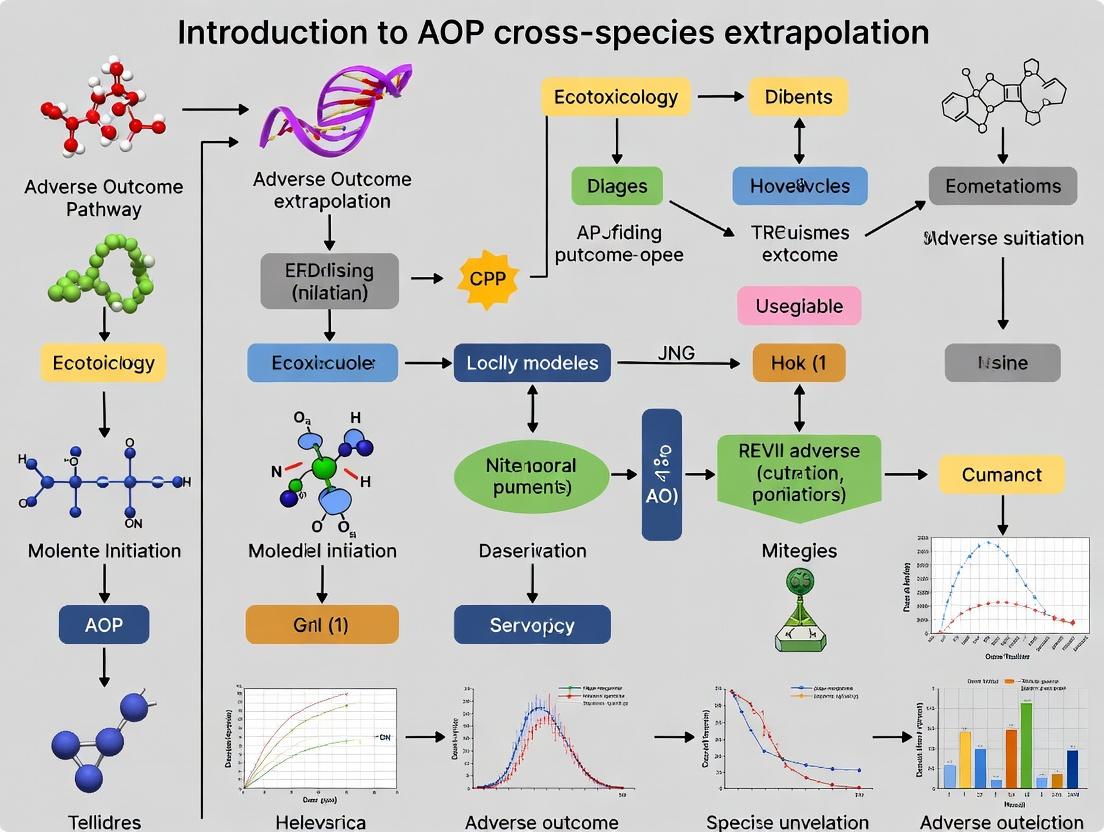
This article provides a comprehensive overview of the Adverse Outcome Pathway (AOP) framework as a transformative tool for cross-species extrapolation in toxicology and drug development.
AOP-Driven Cross-Species Extrapolation: A Mechanistic Framework for Predictive Toxicology and Drug Safety
Abstract
This article provides a comprehensive overview of the Adverse Outcome Pathway (AOP) framework as a transformative tool for cross-species extrapolation in toxicology and drug development. Aimed at researchers and drug development professionals, it explores the foundational concepts of AOPs as modular sequences of biological events, from Molecular Initiating Events (MIEs) to adverse outcomes relevant for regulation [citation:1]. The content details the methodologies and computational tools—such as SeqAPASS and molecular docking—that enable predictions of chemical susceptibility across species by assessing the conservation of biological pathways [citation:2][citation:9]. It addresses key challenges including defining the taxonomic domain of applicability and managing quantitative uncertainties, while outlining optimization strategies [citation:4][citation:6]. Furthermore, the article examines validation frameworks, comparative analyses of different extrapolation methods, and pathways toward regulatory acceptance under evolving policies like the U.S. EPA's directive to reduce mammalian studies [citation:5][citation:8]. The synthesis concludes that integrating AOP networks with bioinformatics and New Approach Methodologies (NAMs) is critical for advancing a One Health approach, reducing animal testing, and building a more predictive, efficient future for chemical safety assessment [citation:7][citation:10].
Demystifying the AOP Framework: Core Concepts and Cross-Species Extrapolation Fundamentals
The Adverse Outcome Pathway (AOP) framework represents a transformative, knowledge-driven approach in toxicology and chemical safety assessment. It provides a structured model to describe the sequential chain of causally linked biological events, spanning different levels of biological organization, that lead from an initial chemical interaction to an adverse effect relevant for regulatory decision-making [1]. This framework addresses a critical challenge in modern risk assessment: the need to evaluate the potential hazards of tens of thousands of data-poor chemicals in the environment with greater efficiency and reduced reliance on traditional animal testing [2] [3].
Within the context of cross-species extrapolation research, the AOP framework is indispensable. It shifts the focus from observing apical outcomes in specific test species to understanding conserved mechanistic pathways. By organizing knowledge around Molecular Initiating Events (MIEs) and Key Events (KEs), AOPs allow researchers to evaluate the taxonomic domain of applicability—determining whether a pathway is conserved across species, from traditional animal models to humans or across ecological taxa [4]. This pathway-based understanding enables the mutual translation of data between mammalian and non-mammalian species, supporting the development of human-relevant, non-animal testing strategies and more robust ecological risk assessments [3] [4].
Core Concepts: Deconstructing the AOP
An AOP is a conceptual construct that links a Molecular Initiating Event (MIE) to an Adverse Outcome (AO) through a series of intermediate Key Events (KEs) [5]. It is not chemical-specific but describes a generalizable sequence of biological perturbations that can be initiated by any stressor capable of triggering the initial MIE [2].
- Molecular Initiating Event (MIE): This is the initial, foundational interaction between a stressor (e.g., a chemical) and a specific biomolecular target within an organism. This interaction is the first "domino" in the cascade. Examples include a chemical binding to a specific receptor (e.g., the estrogen receptor), inhibiting a key enzyme, or directly damaging DNA [1] [2].
- Key Event (KE): KEs are measurable, essential biological changes that occur subsequent to the MIE and are necessary for the progression of the toxic effect. They represent the intermediate "dominos." KEs are organized at increasing levels of biological complexity, from sub-cellular and cellular responses (e.g., altered gene expression, protein production) to tissue and organ-level effects (e.g., inflammation, hypertrophy) [1] [3].
- Key Event Relationship (KER): A KER describes the causal or associative linkage between two KEs (or an MIE and the first KE). It defines the evidence-based rationale for why a change in one event is expected to lead to a change in the next. The strength of a KER is evaluated based on biological plausibility, empirical support from experiments, and quantitative understanding of the relationship [2].
- Adverse Outcome (AO): The AO is an adverse effect of regulatory significance that occurs at the level of the individual organism (e.g., cancer, organ failure, reduced growth) or population (e.g., reduced population sustainability) [1] [3]. It is the final anchor point in the pathway.
Table 1: Core Definitions of the AOP Framework [1] [2] [3]
| Term | Definition | Example |
|---|---|---|
| Molecular Initiating Event (MIE) | The initial interaction between a stressor and a biological target. | Covalent binding of a chemical to DNA. |
| Key Event (KE) | A measurable, essential biological change in the pathway. | Increased mutation frequency in a cell. |
| Key Event Relationship (KER) | A documented causal/associative link between two KEs. | DNA damage is known to lead to mutations if not repaired. |
| Adverse Outcome (AO) | An adverse effect of regulatory significance. | Hepatic tumor formation. |
Diagram: The core linear structure of an Adverse Outcome Pathway (AOP).
AOPs are modular by design. Individual pathways can be linked via shared KEs to form AOP networks, which better represent the complexity of biological systems where multiple stressors or pathways can converge on a common adverse outcome [2].
Quantitative AOPs (qAOPs): From Description to Prediction
While qualitative AOPs are valuable for hazard identification, their implementation in quantitative risk assessment requires Quantitative AOPs (qAOPs). A qAOP defines the mathematical relationships between KEs, enabling the prediction of the probability or magnitude of the AO given a specific level of stressor exposure or MIE activation [6].
Methodological Approach: Bayesian Networks for qAOP Development
A prominent methodological framework for building qAOPs involves the use of Bayesian Networks (BNs). BNs are probabilistic graphical models consisting of nodes (variables, representing KEs) connected by directed edges (representing KERs). They are ideal for qAOPs because they can handle uncertainty, integrate different types of data, and perform simulations in multiple directions (e.g., forward prediction from exposure to outcome, or diagnostic inference from outcome to probable cause) [6].
The general workflow for developing a qAOP using BNs, as demonstrated in a proof-of-concept study on the plant Lemna minor exposed to a pesticide [6], involves the following steps:
- Structure Development: The AOP diagram (MIE→KEs→AO) defines the structure of the BN.
- Data Collection & Regression Modeling: For each KER (e.g., stressor→MIE, KE1→KE2), empirical dose-response or response-response data are fitted using Bayesian regression models. This quantifies the relationship and its associated uncertainty.
- Network Parameterization: The fitted regression models are used to simulate thousands of data points, which in turn are used to populate the Conditional Probability Tables (CPTs) for each node in the BN. A CPT defines the probability distribution of a child node for every possible state of its parent nodes.
- Model Validation & Inference: The fully parameterized BN can be validated and then used for probabilistic prediction and hypothesis testing.
Table 2: Steps for Developing a Quantitative AOP Using Bayesian Networks [6]
| Step | Activity | Key Input | Output |
|---|---|---|---|
| 1. Structure Definition | Map the qualitative AOP (MIEs, KEs, AO) into a network graph. | Established AOP description (e.g., from AOP-Wiki). | Directed Acyclic Graph (DAG) structure for the BN. |
| 2. Relationship Quantification | Fit Bayesian regression models to describe each KER. | Experimental dose-response and response-response data. | Quantified mathematical functions for each KER with uncertainty estimates. |
| 3. Network Parameterization | Use regression outputs to generate Conditional Probability Tables (CPTs). | Simulated data from the quantified relationships. | Fully parameterized Bayesian Network model. |
| 4. Model Application | Run prognostic (forward) or diagnostic (backward) simulations. | New exposure scenario or observed outcome. | Probabilistic predictions of AO or inferred likelihood of upstream KEs. |
Detailed Experimental Protocol: Quantifying an AOP for Growth Inhibition
The following protocol is adapted from a study that quantified AOP #245 ("Uncoupling of photophosphorylation leading to reduced ATP production associated growth inhibition") using the aquatic plant Lemna minor (duckweed) and the pesticide 3,5-dichlorophenol (3,5-DCP) [6].
Objective: To develop a quantitative Bayesian Network model linking exposure to 3,5-DCP (stressor) to growth inhibition (AO) via the uncoupling of photophosphorylation (MIE) and reduced ATP production (KE).
Materials:
- Organism: Aseptic cultures of Lemna minor.
- Stressor: 3,5-dichlorophenol (3,5-DCP) stock solution.
- Media: Standard sterile Lemna growth medium (e.g., Steinberg medium).
- Assay Systems: Multi-well plates for exposure experiments.
- Measurement Instruments:
- Fluorometer/Chlorophyll Fluorescence Imager: To measure photosynthetic efficiency (e.g., Fv/Fm), a proxy for the MIE (uncoupling of photophosphorylation).
- Luminometer/ATP Assay Kit: To measure cellular ATP levels (KE).
- Image Analysis System: To measure frond number and surface area (AO: growth inhibition).
Procedure:
- Exposure Setup: Lemna plants are transferred to multi-well plates containing growth medium spiked with a logarithmic series of 3,5-DCP concentrations (e.g., 0, 0.1, 0.3, 1, 3, 10 mg/L), plus a solvent control. Each concentration is replicated (e.g., n=8).
- MIE Measurement (Photosynthetic Efficiency): After a short-term exposure (e.g., 24h), the photosynthetic efficiency of Photosystem II (Fv/Fm) is measured non-destructively for each plant using pulse-amplitude modulation (PAM) fluorometry. A decrease in Fv/Fm indicates uncoupling (the MIE).
- KE Measurement (ATP Content): Following MIE measurement, plants from each well are harvested, homogenized, and analyzed for ATP content using a commercial luciferin-luciferase bioluminescence assay.
- AO Measurement (Growth): For a separate set of wells, plants are exposed for a longer duration (e.g., 7 days). The number of fronds and total frond area per well are determined via digital image analysis at the start and end of the exposure. Growth rate is calculated.
- Data Analysis & BN Development:
- For each pair of events (e.g., [DCP]→Fv/Fm, Fv/Fm→ATP, ATP→Growth Rate), perform Bayesian regression (e.g., using log-logistic or other standard ecotoxicological models) to quantify the relationship.
- Use the regression models to simulate 10,000 data points for the entire pathway.
- Discretize the variable states (e.g., Low, Medium, High) and use the simulated data to calculate the Conditional Probability Tables for a BN structured as: [DCP Concentration] → [Fv/Fm] → [ATP] → [Growth Rate].
- Validate the model using hold-out data or cross-validation.
Cross-Species Extrapolation: The Role of AOPs and Bioinformatics
A fundamental challenge in toxicology is extrapolating findings from tested species (e.g., rat, zebrafish, Lemna) to untested species (e.g., human, an endangered fish). AOPs provide the conceptual backbone for addressing this challenge by focusing on the conservation of key biological pathways [4].
The Cross-Species Extrapolation Workflow
The process involves determining the taxonomic domain of applicability for each component of an AOP (MIE, KEs, KERs). The central question is: Does the species of interest possess the necessary biological target (for the MIE) and the functional pathway (for the KERs)?
Diagram: The workflow for cross-species extrapolation using AOPs.
Step 1: Identify Essential AOP Elements. Deconstruct the AOP to identify the specific proteins, genes, and biological processes that constitute the MIE and each KE. For example, an AOP for estrogenicity hinges on the estrogen receptor (ESR1) protein (MIE target) and downstream genes regulated by it [2].
Step 2: Assess Structural and Functional Conservation. Use bioinformatic tools to determine if the target species possesses orthologous genes/proteins with sufficient sequence similarity (structural conservation) and evidence of similar biological function (functional conservation).
Step 3: Evaluate Quantitative Differences. Even with conserved pathways, sensitivity may differ due to factors like toxicokinetics (how the chemical is absorbed, distributed, metabolized, and excreted) or life-stage. These differences need to be characterized for accurate extrapolation [4].
Key Bioinformatics Tool: SeqAPASS
The Sequence Alignment to Predict Across Species Susceptibility (SeqAPASS) tool, developed by the U.S. EPA, is a primary resource for cross-species extrapolation [4].
- Function: SeqAPASS compares the protein sequence of a molecular target (e.g., a receptor) from a test species to the predicted proteomes of other species. It assesses conservation at three tiers: primary amino acid sequence, conserved functional domains, and individual amino acid residues known to be critical for chemical binding or protein function (e.g., the ligand-binding pocket of a receptor).
- Protocol for Use:
- Input: Provide the protein sequence (FASTA format) or accession number for the molecular target (e.g., human ESR1) known to be involved in the MIE of interest.
- Tier 1 Analysis: The tool performs BLAST searches against the proteomes of hundreds of species to identify potential orthologs based on overall sequence similarity.
- Tier 2 & 3 Analysis: It then refines the assessment by analyzing the conservation of specific functional domains and critical residues. A weight-of-evidence score is generated.
- Output: A prediction of whether the molecular target (and thus the potential for the MIE) is likely conserved in the queried species. This directly informs the taxonomic domain of applicability for an AOP [2] [4].
From Pathway to Policy: Regulatory Integration and Outcomes
The ultimate value of the AOP framework lies in its ability to inform regulatory decision-making for chemical safety. Regulatory agencies like the U.S. EPA and international bodies like the OECD are actively promoting its use [1] [3].
Applications in Regulatory Science
- Supporting New Approach Methodologies (NAMs): AOPs are a critical component in building scientific confidence for using in vitro and in chemico NAMs to predict in vivo outcomes. They provide the biological context to interpret high-throughput screening data and form the basis for Integrated Approaches to Testing and Assessment (IATA) [1] [3].
- Chemical Prioritization and Screening: For the thousands of chemicals with little to no toxicity data, AOPs enable hypothesis-driven, targeted testing. If a chemical is shown to activate a specific MIE in a high-throughput assay, the associated AOP can guide which specific, higher-level tests should be conducted to confirm potential hazard [2].
- Evaluating Chemical Mixtures: AOP networks help identify shared KEs. If two chemicals in a mixture act through different MIEs but converge on the same KE (e.g., reduced thyroid hormone), they may have additive effects, informing more accurate mixture risk assessment [2].
- Mode of Action (MoA) Analysis: While an AOP is chemical-agnostic, it provides a generalized template that can be populated with chemical-specific data to support or refute a postulated Mode of Action for a specific chemical's toxicity [2].
The AOP Knowledge Base (AOP-KB) and Regulatory Adoption
The OECD-hosted Adverse Outcome Pathway Knowledge Base (AOP-KB) is the central repository for collaborative AOP development and dissemination [5]. It integrates several platforms:
- AOP-Wiki: The primary crowdsourcing platform for writing, reviewing, and publishing qualitative AOP descriptions according to OECD guidelines [5].
- Effectopedia: A platform designed for building quantitative, algorithmic AOP models [5].
- Intermediate Effects Database: Will host chemical-specific data showing how compounds trigger MIEs and KEs, directly linking empirical data to AOPs [5].
OECD-endorsed AOPs represent a high level of scientific consensus and are intended for direct use in regulatory contexts. Regulatory uptake is facilitated through initiatives like the Methods2AOP project, which systematically maps existing in vitro assay data to KEs in AOPs, creating a bridge between available test methods and pathway-based assessment [3].
Table 3: Key Research Reagent Solutions and Tools for AOP Development
| Tool/Resource | Type | Primary Function in AOP Research | Source/Access |
|---|---|---|---|
| SeqAPASS | Bioinformatics Software | Predicts structural conservation of protein targets across species to define the taxonomic domain of applicability for an AOP [4]. | U.S. EPA |
| AOP-Wiki | Knowledge Management Platform | The central repository for developing, sharing, and reviewing qualitative AOP descriptions according to OECD standards [2] [5]. | OECD AOP-KB |
| Effectopedia | Quantitative Modelling Platform | Enables the collaborative development of quantitative, algorithmic AOP models and networks [5]. | OECD AOP-KB |
| Intermediate Effects DB (under dev.) | Chemical Database | Will store empirical chemical testing data linked to specific MIEs and KEs, providing evidence for AOPs [5]. | OECD AOP-KB |
| PAM Fluorometer & ATP Assay Kits | Laboratory Reagents/Instruments | Enable measurement of KEs in example AOPs (e.g., photosynthetic efficiency, cellular ATP levels) for model quantification [6]. | Commercial Vendors |
| High-Throughput Screening Assays | In Vitro Test Methods | Generate data on chemical activity for specific targets (e.g., receptor binding, enzyme inhibition) that can be mapped to MIEs [3]. | Various (e.g., ToxCast) |
The Adverse Outcome Pathway framework provides a powerful, systematic approach for organizing mechanistic toxicological knowledge from the Molecular Initiating Event to the Adverse Outcome. Its true transformative potential is unlocked through quantification (qAOPs) and the application to cross-species extrapolation. By leveraging bioinformatics to assess pathway conservation, AOPs facilitate the translation of data across biological taxa, directly supporting the development of human-relevant, non-animal testing strategies. As the AOP Knowledge Base grows and more pathways undergo quantitative evaluation and formal regulatory endorsement, the framework is poised to become a cornerstone of modern, evidence-based chemical safety assessment, enabling more predictive and efficient protection of human and ecological health.
The Adverse Outcome Pathway (AOP) framework is a conceptual construct designed to organize mechanistic knowledge linking a molecular perturbation to an adverse biological outcome relevant for risk assessment [7]. Its foundational principles—modularity, generality, and the sequential causation metaphor of 'biological dominos'—provide a robust structure for synthesizing toxicological data. Within the context of cross-species extrapolation research, these principles enable the translation of hazard information across taxonomic groups by focusing on evolutionarily conserved Key Events (KEs) and Key Event Relationships (KERs). This whitepaper details these core principles, provides quantitative data on their application, outlines standardized development methodologies, and presents visual and practical tools for researchers engaged in predictive toxicology and drug development.
Regulatory toxicology faces the dual challenge of assessing risks from thousands of environmental chemicals while reducing reliance on whole-animal testing [7]. The AOP framework addresses this by providing a standardized format for organizing mechanistic data that can support prediction and extrapolation [2]. A critical application is cross-species extrapolation, a central uncertainty in both human health and ecological risk assessment [2]. The need is acute: a large-scale analysis revealed that 88% of 975 approved small-molecule drugs lack a complete set of regulatory ecotoxicity data [8]. Filling these gaps solely with traditional testing is impractical, requiring an estimated >300,000 fish to test currently unassessed active pharmaceutical ingredients [8].
The AOP framework facilitates extrapolation by shifting focus from apical endpoints in specific species to the conservation of biological pathways. If the molecular initiating event (MIE) and subsequent KEs are functionally conserved across species, a pathway describing toxicity in one species can inform potential hazards in another [2] [8]. This approach aligns with the "One Health" initiative, recognizing the interconnectedness of human, animal, and environmental health [9]. The principles of modularity and generality are foundational to building the reusable, stressor-agnostic knowledge required for this task.
The 'Biological Domino' Concept: A Foundation of Sequential Causality
An AOP is conceptually analogous to a series of "biological dominos" [2]. In this metaphor:
- The first domino is the Molecular Initiating Event (MIE), the initial interaction between a stressor (e.g., a chemical) and a biological target (e.g., a receptor, DNA).
- The falling of this domino represents the perturbation that, if sufficient in magnitude, triggers the next domino—a downstream Key Event (KE).
- KEs are measurable biological changes at increasing levels of biological organization (e.g., cellular, tissue, organ) [2].
- The final domino is the Adverse Outcome (AO), an effect of regulatory concern, such as organ impairment or population decline [10].
The "domino" analogy underscores the essentiality of KEs: if a KE is blocked (the domino does not fall), progression to downstream KEs and the AO is prevented [2]. The arrows connecting dominos represent Key Event Relationships (KERs), which are supported by evidence of biological plausibility, empirical data, and, ideally, quantitative understanding [2] [11].
Table 1: Core Components of the AOP "Biological Domino" Sequence
| Component | Definition | Role in the Sequence |
|---|---|---|
| Stressor | A chemical, physical, or biological agent that causes a change in the body following exposure [2]. | The external force that tips the first domino. |
| Molecular Initiating Event (MIE) | The initial interaction between a stressor and a molecular target within an organism [2]. | The first biological domino; a specialized type of KE. |
| Key Event (KE) | A measurable change in biological state that is essential to the progression toward an adverse outcome [7] [10]. | An intermediate domino; a critical checkpoint in the pathway. |
| Key Event Relationship (KER) | A scientifically based description of a causal relationship linking an upstream KE to a downstream KE [10]. | The directional push that causes one domino to fall into the next. |
| Adverse Outcome (AO) | A biological change considered relevant for regulatory decision-making (e.g., tumor formation, population decline) [2]. | The final domino; a specialized type of KE representing the harmful effect. |
Diagram 1: The 'Biological Domino' Sequence of an AOP
The Principle of Generality: Stressor-Agnostic Pathways
A fundamental tenet of the AOP framework is that AOPs are not stressor-specific [2] [7]. An AOP describes a generalized sequence of biological perturbations that can be initiated by any stressor capable of triggering the defined MIE [11]. For example, an AOP beginning with "binding to the estrogen receptor" (MIE) is applicable to any chemical—natural hormone, pharmaceutical, or environmental contaminant—that acts as a receptor agonist [2].
This generality is crucial for cross-species extrapolation and chemical prioritization. It allows researchers to:
- Group Chemicals by Mechanism: Chemicals sharing a common MIE can be categorized and evaluated using the same AOP, even if their structures differ [7].
- Leverage Existing Knowledge: Mammalian pharmacological and toxicological data for a drug can inform potential ecological risks if the drug target (MIE) is conserved in wildlife species [8].
- Focus Testing Efforts: A well-established AOP can help design targeted, hypothesis-driven tests for new stressors predicted to act via the same pathway [2].
The Principle of Modularity: Reusable Knowledge Components
Modularity is the structural backbone of the AOP knowledgebase. AOPs are constructed from two reusable, independent units [7] [10]:
- Key Events (KEs): Measurable biological states (nodes).
- Key Event Relationships (KERs): Causal links between pairs of KEs (edges).
This design allows KEs and KERs to be developed and described as self-contained modules that can be assembled into different AOPs [10]. For instance, the KE "Reduction in Circulating Thyroid Hormone" could be a component in AOPs leading to impaired neurodevelopment, disrupted metamorphosis, or reduced fertility, depending on the connecting KERs and AOs.
Table 2: Evidence Supporting Key Event Relationships (KERs) [11]
| Line of Evidence | Description | Role in Establishing Causality |
|---|---|---|
| Biological Plausibility | Understanding of the structural or functional relationship between events based on fundamental biology. | Establishes a credible basis for the proposed linkage. |
| Empirical Support - Temporal Concordance | Evidence that the upstream KE occurs before the downstream KE in a time-course study. | Supports a causative sequence; cause must precede effect. |
| Empirical Support - Dose Concordance | Evidence that the upstream KE is affected at lower exposure levels than the downstream KE. | Indicates the downstream event is a consequence, not a coincidental effect. |
| Empirical Support - Incidence Concordance | Evidence that the incidence of the upstream KE in a population is greater than or equal to that of the downstream KE. | Supports population-level predictability. |
| Essentiality | Evidence that preventing the upstream KE (e.g., via knockout) also prevents the downstream KE. | Provides strong evidence of a causal, essential role. |
Diagram 2: Modularity of Shared Key Events within AOP Networks
From Single Pathways to Networks: The Functional Unit of Prediction
While a single AOP (MIE → KE(s) → AO) is a pragmatic unit for development, biological systems are interconnected [7]. The AOP network, where multiple AOPs link via shared KEs, represents the functional unit for prediction in real-world scenarios [2] [7]. Networks account for complexity, such as one chemical affecting multiple MIEs, one MIE leading to multiple AOs, or adaptive pathways intersecting with adverse ones.
For cross-species extrapolation, networks are essential for understanding mixture effects and susceptibility. If two chemicals share a common KE (e.g., reduced thyroid hormone), they may act in a dose-additive manner to cause an AO, even if their MIEs differ [2]. Evaluating the conservation of an entire network module across species provides a more robust basis for extrapolation than a single linear pathway.
Diagram 3: An AOP Network Formed by Shared Key Events
Application to Cross-Species Extrapolation: A Methodological Framework
The principles of generality and modularity directly enable a systematic approach to cross-species extrapolation. The workflow involves assessing the conservation of the AOP's components across species of interest [8].
Key Methodological Steps
- Define the AOP of Interest: Identify the relevant MIEs, KEs, and KERs from a knowledgebase like the AOP-Wiki.
- Assess Taxonomic Domain of Applicability: For each KE and KER, evaluate the biological domains (species, life stages, sex) where it is applicable. This is based on the conservation of the underlying biological target and function [11].
- Use Bioinformatics Tools for Conservation Analysis: Tools like the Sequence Alignment to Predict Across Species Susceptibility (SeqAPASS) analyze the conservation of protein sequences, domains, and functions to predict if a chemical target (MIE) is present and likely similar in an untested species [2] [8].
- Integrate Quantitative Understanding: Where possible, use Quantitative AOPs (qAOPs) and Physiologically Based Toxicokinetic (PBTK) models to translate external exposures into internal doses at the MIE and predict the magnitude of downstream effects [12]. This addresses both toxicokinetic and toxicodynamic differences between species.
- Conduct a Weight-of-Evidence Assessment: Synthesize evidence from conservation analysis, in vitro assays, and existing in vivo data to evaluate confidence in the extrapolation [10].
Case Study Protocol: Extrapolating Perchlorate Effects via a Conserved AOP
Objective: To assess the risk of perchlorate (ClO₄⁻)-induced thyroid disruption in multiple vertebrate species at a hypothetical contaminated site [12]. AOP: Inhibition of the Sodium-Iodide Symporter (NIS) in the thyroid (MIE) → Reduced Thyroid Hormone Synthesis (KE) → Altered Brain Development/Growth/Reproduction (AOs). Experimental/Methodological Protocol:
- Construct an Aggregate Exposure Pathway (AEP) Model: Develop a quantitative, multi-media transport and fate model for perchlorate at the site. The model quantifies concentrations in water, soil, and food items [12].
- Estimate Species-Specific External Exposure: Using the AEP output, model exposure for humans (via drinking water), fish (via water), and herbivorous mammals (via plants) using Monte Carlo simulation to address parameter variability [12].
- Predict Target Site Exposure (TSE): Apply species-specific PBTK models to convert the estimated external exposure into an internal concentration of perchlorate at the thyroid NIS (the site of the MIE) [12].
- Leverage the Conserved qAOP: Use established in vitro and in vivo dose-response data linking NIS inhibition to reduced thyroid hormone levels. Because this AOP is highly conserved across vertebrates, the quantitative relationship can be applied across species, adjusted by the TSE [12].
- Predict Adverse Outcomes: Apply species-specific response models linking reduced thyroid hormone levels (KE) to relevant AOs (e.g., impaired neurodevelopment in mammals, altered metamorphosis in amphibians) [12].
- Validate and Refine: Compare predictions to any available monitoring or species-specific test data to refine model parameters and assess extrapolation confidence.
Quantitative Data and Regulatory Gaps
The application of AOPs is driven by significant data gaps in traditional toxicology. The following table summarizes key quantitative findings from recent research:
Table 3: Quantitative Data on Ecotoxicity Testing Gaps and AOP Utility
| Data Gap / Metric | Quantitative Finding | Implication for AOP/Extrapolation | Source |
|---|---|---|---|
| Pharmaceuticals lacking full ecotoxicity data | 88% of 975 approved small-molecule drugs lack a complete regulatory dataset (fish, invertebrate, algae). | Creates a compelling need for predictive, non-animal methods like AOP-based read-across. | [8] |
| Estimated animal use for data gap filling | Testing ~1700 untested APIs would require >300,000 fish and capacity for >800 early life-stage tests. | Highlights the impracticality of a traditional testing-only approach and the 3Rs (Replacement, Reduction, Refinement) value of AOPs. | [8] |
| Utility of target conservation analysis | Evolutionary conservation of drug targets (e.g., estrogen receptor) enables accurate extrapolation of mode-of-action effects from mammals to fish for several drug classes. | Provides empirical support for the generality principle and the feasibility of cross-species AOP application. | [8] |
| FAIR Data Principles Adoption | Roadmap for 2025 aims to make AOP data Findable, Accessible, Interoperable, and Reusable to enhance machine-actionability and trustability for risk assessment. | Emphasizes that the utility of modular AOP knowledge depends on standardized, accessible data infrastructure. | [13] [14] |
The Scientist's Toolkit for AOP Development and Cross-Species Extrapolation
Table 4: Essential Research Reagent Solutions and Tools
| Tool/Resource Name | Type | Primary Function in AOP Research | Relevance to Cross-Species Extrapolation |
|---|---|---|---|
| AOP-Wiki (aopwiki.org) | Knowledgebase Platform | The primary collaborative repository for developing, sharing, and storing AOPs, KEs, and KERs in a structured format [11] [10]. | Provides the centralized knowledge needed to identify conserved pathways applicable to multiple species. |
| SeqAPASS (Sequence Alignment to Predict Across Species Susceptibility) | Bioinformatics Tool | Predicts the conservation of protein targets (potential MIEs) across species by comparing sequence, domain, and structural similarity [2] [8]. | Directly assesses the taxonomic domain of applicability for an MIE, a critical first step in extrapolation. |
| ECOdrug | Database/Tool | A resource that maps human drug targets to orthologs in ecologically relevant species and provides related ecotoxicological data [8]. | Facilitates "read-across" from rich mammalian pharmacological data to ecological risk assessment for pharmaceuticals. |
| Effectopedia | Modeling Platform | An open-source platform for building quantitative, computational models of AOPs (qAOPs), including dynamic KERs [7]. | Enables the development of quantitative relationships that can be parameterized for different species, moving from qualitative to predictive extrapolation. |
| Physiologically Based Toxicokinetic (PBTK) Models | Computational Model | Simulates the absorption, distribution, metabolism, and excretion (ADME) of a chemical in a specific organism [12]. | Converts species-specific external exposure into a target site exposure (TSE) at the MIE, bridging exposure science with AOP toxicodynamics. |
| OECD AOP Developers' Handbook | Guidance Document | Provides standardized procedures and best practices for developing and reviewing AOPs, ensuring consistency and quality [10]. | Ensures that developed AOPs have the rigor and transparency required for confident use in regulatory extrapolation contexts. |
Diagram 4: A Workflow for AOP-Based Cross-Species Extrapolation
The core principles of the AOP framework—generality, modularity, and the 'biological domino' concept of sequential causation—transform how toxicological knowledge is organized and applied. By creating a repository of stressor-agnostic, reusable mechanistic modules, the AOP approach provides the necessary foundation for predictive cross-species extrapolation. This is critical for addressing pressing challenges in chemical safety assessment, including immense data gaps, the ethical need to reduce animal testing, and the protection of both human and ecological health under a "One Health" paradigm. The ongoing development of quantitative, network-based, and FAIR (Findable, Accessible, Interoperable, Reusable) AOP resources will further solidify their role as an indispensable tool for 21st-century regulatory science and drug development [13] [14].
The paradigm of chemical and drug safety assessment is undergoing a fundamental transformation. Historically, regulatory decisions have relied on data from animal toxicity testing, using mammalian data for human health and select surrogate species for ecological assessments, with limited integration between these knowledge streams [15]. This approach is increasingly challenged by ethical mandates, scientific limitations of animal models, and the practical impossibility of testing the tens of thousands of chemicals in the environment against all species of concern [16] [2]. In response, a global regulatory evolution is actively promoting the reduction and replacement of animal testing. Landmark directives, such as the U.S. Environmental Protection Agency's goal to eliminate mammalian studies by 2035 and the European Union's stipulation that animal testing be a "last resort" under REACH, underscore this shift [15].
This transition is driven by the One Health principle, which recognizes the interconnected health of people, animals, and the environment [15]. The central challenge is to protect human and ecological health without exhaustive animal testing. Cross-species extrapolation emerges as the critical scientific solution: the practice of using existing knowledge about one species to predict effects in another [15]. Its successful application hinges on mechanistic, pathway-based understanding. The Adverse Outcome Pathway (AOP) framework is the cornerstone of this new paradigm, providing a structured way to organize biological knowledge from a molecular initiating event to an adverse outcome relevant to risk assessment [2]. By defining the taxonomic domain of applicability—the range of species in which a pathway's key events are conserved—AOPs enable principled extrapolation, reducing the need for redundant testing [15] [4]. This technical guide, framed within the broader thesis of AOP-based extrapolation research, details the methodologies, tools, and applications that are making this transformative vision a reality for researchers and drug development professionals.
Core Challenges in Traditional Extrapolation
Successfully predicting toxicity across species requires overcoming significant biological and methodological hurdles. A primary challenge is the integration of Toxicokinetics (TK) and Toxicodynamics (TD). TK (what the body does to the chemical) encompasses species-specific differences in absorption, distribution, metabolism, and excretion, which dramatically alter the dose reaching a target site [15]. TD (what the chemical does to the body) concerns the interaction with biological targets and the subsequent cascade of effects; conservation of these targets and pathways varies across evolutionary lineages [15]. Disentangling and quantifying TK/TD differences is essential for accurate extrapolation.
A major limitation of traditional in vivo testing is its focus on apical endpoints—observable outcomes like mortality, growth, or reproduction—measured in a limited set of model organisms [15]. This provides little mechanistic insight for extrapolating to untested species or for understanding the risks of chemical mixtures. Furthermore, the predictive validity of animal models for human outcomes is not always assured due to interspecies differences in physiology, life-stage sensitivity, and compensatory mechanisms [16].
Finally, the field grapples with a diversity of extrapolation methods, each with varying data requirements and mechanistic depth [17]. These range from empirical interspecies correlation models to trait-based and genomics-based predictive approaches. Selecting and integrating the right method for a given regulatory question remains a complex challenge that the AOP framework aims to simplify.
Methodological Frameworks for Extrapolation
The Adverse Outcome Pathway (AOP) as an Organizing Principle
The AOP framework is a conceptual model that linearly links a Molecular Initiating Event (MIE) to an Adverse Outcome (AO) through a series of measurable Key Events (KEs) at different biological levels (e.g., cellular, tissue, organ) [2]. It is not chemical-specific; rather, it describes a generalizable sequence of biological perturbations that can be triggered by any stressor acting on a particular MIE [2].
For cross-species extrapolation, the most critical utility of an AOP is its ability to define a taxonomic domain of applicability. This involves evaluating the structural and functional conservation of each KE (e.g., the protein target of the MIE, the cellular response pathway) across species [15] [4]. If the early KEs in a pathway are highly conserved from tested to untested species, confidence in extrapolating the downstream AO increases significantly. This pathway-focused perspective moves away from surrogate species selection and toward a direct assessment of biological relevance.
Figure: The AOP Framework for Cross-Species Extrapolation
Quantitative and Computational Modeling Approaches
Beyond qualitative AOP networks, robust extrapolation requires quantitative methods. Physiologically Based Pharmacokinetic (PBPK) modeling is a premier in silico tool for TK extrapolation. It simulates the absorption, distribution, metabolism, and excretion (ADME) of a chemical based on the physiological parameters (e.g., organ volumes, blood flow rates) of different species. A 2025 study demonstrated a whole-body PBPK model for oligonucleotide therapeutics that accurately predicted tissue uptake in rats and mice by incorporating both nonspecific and receptor-mediated endocytosis pathways [18]. The model's parameters, derived from one species, can be scaled to another using known physiological differences, providing a mechanistic basis for dose extrapolation.
For TD and hazard prediction, various statistical and machine learning models are employed. A 2021 simulation study compared survival extrapolation models, finding that flexible approaches like Generalized Additive Models (GAMs) and Dynamic Survival Models (DSMs) could provide better long-term predictions than standard parametric models in data-rich scenarios, though good fit to observed data does not guarantee accurate extrapolation [19].
Table 1: Comparison of Quantitative Extrapolation Modeling Approaches [19] [20] [18]
| Model Class | Primary Application | Mechanistic Depth | Data Requirements | Key Strength | Key Limitation |
|---|---|---|---|---|---|
| PBPK Models | Toxicokinetics (TK) | High | Chemical-specific ADME parameters; species physiology | Mechanistic, species-scalable | Requires detailed input parameters |
| Standard Parametric (e.g., Weibull) | Survival/Hazard | Low | Time-to-event data | Simple, widely accepted | May not capture complex hazard shapes |
| Generalized Additive Models (GAMs) | Survival/Hazard | Medium | Time-to-event data | Flexible, good within-sample fit | Extrapolation can be unstable |
| Interspecies Correlation Models | Toxicity (e.g., LC50) | Low | Toxicity data for multiple species | Simple, empirical | Limited to tested species/taxa |
| Traits-Based Models | Species Sensitivity | Medium | Ecological traits, toxicity data | Provides ecological context | Trait data availability is limited |
| Genomics-Based Models | TD / Mode of Action | High | Omics data (transcriptomics, etc.) | High mechanistic resolution | Costly; complex data interpretation |
Bioinformatics and New Approach Methodologies (NAMs)
Bioinformatics tools are essential for evaluating the taxonomic domain of applicability at the molecular level. SeqAPASS (Sequence Alignment to Predict Across Species Susceptibility) is a publicly available tool that compares the primary sequence, conserved domains, and 3D structures of proteins (e.g., an MIE target) to predict their conservation and potential interaction with chemicals across species [4] [2]. Other tools like ExpressAnalyst facilitate cross-species analysis of transcriptomic data [4].
These tools support New Approach Methodologies (NAMs)—an umbrella term for non-animal testing strategies including in vitro assays, in silico models, and omics technologies [15]. NAMs generate mechanistic data on specific KEs (e.g., receptor binding, cellular stress response). When anchored within an AOP, these data can be used to predict apical outcomes, filling data gaps without new animal studies. A pivotal transitional strategy is the development of Virtual Control Groups (VCGs), which use curated historical control data to replace concurrent animal controls in experiments, directly reducing animal use by up to 25% per study [21].
Integrated Protocols for AOP-Informed Extrapolation
The following protocol integrates AOP development, bioinformatic analysis, and in vitro testing to enable cross-species hazard assessment.
Protocol: Establishing Taxonomic Domain of Applicability for an AOP
Objective: To determine the range of species in which a defined Adverse Outcome Pathway is functionally applicable, supporting extrapolation of toxicity data.
Materials:
- AOP-Wiki Entry: A defined AOP with clearly listed Molecular Initiating Event (MIE) and Key Events (KEs) [16] [2].
- Bioinformatics Tools: SeqAPASS web tool [4]; genomic databases (NCBI, Ensembl).
- In Vitro Assay Kits: Relevant cell-free or cell-based assays for measuring KE endpoints (e.g., receptor binding, cytotoxicity, gene expression).
- Test Chemicals: Prototypical stressor(s) known to activate the AOP.
- Cell Lines/Primary Cells: From human and at least one ecologically relevant model species (e.g., rat, zebrafish, fathead minnow).
Procedure:
- MIE Target Conservation Analysis: a. Identify the specific protein or biomolecule involved in the MIE (e.g., estrogen receptor alpha). b. Use SeqAPASS to input the human (or model species) protein sequence. c. Analyze the sequence homology, conserved domains, and predicted functional residues across a broad taxonomic range. d. Generate a prediction of susceptibility for multiple species, identifying clades where the MIE is likely/not likely to be conserved [4].
KE Pathway Conservation Analysis: a. For each downstream KE (e.g., cellular proliferation, altered hormone synthesis), identify the core genes/proteins in the signaling pathway. b. Perform a Gene Ontology enrichment and pathway analysis using tools like those implemented in [16] to check for the presence and completeness of these pathways in the genomes of species of interest. c. Review existing comparative biology literature for functional evidence of pathway conservation.
In Vitro KE Assay Cross-Species Comparison: a. Treat cells from human and model species with the prototypical stressor across a range of concentrations. b. Measure the relevant KE endpoint(s) (e.g., using transcriptomics for a gene expression KE, or a functional assay for a cellular response). c. Dose-response modeling: Fit concentration-response curves for each species. Compare the effective concentrations (e.g., EC10, EC50) and response magnitudes. d. A small difference (<10-fold) in potency between species, coupled with high MIE target conservation, supports a broad taxonomic domain of applicability for the AOP.
Integrated TDoA Assessment: a. Synthesize evidence from steps 1-3. High conservation at both MIE and KE levels supports extrapolation across the identified taxa. b. Document the TDoA in the AOP-Wiki entry, stating the level of confidence (high, moderate, low) for different taxonomic groups [15].
Protocol: Cross-Species PBPK Modeling for Extrapolation
Objective: To develop a PBPK model for a chemical in a preclinical species and scale it to predict human pharmacokinetics and tissue dose [20] [18].
Materials:
- Physiological parameters (tissue volumes, blood flows) for rat, dog, monkey, and human (available in literature and simulators like Simcyp).
- In vitro ADME data for the chemical: plasma protein binding, hepatic metabolic clearance (e.g., Clint), partition coefficients.
- In vivo pharmacokinetic data (plasma and tissue concentration-time profiles) from rat.
- PBPK software platform (e.g., Simcyp, GastroPlus, PK-Sim, or open-source tools).
Procedure:
- Model Development in Preclinical Species: a. Construct a rat PBPK model incorporating major organ compartments. b. Incorporate tissue:plasma partition coefficients (Kp) predicted using methods like Rodgers & Rowland or Poulin & Theil. c. Optimize and calibrate the model by fitting it to the in vivo rat PK data, adjusting uncertain parameters (e.g., scalar for Kp) within physiological bounds. d. Validate the model with a separate rat PK dataset.
Species Scaling to Human: a. Allometrically scale physiological parameters (e.g., organ weights, blood flows) from rat to human using standard scaling exponents. b. Replace rat-specific in vitro ADME parameters with human in vitro measurements where available. c. If the in vitro to in vivo extrapolation of clearance was successful in the rat model, apply the same scaling methodology using human in vitro data. d. A key strategy from recent research is to calculate a "tissue Kp scalar" from the calibrated rat model and apply the geometric mean of scalars from multiple preclinical species to the initial human Kp prediction [20].
Prediction and Evaluation: a. Run the human PBPK simulation to predict plasma concentration-time profiles and tissue exposures. b. Compare predictions to available human PK data (if any) to assess accuracy. c. The final model output provides a human-equivalent tissue dose for a given external exposure, which can be linked to a TD endpoint (e.g., in vitro bioactivity concentration) for a more accurate risk assessment.
Figure: Integrated Workflow for AOP-Informed Cross-Species Risk Assessment
Case Studies and Validation
Case Study: Extrapolating Endocrine Disruption via AOPs
Context: Assessing the risk of an estrogen receptor (ER) agonist chemical to a protected fish species without conducting animal tests on it. Application: Use AOP 149 (Estrogen Receptor Activation leading to Population Decline) as the framework [2]. Method:
- SeqAPASS analysis confirms high structural conservation of the ER ligand-binding domain between the tested model fish (fathead minnow) and the protected species.
- In vitro ER transactivation assays using the protected species' ER show similar potency (EC50) to the model fish ER.
- PBPK modeling is used to translate the water concentration affecting the model fish in vivo to a predicted tissue concentration in the protected species, accounting for TK differences.
- Extrapolation: The combination of conserved TD (from AOP/SeqAPASS/in vitro data) and adjusted TK (from PBPK) provides a scientifically justified prediction of a safe water concentration for the protected species.
Case Study: Implementing Virtual Control Groups
Context: The IHI VICT3R project aims to reduce animals in chronic toxicity studies by replacing concurrent control groups with VCGs [21]. Protocol:
- Historical Control Data (HCD) Curation: Collect, standardize, and curate high-quality control data (clinical pathology, histopathology) from previous studies conducted under identical conditions (strain, lab, protocol).
- Statistical Matching: For a new study with a treated group, algorithmically select a matched VCG from the HCD repository based on relevant study parameters.
- Analysis: Compare the treated group data to the VCG using standard statistical methods. The VICT3R project focuses on demonstrating that this method preserves statistical power and type I error rates compared to using a concurrent control [21]. Outcome: This direct reduction strategy can lower animal use by ~25% per study and is a pragmatic step toward full replacement, building regulator confidence in data-driven approaches.
The Scientist's Toolkit: Research Reagent Solutions
Table 2: Essential Tools and Reagents for AOP-Based Extrapolation Research
| Tool/Reagent Category | Specific Example | Function in Cross-Species Extrapolation | Key Provider/Resource |
|---|---|---|---|
| Bioinformatics Databases | AOP-Wiki [16] [2] | Central repository for developed AOPs; provides structured knowledge on MIEs, KEs, and KERs. | OECD |
| Genomic Databases (NCBI, Ensembl) | Source for protein/DNA sequences across species for conservation analysis. | International Consortium | |
| Bioinformatics Analysis Tools | SeqAPASS [4] [2] | Predicts protein susceptibility and functional conservation across species based on sequence. | U.S. EPA |
| ExpressAnalyst [4] | Platform for cross-species transcriptomic data analysis and visualization. | McGill University | |
| In Vitro NAM Assays | ERα CALUX Assay | Standardized in vitro assay to measure ER activation (a common MIE). | Commercial vendors |
| Liver Spheroid or Hepatocyte Cultures | Provides metabolic competence and tissue-level response data for KE assessment. | Commercial vendors | |
| PBPK Modeling Platforms | Simcyp Simulator [20] | Industry-standard platform containing physiological and genetic databases for multiple species to build and run PBPK models. | Certara |
| PK-Sim / Open Systems Pharmacology | Open-source modeling suite for whole-body PBPK modeling. | Open-Source Consortium | |
| Historical Data Repositories | ALURES (EU) [21] | Public database of in vivo study data, essential for building VCGs and validating NAMs. | European Chemicals Agency |
| Consortium Resources | ICACSER [15] [4] | International consortium providing collaborative frameworks, tool reviews, and case studies to advance extrapolation science. | SETAC |
The future of cross-species extrapolation lies in enhanced integration and quantitative sophistication. AOP Networks (AOPNs) will move beyond linear pathways to capture the complexity of biological systems, where multiple MIEs converge on common KEs and AOs [16] [2]. Research under the EU's PARC initiative is actively mapping these networks to identify priority gaps, such as in developmental neurotoxicity and immunotoxicity [16]. The development of Scientific Confidence Frameworks (SCFs) offers a modern, fit-for-purpose alternative to traditional validation for NAMs, which is critical for regulatory adoption [22]. Finally, closing the quantitative extrapolation loop is paramount. This involves developing robust, calibrated Quantitative AOP (qAOP) models that mathematically link the magnitude of perturbation at an early KE (measured in vitro) to the probability and severity of the AO in vivo, fully integrated with PBPK models for TK [22].
In conclusion, cross-species extrapolation anchored in the AOP framework provides a robust, mechanistic, and ethical rationale for addressing immense data gaps while systematically reducing animal testing. It transforms the question from "What is the toxicity in this surrogate species?" to "Is the biological pathway of concern conserved, and what is the relevant target site dose?" This paradigm shift, supported by a growing toolkit of bioinformatic, in vitro, and in silico methodologies, empowers researchers and drug developers to make more predictive and human-relevant safety assessments. As these approaches mature through international consortia like ICACSER and are embedded into regulatory practice via SCFs and case studies, they will fulfill the promise of protecting both human and ecological health through a sophisticated, data-driven understanding of biology across the tree of life.
The Adverse Outcome Pathway (AOP) framework provides a structured, mechanistic model for connecting a molecular perturbation to an adverse biological outcome of regulatory significance [23] [7]. This whitepaper examines the core components that define and operationalize this framework: the Molecular Initiating Event (MIE), the sequence of Key Events (KEs), and the Taxonomic Domain of Applicability (tDOA). The MIE anchors the pathway as the initial chemical-biological interaction, which triggers a causally linked series of measurable, essential KEs at increasing levels of biological organization [10]. Critically, the utility of an AOP for cross-species extrapolation in regulatory toxicology hinges on defining its tDOA—the taxonomic boundaries within which the pathway's KEs and their relationships are structurally and functionally conserved [24] [4]. Understanding the interplay of these three elements is foundational for advancing predictive toxicology, supporting chemical safety assessments with reduced animal testing, and implementing a One Health approach that mutually informs human and ecological risk assessment [15].
Regulatory toxicology is undergoing a paradigm shift from apical endpoint observation in whole animals toward mechanistic, pathway-based understanding [15]. This shift is driven by the need to evaluate thousands of chemicals efficiently while reducing animal use [7]. The AOP framework organizes existing knowledge into a conceptual chain of causally linked biological events, providing a scaffold for using in vitro and in silico data to predict adverse outcomes in vivo [25] [10].
A central promise of the AOP framework is enabling cross-species extrapolation. Historically, human and ecological risk assessments have operated in silos [15]. The AOP, by focusing on conserved biological pathways, allows data from model organisms (e.g., rodents, zebrafish) to inform potential hazards in humans and untested wildlife, and vice versa [4]. The reliability of this extrapolation is not assumed but must be evaluated and defined by the Taxonomic Domain of Applicability (tDOA) for each AOP [24]. The tDOA establishes the boundaries of knowledge transfer, determining whether a pathway developed in one species is biologically plausible in another. Thus, the MIE and KEs form the mechanistic backbone of an AOP, while the tDOA defines the scope of its predictive application across the tree of life.
Core Terminology and Definitions
Molecular Initiating Event (MIE)
The Molecular Initiating Event is a specialized type of Key Event defined as the initial point of chemical interaction with a specific biomolecule within an organism that results in a perturbation, starting the AOP [23] [7]. It is the most upstream event, occurring at the molecular level, and is directly dependent on the chemical structure of the stressor [25].
- Characteristics: The MIE involves a direct, specific interaction such as receptor binding, protein oxidation, or DNA adduct formation. It is chemically actionable, meaning it can often be predicted from chemical properties or measured via in silico docking and in vitro assays [25] [26].
- Role in AOP Development: Identifying the MIE is critical as it anchors the pathway and offers the highest leverage point for prediction and intervention. It is suitable for high-throughput screening, enabling the prioritization of chemicals that may trigger a downstream adverse outcome [25].
Key Events (KEs) and Key Event Relationships (KERs)
Key Events are measurable changes in biological state that are essential for the progression from the MIE toward the Adverse Outcome [10] [7]. They represent critical nodes at different levels of biological organization (e.g., cellular, tissue, organ).
- Essential but Not Necessarily Sufficient: A KE must be a required component of the pathway; if it is blocked, the pathway does not proceed to the AO. However, its occurrence alone may not be enough to drive the pathway forward, as this depends on the magnitude and duration of the perturbation [10].
- Key Event Relationships define the causal, directional linkages between pairs of KEs (upstream to downstream) [7]. The weight of evidence for each KER, based on biological plausibility and empirical data, determines the confidence in the AOP [10].
Table 1: Hierarchy of Events within an AOP Framework
| Term | Abbreviation | Definition | Level of Organization | Role in AOP |
|---|---|---|---|---|
| Molecular Initiating Event | MIE | Initial chemical-biological interaction that starts the pathway [23]. | Molecular (e.g., protein, DNA) | Anchors the upstream end; chemically specific. |
| Key Event | KE | Measurable, essential change in biological state [10]. | Cellular, tissue, organ, organism | Forms the modular nodes of the pathway. |
| Adverse Outcome | AO | Specialized KE of regulatory significance (e.g., organ failure, population decline) [23]. | Organ, organism, population | Anchors the downstream end; regulatory anchor point. |
| Key Event Relationship | KER | Causal link describing how one KE leads to another [7]. | Between levels of organization | Provides the directional connections between KEs. |
Taxonomic Domain of Applicability (tDOA)
The Taxonomic Domain of Applicability defines the taxonomic range across which an AOP, its KEs, and KERs are considered biologically plausible [24]. It addresses a fundamental question in cross-species extrapolation: "In which other species is this pathway likely to operate?"
- Basis in Conservation: The tDOA is inferred from the structural and functional conservation of the biological elements involved in the KEs (e.g., proteins, receptors, cells) and the consistency of the KERs across taxa [24].
- Regulatory Importance: Explicitly defining the tDOA is critical for confident application of an AOP in regulation, especially when protecting untested species. It moves beyond simply listing species used in supporting studies to providing evidence-based boundaries for extrapolation [24] [15].
Interrelationship in AOP Development and Application
The MIE, KEs, and tDOA are interdependent concepts that collectively determine an AOP's scientific rigor and regulatory utility. The MIE provides the entry point for chemical screening. The sequence of KEs and KERs establishes the mechanistic plausibility of the pathway. Finally, the tDOA delineates the ecological and translational relevance of the pathway.
This relationship is illustrated in the following workflow for developing and defining the scope of an AOP:
AOP Core Components and tDOA Scope Workflow
This diagram shows that the tDOA is not a sequential step in the pathway but a cross-cutting assessment that applies to every component (MIE, KEs, AO). It defines the taxonomic boundary within which the entire mechanistic sequence is considered valid.
Methodological Approaches for Defining Core Elements
Identifying and Validating the Molecular Initiating Event
Establishing the MIE requires demonstrating a direct chemical-target interaction. A tiered approach integrating in silico, in chemico, and in vitro methods is considered best practice [25] [26].
Table 2: Tiered Experimental Approach for MIE Identification [25] [26]
| Tier | Method | Description | Purpose/Output |
|---|---|---|---|
| Tier 1: Screening & Prediction | Database Mining & In Silico Docking | Screen chemical databases for structural alerts; model chemical binding to protein targets computationally. | Prioritize candidate stressors; predict binding affinity and potential MIE. |
| Tier 2: In Vitro Target Engagement | Receptor Activity Assays (e.g., PPARγ assay) | Use cell-based reporter assays to measure functional consequences of chemical interaction (agonist/antagonist activity). | Confirm functional perturbation of the putative target. |
| Tier 3: Proteome-Wide Target ID | Proteome Integral Solubility Alteration (PISA) | A mass spectrometry-based method that detects changes in protein thermal stability/solubility upon chemical binding across the proteome. | Identify all potential protein targets of a chemical in a complex biological lysate. |
| Tier 4: MIE Prioritization | Analytic Hierarchy Process (AHP) | A multi-criteria decision-making analysis that ranks identified protein targets based on relevance criteria (e.g., potency, biological function). | Select the most relevant protein target from a list to propose as the MIE. |
Featured Protocol: Proteome Integral Solubility Alteration (PISA) Assay The PISA assay is a high-throughput method for identifying protein-chemical interactions in a complex proteome [26].
- Sample Preparation: A soluble proteome is extracted from cells or tissues (e.g., HepG2 human liver cells). The extract is cleared by ultracentrifugation (100,000 × g, 60 min, 4°C) [26].
- Chemical Treatment: The soluble proteome is incubated with the test chemical across a range of concentrations. A vehicle control (e.g., DMSO) is included.
- Thermal Challenge: Aliquots for each concentration are subjected to a gradient of heatshock temperatures (e.g., 10 temps from 37°C to 67°C) for 3 minutes.
- Solubility Separation: Heated samples are centrifuged (100,000 × g, 20 min, 4°C) to pellet aggregated, denatured proteins. The soluble fraction (supernatant), containing proteins stabilized by chemical binding, is collected.
- Mass Spectrometry Analysis: Soluble proteins are digested into peptides, which are analyzed by liquid chromatography-tandem mass spectrometry (LC-MS/MS). Label-free quantification compares protein abundance in the soluble fraction across conditions.
- Data Analysis: Proteins showing a concentration-dependent increase in thermal stability (i.e., remain soluble at higher temperatures when bound) are identified as putative targets of the chemical [26].
Defining the Taxonomic Domain of Applicability (tDOA)
Defining the tDOA involves gathering evidence for the conservation of KEs and KERs across species. Bioinformatics tools are essential for evaluating structural conservation at the molecular level.
Primary Tool: SeqAPASS (Sequence Alignment to Predict Across Species Susceptibility) SeqAPASS is a publicly available bioinformatics tool used to predict protein structural conservation across species in three tiers [24]:
- Level 1 (Primary Sequence): Compares full-length protein sequence similarity to identify potential orthologs.
- Level 2 (Functional Domain): Evaluates conservation of specific functional domains or motifs known to be critical for activity.
- Level 3 (Critical Residues): Assesses conservation of individual amino acid residues known to be essential for chemical binding, protein-protein interaction, or function.
A workflow for defining tDOA integrates SeqAPASS analysis with empirical data:
Workflow for Defining the Taxonomic Domain of Applicability
Case Study Application: For an AOP linking activation of the nicotinic acetylcholine receptor (nAChR) to colony failure in honey bees (Apis mellifera), SeqAPASS was used to evaluate conservation of nine relevant proteins. The analysis provided evidence that the MIE (nAChR activation) and several downstream KEs were structurally conserved across other bee species (e.g., bumble bees) but not in distantly related invertebrates, thereby refining the AOP's tDOA [24].
The Scientist's Toolkit: Essential Research Reagents and Materials
The following table details key reagents and tools used in the experimental methodologies discussed for MIE identification and tDOA analysis.
Table 3: Research Reagent Solutions for AOP Development
| Item | Function/Description | Example in Context |
|---|---|---|
| Curated Chemical/Hazard Databases | Provide structured data on chemical use, exposure routes, and hazards for initial screening. | Used to identify potential inhalation toxicants for a pulmonary fibrosis AOP [25]. |
| Molecular Docking Software | Simulates the 3D binding of a small molecule ligand to a protein target, predicting binding affinity and pose. | Used to screen chemicals for low binding energy to PPARγ as a potential MIE [25]. |
| Stable Reporter Cell Lines | Cell lines engineered with a receptor-driven reporter gene (e.g., luciferase) to quantify receptor activity. | Used in PPARγ activity assays to confirm antagonist activity of candidate chemicals [25]. |
| PISA/TPP Assay Components | Enables proteome-wide target identification via thermal shift principles. Requires high-res mass spectrometer, ultracentrifuge, and chemical reagents. | Used to identify protein targets of TCDD in human hepatic cell lysates [26]. |
| SeqAPASS Online Tool | A bioinformatics tool for comparing protein sequence and structural similarity across species. | Used to assess conservation of MIEs and KE proteins to define tDOA [24] [4]. |
| Analytic Hierarchy Process (AHP) Software | Software or code frameworks that facilitate multi-criteria decision analysis for ranking alternatives. | Used to prioritize the most biologically relevant protein target from a PISA output as the likely MIE [26]. |
The triad of Molecular Initiating Event (MIE), Key Events (KEs), and Taxonomic Domain of Applicability (tDOA) constitutes the conceptual and practical foundation of the AOP framework. The MIE offers a precise, chemically actionable starting point. The sequence of KEs connected by KERs establishes a causal mechanistic narrative. Finally, the rigorously defined tDOA transforms a pathway observed in a single species into a tool with predictive power across taxonomic groups. As the field advances through consortia like the International Consortium to Advance Cross-Species Extrapolation (ICACSER), the integration of high-throughput MIE identification, systematic KE assessment, and bioinformatic tDOA definition will be critical for realizing the vision of a more efficient, mechanistic, and animal-sparing future for predictive toxicology and regulatory science [15] [4].
The Role of AOPs in a Shifting Regulatory Landscape and the One Health Initiative
The Adverse Outcome Pathway (AOP) framework has emerged as a pivotal, knowledge-driven tool for structuring mechanistic toxicological information. It defines a sequence of causally linked events, from a Molecular Initiating Event (MIE) through intermediate Key Events (KEs), culminating in an Adverse Outcome (AO) relevant to risk assessment [27]. Within a rapidly evolving regulatory context that prioritizes the reduction of animal testing and embraces integrated, preventive approaches, AOPs provide the necessary scaffold for leveraging in vitro and in silico data to predict in vivo outcomes [27].
This evolution aligns seamlessly with the One Health Initiative, a collaborative, multisectoral, and transdisciplinary paradigm that recognizes the intrinsic interconnectedness of human, animal, and environmental health [28] [29]. The initiative, supported by major global bodies like the WHO and involving over 1,200 scientific endorsers, seeks to forge co-equal collaborations across medical, veterinary, and environmental disciplines [28]. In this context, AOPs serve as a critical translational bridge. A well-constructed AOP, particularly a quantitative AOP (qAOP), provides a shared mechanistic language that enables the extrapolation of toxicity data across species and ecosystems—a core challenge in implementing One Health for chemical safety [17] [8]. By framing toxicity as a modular sequence of conserved biological pathways, the AOP framework directly supports the integrated environmental safety assessment of pharmaceuticals and other chemicals, moving beyond siloed, species-specific testing towards a more predictive and holistic model [8].
The Quantitative Leap: Methodologies for Developing Predictive AOPs
The transition from qualitative AOPs to quantitative AOPs (qAOPs) is essential for enabling predictive toxicology and dose-response assessment. A qAOP incorporates mathematical models to describe the quantitative relationships between KEs, allowing for the prediction of the likelihood and severity of an AO based on the intensity of an MIE [27].
Core Methodological Approaches
Three primary modeling approaches have been employed in qAOP development, each with distinct strengths and data requirements [27].
Table 1: Methodologies for Quantitative AOP (qAOP) Development [27]
| Approach | Description | Key Strength | Primary Data Need |
|---|---|---|---|
| Response-Response Relationships | Fitting empirical functions (e.g., regression) to data linking two adjacent Key Events. | Simplicity; effective when abundant in vivo dose-response data exists for KEs. | High-quality, paired dose-response data for sequential KEs. |
| Biologically-Based Mathematical Modeling | Using systems of ordinary differential equations to model the underlying biological dynamics. | High mechanistic fidelity; can interpolate and extrapolate under different conditions. | Detailed kinetic and dynamic parameters for pathway components. |
| Causal Modeling (Bayesian Networks) | Representing KEs as probabilistic nodes in a network to model uncertainty and complex, multi-pathway relationships. | Handles probabilistic evidence and missing data; ideal for complex AOPs with branching pathways. | Qualitative & quantitative evidence for KERs; can integrate diverse data types. |
Case Study Protocol: AChE Inhibition Leading to Neurodegeneration (AOP 281)
The development of a qAOP for acetylcholinesterase (AChE) inhibition provides a concrete example of the process and its challenges [27].
Experimental & Modeling Workflow:
- Comprehensive Literature Review: A systematic review of over 200 scientific papers was conducted to gather all existing qualitative and quantitative evidence linking AChE inhibition to neurodegeneration [27].
- Data Categorization: Extracted data were grouped into two categories: Model Development Data (quantitative data covering at least two adjacent KEs) and Model Evaluation Data (independent data for validation) [27].
- Model Selection and Construction: Given the linear cascade with a feedback loop (seizure-induced glutamate release), a dynamic modeling approach (e.g., systems of ODEs) is suitable to capture the temporal progression from synaptic ACh accumulation to neuronal cell death [27].
- Key Challenge – Data Alignment: A significant hurdle was the scarcity of studies that measured multiple KEs in the same biological system under consistent exposure conditions. Most studies provided isolated data points, making it difficult to establish robust quantitative key event relationships (KERs) [27].
Diagram: AOP 281 - AChE Inhibition Leading to Neurodegeneration [27]
Cross-Species Extrapolation: The Mechanistic Foundation for One Health
AOPs are inherently cross-species constructs. Their utility in a One Health context depends on the evolutionary conservation of the biological pathway they describe [8]. Cross-species extrapolation moves beyond simple allometric scaling to incorporate mechanistic similarity.
Predictors for Extrapolation
Multiple predictor classes can be used to estimate chemical sensitivity across species, varying in mechanistic depth and data needs [17].
Table 2: Predictors for Cross-Species Extrapolation of Chemical Sensitivity [17]
| Predictor Class | Mechanistic Information | Data Requirements | Example Application |
|---|---|---|---|
| Interspecies Correlation | Low. Statistical association between toxicity values for two species. | Large datasets of paired toxicity endpoints (e.g., LC50). | Predicting toxicity to an untested fish species from a tested one. |
| Phylogenetic Relatedness | Moderate. Assumes closely related species share similar sensitivities. | Phylogenetic tree; toxicity data for some species in the clade. | Estimating sensitivity of a bird species using data from related birds. |
| Biological Traits | High. Uses functional traits (e.g., physiology, life history) linked to toxicokinetics/dynamics. | Trait databases; understanding of trait-toxicity relationships. | Predicting sensitivity based on gill surface area or metabolic rate. |
| Genomic Data | Highest. Directly assesses conservation of molecular targets (MIE) and pathways. | Genomic/transcriptomic sequences; bioinformatic tools (e.g., SeqAPASS). | Screening drug targets for conservation across mammals, fish, and invertebrates [8]. |
Integrated Extrapolation Framework
An effective strategy combines these predictors. The process begins with identifying the MIE and its associated molecular target (e.g., a receptor, enzyme). Tools like SeqAPASS (Sequence Alignment to Predict Across Species Susceptibility) are then used to assess the structural and functional conservation of that target protein across species of interest (e.g., human, rat, zebrafish, daphnid) [8]. High conservation increases confidence in pathway relevance. Subsequent extrapolation incorporates trait-based adjustments (e.g., for metabolic capacity or tissue partitioning) to refine potency estimates, moving from a qualitative "could it happen" to a quantitative "at what exposure" prediction [17].
Diagram: Integrated Framework for AOP-Based Cross-Species Extrapolation [17] [8]
Implementation in Regulatory and Research Contexts
Addressing Data Gaps and Regulatory Efficiency
The pharmaceutical sector faces a critical data gap: approximately 88% of approved small-molecule drugs lack a complete set of regulatory ecotoxicity data [8]. Generating this data through traditional in vivo testing for all untested compounds would require hundreds of thousands of fish and decades of work [8]. AOP-informed, read-across strategies that leverage existing mammalian data offer a scientifically robust and Three Rs-compliant (Replacement, Reduction, Refinement) solution. By using a qAOP to extrapolate from well-characterized human or rodent pharmacological effects to potential ecological outcomes, resources can be focused on testing only those compounds where significant risk is predicted [8].
The Scientist's Toolkit: Essential Research Reagent Solutions
Implementing AOP and cross-species research requires specialized tools and reagents.
Table 3: Research Reagent Solutions for AOP and Cross-Species Investigations
| Item / Solution | Function | Application in AOP Research |
|---|---|---|
| Recombinant Target Proteins | Produced for species of interest (human, zebrafish, etc.). | In vitro characterization of the MIE (binding affinity, inhibition potency) to establish quantitative KERs and compare cross-species susceptibility [8]. |
| Phospho-Specific & Activity-State Antibodies | Detect post-translational modifications (phosphorylation) or active conformations of pathway proteins. | Measure intermediate Key Events (e.g., receptor activation, kinase signaling) in cell-based or tissue samples to validate pathway linkages [27]. |
| Validated siRNA/shRNA Libraries | Silencing gene expression for specific targets across different cell models. | Establish essentiality of a putative KE in an in vitro AOP model via loss-of-function experiments, strengthening biological plausibility [27]. |
| Cross-Reactive Antibodies | Antibodies that recognize conserved epitopes of a target protein across multiple species. | Enable comparative measurement of the same KE (e.g., protein expression, marker induction) in tissues from different species, supporting cross-species extrapolation. |
| Metabolite Standards & Inhibitors | Chemical standards for quantification; specific enzyme inhibitors. | Measure internal exposure (toxicokinetics) and characterize metabolic pathways (activation/detoxification) that modify the dose reaching the MIE, critical for qAOP modeling [8]. |
| Bioinformatic Tools (e.g., SeqAPASS, ECOdrug) | Software/platforms for analyzing sequence conservation and biological pathways. | Predict the presence and functional similarity of AOP components (MIE target, KE proteins) in diverse species to define the AOP's applicability domain [8]. |
The integration of the AOP framework and the One Health paradigm represents the future of predictive toxicology and integrated chemical risk assessment. The development of quantitative, modular AOPs that are grounded in evolutionary biology provides a transparent, evidence-based method for translating data across the human-animal-environment interface. Key priorities for advancing this field include: 1) systematic curation of high-quality, quantitative KER data from studies measuring multiple key events; 2) expansion of publicly accessible bioinformatic resources for cross-species target and pathway conservation analysis; and 3) fostering interdisciplinary collaboration among pharmacologists, ecotoxicologists, and regulators to develop AOP-based Integrated Approaches to Testing and Assessment (IATA). By addressing these priorities, the scientific community can deliver on the promise of more efficient, mechanistic, and protective safety assessments for the benefit of all species within a shared ecosystem.
From Theory to Practice: Methodologies and Computational Tools for AOP-Based Predictions
The extrapolation of biological data across species is a fundamental yet challenging pillar of biomedical research, drug development, and environmental safety assessment [8]. With a critical data gap where 88% of approved pharmaceuticals lack complete ecotoxicity data [8], traditional animal testing is neither ethically nor logistically sustainable. This whitepaper posits that a pathway-centric approach, anchored in the Adverse Outcome Pathway (AOP) framework, provides the mechanistic understanding necessary for reliable cross-species extrapolation [2]. By systematically assessing the taxonomic domain of applicability—the degree to which molecular initiating events, key events, and their relationships are conserved across species—researchers can predict adverse effects in untested species using data from tested models [4]. This document provides a technical guide to the core principles, bioinformatic methodologies, and experimental protocols that underpin robust pathway conservation analysis, positioning it as the essential foundation for advancing animal-free safety assessments and precision toxicology.
The development of a single pharmaceutical requires, on average, 8.3 years and between $1.3 and $2.8 billion, generating vast volumes of preclinical mammalian data [8]. Simultaneously, environmental safety assessment is legally mandated but faces a staggering data deficit. A large-scale analysis revealed that only 12% of 975 approved drugs have a complete set of multispecies ecotoxicity data [8]. Filling this gap for the estimated 1,700 untested active pharmaceutical ingredients using conventional fish tests would require over 300,000 fish and an unsustainable testing capacity [8].
This crisis necessitates a paradigm shift from empirical, observation-based testing to predictive, mechanism-based extrapolation. The Adverse Outcome Pathway (AOP) framework is central to this shift. An AOP is a conceptual construct that describes a sequential chain of causally linked biological events—from a Molecular Initiating Event (MIE) to an Adverse Outcome (AO) relevant to risk assessment—across different levels of biological organization [2]. Crucially, AOPs are not chemical-specific; they represent generalized biological pathways that can be triggered by any stressor acting on a particular MIE [2].
The core thesis of modern cross-species extrapolation research is that the conservation of these biological pathways determines the applicability of toxicological knowledge across the tree of life [4]. Therefore, assessing whether the molecular targets, key events, and functional relationships within an AOP are present and operative in a species of interest is the critical first step in any extrapolation effort. This process defines the taxonomic domain of applicability, without which extrapolation is merely conjecture [4].
Table 1: The Ecotoxicity Data Gap and Testing Burden for Pharmaceuticals
| Data Gap Metric | Value | Implication |
|---|---|---|
| Approved drugs lacking complete ecotoxicity data [8] | 88% | Regulatory assessments for most drugs rely on extrapolation. |
| Untested Active Pharmaceutical Ingredients (APIs) [8] | ~1,700 | Vast number of substances with unknown environmental hazard. |
| Estimated fish required to test untested APIs [8] | >300,000 | Massive animal use, contravening 3Rs principles. |
| Estimated early life-stage tests needed [8] | >800 | Overwhelming demand on global testing capacity. |
Methodological Foundations: Assessing Conservation from Sequence to Function
Assessing pathway conservation is a multi-layered process that progresses from evaluating genetic and protein-level similarity to confirming functional biological competence.
Bioinformatic Tools for Conservation Analysis
Bioinformatics provides the first line of evidence for pathway conservation. Key publicly available tools enable researchers to interrogate conservation computationally.
- Sequence Alignment to Predict Across Species Susceptibility (SeqAPASS): This tool, developed by the U.S. Environmental Protection Agency, allows for a tiered assessment of protein sequence conservation. It compares the primary sequence (Tier 1), conserved domains (Tier 2), and critical amino acid residues (Tier 3) of a protein target (e.g., a receptor) across species [4]. High sequence similarity in critical functional domains suggests a conserved target, increasing confidence that a chemical will interact with it in a species of interest.
- ECOdrug: This database and analysis platform focuses explicitly on the evolutionary conservation of human drug targets in environmentally relevant species. It facilitates the prediction of potential "off-target" effects of pharmaceuticals in wildlife by mapping drug-target interactions across species [8].
- Phylogenetic Workflows: Broader phylogenetic analyses can contextualize the conservation of entire pathways. By mapping the presence or absence of pathway components onto a phylogenetic tree, researchers can predict which clades of species are likely susceptible to a particular mode of action.
The convergence of evidence from these tools helps establish a hypothesis of conservation that must be validated experimentally.
The Adverse Outcome Pathway (AOP) as an Organizing Framework
The AOP framework operationalizes pathway conservation for extrapolation. An AOP deconstructs a toxicological outcome into modular, measurable components (Key Events, KEs) and their causal relationships (Key Event Relationships, KERs) [2]. For cross-species extrapolation, each node (KE) and edge (KER) in the AOP becomes a subject for conservation assessment.
An AOP network, where multiple AOPs share common KEs, is particularly powerful. It reflects biological reality more accurately and allows extrapolation based on the conservation of a shared, central KE, even if the full pathways differ [2]. For example, conservation of the estrogen receptor (a common MIE) supports extrapolation for numerous AOPs leading to different reproductive adverse outcomes.
The following diagram illustrates the modular structure of an AOP network and the critical nodes where conservation must be assessed for reliable extrapolation.
Diagram 1: AOP Network Structure & Conservation Checkpoints (100 chars)
Experimental Workflows for Functional Validation
Bioinformatic predictions require functional validation. The following protocols outline key experiments to confirm pathway conservation.
Table 2: Experimental Protocols for Validating Pathway Conservation
| Protocol Objective | Key Methodology | Endpoint & Interpretation |
|---|---|---|
| Target Binding & Activation | In vitro receptor-ligand binding assays using cell lines heterologously expressing the target protein from the species of interest. Phosphorylation/dimerization assays to measure downstream activation. | Binding affinity (Kd) and efficacy (EC50). Similar values to the reference species indicate conserved functional interaction. |
| Cellular Key Event Phenotyping | High-content imaging of primary cells or cell lines exposed to the stressor. Measurement of specific biomarkers (e.g., oxidative stress, cytotoxicity, pathway-specific reporters). | Quantitative morphological and fluorescent biomarker data. A conserved concentration-response indicates a conserved KE. |
| Tissue/Organ Response | Ex vivo tissue culture (e.g., precision-cut tissue slices) or in vitro 3D organoid models derived from the species of interest. Exposure to the stressor and multi-omics analysis (transcriptomics, proteomics). | Transcriptomic signature or pathway enrichment. Overlap with the reference species' signature confirms conservation of the KE response network. |
| Quantitative Dose-Response Anchoring | Parallel in vivo or advanced in vitro exposure studies in reference and extrapolation species, measuring a conserved KE (e.g., vitellogenin induction for estrogenicity). | Benchmark dose (BMD) values. A small difference in BMD between species increases confidence in quantitative extrapolation. |
The Integrated Workflow: From Bioinformatics to Quantitative Prediction
Reliable extrapolation requires the integration of bioinformatic, in vitro, and in silico data into a cohesive workflow. The following diagram maps this multi-step process for determining the taxonomic domain of applicability of an AOP.
Diagram 2: Workflow for Assessing AOP Taxonomic Applicability (100 chars)
This workflow emphasizes that pathway conservation assessment is iterative. Negative or insufficient evidence at Step 3 may require a return to more granular bioinformatic analysis (e.g., examining specific protein domains) or different experimental models.
Successful pathway conservation research relies on specialized reagents and databases.
Table 3: Research Reagent Solutions for Pathway Conservation Studies
| Tool/Reagent Category | Specific Examples & Functions | Application in Conservation Studies |
|---|---|---|
| Bioinformatic Databases & Tools | SeqAPASS [4], ECOdrug [8], AOP-Wiki, UniProt, NCBI BLAST. | Tier 1-3 protein conservation analysis, identification of orthologs, and access to structured AOP knowledge for defining KEs. |
| Recombinant Proteins & Cell Lines | Heterologously expressed target proteins (e.g., nuclear receptors, kinases) from non-model species. Stable reporter cell lines (e.g., luciferase-based) for pathway activation. | Functional in vitro binding and activation assays to confirm target interaction and downstream signaling conservation. |
| Species-Specific Antibodies & Probes | Phospho-specific antibodies, FISH probes, or RNAscope assays validated for species of interest. | Detection and quantification of Key Event biomarkers (e.g., protein phosphorylation, gene expression) in experimental tissues. |
| "Omics" Reference Databases | Annotated genome/transcriptome assemblies for non-model species. Mass spectrometry spectral libraries. | Enabling transcriptomic and proteomic analyses to measure KE responses and compare pathway signatures across species. |
| Advanced In Vitro Models | Primary cell cultures, precision-cut tissue slices (PCTS), and induced pluripotent stem cell (iPSC)-derived organoids from relevant species. | Providing a tissue-relevant context for testing KE responses beyond single-cell models, bridging to organ-level biology. |
Assessing pathway conservation is not a peripheral activity but the cornerstone of credible cross-species extrapolation within the AOP framework. It transforms extrapolation from a qualitative assumption into a testable, evidence-based hypothesis. The integration of bioinformatic tools like SeqAPASS with targeted in vitro functional assays creates a powerful, 3Rs-compliant strategy to define the taxonomic domain of applicability for toxicological pathways [8] [4].
Future progress depends on addressing key priorities:
- Expanding Omics Data for Non-Model Species: Building comprehensive, publicly accessible genomic and transcriptomic databases for ecologically relevant species is fundamental.
- Developing Quantitative KERs (qKERs): Moving beyond qualitative conservation to understand how the magnitude and timing of a conserved KE response differs between species is essential for precise risk prediction [8].
- Integrating Toxicokinetics (TK): Pathway conservation is a pharmacodynamic (PD) property. Its predictive power is fully realized only when integrated with cross-species TK models to predict internal target-site concentrations [8].
- Global Collaboration and Training: Initiatives like the International Consortium to Advance Cross-Species Extrapolation (ICACSER) are vital for harmonizing methods [4]. Concurrently, building expertise among scientists to navigate this interdisciplinary field is crucial for translating research into reliable regulatory applications [8].
By systematically evaluating the deep homology of biological pathways, researchers can make extrapolation a rigorous, defensible, and reductionist science, ultimately enabling more efficient protection of both human and ecosystem health.
Sequence Alignment to Predict Across Species Susceptibility (SeqAPASS) is a computational tool developed by the U.S. Environmental Protection Agency (EPA) that enables efficient extrapolation of chemical toxicity data across species by analyzing protein sequence and structural conservation [30]. This guide details SeqAPASS's core methodology, its application in defining taxon-specific Dimensionality of Action (tDOA), and its critical role within the Adverse Outcome Pathway (AOP) framework for cross-species extrapolation research. By translating molecular initiating event data from data-rich model organisms to non-target species, SeqAPASS provides a foundational, screening-level line of evidence essential for ecological risk assessment, endangered species protection, and reducing animal testing [30] [31].
A core challenge in modern toxicology and chemical risk assessment is the extrapolation of effects from model organisms (e.g., rats, zebrafish) to the vast diversity of species in the environment, many of which are threatened, endangered, or economically vital (e.g., pollinators) [30]. The Adverse Outcome Pathway (AOP) framework provides a structured model for linking a Molecular Initiating Event (MIE), such as a chemical binding to a specific protein receptor, to an Adverse Outcome (AO) at the organism or population level. However, an AOP described in one species is not automatically relevant to another; its applicability hinges on the conservation of the MIE's biological target [30].
This necessitates defining the taxon-specific Dimensionality of Action (tDOA)—the phylogenetic scope within which a chemical is predicted to interact with a conserved biological target to initiate the same AOP. SeqAPASS directly addresses this need. It is a fast, online screening tool that uses publicly available protein sequence and, in recent versions, structural data to predict the presence and conservation of protein targets across species [30] [31]. By doing so, it provides a scientifically defensible method for prioritizing toxicity testing and identifying species potentially susceptible or resistant to a given chemical mode of action, thereby operationalizing AOPs for ecological and human health risk assessment.
Technical Foundations of SeqAPASS
SeqAPASS operates on the principle that a species' susceptibility to a chemical is often determined by the presence and functional conservation of specific protein targets (e.g., receptors, enzymes) [30]. The tool performs a tiered analysis, progressing from primary amino acid sequence to higher-order protein structure, increasing the confidence in cross-species predictions.
Sequence-Based Analysis
The primary analysis involves aligning and comparing protein sequences. A user inputs the amino acid sequence of a protein target (the "query sequence") from a known sensitive species (e.g., the human estrogen receptor alpha). SeqAPASS then:
- Retrieves Homologs: Searches the National Center for Biotechnology Information (NCBI) protein database (containing over 153 million proteins from more than 95,000 organisms) for homologous sequences in other species [30].
- Performs Alignment: Aligns the retrieved sequences to the query sequence.
- Calculates Percent Identity: Computes the pairwise percent identity between the query and each target sequence. This is a fundamental metric for assessing conservation.
- Applies Thresholds: Identifies sequences that meet user-defined or empirically derived similarity thresholds (e.g., ≥XX% identity), which suggest the potential for similar chemical-protein interaction.
Structure-Based Analysis (Versions 7.0+)
SeqAPASS version 7.0, released in September 2023, significantly enhanced the tool by incorporating protein structural evaluation [31]. This is critical because chemicals interact with specific three-dimensional binding pockets; sequences with moderate overall identity may still conserve key binding site residues and topology.
- Structure Generation & Integration: Users can generate protein structures for their query and target sequences using the integrated Iterative Threading ASSEmbly Refinement (I-TASSER) tool. Alternatively, users can import experimentally determined structures from the Protein Data Bank (PDB) or predicted models from AlphaFold [31].
- Structural Alignment: The tool aligns the three-dimensional structures of the target protein from different species.
- Binding Site Comparison: It evaluates the conservation of key binding site residues, side-chain orientations, and physicochemical properties within the pocket. Structural similarity provides stronger evidence for the conservation of chemical interaction potential than sequence data alone.
Table 1: Key Data Sources and Features of SeqAPASS
| Component | Description | Relevance to tDOA/AOP |
|---|---|---|
| Primary Data Source | NCBI Protein Database (>153M proteins, >95K organisms) [30] | Provides the foundational taxonomic breadth for extrapolation. |
| Core Analysis | Primary sequence alignment & percent identity calculation [30]. | Initial screen for target protein presence/absence across taxa. |
| Advanced Analysis (v7.0+) | Protein structure generation (I-TASSER) and alignment [31]. | Confirms conservation of the 3D binding site, defining functional tDOA. |
| Output | Customizable visualizations, summary tables, downloadable data [30]. | Enables synthesis of evidence for risk assessment and AOP development. |
| Interoperability | Links with EPA CompTox Chemicals Dashboard for ToxCast assay targets [30]. | Connects high-throughput screening (HTS) data directly to cross-species predictions. |
Experimental Protocols for Cross-Species Extrapolation
The following protocols outline the step-by-step application of SeqAPASS to define tDOA for specific AOPs.
Protocol 1: Extrapolating Endocrine Disruption via the Estrogen Receptor
Objective: To predict the taxonomic range of susceptibility to chemicals that act as agonists/antagonists of the estrogen receptor (ER), a key MIE for endocrine disruption AOPs [30].
- Define Query: Obtain the full-length amino acid sequence of the ligand-binding domain (LBD) of human ERα (UniProt ID P03372).
- SeqAPASS Input: Enter the query sequence into SeqAPASS. Select "Standard" analysis mode.
- Set Taxonomic Scope: Specify target taxa of interest (e.g., all vertebrates, or select fish, amphibian, and bird species).
- Perform Tier 1 Analysis: Run the primary sequence alignment. Review the distribution of percent identities. Establish a preliminary threshold (e.g., >60% identity in the LBD) for potential susceptibility based on known in vitro activity data.
- Perform Tier 2 Analysis (Structural): Upload or generate the crystal structure of the human ERα LBD bound to 17β-estradiol (e.g., PDB 1A52). Use SeqAPASS to generate or align structures for species near the identity threshold. Focus on the conservation of key binding residues (e.g., Glu353, Arg394, His524).
- Define tDOA: Integrate sequence and structural data. The tDOA for ER-mediated endocrine disruption includes all species where both sequence identity and binding site architecture are conserved. Species lacking the receptor or with a non-conserved binding site fall outside the tDOA [30].
Protocol 2: Predicting Pollinator Risk via the Nicotinic Acetylcholine Receptor
Objective: To assess the potential susceptibility of non-target insects, particularly pollinators, to neonicotinoid insecticides targeting the nicotinic acetylcholine receptor (nAChR) [30].
- Define Query: Use the amino acid sequence of the nAChR subunit (e.g., the β1 subunit from Apis mellifera, the honey bee) known to be critical for neonicotinoid binding.
- Comparative Analysis: Run SeqAPASS comparing the honey bee query sequence against other insect orders (e.g., Lepidoptera, Diptera, Coleoptera).
- Identify Critical Subdomains: Focus analysis on specific loop regions (e.g., loops D, E, F) of the receptor that form the neonicotinoid binding pocket.
- Correlate with Toxicity Data: Where available, overlay SeqAPASS percent identity results with known LD₅₀ values for different insect species. Calibrate a susceptibility threshold based on in vivo toxicity.
- Risk Prediction: Predict high susceptibility for species with sequence identity above the calibrated threshold in critical subdomains, informing pollinator protection policies [30].
SeqAPASS Tiered Analysis Workflow for tDOA
Quantitative Analysis & Interpretation
Effective use of SeqAPASS requires careful interpretation of its quantitative outputs. The tool provides data in both graphical and tabular formats.
Table 2: SeqAPASS Output Metrics and Their Interpretation
| Output Metric | Typical Range | Interpretation for AOP/tDOA |
|---|---|---|
| Global % Identity | 0-100% | High overall identity (>70-80%) suggests general protein conservation. Caution: May not reflect binding site conservation. |
| Binding Site % Identity | 0-100% | A more specific metric. Identity >90% in the binding pocket strongly supports conserved MIE potential. |
| Alignment Score | Variable | Normalized score comparing alignment quality. Used to rank order homologs. |
| Structural RMSD | ≥0 Å | Root-mean-square deviation of atomic positions. Lower values (<2.0 Å for binding site Cα atoms) indicate high structural conservation. |
Threshold Determination: There is no universal identity threshold. It must be calibrated per protein target and chemical class using available in vitro or in vivo data from a few representative species. For example, the threshold for predicting estrogen receptor binding may be derived from correlating % identity with relative binding affinity data from transfected cell assays.
Applications & Case Studies within AOP Framework
SeqAPASS has been actively used to address real-world risk assessment challenges by informing the taxonomic applicability of AOPs.
- Endocrine Disruptor Screening Program (EDSP): Scientists used SeqAPASS to evaluate the conservation of the estrogen receptor across vertebrates. This helped determine when mammalian assay data could be reliably extrapolated to fish, amphibians, and birds, refining testing strategies for thousands of chemicals [30].
- Pollinator Protection: To understand the risk of insecticides to bees, SeqAPASS analyzed the conservation of the nAChR target site. It confirmed high conservation among bees, predicting broad susceptibility, while identifying key differences in certain non-insect invertebrates, helping to explain observed selective toxicity [30].
- Evaluating Pesticide Effects on Non-Target Species: For pesticides designed to disrupt the ecdysone receptor in pest insects, SeqAPASS was used to demonstrate low conservation of the binding site in beneficial arthropods (e.g., honey bees) and vertebrates, providing a mechanistic explanation for their safety profile and defining the narrow tDOA for that AOP [30].
AOP Framework and the Role of SeqAPASS in Defining tDOA
Integration into AOP Framework: Defining tDOA
The primary value of SeqAPASS in AOP research is its ability to objectively define the taxon-specific Dimensionality of Action (tDOA). The tDOA is not merely a list of susceptible species; it is a hypothesis about the phylogenetic breadth of a specific MIE.
Evidence Integration: tDOA is defined by integrating multiple lines of evidence from SeqAPASS:
- Primary Sequence Analysis: Identifies species that likely possess the protein target.
- Structural Analysis: Confirms functional conservation of the chemical interaction site.
- Empirical Data Calibration: Uses available toxicity data to validate or refine similarity thresholds.
Uncertainty Characterization: SeqAPASS outputs directly inform uncertainty in AOP extrapolation. For species with sequence identity just below a threshold, the AOP's applicability is uncertain, suggesting a need for targeted testing. For species with no identifiable homolog, the AOP is likely not applicable, effectively reducing testing needs.
Mechanistic Refinement: Discrepancies between SeqAPASS predictions and observed toxicity can lead to AOP refinement. For example, if a species predicted to be sensitive is not, it may indicate an alternative metabolic pathway or compensatory mechanism, prompting the development of a more nuanced AOP network.
Table 3: Key Research Reagent Solutions for SeqAPASS-Informed AOP Studies
| Tool/Resource | Function | Source/Access |
|---|---|---|
| SeqAPASS Web Tool | Core platform for performing sequence and structural cross-species comparisons. | U.S. EPA Comptox Tools Website [30] |
| NCBI Protein Database | Primary source for protein sequence data used by SeqAPASS [30]. | National Center for Biotechnology Information |
| Protein Data Bank (PDB) | Repository for experimentally determined 3D protein structures for structural alignment [31]. | Research Collaboratory for Structural Bioinformatics |
| AlphaFold Protein Structure Database | Source of highly accurate predicted protein structures for species lacking experimental data [31]. | EMBL-EBI |
| I-TASSER | Integrated protein structure prediction and threading tool within SeqAPASS v7.0+ [31]. | SeqAPASS Platform / University of Michigan |
| PyMOL / ChimeraX | Standalone molecular visualization software for detailed inspection of aligned structures from SeqAPASS. | Open Source / Commercial |
| EPA CompTox Chemicals Dashboard | Integrated platform to obtain toxicity data, assay targets (ToxCast), and link to SeqAPASS analyses [30]. | U.S. EPA |
The SeqAPASS tool continues to evolve. Version 8.0 enhances protein structure generation and quality assessment [30]. Future developments are anticipated to include more sophisticated machine learning approaches to predict binding affinity directly from sequence and structural features, and deeper integration with AOP knowledge bases (AOP-Wiki) to create a fully linked predictive toxicology framework.
In conclusion, SeqAPASS is a pivotal component of the modern bioinformatics toolbox for toxicology. By providing a robust, publicly accessible method for extrapolating the molecular basis of chemical susceptibility, it brings scientific rigor to the critical task of defining the taxonomic boundaries of AOPs. Its use in defining tDOA enables more efficient, mechanistically informed ecological risk assessments, supports the protection of endangered species, and aligns with global efforts to reduce reliance on animal testing while improving the predictability of chemical safety evaluations.
Traditional chemical risk assessment is constrained by its reliance on a limited set of test species and the practical impossibility of conducting whole-animal toxicity tests for every species-chemical combination [32]. This creates significant uncertainty when protecting diverse ecosystems or specific, vulnerable species [15]. The field is undergoing a paradigm shift towards Next Generation Risk Assessment (NGRA), which prioritizes New Approach Methodologies (NAMs) that reduce or eliminate animal testing [32] [15].
Central to this shift is the Adverse Outcome Pathway (AOP) framework. An AOP is a conceptual model that describes a sequential chain of causally linked events, beginning with a Molecular Initiating Event (MIE)—typically the interaction of a chemical with a biological target like a protein—and culminating in an adverse outcome of regulatory relevance [2]. The AOP framework provides the critical theoretical foundation for cross-species extrapolation: if the protein target involved in the MIE is structurally and functionally conserved across species, the pathway of toxicity is likely conserved as well [15] [4].
Advanced in silico techniques, specifically cross-species molecular docking and binding affinity prediction, are emerging as powerful NAMs. They directly inform the taxonomic domain of applicability of an AOP by computationally assessing the conservation of the chemical-protein interaction at its heart [32] [33]. By predicting whether and how a chemical binds to protein orthologs from untested species, these methods generate a line of evidence for susceptibility, supporting a weight-of-evidence approach within ecological and human health risk assessment [33].
Theoretical Foundations
The Adverse Outcome Pathway (AOP) Framework as an Organizing Principle
The AOP framework modularizes toxicity into a sequence of measurable Key Events (KEs), connected by Key Event Relationships (KERs) [2]. It is stressor-agnostic, meaning the same pathway can be activated by different chemicals that share the same MIE [2]. For cross-species extrapolation, the critical question is the conservation of these KEs and KERs across taxa. The initial MIE, often a protein-ligand binding event, is the most fundamental and frequently conserved step [15]. Consequently, computational methods that predict the conservation and function of the molecular target provide a strong basis for extrapolating the entire pathway.
Table: Core Components of the AOP Framework for Cross-Species Extrapolation [15] [2]
| Component | Definition | Role in Cross-Species Extrapolation |
|---|---|---|
| Molecular Initiating Event (MIE) | The initial interaction between a chemical and a biomolecular target. | Determining conservation of the chemical-target interaction is the primary focus of in silico docking. |
| Key Event (KE) | A measurable biological change at a level of organization (cellular, tissue, organ, organism). | Conservation of downstream KEs (e.g., gene expression changes, tissue pathology) determines the breadth of the taxonomic domain. |
| Key Event Relationship (KER) | A scientifically supported causal link between two KEs. | Evidence for KERs in one species can support their plausibility in another if the underlying biology is conserved. |
| Adverse Outcome (AO) | An adverse effect of regulatory significance at the organism or population level. | The ultimate endpoint for risk assessment; prediction relies on the conserved execution of the entire AOP. |
| Taxonomic Domain of Applicability | The range of taxa for which the AOP is considered relevant. | Defined by the structural/functional conservation of the MIE and subsequent KEs. |
Fundamentals of Molecular Docking and Binding Affinity
Molecular docking is a computational technique that predicts the preferred orientation (pose) and interaction strength of a small molecule (ligand) when bound to a protein target [34]. The process involves a search algorithm that samples possible ligand conformations and orientations within the protein's binding site, and a scoring function that ranks these poses based on estimated interaction energy [34].
The predicted interaction strength is often expressed as a docking score (in kcal/mol). However, a major limitation is that docking scores are frequently poor correlates of experimentally measured binding affinity (e.g., Kd, Ki) [32] [33]. Binding affinity quantifies the equilibrium strength of the complex, which is the critical determinant of a toxicological response following an MIE. To overcome this, advanced workflows employ multiple complementary metrics—such as ligand root-mean-square deviation (RMSD), binding pocket similarity, and interaction fingerprint similarity—alongside machine learning models to improve predictive accuracy for cross-species susceptibility [32] [35] [36].
Integrated Methodology for Cross-Species Docking
A state-of-the-art cross-species molecular docking protocol, as demonstrated with the androgen receptor (AR), involves a multi-stage workflow [32] [33]. This method reverses the typical virtual screening paradigm by docking a single chemical against hundreds of protein orthologs from different species.
Experimental Protocol: A Four-Step Workflow
Step 1: Protein Target Identification and Structural Model Generation
- AOP Context: Identify the protein target responsible for the MIE of interest.
- Tool Application: Use the SeqAPASS tool to evaluate the primary sequence conservation of the target protein (e.g., human androgen receptor) across species (Levels 1-3 evaluation) [32] [33].
- Structural Prediction: For species passing sequence filters, generate 3D protein structures using integrated prediction algorithms like I-TASSER or access pre-computed AlphaFold models [32]. In the AR case study, 268 structural models were generated for diverse species (73.9% birds, 14.6% bony fish, 6.72% mammals) [32].
Step 2: System Preparation for Comparative Docking
- Challenge: Protein models have different residue numbering, extraneous loops, and spatial orientations, making direct comparison invalid.
- Solution: Execute a standardized preparation pipeline [32]:
- Perform multiple sequence alignment (e.g., using MUSCLE) to harmonize residue numbering.
- Trim all structures to retain only the aligned ligand-binding domain.
- Structurally superimpose all trimmed models onto a high-quality reference crystal structure (e.g., from the RCSB PDB).
- Add hydrogens and assign partial charges using tools like AutoDock Tools.
Step 3: Flexible Molecular Docking Simulation
- Docking Engine: Perform docking simulations using programs such as AutoDock Vina [32] or Glide [34]. A degree of flexible side-chain docking is recommended to accommodate subtle differences in predicted structures [32].
- Defining the Search Space: The binding pocket is defined based on the coordinates of the ligand in the reference crystal structure.
Step 4: Multi-Metric Binding Mode Analysis and Susceptibility Calling
- Single Metric Limitation: Do not rely solely on docking score.
- Multi-Metric Evaluation: Calculate a suite of metrics for each species' docked complex [32] [33]:
- Docking Score: The raw output from the docking software.
- Ligand RMSD: The spatial deviation of the docked pose from the pose in the reference structure.
- Pocket Similarity (PPS-score): Shape complementarity of the binding pocket versus the reference.
- Interaction Fingerprint Similarity (Tanimoto): Conservation of specific protein-ligand interactions (H-bonds, hydrophobic contacts).
- Machine Learning Integration: Use a classifier (e.g., k-Nearest Neighbors/kNN) trained on these metrics to assign a final "susceptible" or "not susceptible" call for each species [32].
Cross-Species Molecular Docking and Analysis Workflow
Case Study: Androgen Receptor Binding Across 268 Species
This protocol was applied to predict species susceptibility to two AR ligands: the endogenous agonist 5α-dihydrotestosterone (DHT) and the synthetic SARM FHPMPC [32] [33].
Table: Summary of Cross-Species Docking Case Study Results for Androgen Receptor [32] [33]
| Aspect | Detail |
|---|---|
| Target Protein | Androgen Receptor Ligand-Binding Domain (LBD) |
| Reference Structure | PDB ID: 2AMA |
| Number of Species Modeled | 268 |
| Key Docking Metrics | Docking Score, Ligand RMSD, PPS-score, PLIF Tanimoto |
| Analysis Method | k-Nearest Neighbors (kNN) classifier |
| Primary Output | Species-level susceptibility call (Positive/Negative) |
| Utility for AOP | Directly informs the taxonomic domain of an AR-mediated AOP (e.g., for endocrine disruption). |
Benchmarking Docking Protocols and Affinity Prediction
Performance of Docking Software
The choice of docking software significantly impacts pose prediction accuracy. A benchmark study on cyclooxygenase (COX) inhibitors found substantial variation in performance [34].
Table: Benchmarking of Docking Software for Pose Prediction [34]
| Docking Program | Success Rate (RMSD < 2Å) | Key Characteristics | Virtual Screening AUC Range |
|---|---|---|---|
| Glide | 100% (Superior) | Comprehensive search & scoring, often top-tier. | 0.61 - 0.92 |
| GOLD | 82% | Genetic algorithm, flexible handling. | 0.61 - 0.92 |
| AutoDock | 71% | Widely used, good for flexible docking. | 0.61 - 0.92 |
| FlexX | 65% | Incremental construction approach. | 0.61 - 0.92 |
| MVD (Molegro) | 59% | Combined heuristic search algorithm. | Not tested |
From Docking Scores to Binding Affinity Prediction
Overcoming the scoring function problem is an active research frontier. Modern approaches move beyond classical physics-based or empirical scores [35].
Table: Approaches for Predicting Protein-Ligand Binding Affinity [35] [36]
| Approach | Description | Advantages | Challenges |
|---|---|---|---|
| Classical Scoring Functions | Physics-based, empirical, or knowledge-based functions within docking software. | Fast, integrated with docking. | Low correlation with experimental affinity; limited transferability. |
| Machine Learning (ML) Models | Train models (e.g., Random Forest, SVM) on features from protein-ligand complexes. | Can learn complex patterns; often more accurate than classical functions. | Requires large, high-quality training datasets; risk of overfitting. |
| Deep Learning (DL) Models | Use neural networks (e.g., CNNs, GNNs) on raw structural or topological data. | Potential for highest accuracy; automatic feature extraction. | High computational cost; "black box" nature; massive data requirements. |
| Consensus & Integrated Methods | Combine multiple docking scores and/or ML predictions. | Improves robustness and reliability. | Increases computational overhead. |
Table: Key Research Reagent Solutions for Cross-Species Docking Studies
| Tool/Resource Name | Type | Primary Function in Workflow | Access/Reference |
|---|---|---|---|
| SeqAPASS | Web Tool / Software | Evaluates protein sequence and structural conservation across species to prioritize targets. [32] [4] | https://seqapass.epa.gov |
| I-TASSER / AlphaFold | Protein Structure Prediction | Generates 3D protein models from amino acid sequences for species lacking crystal structures. [32] | Standalone servers & databases (e.g., AlphaFold DB) |
| AutoDock Vina / Glide | Molecular Docking Engine | Samples ligand conformations and scores protein-ligand interactions. [32] [34] | Open-source (Vina) / Commercial (Glide) |
| RCSB Protein Data Bank | Database | Source of high-quality reference protein-ligand crystal structures for alignment and validation. [32] | https://www.rcsb.org |
| Python BioPython & MD Analysis | Programming Library | Enables custom scripting for structural alignment, trajectory analysis, and metric calculation. [32] | Open-source libraries |
| EPA Cross-Species Docking Dataset | Dataset & Code | Provides example data, scripts, and workflows for the published AR case study. [37] | GitHub repository via Data.gov [37] |
Regulatory Integration and Future Perspectives
Cross-species in silico methods are gaining traction within regulatory science initiatives like the International Consortium to Advance Cross-Species Extrapolation in Regulation (ICACSER), which aims to promote their acceptance [15] [4]. These methods directly support the One Health approach by using mechanistic data to bridge human and ecological risk assessment [15].
Future advancements will focus on integrating these static binding predictions with dynamic simulations (molecular dynamics), toxicokinetic models (to predict internal dose), and multi-omics data within a quantitative AOP framework [35] [15]. Furthermore, the development of AI Virtual Cells (AIVCs) and more sophisticated machine learning models promises to simulate the temporal and cell-type-specific dynamics of toxicity pathways, moving beyond single protein-ligand interactions towards a systems-level prediction of adverse outcomes across species [35].
AOP Framework and Lines of Evidence for Cross-Species Extrapolation
The global increase in the production and consumption of active pharmaceutical ingredients (APIs)—approximately 18.9 million tons—has led to their persistent introduction into aquatic ecosystems [38]. These substances enter the environment through human excretion, improper disposal of medications, and pharmaceutical industry waste, resulting in detectable concentrations of over 600 APIs in water systems across more than 71 countries [38]. This contamination underscores an intrinsic connection between human health and ecosystem integrity, a core principle of the One Health approach [15]. Historically, chemical risk assessment has operated in silos: mammalian data informs human health, while data from standard aquatic species (e.g., fish, daphnia, algae) informs environmental protection, with minimal crosstalk between these domains [4] [15].
The Adverse Outcome Pathway (AOP) framework is a transformative conceptual model designed to bridge this gap. An AOP is a structured representation of a biological sequence that begins with a Molecular Initiating Event (MIE)—the direct interaction of a stressor (e.g., an API) with a biomolecule [39] [2]. This MIE triggers a series of measurable Key Events (KEs) at different levels of biological organization (cellular, tissue, organ, organism), linked by Key Event Relationships (KERs), and culminating in an Adverse Outcome (AO) relevant to risk assessment (e.g., population decline, cancer) [39] [2]. AOPs are not chemical-specific; instead, they describe generalizable biological pathways that can be initiated by any stressor impacting a particular MIE [2].
For cross-species extrapolation, the critical task is defining the Taxonomic Domain of Applicability—the range of species across which the pathway's components (MIE, KEs) are structurally and functionally conserved [4] [15]. Demonstrating conservation allows knowledge and data from tested model species (e.g., rodents, zebrafish) to predict outcomes in untested species, including humans or ecologically relevant wildlife. This pathway-based approach facilitates the integration of data streams from human pharmacology (which understands drug targets and mechanisms) and ecotoxicology (which measures ecosystem impacts), aligning with global regulatory shifts toward New Approach Methodologies (NAMs) that reduce reliance on animal testing [2] [15].
Table 1: Key Aquatic Model Organisms for Ecotoxicology and Cross-Species Extrapolation
| Organism | Scientific Name | Trophic Level/Regulatory Role | Key Advantages for Research | Common Endpoint (Example) |
|---|---|---|---|---|
| Zebrafish | Danio rerio | Vertebrate (fish) model | High genomic homology with humans, transparent embryos, high fecundity [38]. | Developmental toxicity, mortality. |
| Water Flea | Daphnia magna/pulex | Invertebrate, primary consumer | Small size, short life cycle, high sensitivity, key part of food chain [38]. | Reproduction inhibition, immobilization (NOEC/EC50). |
| Green Algae | Pseudokirchneriella subcapitata / Chlamydomonas reinhardtii | Primary producer | Small, fast growth, sensitive to pollutants, foundational to aquatic food webs [38]. | Growth inhibition (NOEC). |
| Fathead Minnow | Pimephales promelas | Vertebrate (fish) model | Standard EPA test species, well-established toxicology database. | Reproduction, survival. |
Effective integration requires an understanding of the disparate data streams generated in human health pharmacology and environmental toxicology. These streams vary in format, scale, and generation context.
Human Health Pharmacology Data Streams:
- Molecular and Target Data: High-resolution information on a drug's primary target (e.g., receptor, enzyme), its mechanism of action (agonist/antagonist), and binding affinity (Ki, IC50). This is essentially the characterization of a potential MIE for human-relevant AOPs.
- Pharmacokinetic (PK)/Toxicokinetic (TK) Data: Quantitative data on Absorption, Distribution, Metabolism, and Excretion (ADME) in mammals. This includes parameters like plasma concentration, half-life, volume of distribution, and metabolic pathways.
- Clinical and Preclinical Toxicity Data: Observations from in vivo mammalian studies and human clinical trials, detailing dose-response relationships for adverse effects (e.g., hepatotoxicity, cardiotoxicity).
- Chemical Descriptor Data: Computed or measured physicochemical properties of the API (e.g., logP (lipophilicity), pKa, molecular weight, topological surface area) crucial for QSAR modeling.
Ecotoxicological Data Streams:
- Single-Species Bioassay Data: Traditional toxicity test results from standard organisms (see Table 1), reporting endpoints like LC50 (lethal concentration for 50%), EC50 (effect concentration), and NOEC (No Observed Effect Concentration) [38].
- Environmental Fate and Monitoring Data: Data on API persistence, biodegradation, and measured environmental concentrations (MECs) in water, sediment, and soil from field studies [40].
- Omics Data: High-throughput molecular data (transcriptomics, proteomics, metabolomics) from exposed aquatic organisms, revealing sub-lethal pathway perturbations and potential KEs.
- Ecosystem-Level and Microcosm Data: Complex data on population dynamics, community structure, and ecosystem function in response to contaminants.
Table 2: Data Integration Techniques Applicable to Toxicology and Risk Assessment
| Technique | Core Function | Application in Integrated Risk Assessment | Key Tools/Examples |
|---|---|---|---|
| Data Consolidation (ETL/ELT) | Extracts, transforms, loads data from sources into a central repository (data warehouse/lake). | Creating a unified chemical safety database merging pharmacological ADME, ecotoxicity results, and chemical descriptors. | Pentaho, Talend, custom ETL pipelines [41] [42]. |
| Data Federation/Virtualization | Provides a unified, real-time query interface across distributed data sources without physical movement. | Enabling simultaneous query of pharmacological target databases (e.g., DrugBank) and ecotoxicology databases (e.g., ECOTOX). | Middleware solutions, virtual data layers [42]. |
| Change Data Capture (CDC) | Captures and propagates incremental changes from source systems in real-time. | Ensuring newly published toxicology data or newly calculated chemical descriptors are immediately available for model updates. | Database-specific tools (e.g., Oracle GoldenGate) [42]. |
| API-Based Integration | Connects applications and databases via Application Programming Interfaces (APIs). | Programmatically pulling chemical structures from PubChem or toxicity summaries from the AOP Knowledge Base (AOP-KB). | REST APIs, SOAP services [41]. |
| Middleware Integration | Acts as an intermediary to translate and route data between disparate systems. | Facilitating data exchange between a laboratory information management system (LIMS) and a statistical computing environment (e.g., R, Python). | Enterprise Service Bus (ESB), integration platforms [42]. |
Diagram 1: The generalized structure of an Adverse Outcome Pathway (AOP).
Integrated AOP-Driven Workflow for Data Stream Integration
A practical workflow for integrating pharmacology and ecotoxicology data leverages the AOP as an organizing scaffold. This workflow moves from data ingestion to predictive risk assessment.
Step 1: AOP Identification and Problem Formulation The process begins by identifying a relevant AOP from the OECD's AOP Knowledge Base (AOP-KB). For example, one might select an AOP linking "Aromatase Inhibition" (MIE) to "Population Decline in Fish" (AO). This AOP defines the required biological data points (KEs) that must be populated or predicted.
Step 2: Multi-Source Data Ingestion and Curation Data streams are ingested using the techniques in Table 2:
- Pharmacology Stream: Data on drugs known to inhibit aromatase (e.g., letrozole) is pulled from pharmacological databases, including human target affinity (Ki) and PK data.
- Ecotoxicology Stream: Existing single-species toxicity test results for these drugs on fish, daphnia, and algae are consolidated from databases like ECOTOX [15].
- Chemical Data: Physicochemical descriptors and molecular structures for the target APIs are gathered.
Step 3: In Silico Model Application for Data Gap Filling For APIs lacking experimental ecotoxicity data, predictive models are applied:
- Quantitative Structure-Toxicity Relationship (QSTR) Models: These statistically correlate chemical descriptors with toxicity endpoints (e.g., NOEC) for a single species [38]. For instance, a model can predict a drug's chronic toxicity to Daphnia magna based on its lipophilicity and electronegativity.
- Interspecies Quantitative Structure Toxicity-Toxicity Relationship (i-QSTTR) Models: These advanced models predict toxicity in a target species (e.g., fish) using known toxicity data from a surrogate species (e.g., daphnia) plus chemical descriptors, formally bridging data across species [38].
- Bioinformatic Tools for Extrapolation: Tools like the Sequence Alignment to Predict Across Species Susceptibility (SeqAPASS) analyze the conservation of protein targets (the MIE) across species to define the taxonomic domain of applicability for an AOP [4] [2].
Step 4: Integrated Risk Characterization Data from all streams are synthesized within the AOP context. Predicted or measured perturbations at early KEs (e.g., in vitro aromatase inhibition) are quantitatively linked to apical AOs using KERs. This allows for the calculation of Risk Quotients (RQs) based on pathway perturbations, which can be more mechanistic than traditional RQs based solely on apical mortality [40]. The output is a prioritized list of APIs posing the greatest potential risk to specific taxa or ecosystems, guiding targeted testing or regulatory action.
Diagram 2: Integrated data workflow from source streams to risk assessment.
Experimental Protocols for Key Models and Tools
Protocol for Developing and Applying QSTR/i-QSTTR Models
This protocol follows OECD guidelines for QSAR model development and validation [38].
1. Data Curation and Preparation:
- Source high-quality, experimental toxicity data (e.g., NOEC, EC50) for a defined endpoint (e.g., Daphnia magna 48h immobilization) from peer-reviewed literature or databases like ECOTOX. A minimum of 20-30 data points per model is recommended.
- For i-QSTTR, curate paired datasets where toxicity for the same chemical is available for both a "source" species (e.g., algae) and a "target" species (e.g., fish) [38].
- Prepare corresponding, unambiguous chemical structures (SMILES notation).
2. Chemical Descriptor Calculation and Selection:
- Using software like PaDEL, DRAGON, or RDKit, compute a wide array of molecular descriptors (e.g., constitutional, topological, electronic, geometric).
- Apply pre-processing: Remove constant or near-constant descriptors, then reduce multicollinearity (e.g., pairwise correlation threshold >0.95).
- Use genetic algorithms or stepwise selection to identify the most relevant, interpretable subset of descriptors for model construction.
3. Model Development and Training:
- Split the dataset into a training set (70-80%) for model building and a hold-out test set (20-30%) for external validation.
- Apply multiple machine learning algorithms to the training set:
- Multiple Linear Regression (MLR): For simple, interpretable models.
- Partial Least Squares (PLS): For handling descriptor collinearity.
- Random Forest (RF) / Support Vector Machines (SVM): For capturing complex, non-linear relationships [38].
- Optimize hyperparameters via cross-validation on the training set.
4. Model Validation and Acceptance Criteria:
- Internal Validation: Assess the training set performance using 5- or 10-fold cross-validation. Report Q² (cross-validated R²) and Root Mean Square Error (RMSE).
- External Validation: Apply the finalized model to the unseen test set. Report R²ext, RMSEext, and the slope of the regression line (should be ~1).
- Applicability Domain (AD) Definition: Use leverage-based or distance-based methods (e.g., Williams plot) to define the chemical space where the model's predictions are reliable.
5. Model Application and Interpretation:
- Apply the validated model to predict toxicity for new pharmaceuticals.
- Interpret influential descriptors (e.g., high lipophilicity (logP) often correlates with increased toxicity) to provide biological insight and support Green Chemistry design of safer APIs [38].
Protocol for Conducting a SeqAPASS Analysis for Taxonomic Extrapolation
SeqAPASS (Sequence Alignment to Predict Across Species Susceptibility) is a bioinformatic tool used to evaluate the conservation of a protein target (MIE) across species [4] [2].
1. Input Sequence Definition:
- Obtain the primary amino acid sequence of the protein target of interest (e.g., human aromatase enzyme, CYP19A1) from a reliable database like UniProt. This is the "primary sequence."
- Define the functional domain(s) critical for the chemical-protein interaction (e.g., the heme-binding region for cytochrome P450 enzymes). This information can be derived from literature or domain databases (e.g., Pfam).
2. Sequence Alignment and Comparison:
- Input the primary sequence and optional functional domain information into the SeqAPASS web tool.
- The tool performs BLASTp searches against the NCBI protein database for species of interest (e.g., all available fish species).
- It evaluates conservation at three tiers:
- Tier 1: Primary Sequence Conservation: Percentage identity/alignment score.
- Tier 2: Functional Domain Conservation: Presence/absence and identity within the critical domain.
- Tier 3: Individual Amino Acid Conservation: Identity at specific amino acid residues known to be essential for binding or function.
3. Taxonomic Domain of Applicability Assessment:
- SeqAPASS outputs a heatmap or table showing the level of conservation across the queried taxonomic groups.
- High conservation across vertebrates in all three tiers suggests the AOP initiated by binding to this target is likely applicable across that broad taxonomic range. A lack of conservation in invertebrates suggests they may be insensitive to chemicals acting via this specific MIE [2].
- This analysis directly informs the "Taxonomic Domain of Applicability" for an AOP, determining to which species toxicity data can be extrapolated with confidence.
The Scientist's Toolkit: Key Reagents, Tools, and Platforms
Table 3: Essential Research Toolkit for Integrated Pharmacology-Ecotoxicology Studies
| Item/Tool | Type | Primary Function in Research | Example/Source |
|---|---|---|---|
| Zebrafish (Danio rerio) | Model Organism | In vivo testing of developmental, behavioral, and systemic toxicity; high homology to humans aids extrapolation [38]. | Commercial suppliers, in-house breeding. |
| Daphnia spp. (D. magna, D. pulex) | Model Organism | Standard acute and chronic invertebrate toxicity testing; key for regulatory environmental risk assessment [38]. | Culture collections, lab cultures. |
| QSTR/i-QSTTR Modeling Software | Software Platform | Develop and apply predictive models to fill ecotoxicity data gaps using chemical structure [38]. | KNIME, Orange Data Mining, Python/R with scikit-learn, mold2 descriptors. |
| AOP Knowledge Base (AOP-KB) | Database/Platform | Central repository for developed AOPs; provides the scaffold for organizing and integrating mechanistic data [39] [2]. | Hosted by the OECD (https://aopkb.oecd.org/). |
| SeqAPASS Tool | Bioinformatics Tool | Predicts protein target conservation across species to define the domain of applicability for an AOP or MIE [4] [2]. | Developed by US EPA (https://seqapass.epa.gov/seqapass/). |
| ECOTOXicology Knowledgebase | Database | Curated source of single-species toxicity test data for chemicals, essential for model training and validation [15]. | US EPA (https://cfpub.epa.gov/ecotox/). |
| High-Throughput Screening Assays | In vitro Assay | Measures MIEs or early KEs (e.g., receptor binding, enzyme inhibition) for hundreds of chemicals; generates data for AOPs. | Commercially available kits (e.g., for aromatase, thyroid peroxidase). |
| Chemical Descriptor Calculation Tools | Software Library | Computes molecular descriptors from chemical structures for use in QSTR models. | PaDEL-Descriptor, RDKit, DRAGON. |
| Data Integration Platform (iPaaS/ETL) | IT Infrastructure | Technically integrates disparate data streams from labs, databases, and literature into a unified analysis-ready format [41] [42]. | Commercial iPaaS (e.g., Rivery, Talend), custom Python/Java pipelines. |
| Omics Analysis Platform (e.g., ExpressAnalyst) | Bioinformatics Tool | Processes, annotates, and visualizes transcriptomics/proteomics data from exposed organisms to identify potential KEs and pathway perturbations [4]. | Public web tool (https://www.expressanalyst.ca). |
The integration of human pharmacology and ecotoxicology data streams through the AOP framework represents a paradigm shift toward a predictive, mechanistic, and One Health-aligned approach to chemical risk assessment. By using AOPs as an organizing scaffold, data on molecular targets (MIEs) from drug discovery can inform ecological susceptibility, while ecotoxicological observations can feedback to elucidate human-relevant pathways. The deployment of QSTR/i-QSTTR models and bioinformatic extrapolation tools like SeqAPASS enables efficient data gap filling and cross-species prediction, directly supporting the global regulatory adoption of New Approach Methodologies (NAMs) [15].
Future advancements will depend on several key developments:
- Expansion and Quantification of AOP Networks: Moving beyond linear pathways to interconnected AOP networks that reflect biological complexity. This requires developing quantitative AOP (qAOP) models that mathematically define KERs, enabling precise prediction of AO probabilities from early KE measurements [2].
- Advanced Data Integration and FAIR Principles: Implementing sophisticated data engineering solutions (see Table 2) to automatically ingest, harmonize, and link diverse data types. Adherence to FAIR (Findable, Accessible, Interoperable, Reusable) data principles is critical for building scalable, machine-actionable knowledge bases.
- Consortium-Led Collaboration: Initiatives like the International Consortium to Advance Cross-Species Extrapolation in Regulation (ICACSER) are vital for aligning research with regulatory needs, standardizing methodologies, and building confidence in these integrated approaches [4] [15].
Ultimately, this integrated, data-driven paradigm promises not only to reduce animal testing but also to accelerate the development of safer pharmaceuticals and chemicals, protecting both human and ecosystem health through a unified scientific framework.
The extrapolation of biological data across species constitutes a foundational challenge in toxicology, essential for both human health and environmental protection. The Adverse Outcome Pathway (AOP) framework has emerged as a pivotal organizing principle for addressing this challenge. An AOP is a structured representation of causally linked events, beginning with a Molecular Initiating Event (MIE) and culminating in an Adverse Outcome (AO) relevant to risk assessment [43] [10]. This framework provides a systematic method for translating mechanistic data across biological levels of organization and, critically, across different species [15].
Within the context of a broader thesis on cross-species extrapolation, the AOP framework shifts the paradigm from empirical, apical endpoint testing to predictive, pathway-based assessment. It facilitates the identification of conserved biological pathways, enabling researchers to use data from traditional model organisms (e.g., rodents) to predict effects in non-target species, including wildlife and humans [8] [15]. This is especially critical given the vast data gaps in ecotoxicology; for instance, a complete set of regulatory ecotoxicity data is lacking for approximately 88% of approved small-molecule pharmaceuticals [8]. The AOP framework supports a "read-across" approach, where existing mammalian data can inform hazard predictions for other species, thereby streamlining safety assessments and reducing reliance on extensive new animal testing [8] [44].
Case Study Analysis: Pharmaceuticals and Endocrine Disruptors
Pharmaceutical Safety Assessment: Bridging Human and Environmental Health
The environmental risk assessment (ERA) of human pharmaceuticals is legally mandated but faces significant practical hurdles. The traditional approach requires extensive testing on environmentally relevant species, a process that is time-consuming, costly, and ethically concerning due to high animal use [8]. The AOP framework offers a solution by leveraging the rich pharmacological data generated during human drug development to predict potential ecological hazards.
Table 1: Data Gaps and Testing Implications for Pharmaceutical Environmental Risk Assessment (ERA)
| Data Category | Finding | Implication for Cross-Species Extrapolation |
|---|---|---|
| ERA Data Coverage | Only 11% of 1912 UK-registered Active Pharmaceutical Ingredients (APIs) have any ERA data [8]. | Highlights the immense scale of the data gap that read-across and AOP-based predictions must address. |
| Complete Data Sets | 88% of 975 approved drugs lack a complete regulatory multispecies ecotoxicity dataset [8]. | Underscores the impossibility of filling all gaps via traditional testing, necessitating predictive approaches. |
| Projected Animal Use | Testing ~1700 untested APIs could require >300,000 fish [8]. | Provides a strong ethical and economic driver for adopting New Approach Methodologies (NAMs) anchored in AOPs. |
| Conservation-Based Prediction | High evolutionary conservation of a drug target increases probability of target-mediated effects in non-target species [8]. | Forms the basis for using in silico tools (e.g., SeqAPASS) to screen for potential hazards across species. |
A key advancement is the development of public bioinformatic tools like SeqAPASS (Sequence Alignment to Predict Across Species Susceptibility) and ECOdrug, which assess the structural and functional conservation of drug targets across the tree of life [8]. This allows for the early identification of pharmaceuticals whose human targets are highly conserved in aquatic organisms, flagging them for closer scrutiny. Successful extrapolations have been demonstrated for several drug classes, including antidepressants (affecting serotonin and norepinephrine systems in fish) and the 5α-reductase inhibitor finasteride, where reproductive effects observed in mammals were successfully predicted and confirmed in fish models [8].
Endocrine Disruptors: AOPs for Mechanistic Insight
Endocrine-disrupting chemicals (EDCs) present a prime use case for the AOP framework. Regulatory identification of an EDC requires evidence of: 1) an adverse effect, 2) an endocrine-mediated mode of action, and 3) a plausible causal link between the two [43]. AOPs are inherently designed to establish this causal plausibility. As of recent analyses, 80 of the 370 AOPs in the AOP-Wiki are related to endocrine-mediated pathways [43].
The development of AOPs for EDCs, such as those within the European EURION research cluster, focuses on disrupting specific hormonal pathways (e.g., androgen, thyroid, retinoid signaling) [43]. For example, a well-established AOP network describes how various MIEs (like inhibition of thyroperoxidase or antagonism of the thyroid hormone receptor) converge on the key event of reduced circulating thyroid hormone (T4/T3), leading to adverse neurodevelopmental outcomes in mammals and fish [43] [27]. This modularity—where a single KE like "Decreased T4" can sit within multiple AOPs—is a strength of the framework, enabling efficient knowledge assembly and cross-chemical extrapolation.
Table 2: Computational Tools Supporting AOP Development and Cross-Species Extrapolation
| Tool Name | Primary Function | Application in Extrapolation |
|---|---|---|
| SeqAPASS | Assesses protein sequence, functional domain, and structural similarity across species [8]. | Determines taxonomic domain of applicability for an MIE (e.g., is a specific receptor conserved in species X?). |
| AOP-helpFinder | Uses text mining and graph theory to automatically extract AOP-related terms and evidence from literature [43]. | Accelerates the systematic literature review process for building or supporting KERs. |
| ECOdrug | Database linking drug targets, pharmaceuticals, and conservation data for ecotoxicologically relevant species [8]. | Supports early screening of pharmaceuticals for potential environmental hazard based on target conservation. |
| AOP-Wiki | The central repository for collaborative AOP development and knowledge storage [27] [10]. | Provides the structured framework and shared ontology essential for consistent AOP description and evaluation. |
Experimental Protocols: From Qualitative AOP to Quantitative Prediction (qAOP)
The transition from a qualitative AOP to a Quantitative AOP (qAOP) is essential for making predictive, risk-based decisions. A qAOP formalizes the relationships between Key Events (KEs) with mathematical models, allowing prediction of the probability or severity of an Adverse Outcome (AO) based on the intensity of an MIE [27].
Case Study Protocol: Developing a qAOP for Acetylcholinesterase (AChE) Inhibition Leading to Neurodegeneration (AOP 281) [27]
This protocol outlines the methodology for constructing a qAOP, using AChE inhibition by organophosphate and carbamate pesticides as a model.
1. Problem Formulation & Literature Review:
- Objective: To develop a quantitative, predictive model linking the degree of AChE inhibition to the onset of neurodegeneration.
- Process: Conduct a comprehensive, systematic literature review to gather all evidence supporting the qualitative AOP. This involves searching public databases (e.g., PubMed, Web of Science) using terms related to each KE: "acetylcholinesterase inhibition," "acetylcholine accumulation," "muscarinic receptor overactivation," "seizure," "excitotoxicity," "status epilepticus," "neuronal cell death." The goal is to identify studies that measure two or more adjacent KEs in the same experimental system [27].
2. Data Curation and Categorization:
- Model Development Data: Extract quantitative data from studies suitable for defining the mathematical relationships between KEs. Ideal data includes dose-response or time-course measurements for upstream and downstream KEs (e.g., brain AChE activity level vs. severity of tremors or seizure frequency) [27].
- Model Evaluation Data: Reserve a separate set of high-quality experimental data not used in model building. This data will be used for independent validation of the qAOP's predictive accuracy [27].
3. Model Selection and Construction:
- Several mathematical approaches can be used, chosen based on data availability and pathway complexity [27]:
- Response-Response Relationships: Fit empirical functions (e.g., logistic, linear) to data linking two KEs. This is often the first step where direct data exists.
- Biologically-Based Kinetic/Dynamic Models: Use systems of ordinary differential equations (ODEs) to model the underlying biology (e.g., acetylcholine synthesis, release, and degradation kinetics; neuronal calcium dynamics). This requires more detailed mechanistic knowledge.
- Bayesian Network (BN) Models: Construct a probabilistic graph where nodes represent KEs and edges represent conditional dependencies. BNs are particularly useful for integrating different data types and handling uncertainty, making them suitable for complex AOPs with limited or heterogeneous data [27].
4. Weight of Evidence (WoE) and Uncertainty Quantification:
- For each Key Event Relationship (KER) in the qAOP, document the biological plausibility, empirical support, and quantitative understanding [10].
- Use the BN model or sensitivity analysis on ODE models to quantify uncertainty and identify the KERs with the largest influence on the AO prediction. This highlights the most critical data gaps [27].
5. Validation and Regulatory Application:
- Test the finalized qAOP model against the held-out Model Evaluation Data.
- The validated qAOP can then be used as a screening tool to predict the neurotoxic potential of new AChE inhibitors based solely on in vitro AChE inhibition potency data, or to set in vivo testing priorities [27].
AChE Inhibition qAOP Development Workflow
Visualizing AOP Workflows and Cross-Species Integration
The following diagram synthesizes the core workflow for applying the AOP framework to cross-species extrapolation, integrating problem formulation, tool use, and quantitative development as discussed in the case studies.
AOP-Based Cross-Species Extrapolation Workflow
The Scientist's Toolkit: Essential Research Reagents and Solutions
Table 3: Key Research Reagent Solutions for AOP-Based Extrapolation Studies
| Category | Item/Assay | Function in Cross-Species Extrapolation Research |
|---|---|---|
| In Silico Bioinformatics | SeqAPASS Tool [8] | Determines the taxonomic applicability domain of an MIE by comparing protein sequence and structural homology across species. |
| In Silico Literature Mining | AOP-helpFinder [43] | Automates the systematic retrieval of published evidence linking stressors to MIEs and KEs, accelerating AOP development. |
| In Vitro Mechanistic | Receptor Ligand Binding Assays (e.g., for ER, AR, TR) [43] [44] | Measures the potency of a chemical for a specific MIE (e.g., receptor binding). Data can be compared across species if receptors from different species are used. |
| In Vitro Mechanistic | Thyroperoxidase (TPO) Inhibition Assay [43] | Directly measures inhibition of a key enzyme in thyroid hormone synthesis, a common MIE for endocrine disruptors. |
| In Vitro High-Throughput | Tiered in vitro screening battery (e.g., ToxCast/Tox21) [15] | Generates mechanistic bioactivity profiles for thousands of chemicals, providing potential MIEs for AOP network development. |
| Ex Vivo/In Vivo | Targeted Omics (Transcriptomics, Proteomics) | Measures molecular-level KEs (e.g., gene expression changes) to establish empirical support for KERs and identify conserved responses. |
| In Vivo Model Systems | Alternative Small Fish Models (e.g., zebrafish, fathead minnow) | Provides whole-organism context for testing AOP predictions across multiple KEs, from molecular to apical levels. |
| Computational Modeling | Bayesian Network Software (e.g., GeNIe, Netica) [27] | Enables the construction of probabilistic qAOP models that can integrate diverse data types and quantify uncertainty. |
| Knowledge Management | AOP-Wiki (aopwiki.org) [27] [10] | The central repository for publishing, sharing, and collaboratively developing AOPs according to OECD standards. |
The application of the AOP framework to cross-species extrapolation represents a transformative shift in toxicology, moving from descriptive, species-specific testing toward predictive, mechanism-based assessment. As demonstrated in the case studies for pharmaceuticals and endocrine disruptors, the strength of this approach lies in its ability to organize disparate data, highlight conserved biological pathways, and formally articulate testable hypotheses about chemical toxicity across the tree of life [8] [15]. The development of qAOPs, though challenging, is the critical next step to delivering regulatory-grade, predictive tools [27].
Future priorities must address several key frontiers. First, there is a need to expand the systematic, evidence-based development of AOPs, particularly for endocrine-mediated outcomes, ensuring robustness and preventing misuse [43] [44]. Second, greater investment in bioinformatic infrastructure and tools is required to automate evidence gathering and refine predictions of taxonomic applicability [8] [15]. Finally, successful translation depends on multistakeholder collaboration through initiatives like the International Consortium to Advance Cross-Species Extrapolation in Regulation (ICACSER), which brings together researchers, regulators, and industry to align tool development with regulatory needs [15]. By advancing along these fronts, AOP-driven cross-species extrapolation will be instrumental in realizing a more efficient, ethical, and protective paradigm for global chemical safety assessment.
Navigating Challenges: Optimization Strategies and Uncertainty Management in AOP Applications
The Adverse Outcome Pathway (AOP) framework is a conceptual model that organizes knowledge about the sequence of measurable biological events leading from a Molecular Initiating Event (MIE), such as a chemical binding to a protein target, to an Adverse Outcome (AO) relevant to risk assessment [2]. This framework provides a structured, modular way to translate mechanistic data into predictions of toxicity, supporting the use of New Approach Methodologies (NAMs) to reduce reliance on traditional animal testing [4] [1].
A central challenge in applying AOPs is defining their Taxonomic Domain of Applicability (tDOA)—the range of species for which the pathway is biologically plausible [4] [9]. Historically, extrapolation has often relied on an assumption that sequence or structural conservation of a primary molecular target (e.g., a receptor) implies conserved function and, therefore, conserved toxicological susceptibility across species [8]. This assumption is a critical pitfall. Sequence alignment alone cannot confirm the preservation of functional biological pathways, the quantitative dynamics of key event relationships, or the influence of divergent toxicokinetics (what the body does to the chemical) and toxicodynamics (what the chemical does to the body) [8] [9].
This whitepaper critiques the over-reliance on sequence conservation and outlines an integrated, evidence-driven strategy for robust cross-species extrapolation. It emphasizes the need to combine bioinformatic tools for assessing functional pathway conservation with advanced computational modeling to establish quantitative relationships, thereby strengthening the scientific confidence and regulatory acceptance of AOP-based predictions.
The Foundational Pitfall: Equating Sequence Conservation with Functional Conservation
The conservation of a protein's amino acid sequence, especially in its ligand-binding domain, is a necessary but insufficient condition for predicting a conserved adverse outcome. A sequence-conserved protein may be embedded in a divergent signaling network, have altered expression patterns, or interact with different co-factors in another species.
Table 1: Comparative Analysis of Key Computational Tools for Cross-Species Extrapolation
| Tool Name | Primary Function | Core Input | Output & Utility | Key Limitation |
|---|---|---|---|---|
| SeqAPASS (v7.0) [45] [33] | Predicts protein conservation & species susceptibility. | Primary protein sequence; known critical amino acids. | Identifies species with conserved targets; generates predicted 3D protein structures. | Does not directly assess function of entire biological pathways. |
| G2P-SCAN [45] | Infers conservation of biological pathways. | List of human genes/proteins. | Maps genes to Reactome pathways; estimates conservation across 7 model species. | Limited to a pre-defined set of species; relies on database annotations. |
| Cross-Species Molecular Docking [33] | Predicts functional ligand binding across orthologs. | Predicted protein structures (e.g., from SeqAPASS); chemical ligand. | Scores binding affinity & mode; provides a functional line of evidence for MIEs. | Requires a high-quality reference ligand-protein structure; computationally intensive. |
A case study on the Peroxisome Proliferator-Activated Receptor Alpha (PPARα) pathway illustrates this pitfall. While the PPARα receptor itself is highly conserved across many vertebrates, activation leads to rodent-specific hepatocarcinogenesis via a sustained proliferative response. This adverse outcome is not observed in humans or guinea pigs due to downstream differences in gene regulation and cellular response [45]. Therefore, an AOP for PPARα-mediated hepatocarcinogenesis has a narrow tDOA, limited essentially to rodents, despite broad sequence conservation of the initiating target.
Experimental Protocol: Integrated SeqAPASS and G2P-SCAN Analysis [45]
- Target Identification: For a chemical of interest (e.g., a pharmaceutical), identify its primary protein target(s) (e.g., ESR1 for an estrogen mimic) from pharmacological data or databases.
- SeqAPASS Level 1-3 Analysis: Submit the primary amino acid sequence of the human target protein to SeqAPASS. The tool performs pairwise alignment against proteomes of other species at Level 1 (full-length sequence), Level 2 (functional domain), and Level 3 (specific critical residues). A species is predicted as "susceptible" if sequence similarity thresholds are met at all three levels.
- G2P-SCAN Pathway Mapping: Input the same human target gene(s) into G2P-SCAN. The tool maps the gene to its associated biological pathways (e.g., "Estrogen Receptor Signaling") within the Reactome database.
- Consensus Prediction: Compare the list of species with a conserved protein target (from SeqAPASS) with the list of species in which the broader biological pathway is conserved (from G2P-SCAN). A weight-of-evidence prediction for tDOA is strengthened where both sequence and pathway conservation align. Discrepancies highlight species requiring further functional investigation.
Diagram 1: Integrated Computational Workflow for Cross-Species Prediction (Max Width: 760px)
Advancing to Quantitative Understanding: From Qualitative Pathways to Predictive Models
A qualitative AOP describes that one key event leads to another. A quantitative AOP (qAOP) defines how much of a change in the first event is required to trigger the next, under specific conditions, often expressed as a mathematical relationship [2]. This is essential for translating in vitro or computational MIE data into predictions of in vivo effect levels.
Pitfall Alert: Assuming that the concentration-response or dose-time relationship for a key event is conserved across species. Differences in metabolic rates, protein expression levels, and system feedback loops can lead to orders-of-magnitude differences in sensitivity.
Experimental Protocol: Cross-Species Molecular Docking for Quantitative MIE Assessment [33]
- Structure Prediction & Preparation: For a target protein (e.g., Androgen Receptor - AR), use SeqAPASS v7.0 to generate predicted 3D structures for its orthologs across hundreds of species, based on their sequences and using algorithms like I-TASSER.
- Ligand and Reference Preparation: Obtain the 3D structure of the chemical ligand (e.g., dihydrotestosterone - DHT). Identify a high-resolution, experimentally determined crystal structure of the ligand bound to a reference species' protein (e.g., human AR) from the Protein Data Bank (PDB).
- Molecular Docking Simulation: Dock the ligand into the predicted binding site of each species' protein ortholog using software like AutoDock Vina or Glide.
- Binding Mode Quantification: For each species' docked complex, calculate multiple metrics:
- Docking Score (ΔG): Estimated binding free energy in kcal/mol.
- Ligand RMSD: Root-mean-square deviation of the ligand pose compared to its pose in the reference PDB structure.
- Pocket Similarity (PPS-score): Shape similarity of the binding pocket to the reference.
- Interaction Fingerprint (PLIF) Similarity: Tanimoto coefficient comparing ligand-protein interaction patterns to the reference.
- Susceptibility Classification: Use a k-Nearest Neighbors (kNN) classifier trained on the multi-metric data to categorize each species as "Susceptible," "Not Susceptible," or "Indeterminate" to the chemical's MIE. This provides a quantitative, functionally grounded line of evidence for the initial event in an AOP.
Table 2: Key Metrics for Interpreting Cross-Species Molecular Docking Results [33]
| Metric | Description | Interpretation for Cross-Species Extrapolation |
|---|---|---|
| Docking Score (ΔG) | Computed binding affinity (more negative = stronger). | A score comparable to the reference suggests similar binding potential. Large deviations suggest altered affinity. |
| Ligand RMSD | Measures spatial deviation of the docked ligand pose from its known reference pose. | Low RMSD (<2.0 Å) indicates a conserved binding mode, supporting a conserved MIE. |
| Pocket Similarity (PPS) | Quantifies 3D shape conservation of the binding pocket. | High similarity suggests the protein can accommodate the ligand similarly across species. |
| Interaction Fingerprint Similarity | Compares patterns of bonds (H-bonds, hydrophobic contacts) to the reference. | High similarity indicates conserved key interactions, crucial for functional mimicry. |
Table 3: Research Reagent Solutions for AOP Cross-Species Investigations
| Item / Resource | Function / Description | Utility in AOP Research |
|---|---|---|
| SeqAPASS Tool (US EPA) [4] [45] | A publicly available bioinformatic tool for protein sequence alignment and structural prediction across species. | Provides the foundational line of evidence for taxonomic applicability of the Molecular Initiating Event (MIE). |
| G2P-SCAN Tool [45] | A computational tool for translating gene lists into biological pathways and assessing their conservation. | Moves beyond the single target to evaluate the conservation of the broader pathway context, addressing functional conservation. |
| AlphaFold DB or I-TASSER [33] | Protein structure prediction servers. | Generates high-quality 3D protein models for species lacking crystal structures, enabling structural bioinformatics and docking studies. |
| AutoDock Vina, Glide, or GOLD | Molecular docking software suites. | Performs in silico binding simulations to quantitatively assess the MIE (ligand-target interaction) across species orthologs. |
| Reactome Pathway Database [45] | A curated, peer-reviewed database of biological pathways. | Serves as the knowledgebase for mapping genes to pathways and understanding functional modules within an AOP network. |
| AOP-Wiki (OECD) [2] [1] | The central repository for collaborative AOP development. | The platform for publishing, sharing, and reviewing AOPs, ensuring formalized knowledge organization and transparency. |
Overcoming the pitfalls in cross-species extrapolation requires a weight-of-evidence approach that integrates multiple lines of inquiry [45] [9]. The path forward involves:
- Leveraging Computational Synergy: Combining tools like SeqAPASS (sequence/structure) and G2P-SCAN (pathway function) to build a more complete picture of conservation.
- Investing in Quantitative Methods: Developing qAOPs and applying techniques like cross-species molecular docking to move from "if" to "how much."
- Embracing AOP Networks: Recognizing that adverse outcomes often arise from interconnected pathways. Assessing tDOA for shared key events within a network, as shown in the diagram below, provides more robust and holistic predictions than considering single, linear AOPs in isolation [2].
Diagram 2: Modular AOP Networks Sharing Key Events (Max Width: 760px)
The ultimate goal, championed by consortia like the International Consortium to Advance Cross-Species Extrapolation (ICACSER), is to build a defensible, bioinformatics-informed toolbox that supports regulatory decision-making [4] [9]. By moving beyond sequence conservation to a functional and quantitative understanding, researchers can more accurately define the taxonomic domain of applicability for AOPs, enabling reliable predictions of chemical risk for both human and ecological health.
Addressing Toxicokinetic and Toxicodynamic Differences Across Species
The extrapolation of toxicity data across species represents a fundamental challenge in chemical safety assessment and drug development. Historically, this challenge has been addressed through the application of default uncertainty factors—most commonly a 10-fold factor to account for inter-species differences and another 10-fold for intra-species variability [46]. While pragmatically useful, these defaults are recognized as largely arbitrary substitutes for chemical-specific data [46]. The emerging paradigm in toxicology, championed by initiatives like the International Consortium to Advance Cross-Species Extrapolation (ICACSER), seeks to replace these defaults with mechanistically informed, data-driven approaches [15] [4].
This shift is framed within the broader thesis that Adverse Outcome Pathway (AOP) networks provide the conceptual scaffolding necessary for credible cross-species extrapolation [15] [10]. An AOP describes a sequential chain of causally linked biological events, from a Molecular Initiating Event (MIE)—the initial interaction between a chemical and a biomolecule—through intermediate Key Events (KEs), culminating in an Adverse Outcome (AO) of regulatory concern [10] [2]. The power of this framework lies in its modularity and its focus on conserved biological pathways. By evaluating the structural and functional conservation of MIEs and KEs across taxa, researchers can delineate the Taxonomic Domain of Applicability of an AOP, thereby determining for which species a given toxicity pathway is relevant [15] [4].
The central thesis posits that quantitative differences in susceptibility between species arise primarily from disparities in Toxicokinetics (TK), which governs the absorption, distribution, metabolism, and excretion of a chemical (the "delivery" to the target), and Toxicodynamics (TD), which encompasses the interaction of the chemical with its target and the subsequent biological response [47]. Therefore, addressing cross-species differences effectively requires integrated strategies that account for both TK and TD variability within the context of conserved AOPs. This whitepaper provides an in-depth technical guide to the methodologies enabling this next-generation, mechanistic approach to species extrapolation.
Foundational Concepts: TK/TD Variability and the AOP Framework
The Source of Variability: Toxicokinetics and Toxicodynamics
Inter-species differences in chemical sensitivity are rooted in biology. Toxicokinetic (TK) variability arises from differences in physiology and biochemistry that affect the internal dose of a chemical at its target site. Key processes include:
- Absorption: Variations in gastrointestinal tract physiology, respiratory surfaces, or skin permeability.
- Distribution: Differences in plasma protein binding, body composition, and the presence/function of membrane transporters.
- Metabolism: The most significant source of TK disparity, driven by the expression, activity, and substrate specificity of xenobiotic-metabolizing enzymes (e.g., cytochrome P450s) [46] [47].
- Excretion: Differences in renal or biliary clearance mechanisms.
Toxicodynamic (TD) variability stems from differences in the affinity of a chemical for its molecular target (e.g., a receptor, enzyme, or ion channel) and the downstream response of the biological system. This includes the expression level of the target protein, the sensitivity of cellular signaling networks, and the capacity for tissue repair and adaptation [47].
Saturation of TK processes, such as metabolism or absorption, leads to non-linear dose-response relationships, where increases in external dose do not produce proportional increases in internal exposure. This kinetic saturation is formalized in the concept of the Kinetically Derived Maximum Dose (KMD), which is critical for selecting relevant dose levels in animal studies to avoid toxicity artifacts unrelated to human exposure scenarios [47].
The Organizing Principle: The Adverse Outcome Pathway (AOP) Framework
The AOP framework structures knowledge on the progression of toxicity from a molecular perturbation to an adverse outcome [10] [2]. It is the ideal context for investigating TK/TD differences because it forces a mechanistic decomposition of the toxicological process.
Table 1: Core Components of the Adverse Outcome Pathway (AOP) Framework.
| Component | Acronym | Definition | Role in Cross-Species Extrapolation |
|---|---|---|---|
| Molecular Initiating Event | MIE | The initial chemical-biological interaction that starts the pathway (e.g., receptor binding, protein inhibition). | Focus for assessing target conservation (sequence, structure, function) across species. |
| Key Event | KE | A measurable, essential change in biological state at any level of organization (cellular, tissue, organ, organism). | Units for evaluating functional conservation of biological processes downstream of the MIE. |
| Key Event Relationship | KER | A scientifically documented causal relationship linking an upstream KE to a downstream KE. | Basis for predicting downstream effects from upstream measurements; can be modeled quantitatively. |
| Adverse Outcome | AO | An adverse effect of regulatory significance at the organism or population level. | The common endpoint for which protection is sought; defines the regulatory relevance of the pathway. |
The strength of an AOP for extrapolation is evaluated through Weight of Evidence (WoE), which assesses the biological plausibility, empirical support, and essentiality of the KEs and KERs [10]. For cross-species application, a critical additional assessment is the Taxonomic Domain of Applicability, which defines the range of species for which the AOP is expected to be operational based on the conservation of its essential elements [15].
Diagram 1: AOP Framework Integrates TK/TD Variability. This diagram illustrates the linear progression of an AOP from stressor to adverse outcome, highlighting how Toxicokinetic (TK) processes like saturation modulate the internal dose reaching the MIE, while Toxicodynamic (TD) factors modulate the biological response at subsequent Key Events (KEs). KER=Key Event Relationship [10] [2] [47].
Methodological Approaches for Cross-Species Extrapolation
A robust strategy for cross-species extrapolation integrates multiple lines of evidence. The methodologies can be categorized based on the type of predictor data they utilize, each contributing different mechanistic insights [17].
Bioinformatics & In Silico Prediction of Susceptibility
Computational methods are essential for predicting protein conservation and chemical-target interactions across wide taxonomic ranges.
Sequence- and Structure-Based Tools:
- SeqAPASS (Sequence Alignment to Predict Across Species Susceptibility): This tool uses primary amino acid sequence and, in its advanced version (v7.0), predicted protein structural data to evaluate the conservation of a protein target (e.g., a receptor involved in an MIE) across species. It performs a tiered evaluation from whole-protein sequence similarity down to the conservation of specific functional domains and critical amino acid residues [32] [4].
- Molecular Docking for Cross-Species Extrapolation: An emerging methodology involves docking a chemical of interest into the predicted ligand-binding domains of a target protein from multiple species. As demonstrated for the Androgen Receptor (AR), susceptibility calls for different species can be assigned by comparing docking scores and binding modes (e.g., ligand RMSD, interaction fingerprints) to a known reference using a k-nearest neighbors (kNN) classifier. This provides a functional assessment of TD differences based on structural variations in the target site [32].
Table 2: Summary of Key Bioinformatics Tools for Cross-Species Extrapolation.
| Tool / Method | Primary Data Input | Predictor Type | Mechanistic Insight Provided | Key Output |
|---|---|---|---|---|
| SeqAPASS [32] [4] | Protein sequence; predicted 3D structure. | Relatedness- & Structure-based. | Conservation of molecular target (MIE) across species. | Taxonomic domain of applicability for a protein target. |
| Cross-Species Molecular Docking [32] | Protein structures (predicted/crystal), ligand structure. | Structure-based. | Predicted binding affinity and mode of interaction for a chemical with orthologous targets. | Quantitative susceptibility ranking or classification for species. |
| ECOdrug [8] | Drug target gene sequences. | Relatedness-based. | Evolutionary conservation of human drug targets in ecologically relevant species. | Identification of potentially susceptible non-target species. |
| Phylogenetic Workflows | Genetic sequence data. | Relatedness-based. | Evolutionary relationships as a proxy for functional similarity. | Phylogenetic trees informing sensitivity grouping. |
Population-Based In Vivo and In Vitro Models
Traditional toxicology relies on genetically homogeneous animal strains, which fail to capture the breadth of intra- and inter-species variability [46]. Newer models address this gap:
- Diversity Outbred (DO) and Collaborative Cross (CC) Mouse Populations: These are genetically heterogeneous mouse populations derived from multiple inbred founder strains. They model the genetic diversity found in human populations and allow for the quantification of heritable variation in TK/TD responses to chemicals [46].
- Population-Based In Vitro Models: These include panels of primary cell lines derived from many individuals or engineered cell lines expressing genetic variants of key metabolizing enzymes or target proteins. They are used to characterize the range of human cellular responses in a controlled system [46].
The data from these models can be used to derive chemical-specific adjustment factors (CSAFs) to replace default uncertainty factors, thereby refining risk assessment with actual data on variability [46].
Quantitative In Vitro to In Vivo Extrapolation (QIVIVE) via TK-TD Modeling
QIVIVE aims to predict in vivo toxicity from in vitro assay data, a process that inherently requires bridging cross-species gaps when using human cells. The core challenge is relating the external concentration in a well to the internal dose at a target site in an organism [48].
Integrated TK-TD Modeling Workflow:
- In Vitro TK Modeling: Measures or models the time-course of chemical concentration in the cell culture medium, accounting for losses to plastic, metabolism by cells, and intracellular accumulation. The goal is to define the biologically effective dose (e.g., free intracellular concentration) [48].
- In Vivo TK Modeling (PBPK): Uses Physiologically Based Pharmacokinetic (PBPK) models to predict the internal dose (e.g., plasma or tissue concentration) in a rodent or human from a given exposure scenario [48].
- In Vitro TD Modeling: Characterizes the concentration-response relationship in the cell-based assay (e.g., inhibition of cell growth) [48].
- In Vivo TD Modeling & Bridging: A Toxicodynamic (TD) model (e.g., a Generalized Compartment Model) links the predicted internal dose from the PBPK model to the observed in vivo effect (e.g., reduced body weight). The central QIVIVE hypothesis is that the same effective concentration causing an effect in vitro will produce a corresponding effect in vivo, allowing parameters from the in vitro TD model to inform the in vivo TD model [48].
Diagram 2: QIVIVE Workflow Bridging In Vitro and In Vivo Data via TK-TD Modeling. This workflow illustrates the integration of toxicokinetic (TK) and toxicodynamic (TD) models to translate in vitro findings into predictions of in vivo effects, a process central to cross-species extrapolation [48].
Detailed Experimental Protocol: Cross-Species Molecular Docking
The following protocol, based on a case study for the Androgen Receptor (AR), details a method for generating lines of evidence on species susceptibility using protein structure prediction and molecular docking [32].
Objective
To predict the relative susceptibility of multiple vertebrate species to chemicals known to act as agonists or antagonists of the human Androgen Receptor (AR), by computationally assessing the binding of these chemicals to orthologous AR ligand-binding domains (LBDs).
Materials and Computational Tools
Table 3: Research Toolkit for Cross-Species Molecular Docking.
| Tool / Resource | Function in Protocol | Key Specifications / Notes |
|---|---|---|
| SeqAPASS v7.0+ [32] [4] | Generates initial list of species with conserved AR protein and predicts 3D structures of the AR LBD for each. | Uses I-TASSER algorithm for structure prediction. Provides Level 1-4 evaluations of conservation. |
| I-TASSER or AlphaFold2 | Protein structure prediction from amino acid sequence. | Integrated into SeqAPASS v7.0; can be run separately for custom sequences. |
| MUSCLE (v5.1+) | Performs multiple sequence alignment of protein sequences. | Used to harmonize residue numbering across orthologs for comparable analysis. |
| PyMOL (Open-Source) | Molecular visualization and, critically, structural alignment of predicted proteins to a reference crystal structure. | Used to superimpose and trim all predicted LBD structures to a common reference frame. |
| AutoDock Tools & AutoDock Vina | Prepares proteins and ligands for docking and performs the semi-flexible molecular docking simulations. | Vina v1.2.5 used for docking. Flexible residue selection is based on proximity to the reference ligand. |
| Custom Python Scripts | Automates workflow: file format conversion, sequence/structural alignment, residue renumbering, and post-docking analysis. | Essential for handling the large number of species (e.g., 268 in the case study). |
| Reference Crystal Structures | Provides the "gold standard" binding mode and coordinates for the chemical of interest. | Sourced from RCSB PDB (e.g., PDB ID: 2AMA for DHT-bound human AR). |
| k-Nearest Neighbors (kNN) Classifier | A machine learning algorithm used to classify species as "susceptible" or "not susceptible" based on multiple docking metrics. | Implemented in Python (scikit-learn). Uses metrics like docking score, RMSD, and interaction fingerprints. |
Step-by-Step Procedure
Step 1: Define the Molecular Target and Chemical.
- Select a protein target of toxicological significance with a well-defined MIE (e.g., AR).
- Choose a chemical stressor with a known, experimentally resolved crystal structure in complex with the human target protein.
Step 2: Generate Orthologous Protein Structures with SeqAPASS.
- Input the human reference protein sequence (e.g., AR, NCBI Accession AAI32976.1) into SeqAPASS.
- Run the tool through Levels 1-3 to obtain a list of species with conserved primary sequence and functional domains.
- Utilize the Level 4 function in SeqAPASS v7.0 to generate 3D structural models for the AR LBD of all prioritized species using the integrated I-TASSER algorithm [32].
Step 3: Prepare Protein and Ligand Structures for Docking.
- Align and Trim Structures: Convert all predicted protein structures (
.pdb) to FASTA format. Perform a multiple sequence alignment (MSA) using MUSCLE. Use the MSA to renumber residues consistently across all species. Structurally align each protein to the reference crystal structure using PyMOL'salignfunction and trim to retain only the LBD region [32]. - Prepare for Docking: Using AutoDock Tools (via Python scripting), remove water molecules, add polar hydrogens, and assign Kollman charges to each aligned protein structure.
- Prepare Ligand: Extract the ligand (e.g., DHT) from the reference PDB file, add hydrogens, and define rotatable bonds.
Step 4: Perform Semi-Flexible Molecular Docking.
- Define a docking grid box centered on the binding pocket of the reference structure.
- Identify flexible receptor residues: Select residues in the binding pocket of each ortholog that are within a threshold distance (e.g., 5 Å) of the ligand atoms in the reference structure. This accounts for minor structural inaccuracies in predicted models [32].
- Run AutoDock Vina for each chemical against each species' protein structure, allowing the defined residues to be flexible.
Step 5: Analyze Docking Results and Assign Susceptibility.
- For each species, extract the docking score (kcal/mol) of the best pose.
- Calculate comparative metrics relative to the reference human crystal structure:
- Ligand RMSD: Root-mean-square deviation of the docked ligand pose vs. the crystallized pose.
- Protein-Ligand Interaction Fingerprint (PLIF) Similarity: Tanimoto coefficient comparing interaction patterns (H-bonds, hydrophobic contacts).
- Pocket Shape Similarity (PPS-score).
- Use a kNN classifier trained on these metrics to assign each species a susceptibility call (e.g., "Susceptible" or "Not Susceptible") based on its similarity to the known positive control (human reference) [32].
Data Interpretation
- Species classified as "Susceptible" are predicted to be sensitive to the chemical via the AR pathway, assuming conserved TK.
- This method provides a quantitative, structural line of evidence that complements sequence-based conservation analysis from SeqAPASS. It directly addresses a component of toxicodynamic variability—differences in target-ligand interaction affinity.
Applications and Regulatory Integration
The methodologies described are transitioning from research tools to components of regulatory-grade assessments under the "New Approach Methodologies (NAMs)" paradigm [15].
Defining the Taxonomic Domain of Applicability for AOPs
Regulators are increasingly using tools like SeqAPASS to define the scope of an AOP. If the MIE (e.g., binding to the estrogen receptor) is structurally conserved across a group of fish species, and the downstream KEs are also functionally conserved, the AOP's domain of applicability can be confidently extended to those untested species, potentially waiving the need for additional animal testing [15] [2].
Informing Dose Selection and Translating Points of Departure
Understanding TK saturation (KMD) is critical for selecting high doses in rodent studies that are relevant to human exposure, avoiding toxicity secondary to unrealistic pharmacokinetics [47]. Furthermore, QIVIVE and TK-TD modeling aim to translate a point of departure (e.g., an AC50 from a high-throughput in vitro assay) into an equivalent external dose for an in vivo species, forming the basis for a predicted no-effect level [48].
Chemical Prioritization and Screening
AOP networks and cross-species extrapolation tools enable efficient screening. A chemical found to activate a conserved MIE in a human cell assay can be prioritized for further evaluation in specific ecological taxa predicted to be susceptible via bioinformatic analysis, making the testing process more targeted and efficient [8] [2].
Addressing toxicokinetic and toxicodynamic differences across species is moving from a reliance on default uncertainty factors to a mechanistically detailed, data-driven discipline. The integration of the AOP framework with advanced bioinformatic tools, population-based experimental models, and quantitative TK-TD modeling provides a robust, multi-evidence strategy for credible cross-species extrapolation.
Key priorities for the future include:
- Enhancing Quantitative Understanding: Developing more high-quality, quantitative KERs within AOPs to allow for predictive modeling of effect levels across species [8].
- Improving TK Predictions: Advancing the accuracy of in vitro and in vivo TK models, particularly for complex exposure routes like dietary dosing [48].
- Data Accessibility and Tool Integration: Improving access to raw toxicity and omics data, and fostering the integration of various bioinformatic tools (SeqAPASS, EcoDrug, docking workflows) into unified, user-friendly platforms under consortia like ICACSER [17] [4].
- Education and Training: Building expertise in these interdisciplinary methodologies across the toxicology community to enable their widespread application [8].
By anchoring extrapolation in conserved biology and quantitative dose-response, this next-generation approach promises to strengthen the scientific foundation of chemical risk assessment while aligning with the global movement toward reducing animal testing through the principles of the 3Rs (Replacement, Reduction, Refinement).
The cross-species extrapolation of biological data is a cornerstone of biomedical research and environmental safety assessment, yet it remains fraught with uncertainty. This technical guide outlines a predictive integration framework that synthesizes three complementary methodologies: traits-based (phenotypic anchoring), genomics-based (mechanistic pathway conservation), and relatedness-based (phylogenetic inference) approaches. Framed within the Adverse Outcome Pathway (AOP) paradigm, this guide provides detailed experimental protocols, quantitative data summaries, and visual workflows designed to enhance the accuracy and confidence of predictions in drug development and ecotoxicology. By moving beyond single-method reliance, the integrated strategy addresses critical data gaps—such as the finding that 88% of approved small-molecule drugs lack complete ecotoxicity data—and offers a robust, scalable solution for next-generation risk assessment [8].
The Adverse Outcome Pathway (AOP) framework provides a structured, modular representation of the sequential events linking a Molecular Initiating Event (MIE), such as drug-target binding, to an adverse outcome at the organism or population level [32]. This construct is indispensable for cross-species extrapolation, a critical task in both drug development (translating preclinical findings to humans) and environmental toxicology (predicting chemical risk to diverse wildlife) [8].
The core challenge lies in the data gap-complexity trade-off. For the vast majority of pharmaceuticals, comprehensive toxicity data across all relevant species is nonexistent. A large-scale analysis revealed that a complete set of regulatory ecotoxicity data is lacking for 88% of 975 approved drugs, and only 3% of 332 priority active pharmaceutical ingredients have sufficient data for environmental risk assessment [8]. Filling these gaps solely through traditional whole-animal testing is neither ethically sustainable nor logistically feasible, potentially requiring over 300,000 fish for currently untested compounds [8].
This guide posits that optimizing predictions requires the integration of three methodological pillars:
- Traits-Based Methods: Leveraging phenotypic and genetic susceptibility data within and across populations.
- Genomics-Based Methods: Assessing the functional conservation of molecular targets and pathways.
- Relatedness-Based Methods: Utilizing phylogenetic relationships to infer susceptibility.
The following sections detail each methodology, provide protocols for their application, and demonstrate how their synthesis within the AOP framework creates a robust, evidence-driven prediction engine.
Core Methodologies and Protocols
Traits-Based Methods: Anchoring Predictions in Phenotypic and Genetic Susceptibility
Traits-based methods focus on measurable characteristics—from genetic variants to physiological phenotypes—that define susceptibility within a species. The AOP framework is crucial for organizing these data, linking genetic polymorphisms in key events to variability in the final adverse outcome [49].
- Key Data Sources: Public human genetic databases (e.g., dbSNP, 1000 Genomes) and results from Genome-Wide Association Studies (GWAS) are mined for Single Nucleotide Polymorphisms (SNPs) associated with disease states relevant to chemical exposure [49].
- Computational Workflow:
- AOP Anchoring: Identify the relevant AOP(s) for the chemical or stressor of interest. Pinpoint Key Events (KEs), especially MIEs and early KEs, where genetic variation is likely to modulate response.
- Gene Target Identification: Map the KEs to specific genes and proteins (e.g., the protein target of a drug, a metabolic enzyme).
- Variant Analysis: Query genetic databases for non-synonymous SNPs (nsSNPs) or regulatory variants in the identified genes. Filter based on Minor Allele Frequency (MAF) and predicted functional impact.
- Susceptibility Characterization: Calculate metrics like Population Attributable Risk (PAR) for specific variants to identify potential "hot-spots" of susceptibility within or between populations [49].
Table 1: Key Data Gaps Highlighting the Need for Integrated Prediction Methods
| Data Gap Dimension | Key Statistic | Implication for Risk Assessment |
|---|---|---|
| Ecotoxicity Data Coverage | 88% of 975 approved drugs lack a complete set of multispecies ecotoxicity data [8]. | Standalone experimental testing for all compounds is impossible; prediction is essential. |
| Priority Compound Testing | Only 3% of 332 priority APIs have sufficient environmental risk assessment (ERA) data [8]. | High-priority chemicals lack the very data needed for basic safety evaluation. |
| Estimated Animal Requirement | Testing ~1700 untested APIs could require >300,000 fish [8]. | Highlights the urgent need for New Approach Methodologies (NAMs) to adhere to the 3Rs (Replacement, Reduction, Refinement). |
| Human Susceptibility Data | Comprehensive data linking genetic variants to chemical-specific outcomes is often lacking [49]. | Default uncertainty factors (e.g., 10x for interhuman variability) are used in lieu of data-driven susceptibility estimates. |
Genomics-Based Methods: Assessing Functional Conservation of Targets and Pathways
This approach investigates the conservation of the specific proteins and biological pathways that mediate a chemical's effect. The central hypothesis is that the higher the conservation of a drug target between a reference species (e.g., human) and a species of interest (e.g., fish), the higher the probability of similar target-mediated effects [8].
Core Protocol: Cross-Species Molecular Docking for Susceptibility Prediction [32] This protocol uses protein structure prediction and molecular docking to generate a line of evidence for species susceptibility.
- Target Identification & Sequence Acquisition: Identify the primary protein target (MIE) and its reference sequence (e.g., human androgen receptor, AR). Gather orthologous protein sequences for species of interest from databases like NCBI.
- Initial Conservation Screening (SeqAPASS): Use the Sequence Alignment to Predict Across Species Susceptibility (SeqAPASS) tool. Perform Level 1 (primary sequence alignment), Level 2 (functional domain conservation), and Level 3 (critical residue conservation) evaluations to prioritize species likely to be susceptible [32].
- Protein Structure Modeling: For prioritized species, generate 3D protein structures of the target domain (e.g., ligand-binding domain) using homology modeling (e.g., I-TASSER) or AI-based prediction (e.g., AlphaFold) [32].
- Molecular Docking Simulation:
- Prepare the ligand (chemical of interest) and the suite of predicted protein structures (adding charges, removing water).
- Perform flexible docking simulations using software like AutoDock Vina. Dock the single chemical against the orthologous proteins from multiple species.
- Binding Mode Analysis & Susceptibility Call:
- For each species, analyze multiple docking metrics: docking score, ligand Root-Mean-Square Deviation (RMSD) compared to a reference pose, and Protein-Ligand Interaction Fingerprint (PLIF) similarity.
- Use a supervised classifier (e.g., k-Nearest Neighbors, kNN) to integrate these metrics and assign a qualitative susceptibility call (High, Moderate, Low) for each species [32].
Relatedness-Based Methods: Phylogenetic Inference and Read-Across
Relatedness-based methods use evolutionary relationships as a scaffold for prediction. The assumption is that closely related species are more likely to share similar biological responses to a chemical than distantly related ones. This forms the basis of biological read-across [32].
- Phylogenetic Footprinting: This involves mapping toxicological data or susceptibility calls (from genomics or traits-based methods) onto a phylogenetic tree. Clustering of a particular response (e.g., high susceptibility) within a clade provides supporting evidence and allows for informed extrapolation to untested species within that clade.
- Integrated Read-Across: Relatedness is not used in isolation but as one line of evidence within a weight-of-evidence (WoE) framework. A prediction of high susceptibility for a species is strengthened if that species is both phylogenetically close to a known susceptible species and shows high genomic conservation of the relevant target.
Table 2: Comparison of the Three Core Prediction Methodologies
| Method | Primary Data Input | Key Analytical Tools | Output | Major Strength | Key Limitation |
|---|---|---|---|---|---|
| Traits-Based | Population genotype data, phenotypic response data, AOPs. | GWAS analysis, population genetics statistics, PAR calculation. | Identification of susceptible subpopulations; quantitative adjustment of risk. | Directly addresses human inter-individual variability; uses human data directly [49]. | Chemical-specific genetic association data is often sparse; difficult to translate across species. |
| Genomics-Based | Protein/DNA sequences, chemical structures, protein 3D models. | SeqAPASS, I-TASSER/AlphaFold, molecular docking (AutoDock Vina). | Qualitative/quantitative prediction of species susceptibility based on target conservation. | Provides mechanistic, hypothesis-driven predictions; scalable to many species [8] [32]. | Depends on quality of sequence data and modeling; may miss off-target or systemic effects. |
| Relatedness-Based | Phylogenetic trees, toxicological data from surrogate species. | Phylogenetic analysis software, read-across assessment frameworks. | Inference of toxicity for data-poor species based on evolutionary proximity. | Intuitive, leverages all existing biological knowledge for related organisms. | Assumption that relatedness equals toxicological similarity can fail due to unique adaptations. |
Strategy for Integrated Implementation
Optimal prediction relies on the synergistic integration of all three methods, framed within the AOP and supported by a WoE approach.
- AOP as the Organizing Framework: Initiate all assessments by defining the relevant AOP(s). This identifies the precise MIE and KEs that must be interrogated across methods (e.g., which protein target to analyze for conservation, which genetic variants in related pathways to screen) [49].
- Sequential and Parallel Application:
- Genomics-first screening: Use SeqAPASS and molecular docking to generate an initial, broad prediction of susceptibility across the taxonomic tree of interest [32].
- Traits-based refinement: Within species of high concern (e.g., humans, a specific endangered species), layer on traits-based analysis to understand population-level variability.
- Relatedness as context: Map all findings onto a phylogeny to identify patterns, validate predictions, and confidently extrapolate to closest untested relatives.
- Weight-of-Evidence Synthesis: Create an integrated prediction profile for each species. Concordance across methods (e.g., high genomic conservation and close phylogenetic relatedness to a susceptible species) yields a high-confidence prediction. Discordance flags areas requiring further investigation.
The Scientist's Toolkit: Essential Research Reagent Solutions
Table 3: Key Computational Tools and Resources for Integrated Predictions
| Tool/Resource Name | Type | Primary Function in Integration | Access/Reference |
|---|---|---|---|
| SeqAPASS | Web-based tool | Performs primary through quaternary (structural) analysis of protein conservation across species to prioritize susceptible taxa [8] [32]. | https://seqapass.epa.gov |
| ECOdrug | Database/Tool | Integrates drug target conservation information with ecotoxicological data to facilitate hazard assessment [8]. | https://www.ecodrug.org |
| I-TASSER / AlphaFold | Protein Structure Prediction | Generates high-quality 3D protein models from amino acid sequences for species lacking experimental structures, enabling molecular docking studies [32]. | Standalone servers / https://alphafold.ebi.ac.uk |
| AutoDock Vina | Molecular Docking Software | Performs the computational simulation of ligand binding into a protein binding site, used to compare binding interactions across orthologous proteins [32]. | Open-source software package. |
| AOP-Wiki | Knowledgebase | The central repository for collaborative AOP development, providing the structured frameworks to anchor mechanistic data [49]. | https://aopwiki.org |
| Phylogenetic Tree Databases (e.g., TimeTree, Open Tree of Life) | Data Resource | Provide standardized phylogenetic trees needed for relatedness-based read-across and evolutionary context. | Public websites. |
Managing Uncertainty in Key Event Relationships and Quantitative Response Thresholds
The Adverse Outcome Pathway (AOP) framework provides a structured, modular approach to organizing biological knowledge, describing a sequential chain of causally linked events from a Molecular Initiating Event (MIE) to an Adverse Outcome (AO) of regulatory relevance [2]. In the critical context of cross-species extrapolation research, AOPs offer a translational tool to predict chemical hazards for untested species, including humans and ecological receptors, by leveraging knowledge of conserved biological pathways [2] [8]. The central promise of this approach is to use data-rich models (e.g., laboratory rodents, in vitro systems) to infer hazards for data-poor species, thereby reducing reliance on extensive, species-specific animal testing [4] [8].
However, the predictive utility of AOPs for cross-species extrapolation is fundamentally governed by the strength and certainty of two core elements: Key Event Relationships (KERs) and their associated Quantitative Response Thresholds. A KER defines the causal, predictive linkage between an upstream and downstream Key Event (KE) [2] [50]. Uncertainty in a KER questions whether the relationship holds true across different biological contexts, chemical classes, or species. Concurrently, quantitative thresholds define the magnitude, duration, or timing of a KE perturbation required to trigger the next event in the sequence [2]. Uncertainty in these thresholds limits our ability to predict when or under what exposure conditions a pathway will progress.
Managing these intertwined uncertainties is paramount for transitioning AOPs from qualitative diagrams to quantitative, trusted tools for regulatory decision-making in species extrapolation. This guide details the methodological and theoretical approaches to characterize, assess, and reduce these uncertainties.
Theoretical Foundations: KERs and Thresholds in the AOP Framework
An AOP is conceptualized as a series of essential, measurable biological changes (Key Events) linked by defined relationships [50]. The modularity of the framework is key: KEs and KERs are designed as standalone units that can be assembled into different AOPs or networks [2].
- Key Event Relationship (KER): A KER is a scientifically supported statement describing how a change in an upstream KE is expected to cause a change in a downstream KE. The confidence in a KER is evaluated based on three pillars: biological plausibility, empirical support, and quantitative understanding [2].
- Quantitative Response Threshold: This refers to the conditions under which the upstream KE will reliably lead to the downstream KE. It is the quantitative descriptor embedded within the KER. Thresholds can be expressed as dose-response relationships, temporal sequences, or defined magnitude-of-change requirements (e.g., "≥50% reduction in thyroxine (T4) for ≥48 hours leads to impaired neurodevelopment") [50].
In cross-species extrapolation, the core question is whether a given KER and its quantitative thresholds are conserved across the taxa of interest. A KER may be biologically plausible in two species, but differences in receptor affinity, metabolic capacity, or compensatory pathways can alter the quantitative thresholds, changing the sensitivity of the pathway [8].
Table 1: Core AOP Terminology and Relevance to Uncertainty Management [2] [50]
| Term | Abbreviation | Definition | Source of Uncertainty in Cross-Species Extrapolation |
|---|---|---|---|
| Molecular Initiating Event | MIE | The initial interaction between a stressor and a biomolecule that starts the AOP. | Sequence/structural conservation of the molecular target; differences in binding affinity. |
| Key Event | KE | A measurable, essential change in biological state at any level of organization. | Availability and sensitivity of analogous measurement endpoints in different species. |
| Key Event Relationship | KER | A causal, predictive link between two KEs. | Conservation of the underlying biological mechanism linking the events. |
| Adverse Outcome | AO | An adverse effect of regulatory significance. | Relevance of the apical endpoint to the protection goals for the untested species. |
| Weight of Evidence | WoE | The systematic evaluation of the quality, consistency, and relevance of all data supporting an AOP or KER. | Scarcity of direct empirical evidence for the relationship in the species of concern. |
Assessing Uncertainty in Key Event Relationships
Uncertainty in KERs arises from gaps in the three lines of evidence. A systematic assessment is required to determine the confidence in extrapolation.
1. Biological Plausibility Uncertainty: Assessed by investigating the evolutionary conservation of the mechanistic link. Bioinformatics tools are essential.
- Method: Use tools like SeqAPASS (Sequence Alignment to Predict Across Species Susceptibility) to analyze the conservation of protein sequences (for MIEs like receptor binding) or functional domains critical for the KER [4] [8]. For broader pathway conservation, genomic and transcriptomic analyses can check for the presence and co-regulation of genes involved in the intervening steps.
- Uncertainty Reduction: High sequence similarity and conserved functional domains increase confidence. Clear absence of a homologous target or critical pathway component indicates the KER may not be applicable.
2. Empirical Support Uncertainty: Assessed by reviewing existing toxicological data across species.
- Method: Conduct a WoE review of literature documenting co-occurrence of the paired KEs in response to stressors. Data can come from in vivo studies, in vitro comparative systems (e.g., hepatocytes from rat, human, fish), or from high-throughput screening [2] [50].
- Key Experimental Design: The strongest empirical support comes from essentiality experiments. If modulation (e.g., inhibition, knockout, supplementation) of the upstream KE prevents, attenuates, or delays the downstream KE across multiple species, it provides powerful causal evidence for the KER's conservation [50].
- Uncertainty Reduction: Consistent, dose-responsive co-occurrence of KEs across diverse species strengthens empirical support. Inconsistent findings or a complete lack of data for a taxonomic group increases uncertainty.
3. Quantitative Understanding Uncertainty: This is the most challenging and is assessed by comparing response dynamics across species.
- Method: Analyze and compare dose-response and time-course data for the linked KEs. This requires quantitative data from studies where both KEs were measured concurrently [8].
- Uncertainty Reduction: Developing quantitative systems pharmacology (QSP) or mechanistically based computational models that can integrate species-specific parameters (e.g., metabolic rate, protein expression levels) to predict threshold differences significantly reduces uncertainty [8].
Defining and Evaluating Quantitative Response Thresholds
Quantitative thresholds transform a KER from a qualitative link into a predictive model. Their definition is critical for identifying "points of departure" for risk assessment.
Table 2: Types of Quantitative Response Thresholds and Assessment Methods
| Threshold Type | Description | Exemplary Assessment Method | Cross-Species Uncertainty Consideration |
|---|---|---|---|
| Dose-Response | The exposure concentration or internal dose of a stressor required to trigger KE progression. | Fit dose-response models (e.g., Hill, logistic) to in vivo or in vitro data for upstream KE; determine EC10, EC50, etc. | Differences in toxicokinetics (absorption, distribution, metabolism, excretion) can dramatically shift dose-response curves between species. |
| Magnitude-of-Change | The required level of perturbation in the upstream KE (e.g., % inhibition, fold increase). | Analyze empirical data from essentiality or co-occurrence studies to identify a critical effect size below which the downstream KE is not observed. | Compensatory biological mechanisms may vary, altering the system's buffer capacity and the critical effect size. |
| Temporal | The required duration of the upstream KE perturbation. | Conduct time-course studies where the upstream KE is modulated and the onset of the downstream KE is monitored. | Differences in biological rates (e.g., cell turnover, hormone synthesis cycles) can affect temporal thresholds. |
Protocol for Threshold Refinement via Integrated Testing: A robust approach involves an iterative, cross-species testing strategy.
- In Vitro Benchmarking: Establish dose-response relationships for the MIE and early KEs (e.g., receptor binding, gene expression) in cells or tissues from a model species (e.g., human, rat) and a target species (e.g., zebrafish, fathead minnow) [8].
- In Vivo Anchor Points: Conduct a focused in vivo study in the target species to measure the paired KEs at exposure levels informed by the in vitro data. This anchors the in vitro-to-in vivo extrapolation (IVIVE).
- Computational Modeling: Integrate the in vitro potency data and in vivo anchor points into a physiologically based toxicokinetic (PBTK) model for the target species. This model can predict internal doses at the target site under various exposure scenarios.
- Threshold Definition: The modeled internal dose associated with the critical magnitude/duration of the upstream KE becomes the quantitative threshold for predictive purposes. Uncertainty is characterized by the confidence intervals of the underlying data and model parameters.
Experimental Protocols for Key Investigations
Protocol 1: Essentiality Testing for KER Validation Objective: To provide causal evidence that an upstream KE (uKE) is essential for the occurrence of a downstream KE (dKE) in a specific species. Methodology:
- Selection of Modulator: Choose a highly specific pharmacological inhibitor, siRNA, CRISPR-Cas9 knockout, or neutralizing antibody targeting the uKE.
- Study Design: Use at least three experimental groups: (a) Stressor-only group exposed to a compound known to activate the AOP; (b) Modulator + Stressor group pre-treated or co-treated with the uKE modulator; (c) Vehicle control group.
- Endpoint Measurement: Quantify both the uKE and dKE using validated, sensitive assays (e.g., qPCR, immunoassay, functional test). Measurement should be time-matched.
- Analysis: Demonstrate that in the Modulator + Stressor group, the uKE is significantly inhibited/blocked and that this inhibition concurrently prevents or significantly attenuates the manifestation of the dKE, compared to the Stressor-only group [50].
Protocol 2: Determining Quantitative Thresholds via Dose-Response Co-Analysis Objective: To establish the quantitative relationship between the magnitude of change in a uKE and the probability or magnitude of a dKE. Methodology:
- Graded Exposure: Expose test organisms (in vivo or in vitro systems) to a minimum of five concentrations of the stressor, spanning from no effect to a maximum effect level.
- Temporal Sampling: Sample at multiple time points to capture the progression of events.
- Multiplexed Measurement: At each sampling point, measure both the uKE and dKE endpoints in the same biological sample or parallel replicates.
- Model Fitting: Fit appropriate dose-response models (e.g., sigmoidal models) to the uKE data. Use techniques like benchmark dose (BMD) modeling or regression analysis to identify the level of uKE perturbation (e.g., EC20) that correlates with a statistically significant increase in the dKE. The resulting BMD confidence interval characterizes the threshold uncertainty [8].
The Scientist's Toolkit: Research Reagent Solutions
Table 3: Essential Research Tools for Managing Uncertainty in Cross-Species AOPs
| Tool / Reagent Category | Specific Example(s) | Primary Function in Uncertainty Management |
|---|---|---|
| Bioinformatics for Conservation | SeqAPASS [4] [8], ECOdrug [8] | Evaluates sequence and functional conservation of molecular targets (MIEs) and pathway components across species to assess biological plausibility of KERs. |
| In Vitro Comparative Systems | Primary hepatocytes, cell lines, organoids from human and ecological species (e.g., fish, amphibians). | Provides a controlled platform to generate species-specific quantitative data on early KEs (potency, efficacy) for threshold comparison and PBTK model parameterization. |
| Specific Modulators for Essentiality | Pharmacological inhibitors (e.g., enzyme inhibitors, receptor antagonists), siRNA/shRNA, CRISPR-Cas9 reagents. | Enables essentiality testing to establish causal KERs and identify potential points of pathway divergence between species. |
| Computational Modeling Platforms | PBTK/PD modeling software (e.g., R, MATLAB libraries, specialized PBPK platforms), AOP network modeling tools. | Integrates species-specific physiological and biochemical parameters to simulate dose-threshold relationships and quantify inter-species pharmacokinetic/dynamic differences. |
| Standardized AOP Knowledgebase | AOP-Wiki [2] [50] | Central repository for structured AOP information. Critical for WoE assessment, identifying knowledge gaps (uncertainties), and ensuring consistent KER documentation. |
Visualizing Pathways, Workflows, and Relationships
The following diagrams, generated using Graphviz's DOT language, illustrate core concepts and workflows for managing uncertainty. The color palette and explicit fontcolor settings ensure compliance with WCAG contrast guidelines [51] [52].
AOP Network with Shared Key Event and Uncertainty
Workflow for Cross-Species KER Uncertainty Assessment
Uncertainty in KERs and quantitative thresholds is an inherent feature of biological extrapolation, not a flaw in the AOP framework. The path forward lies in systematic uncertainty characterization—explicitly documenting the strength of evidence for each KER pillar—and strategic uncertainty reduction through targeted, hypothesis-driven research using the protocols and tools outlined above. By applying this rigorous approach, researchers can transform AOPs from static diagrams into dynamic, probabilistic models. This progress enables more confident, knowledge-driven predictions of chemical hazards across species, directly supporting the development of new approach methodologies (NAMs) that reduce animal testing while strengthening the scientific basis for environmental and human health protection [2] [4] [8].
Building Robust AOP Networks to Capture Complex Mixture Effects and Multiple Stressors
The global shift in toxicological science, driven by regulatory mandates to reduce animal testing and embrace New Approach Methodologies (NAMs), necessitates a paradigm shift in chemical hazard and risk assessment [15]. This evolution is central to a broader thesis on cross-species extrapolation, which posits that understanding the conservation of biological pathways across taxa is foundational to predicting chemical safety for both human and ecological health [15] [4]. The Adverse Outcome Pathway (AOP) framework has emerged as a pivotal, modular construct for organizing mechanistic knowledge, linking a Molecular Initiating Event (MIE) to an Adverse Outcome (AO) via intermediate Key Events (KEs) [2]. While individual AOPs are tractable units for development, they are simplifications of biological reality. Real-world exposures involve complex chemical mixtures and combinations of chemical and non-chemical stressors (e.g., temperature, diet, social stress), which can interact through shared biological pathways [53] [54]. Consequently, AOP networks (AOPNs), which are assemblies of individual AOPs linked by shared KEs, are recognized as the functional unit for prediction [2] [55]. Building robust AOPNs is therefore critical for advancing cross-species extrapolation research, as it allows for the integrated assessment of complex, realistic exposure scenarios and leverages conserved pathway biology to extrapolate effects across the tree of life [15] [17]. This technical guide details the methodologies, quantitative frameworks, and applications for developing such robust AOPNs.
Foundational Concepts: From Individual AOPs to Predictive Networks
An AOP is a chemical-agnostic, modular framework describing a sequence of causally linked KEs at different levels of biological organization [2]. The sequence begins with an MIE (e.g., a chemical binding to a specific protein) and progresses through cellular, tissue, and organ-level KEs, culminating in an AO relevant to risk assessment (e.g., organ failure, population decline). The causal linkages between KEs are termed Key Event Relationships (KERs), supported by evidence of biological plausibility, empirical support, and essentiality [56] [2].
Table 1: Core Components of the AOP Framework
| Term | Definition | Role in Network Building |
|---|---|---|
| Molecular Initiating Event (MIE) | The initial interaction between a stressor and a biological target within an organism [2]. | Serves as a primary entry node for stressors in a network; multiple MIEs can lead to convergent toxicity. |
| Key Event (KE) | A measurable, essential change in biological state along the pathway [2]. | Functions as the fundamental node in a network. Shared KEs between different AOPs create network connectivity. |
| Adverse Outcome (AO) | An adverse effect of regulatory relevance at the organism or population level [2]. | Often a convergent endpoint in a network where multiple pathways terminate. |
| Key Event Relationship (KER) | A scientifically supported, causal link describing how one KE leads to another [2]. | Represented as edges (arrows) between nodes (KEs) in a network diagram. |
| Taxonomic Domain of Applicability | The range of taxa for which the AOP is considered relevant, based on conservation of the KEs and KERs [15]. | Defines the extrapolation potential of the network across species; critical for cross-species application. |
Individual AOPs are limited in their ability to capture the complexity of mixture effects or multiple stressors, where a single stressor may trigger multiple MIEs or different stressors may converge on shared KEs [55]. An AOP network addresses this by graphically linking individual AOPs. Connections occur wherever different pathways share a common KE (e.g., 'oxidative stress' or 'inflammation'), creating a web of interacting pathways that more accurately reflects systems biology [55]. The U.S. EPA emphasizes that these networks are "living documents" that should be updated as new evidence emerges [2].
Diagram 1: Modular Structure of an AOP Network (max width: 760px)
Methodologies for AOP Network Development
Developing an AOP network requires a systematic strategy to identify, extract, and link relevant pathway information. Two primary approaches are network-guided AOP development (building new AOPs with intended connectivity) and AOP network derivation (extracting and linking existing AOPs from a knowledgebase like the AOP-Wiki) [55]. A data-driven derivation approach is increasingly necessary as the number of described AOPs grows [57].
Data-Driven AOP Network Derivation: A Protocol
The following protocol, adapted from recent research, outlines a reproducible method for deriving AOP networks from the AOP-Wiki [57].
Table 2: Protocol for Data-Driven AOP Network Derivation
| Step | Action | Tools & Considerations |
|---|---|---|
| 1. Problem Formulation | Define the specific biological domain or toxicological question (e.g., cholestasis, EATS modalities) [56] [57]. | Scope determines search strategy and filtering criteria. |
| 2. Structured Search | Perform targeted searches in the AOP-Wiki using pre-defined keywords related to MIEs, KEs, and AOs [57]. | Use terms from regulatory guidance documents (e.g., ECHA/EFSA) or mechanistic ontologies. Syntax simplification may be needed [57]. |
| 3. Expert Curation & Filtering | Manually screen search results to exclude irrelevant AOPs and apply filters (e.g., taxonomic applicability, sex, life stage) [57]. | Critical for maintaining network relevance and quality. Relies on domain expertise. |
| 4. Data Extraction & Processing | Programmatically download relevant AOP data (KEs, KERs) from the AOP-Wiki API or database exports. | Scripting in R or Python can automate this step [57]. |
| 5. Network Assembly | Identify shared KEs (common nodes) among the collected AOPs and construct the network graph. | Network analysis software (e.g., Cytoscape) or libraries (e.g., igraph in R) are used for visualization and analysis [56] [57]. |
| 6. Confidence Assessment | Evaluate and assign confidence levels to the KERs within the network using Weight of Evidence (WoE) frameworks [56]. | Quantify biological plausibility, empirical evidence, and essentiality for each KER [56]. |
| 7. Iterative Optimization | Refine the network by feeding in new data from literature or high-throughput screening. | AI-assisted literature mining tools (e.g., Sysrev) can automate updates [56]. |
Diagram 2: Workflow for Developing an AOP Network (max width: 760px)
Case Study: Optimizing a Cholestasis AOP Network with AI
A recent study demonstrated the power of combining AI-assisted data collection with quantitative confidence assessment to optimize an AOP network for chemical-induced cholestasis [56]. Researchers used the free web platform Sysrev to perform intelligent literature mining, systematically collecting new evidence on MIEs (e.g., transporter inhibition) and KEs (e.g., intracellular bile acid accumulation). The confidence for each KER was quantified by scoring three tailored Bradford-Hill criteria: Biological Plausibility (BP), Empirical Evidence (EE), and Essentiality (ESS). These scores were integrated into a Total KER Confidence (TOTKER) value [56]. The optimized network, visualized in Cytoscape, contained 38 unique KEs and 135 KERs, with node and edge sizes representing KE incidence and KER confidence, respectively. This process transformed a preliminary network into an extensive, confidence-weighted map where "transporter changes" was identified as the highest-incidence KE and the most confident link to the AO of cholestasis [56].
Quantitative Modeling of AOP Networks for Mixture Prediction
Qualitative AOP networks are useful for hazard identification, but quantitative AOP networks (qAOPNs) are required to predict the probability or severity of an AO given exposure to a mixture. Bayesian Networks (BNs) provide a natural modeling framework for this purpose, as they are probabilistic, graphical, and can handle uncertainty [6].
Bayesian Network Protocol for qAOPN Development
The following protocol details a method for quantifying an AOP network using Bayesian regression and BN modeling, even with relatively small datasets [6].
Table 3: Protocol for Quantifying an AOP Network with a Bayesian Network [6]
| Step | Action | Technical Details |
|---|---|---|
| 1. Define Network Structure | Map the AOP network topology (MIEs, KEs, AO) into a directed acyclic graph (DAG). | Each KE becomes a node; KERs become directed edges. Based on AOP #245, a network with 2 MIEs, 3 KEs, and 1 AO was used [6]. |
| 2. Quantify KERs with Bayesian Regression | For each KER (dose-response or response-response), fit a Bayesian regression model (e.g., log-logistic). | Models uncertainty in parameters (e.g., slope, EC50) as probability distributions. Uses experimental data (e.g., Lemna minor exposed to 3,5-dichlorophenol) [6]. |
| 3. Simulate Response Values | Use the fitted regression models to simulate 10,000 response values across a gradient of the predictor variable. | Propagates uncertainty from the regression parameters into the predicted KE states. |
| 4. Parameterize Conditional Probability Tables (CPTs) | Discretize the states of each node (e.g., Low, Medium, High). Use simulated data to calculate the CPT for each child node. | CPT defines the probability of the child's state given every combination of its parent nodes' states. |
| 5. Model Validation & Inference | Validate the BN using internal methods. Use the parameterized BN to run forward (prognostic) or backward (diagnostic) inference. | Forward: Predict AO probability from stressor dose. Backward: Diagnose likely upstream KEs from an observed AO. |
This approach was successfully applied as a proof-of-concept to AOP #245 ("Uncoupling of photophosphorylation leading to reduced ATP production associated growth inhibition"), demonstrating that BNs can effectively quantify AOP networks for predictive toxicology [6].
Cross-Species Extrapolation Using AOP Networks
AOP networks are powerful tools for cross-species extrapolation within a One Health paradigm, which recognizes the interconnected health of humans, animals, and the environment [15]. The core principle is that the conservation of pathway biology across species allows data from one species to inform predictions for another.
Table 4: Approaches for Cross-Species Extrapolation within the AOP Framework [17] [4]
| Method | Description | Mechanistic Information | Data Requirements |
|---|---|---|---|
| Interspecies Correlation (ICE) Models | Statistically extrapolate toxicity values between specific pairs of species. | Low. Empirical correlations without explicit biological basis. | Large datasets of standardized toxicity values. |
| Relatedness/Phylogenetic Extrapolation | Assume sensitivity is correlated with evolutionary relatedness. | Medium. Implicitly assumes conservation of traits. | Phylogenetic tree and toxicity data for some species. |
| Traits-Based Extrapolation | Use functional traits (e.g., body size, life history) to predict sensitivity. | Medium to High. Links biology to ecological function. | Trait databases and associated toxicity data. |
| Genomic/Pathway-Based Extrapolation | Use conservation of genes, proteins, or pathways (the AOP network itself) to extrapolate. | High. Directly addresses conservation of the mechanistic sequence. | Genomic data and understanding of pathway function. |
Bioinformatic tools are essential for implementing the genomic/pathway-based approach. For example, the Sequence Alignment to Predict Across Species Susceptibility (SeqAPASS) tool compares protein sequence similarity across species to predict the potential for a chemical interaction (MIE) [4]. If the primary target protein for an MIE is highly conserved between a tested model species (e.g., rat) and an untested species of concern (e.g., an endangered fish), there is a stronger basis to extrapolate the entire downstream AOP network [2]. The International Consortium to Advance Cross-Species Extrapolation in Regulation (ICACSER) was founded to advance the integration of such bioinformatic tools into regulatory decision-making [15] [4].
The Scientist's Toolkit: Research Reagent Solutions
Table 5: Essential Tools and Reagents for AOP Network Research
| Item / Resource | Function / Purpose | Application in AOP Network Context |
|---|---|---|
| AOP-Wiki (aopwiki.org) | Crowd-sourced, central knowledgebase for published AOPs, KEs, and KERs [6] [57]. | Primary source for data-driven network derivation and identifying shared KEs. |
| Cytoscape | Open-source software platform for visualizing complex networks and integrating with attribute data [56]. | Visual assembly, analysis, and customization of AOP networks (node/edge sizing by confidence). |
| SeqAPASS Tool | A bioinformatic tool to evaluate protein sequence conservation across species [2] [4]. | Defining the Taxonomic Domain of Applicability for MIEs and KEs within a network. |
Bayesian Network Software (e.g., Netica, AgenaRisk, R packages like bnlearn) |
Software to construct, parameterize, and run inference on Bayesian Networks [6]. | Developing quantitative AOP network (qAOPN) models for probabilistic prediction. |
| Sysrev | An AI-assisted platform for structured literature review and data extraction [56]. | Semi-automated collection of evidence for KERs during network optimization and updating. |
| High-Throughput Screening (HTS) Assays | In vitro assays (e.g., ToxCast/Tox21) measuring activity on specific targets or pathways [53]. | Generating data for populating MIEs and early KEs in networks, especially for mixture components. |
| Defined Chemical Mixtures (e.g., Firemaster 550, technical alkylphenol polyethoxylates) | Environmentally relevant or commercially used mixtures of known composition [53]. | Experimental testing of AOP network predictions for combined chemical exposures. |
| R / Python Scripting Environments | Programming languages with extensive libraries for data analysis, statistics, and network science. | Automating data extraction from AOP-Wiki, statistical analysis of KERs, and network analytics [57]. |
Building Scientific Confidence: Validation Frameworks and Comparative Analysis of AOP Approaches
The field of toxicology is undergoing a foundational shift, driven by the dual mandates of enhancing scientific relevance and eliminating animal testing. Regulatory decisions for chemical and pharmaceutical safety, historically reliant on apical endpoint data from animal models, are increasingly informed by mechanistic, cell-based, and computational information [15]. This evolution is encapsulated in the broad adoption of New Approach Methodologies (NAMs)—an umbrella term for in silico, in chemico, and in vitro assays that improve toxicokinetic and toxicodynamic knowledge while reducing animal use [15]. Concurrently, the Adverse Outcome Pathway (AOP) framework has emerged as a critical organizing principle. An AOP is a conceptual construct that portrays existing knowledge concerning the linkage between a Molecular Initiating Event (MIE), such as a chemical-biomolecule interaction, and an Adverse Outcome (AO) at a level of organization relevant to risk assessment [15]. This framework is particularly powerful for cross-species extrapolation, as it allows for the evaluation of the Taxonomic Domain of Applicability—the range of species across which the pathway knowledge is applicable based on conservation of biological structure and function [15] [4].
However, the promise of these innovative tools and frameworks can only be realized if they are deemed reliable and relevant for regulatory decision-making. This necessitates robust validation paradigms. For decades, traditional validation, often operationalized through multi-laboratory ring trials (or "round-robins"), has been the gold standard [22] [58]. While effective, this process is widely recognized as time-consuming, resource-intensive, and struggling to keep pace with rapid technological innovation [22] [58]. In response, Scientific Confidence Frameworks (SCFs) have been developed as a modern, fit-for-purpose alternative to systematically evaluate and build confidence in NAMs and AOPs for specific regulatory contexts [59] [22]. This whitepaper provides an in-depth technical guide on this critical transition in validation science, framed within the context of advancing AOP-driven cross-species extrapolation research.
The Driving Forces: Regulatory Evolution and Data Gaps
The transition to modern validation is not merely scientific but is underpinned by significant regulatory and practical imperatives.
- Regulatory Mandates for Change: Globally, legislation is moving decisively to reduce animal testing. The European Union's REACH regulation mandates animal testing as a last resort [15]. In 2019, the U.S. Environmental Protection Agency set a goal to eliminate all mammalian study requests and funding by 2035 [15]. Such directives create an urgent need for validated, non-animal approaches.
- The Immense Ecotoxicity Data Gap: The scale of the challenge is vast. For approved human pharmaceuticals, a complete set of regulatory ecotoxicity data is lacking for approximately 88% of compounds [8]. Closing this gap using traditional standardized tests on fish, invertebrates, and algae would require hundreds of thousands of animals and decades of work, representing an impractical and ethically untenable burden [8].
- The Opportunity of Cross-Species Extrapolation: A promising solution lies in leveraging existing rich data from mammalian toxicology and pharmacology to inform ecological risk assessments—a "read-across" approach [8]. The AOP framework is essential here, as it allows researchers to organize knowledge around conserved biological pathways. The critical task is to determine the taxonomic domain of applicability for an AOP, thereby identifying which species are susceptible to a chemical perturbation via a conserved MIE and subsequent Key Events [15] [4]. Successfully validating tools for this task is paramount.
Core Validation Paradigms: A Comparative Analysis
The scientific community employs two primary paradigms to establish confidence in new methods: the traditional ring trial and the evolving scientific confidence framework. The table below provides a structured comparison of their key characteristics.
Table 1: Comparative Analysis of Traditional Ring Trial vs. Scientific Confidence Framework (SCF) Validation Paradigms
| Feature | Traditional Ring Trial (Round-Robin) | Scientific Confidence Framework (SCF) |
|---|---|---|
| Core Philosophy | Standardization and reproducibility across multiple laboratories. | Fit-for-purpose evaluation tailored to a specific decision context [59] [22]. |
| Primary Objective | Demonstrate inter-laboratory transferability and reliability of a single, standardized test method. | Build a weight-of-evidence argument for the relevance and reliability of a method, model, or framework (e.g., an AOP) for a defined use [59] [22]. |
| Typical Output | A standardized, OECD-style Test Guideline. | A documented justification narrative supporting use in a specific regulatory application (e.g., prioritization, hazard identification) [58]. |
| Key Strengths | High degree of standardization; proven track record for definitive test methods; reduces laboratory-specific artifacts [60]. | Flexible and adaptable to novel, complex NAMs; faster and more resource-efficient; encourages mechanistic understanding [22]. |
| Key Limitations | Time-intensive (often years) and costly; less suited for rapidly evolving technologies; can be a bottleneck for innovation [22] [58]. | Requires expert judgment; confidence is graded and context-dependent rather than binary; newer approach with evolving best practices. |
| Role in AOP/Cross-Species Extrapolation | Can validate specific in vitro assays (e.g., ER transactivation) used as Key Events within an AOP [60]. | Ideal for evaluating the overall utility and confidence in an entire AOP or a computational tool (e.g., SeqAPASS) for cross-species prediction [59] [4]. |
The Traditional Ring Trial: Design and Application
A ring trial is a multi-laboratory study where the same protocol is applied to a shared set of test compounds to assess reproducibility. Its design is particularly crucial for evaluating methods where protocol standardization is paramount.
- Protocol Design: A successful ring trial requires a meticulously detailed and standardized experimental protocol. This includes precise specifications for reagents (e.g., source and concentration of liver S9 fractions), cell lines or bacterial strains, equipment settings, data acceptance criteria, and statistical analysis plans [60].
- Application Example – Ames Test Optimization: A recent ring trial sponsored by the Health and Environmental Sciences Institute (HESI) aimed to optimize the Ames test for detecting mutagenicity of N-Nitrosamines (NAs). The study involved multiple laboratories testing 29 compounds under various metabolic activation conditions. Key protocol variables included the source (rat or hamster) and concentration (10% or 30%) of liver S9 fractions. The trial concluded that using 30% hamster S9 provided the highest sensitivity (90%) for identifying rodent carcinogens, leading to recommendations for harmonized testing protocols [60]. This demonstrates how ring trials can refine established methods for new challenges.
- Experimental Workflow:
- Protocol Development: A draft protocol is developed by an expert working group.
- Pilot Phase: A limited number of labs test the protocol on a small compound set to identify and resolve ambiguities.
- Final Ring Trial: The finalized protocol is distributed to participating laboratories (often 6-12). Each lab receives blinded coded chemicals and performs the test.
- Data Collation & Analysis: A central coordinator collects all data, unblinds the codes, and analyzes inter-laboratory reproducibility (e.g., concordance, sensitivity, specificity).
- Guideline Development: Successful results form the basis for a formal OECD Test Guideline.
The Scientific Confidence Framework: A Fit-for-Purpose Paradigm
An SCF provides a structured, transparent process to evaluate whether the scientific evidence supporting a NAM or an AOP is sufficient for a specific regulatory purpose. Unlike a binary "validated/not validated" outcome, it builds a graded confidence narrative [59] [58].
- Core Principles: SCFs are modular and iterative. Different frameworks, such as those proposed by the American Chemistry Council (ACC) and the Interagency Coordinating Committee on the Validation of Alternative Methods (ICCVAM), share common core elements [22] [58]. These generally include: defining the Context of Use; assessing Biological Relevance; evaluating Technical Characterization (reliability, reproducibility); demonstrating Inference Performance (predictive capacity); and ensuring Transparent Documentation and Peer Review [22] [58].
- Application to AOPs: The utility of an AOP for regulation is highly context-dependent [59]. An SCF can be used to evaluate questions such as: Is the AOP sufficiently developed to prioritize chemicals for screening? Can it support a mechanistic hazard identification? Does it contain enough quantitative information to inform risk assessment? Confidence increases with the weight of evidence supporting the Key Event Relationships (KERs) and the taxonomic conservation of those events [59].
- Case Study - Estrogen Receptor Alpha (ERα) Agonism: Research has applied SCF principles to establish a Human Relevant Potency Threshold (HRPT) for ERα agonism. By analyzing data from standardized in vitro (ERTA assay) and in vivo (rodent uterotrophic assay) NAMs and correlating them with clinical human data, a potency threshold (relative to estradiol) was identified below which adverse endometrial effects in humans are unlikely [58]. This HRPT, validated through an inference performance assessment (a key step in ACC's SCF), can now act as a health-protective screening tool, potentially eliminating the need for certain animal tests for low-potency compounds [58]. This exemplifies a fit-for-purpose application of an AOP-informed NAM.
Scientific Confidence Framework Evaluation Workflow
Implementation in Cross-Species Extrapolation Research
Integrating these validation paradigms into AOP-based cross-species extrapolation requires specific tools, reagents, and experimental strategies.
Essential Bioinformatic Tools and Workflows
Computational tools are indispensable for assessing the taxonomic domain of applicability of an AOP. The following table lists key publicly available resources.
Table 2: Key Bioinformatic Tools for Cross-Species Extrapolation Research
| Tool Name | Primary Function | Application in AOP Development/Validation | Source/Availability |
|---|---|---|---|
| SeqAPASS (Sequence Alignment to Predict Across Species Susceptibility) | Compares protein sequence similarity (primary, secondary, tertiary) across species to predict potential for chemical interaction at a molecular target (MIE) [8] [4]. | Determines the likelihood that a protein target (e.g., a specific nuclear receptor) is conserved in a non-test species, informing the AOP's taxonomic domain of applicability. | U.S. EPA, publicly available [4]. |
| ECOdrug | A database and tool that maps drug targets from humans to eco-relevant species, integrating pharmacological and toxicological data [8]. | Supports read-across by identifying conserved drug targets and pathways, helping to justify the extrapolation of mammalian effect data to fish or other wildlife. | Academic consortium, publicly available [8]. |
| ExpressAnalyst | A cross-species platform for RNA-seq data annotation, quantification, and visualization, useful even for species without a reference genome [4]. | Enables comparative transcriptomics to verify if Key Event responses (e.g., gene expression changes) are conserved across species in an AOP network. | Publicly available web platform [4]. |
The Scientist's Toolkit: Key Research Reagent Solutions
The experimental validation of cross-species predictions often relies on a suite of in vitro and in vivo reagents.
Table 3: Key Reagent Solutions for Cross-Species Extrapolation Experiments
| Reagent/Category | Function in Experimentation | Example Use-Case in Validation |
|---|---|---|
| Species-Specific Liver S9 Fractions or Microsomes | Provide metabolic activation (Phase I/II enzymes) for in vitro assays (e.g., Ames, cytotoxicity), critical for simulating toxicokinetic differences [60]. | Ring trial to optimize Ames test protocols for N-nitrosamines using rat vs. hamster S9 to determine most sensitive metabolic activation system [60]. |
| Recombinant Proteins & Cell Lines Expressing Orthologous Receptors | Enable in vitro binding or transactivation assays to compare chemical affinity and potency across species variants of a target protein (MIE). | Testing a pharmaceutical's binding potency to human, zebrafish, and frog estrogen receptor alpha orthologs to quantify conservation of the MIE. |
| Eleutheroembryo Assay Systems (e.g., transgenic zebrafish) | Provide a whole-organism, high-throughput in vivo model that bridges in vitro mechanisms and apical outcomes. Used in OECD Test Guidelines for endocrine disruption [22]. | Serving as a Key Event reporter assay within an AOP for endocrine disruption; data can support SCF evaluation for screening purposes [22]. |
| High-Quality Reference Toxicogenomic Datasets | Curated in vivo 'omics data (transcriptomic, proteomic) from multiple species exposed to reference chemicals. | Used as a benchmark to assess the inference performance of a putative AOP or a computational model's predictions across species. |
Integrated Protocol: Validating a Cross-Species AOP Prediction
The following workflow outlines a multi-step protocol for generating and validating a cross-species extrapolation hypothesis.
- Hypothesis Formulation (SCF Step 1): Based on a known human/adult rodent AOP for liver steatosis, hypothesize that the pathway is conserved in zebrafish larvae, with a conserved MIE at the PPARγ receptor.
- Computational Conservation Assessment: Use SeqAPASS to analyze the sequence and structural conservation of PPARγ between human, rat, and zebrafish. Use ECOdrug to identify known interacting chemicals and downstream pathways.
- In Vitro MIE Confirmation: Perform a competitive binding or reporter gene assay using recombinant human and zebrafish PPARγ protein/cell lines with a prototype chemical (e.g., rosiglitazone). Establish relative potencies.
- In Vivo Key Event Verification: Expose zebrafish eleutheroembryos to the chemical. Use ExpressAnalyst to analyze transcriptomic changes in conserved downstream pathways (e.g., lipid metabolism). Measure triglyceride accumulation (a steatosis-related Key Event) via histopathology or lipid staining.
- Inference Performance & SCF Evaluation: Correlate the in vitro PPARγ potency and the in vivo transcriptomic/steatosis response in zebrafish with existing mammalian in vivo dose-response data. Document the strength of these Key Event Relationships (KERs) and the overall weight of evidence. This body of evidence forms the justification narrative for using the zebrafish model as a predictive tool for this AOP in aquatic species.
The journey from traditional ring trials to flexible Scientific Confidence Frameworks represents a maturation of validation science, aligning it with the complexity of modern toxicology and the urgency of regulatory change. For the critical field of AOP-driven cross-species extrapolation, SCFs are not just an alternative but a necessity. They provide the structured flexibility needed to evaluate integrated suites of bioinformatic tools, in vitro assays, and limited in vivo data that together support predictions of chemical effects across the tree of life.
Future success depends on several key actions:
- Harmonization of SCF Criteria: While consensus exists on core elements, further international alignment on SCF implementation will streamline regulatory acceptance [22].
- Investment in High-Quality Anchor Data: The predictive power of any model relies on the data used to train and validate it. Continued curation of reliable in vivo reference datasets for multiple species is essential [8] [22].
- Fostering Interdisciplinary Collaboration: Advancing this field requires sustained collaboration between computational biologists, toxicologists, ecologists, and regulators within consortia like the International Consortium to Advance Cross-Species Extrapolation in Regulation (ICACSER) [15] [4].
By embracing fit-for-purpose validation, the scientific community can accelerate the development of robust, predictive models that protect both human and ecological health while fulfilling the mandate to replace, reduce, and refine animal testing.
The ecological risk assessment of chemicals and the development of new pharmaceuticals face a fundamental challenge: it is impossible to experimentally test every chemical against every potential species, including humans [17]. To address this, the field relies on cross-species extrapolation methodologies to predict outcomes in one species based on data from another. This practice is a cornerstone of regulatory decision-making, aiming to protect ecosystem health and human safety [17].
Framed within the broader thesis of Adverse Outcome Pathway (AOP) cross-species extrapolation research, this analysis examines three foundational paradigms: interspecies correlation (allometric scaling), traits-based approaches, and genomics-informed methods. The AOP framework, a conceptual construct that describes a sequential chain of causal links from a Molecular Initiating Event (MIE) to an Adverse Outcome (AO) at the organism or population level, provides a mechanistic backbone for understanding and justifying extrapolations [61]. An AOP is modular, stressor-agnostic, and scalable, making it an ideal organizing principle for integrating diverse extrapolation data [61]. This guide provides a comparative technical analysis of these methods, detailing their principles, applications, protocols, and integration within a modern, mechanism-driven research strategy.
Core Extrapolation Methodologies: A Comparative Foundation
The efficacy of cross-species extrapolation hinges on the predictors used to explain differences in species sensitivity. These methods vary in their mechanistic depth, data requirements, and protective scope [17].
Interspecies Correlation Methods (Allometric Scaling)
This empirical approach is based on observed physiological and pharmacokinetic correlations across species, most famously expressed by the allometric equation: ( Y = aW^b ), where ( Y ) is the parameter of concern (e.g., elimination half-life), ( a ) is a drug-specific coefficient, ( W ) is body weight, and ( b ) is the scaling exponent [62]. It assumes that physiological processes scale predictably with body size.
- Principle: Body weight serves as a surrogate for complex physiological time processes (e.g., metabolic rate, blood flow) [63].
- Application: Primarily used for predicting pharmacokinetic parameters like clearance and volume of distribution in drug development. It is most reliable for drugs eliminated by renal filtration or high hepatic extraction, where processes are blood-flow dependent [63].
- Limitations: The method often fails for drugs metabolized by enzymes with species-specific expression or activity (e.g., low-clearance drugs metabolized by cytochrome P450) [63]. Predictions based solely on body weight are less accurate than those based on body surface area, though both are outperformed by pharmacokinetic-based approaches [64].
Table 1: Results from an Allometric Analysis of Veterinary Drug Half-Lives [62]
| Drug Category | Example Drugs Showing Significant Allometric Correlation (Half-Life) | Key Implication for Extrapolation |
|---|---|---|
| Tetracyclines | Tetracycline, Oxytetracycline, Chlortetracycline | Good candidates for interspecies scaling in veterinary medicine. |
| Macrolides | Erythromycin | Half-life predictable across species based on weight. |
| Beta-Lactams | Ampicillin, Cephapirin, Carbenicillin | Scaling possible for this antibiotic class. |
| Aminoglycosides | Gentamicin, Apramycin | Pharmacokinetic parameters can be extrapolated. |
| Others | Diazepam, Prednisolone | Applicability extends to non-antibiotic drugs. |
Traits-Based Extrapolation Methods
This approach moves beyond simple size metrics to use heritable morphological, physiological, life-history, or ecological characteristics as predictors of sensitivity [17]. In ecotoxicology, traits like respiratory anatomy (gill vs. lung), trophic level, or metabolic rate can explain differential vulnerability to contaminants.
- Principle: Species with similar traits that influence toxicokinetics and toxicodynamics (e.g., absorption sites, metabolic capacity, target site conservation) will exhibit similar sensitivity.
- Application: Used in ecological risk assessment to protect untested species by grouping them with tested ones based on shared traits. It adds more mechanistic insight than pure correlation methods.
- Limitations: Requires extensive and reliable trait databases. The predictive power depends on identifying the most relevant traits for a specific chemical or mode of action, which is not always known a priori [17].
Genomics-Based Extrapolation and the AOP Framework
This is the most mechanistic approach, utilizing genomic, transcriptomic, and pathway conservation data to inform extrapolation. Its natural integration with the AOP framework makes it particularly powerful [61].
- Principle: If the sequence and function of a chemical's molecular target (the MIE in an AOP) and the downstream Key Events (KEs) are conserved between species, then the biological response is likely to be similar. Differences in genomic sequences or gene expression profiles of these key elements can predict differential sensitivity.
- Application: Informing species selection for testing (choosing species with relevant conservation), justifying read-across in regulation, and identifying potentially sensitive human sub-populations. In silico tools like AOP-helpFinder use text mining and machine learning on literature to build and validate AOP networks, accelerating the identification of causal links between stressors and adverse outcomes [61].
- Limitations: Requires sophisticated tools and bioinformatics expertise. A clear understanding of the mechanism (AOP) is needed. Functional conservation is not guaranteed by sequence conservation alone.
Table 2: Comparative Overview of Core Extrapolation Methodologies
| Methodological Paradigm | Core Predictor | Mechanistic Information | Data Requirements | Primary Application Context |
|---|---|---|---|---|
| Interspecies Correlation | Body weight/surface area, empirical PK correlation | Low | Low (body weights, PK parameters) | Early drug development, initial dose prediction [64] [63]. |
| Traits-Based | Physiological, life-history, ecological traits | Medium | Medium-High (curated trait databases) | Ecological risk assessment, ecosystem protection [17]. |
| Genomics & AOP-Based | Genetic sequence, pathway conservation, AOP key events | High | High (genomic data, established AOPs) | Mechanistic toxicology, read-across, precision medicine, regulatory IATA [61]. |
Integrated Framework and Experimental Protocols
The most robust strategy combines these methods within an iterative, hypothesis-driven framework. AOPs provide the mechanistic narrative, traits help select biologically relevant test species, and allometric scaling can offer initial quantitative predictions for pharmacokinetics, which are then refined with genomic and physiological data [17].
Visualizing the Integrated Workflow
Workflow for an Integrated Cross-Species Extrapolation
Detailed Experimental Protocols
Protocol 1: Conducting an Interspecies Allometric Analysis for Pharmacokinetics [62]
- Data Curation: Collect pharmacokinetic parameters (e.g., clearance
Cl, volume of distributionVd, half-lifet1/2) for the compound of interest from at least three animal species (four or more is ideal for reliability) [65]. Ensure data consistency (e.g., intravenous administration, plasma/serum matrix). - Parameter Selection: Choose a robust composite parameter like elimination half-life for initial analysis, as it incorporates both clearance and volume [62].
- Regression Analysis: Perform a log-log linear regression of the parameter (Y) against average species body weight (W):
log(Y) = log(a) + b * log(W). - Model Evaluation: Assess the statistical significance (p-value) and goodness-of-fit (R²) of the correlation. A significant correlation indicates the parameter is scalable.
- Extrapolation: Use the derived allometric equation (
Y = aW^b) to predict the parameter value in the target species (e.g., human) using its average body weight.
Protocol 2: Developing a Multi-Species PBPK Model for Extrapolation [66] [67]
- Model Structure Definition: Create a compartmental model reflecting mammalian physiology (e.g., blood, liver, kidney, fat, slowly/perfused tissues) connected by circulatory blood flow.
- Parameterization:
- Physiological Parameters: Populate with species-specific data on organ weights, blood flow rates, and glomerular filtration rates.
- Compound-Specific Parameters: Incorporate in vitro or in vivo data on tissue:blood partition coefficients, and metabolic kinetic constants (
Vmax,Km). - Key Adjustment for Interspecies Extrapolation: Systematically adjust four parameter domains [67]:
- Species-specific physiology.
- Fraction of drug unbound in plasma.
- Kinetic parameters for metabolism/excretion.
- Tissue-specific expression levels of relevant enzymes/transporters.
- Model Calibration & Verification: Calibrate the model using in vivo pharmacokinetic data from laboratory animals (e.g., mice, rats). Verify predictive performance against an independent dataset not used for calibration [66].
- Extrapolation and Uncertainty Analysis: Execute the model for the human physiology parameter set to predict human pharmacokinetics. Employ Bayesian statistical methods (e.g., Markov Chain Monte Carlo) to optimize parameters and quantify interspecies uncertainty and variability [66].
Protocol 3: Leveraging the AOP Framework and In Silico Tools for Hypothesis Generation [61]
- Problem Formulation: Define the adverse outcome of regulatory or research concern (e.g., impaired reproduction, liver toxicity).
- AOP Network Exploration: Query the AOP-Wiki database to identify existing AOPs leading to that AO. Examine the described Molecular Initiating Events (MIEs) and Key Events (KEs).
- In Silico Data Mining: Use computational tools like AOP-helpFinder to perform text mining of scientific literature (e.g., PubMed abstracts) [61].
- Input a prototypical stressor (chemical) and an AO or KE.
- The tool uses machine learning to identify and score co-occurrences of terms, suggesting potential causal links and constructing a "pre-AOP" network.
- Hypothesis Development for Extrapolation: Analyze the resulting network to:
- Identify the putative conserved KEs across species.
- Generate testable hypotheses about which species will be sensitive based on conservation of those KEs.
- Pinpoint major data gaps in the pathway that hinder confident extrapolation.
The Scientist's Toolkit: Essential Research Reagent Solutions
Table 3: Key Reagents and Resources for Cross-Species Extrapolation Research
| Category | Item / Resource | Function in Extrapolation Research | Example / Source |
|---|---|---|---|
| Data & Databases | AOP-Knowledge Base (AOP-KB) | Central repository for curated AOPs, facilitating mechanism-based extrapolation [61]. | https://aopkb.oecd.org/ (AOP-Wiki) |
| Species Trait Databases | Provide ecological, physiological, and life-history data for traits-based grouping and prediction. | Ecological traits databases (e.g., EPA's Ecotox, TRY Plant Trait Database). | |
| Pharmacokinetic Databases | Source of curated in vivo PK parameters for allometric scaling and model training. | FDA databases, published literature, proprietary data warehouses. | |
| In Silico Tools | AOP-helpFinder | Text-mining and AI tool to rapidly identify literature-supported links between stressors and biological events, accelerating AOP development [61]. | https://aop-helpfinder.u-paris-sciences.fr/ |
| PBPK Modeling Software | Platforms for building, simulating, and optimizing physiologically based pharmacokinetic models. | GastroPlus, Simcyp, PK-Sim, open-source tools (e.g., R/PKSim). | |
| Biological Materials | Primary Hepatocytes (Multi-Species) | In vitro systems to compare species-specific metabolic activity, a critical domain for PBPK model adjustment [67]. | Cryopreserved hepatocytes from human, rat, mouse, dog, etc. |
| Recombinant Enzymes & Transporter Cells | To quantify and compare the intrinsic kinetics (Vmax, Km) of specific metabolic pathways across species. |
Commercially available transfected cell systems expressing CYP450s, UGTs, transporters. | |
| Analytical Standards | Stable Isotope-Labeled Analytics | Essential internal standards for accurate, simultaneous quantification of parent compounds and metabolites in complex matrices across species in PK studies. | Chemical vendors (e.g., Sigma-Aldrich, Cambridge Isotopes). |
The AOP as the Unifying Conceptual Framework
The Adverse Outcome Pathway is not merely another tool but the conceptual scaffold that unifies disparate extrapolation methods. It provides the causal chain that connects a molecular event to an apical outcome, creating a structured context for data integration [61].
Visualizing the AOP Structure for Extrapolation
AOP Framework and Extrapolation Focal Points
Within this framework:
- Genomics-based methods interrogate the conservation of the MIE and early KEs (e.g., is the target protein sequence and function similar?) [61].
- Traits-based methods inform on the feasibility of mid-level KEs (e.g., does the organism's physiology allow for this cellular response to manifest at the tissue level?) [17].
- Interspecies correlation/PBPK models quantify the toxicokinetic linkages that determine the concentration of stressor reaching the MIE and driving progression along the AOP [66] [67].
This integration allows for a weight-of-evidence approach, where data from all three methodological streams converge to support or refute a hypothesis of conserved susceptibility, thereby making extrapolation more transparent, mechanistic, and defensible [17] [61].
The comparative analysis reveals that no single extrapolation method is universally superior. Interspecies allometric scaling offers simplicity and utility for well-behaved pharmacokinetic parameters but lacks mechanistic depth. Traits-based approaches add ecological and physiological context, bridging the gap between correlation and mechanism. Genomics and AOP-based methods provide the deepest mechanistic understanding and are essential for credible extrapolation in modern, mechanism-based toxicology and drug development.
The future lies in their systematic integration, facilitated by computational tools and shared databases. Key advancements will include:
- Quantitative AOPs (qAOPs): Transforming qualitative pathways into predictive mathematical models that can be parameterized with species-specific data.
- High-Throughput In Vitro to In Vivo Extrapolation (HT-IVIVE): Coupling high-throughput screening data with PBPK models and AOP networks to predict in vivo outcomes across species directly from in vitro assays.
- Enhanced Data Accessibility: As emphasized in foundational reviews, the success of future extrapolation efforts depends critically on improved access to raw and meta-data, enabling the integration of these advanced approaches into the regulatory environment [17].
By framing extrapolation within the AOP paradigm and leveraging the complementary strengths of correlative, traits-based, and genomic methods, researchers can develop more reliable, transparent, and scientifically justified predictions of chemical and drug effects across the tree of life.
Weight-of-Evidence and Bayesian Network Approaches for Strengthening AOP Confidence
The Adverse Outcome Pathway (AOP) framework is a conceptual construct that organizes mechanistic knowledge linking a Molecular Initiating Event (MIE), through a series of intermediate Key Events (KEs), to an Adverse Outcome (AO) relevant to risk assessment [2]. This "biological domino" model provides a structured way to use in vitro and mechanistic data to predict in vivo toxicity, supporting the transition toward New Approach Methodologies (NAMs) that reduce reliance on animal testing [68] [2]. A critical principle is that AOPs are not stressor-specific; a single pathway can be applicable to any chemical or agent that triggers the defined MIE [2].
Within the context of cross-species extrapolation research, AOPs offer a powerful translational tool. The core challenge is determining the Taxonomic Domain of Applicability (TDA)—predicting whether a pathway characterized in one species (e.g., a laboratory rat or fish) is conserved and operative in another (e.g., humans or an untested wildlife species) [4] [9]. Successfully extrapolating AOPs across species is paramount for protecting ecosystems and human health efficiently. It allows the vast toxicological data generated for model species during drug development to inform environmental risk assessments, and vice-versa, aligning with the One Health paradigm [8] [9].
However, establishing confidence in an AOP's prediction across species is complex. It requires integrating diverse, often disparate, lines of evidence from comparative biology, in vitro assays, in silico models, and traditional toxicology. This guide details two complementary, rigorous methodologies for synthesizing this evidence: Weight-of-Evidence (WoE) assessment and Bayesian Network (BN) modeling. Together, they provide a quantitative, transparent, and defensible foundation for strengthening AOP confidence and enabling reliable cross-species predictions in regulatory and research settings.
The Weight-of-Evidence (WoE) Framework for AOP Evaluation
Weight-of-Evidence is a systematic approach for qualitatively and semi-quantitatively integrating multiple lines of evidence to answer a scientific question and characterize uncertainty. In AOP development and application, a WoE assessment evaluates the strength, consistency, and biological plausibility of the evidence supporting the existence and essentiality of each Key Event Relationship (KER) within a pathway [2].
Core Components and Types of Evidence
A robust WoE assessment for AOP cross-species applicability synthesizes several core types of evidence, guided by Bradford Hill considerations. The following table summarizes the key evidence types and their role in AOP evaluation.
Table 1: Key Evidence Types in a WoE Assessment for AOP Confidence
| Evidence Category | Description | Role in AOP Evaluation | Example Tools/Methods |
|---|---|---|---|
| Biological Plausibility | Evidence that a proposed KER is consistent with established biological knowledge. | Supports the fundamental logic of the pathway. High conservation of genes/proteins involved increases cross-species confidence. | Literature review, curated biological pathway databases (KEGG, Reactome). |
| Essentiality | Evidence that a KE is indispensable for the progression to the next KE and the AO. | Demonstrated through experimental modulation (e.g., inhibition, knockdown). Confirms the pathway's causal structure. | Genetic knockout/knockdown models, chemical inhibitors, rescue experiments. |
| Empirical Support | Quantitative, observational data demonstrating that changes in an upstream KE lead to predictable changes in a downstream KE. | Provides direct experimental proof for KERs. Dose, temporal, and incidence concordance are critical. | In vivo dose-response studies, in vitro high-throughput screening, omics profiling. |
| Quantitative Understanding | Data defining the magnitude and timing of a change in one KE required to trigger the next KE. | Enables Quantitative AOP (qAOP) development, allowing predictive modeling of effect thresholds. | Benchmark dose modeling, time-course studies, computational dynamic models. |
| Taxonomic Conservation | Evidence that the molecular targets and physiological processes in the AOP are conserved across species. | Directly informs the TDA and feasibility of cross-species extrapolation. | Bioinformatics tools (SeqAPASS, ECOdrug), comparative genomics/physiology [8] [4]. |
| Uncertainty & Inconsistency | Evaluation of data gaps, conflicting results, and sources of variability. | Critical for transparently communicating the limitations and reliability of the AOP for decision-making. | Systematic review, statistical analysis of variability, identification of modulating factors. |
Application in Regulatory Decision-Making: The ICH S1B(R1) Example
The ICH S1B(R1) guideline for carcinogenicity testing of pharmaceuticals provides a landmark example of WoE in regulatory practice. It allows sponsors to forgo a standard 2-year rat carcinogenicity study based on a robust WoE assessment of human carcinogenic risk [69]. The guideline outlines six primary factors for evaluation, demonstrating how WoE is applied to a complex toxicological endpoint:
- Target Biology: Assessment of the drug's primary pharmacologic target and its relevance to carcinogenic processes in rats versus humans.
- Secondary Pharmacology: Screening for off-target interactions associated with known carcinogenic mechanisms.
- Histopathologic Findings: Analysis of prechronic and chronic study findings for precursors to neoplasia.
- Hormonal Effects: Evaluation of endocrine modulation that could influence tumor development.
- Genotoxicity: Comprehensive assessment of genetic damage potential.
- Immune Suppression: Consideration of immunosuppression as a tumor-promoting factor [69].
This framework shifts testing from a default "check-the-box" animal study to a mechanism-based, holistic review of existing data. It highlights that a successful WoE assessment depends not only on the data but on its rigorous, transparent, and well-documented evaluation [69].
WoE Assessment Workflow Diagram
The following diagram illustrates the integrative and iterative workflow for conducting a WoE assessment to evaluate an AOP's confidence and its applicability across species.
Bayesian Networks for Quantitative AOP Confidence
Bayesian Networks provide a powerful computational framework for quantifying uncertainty and strengthening AOP confidence. A BN is a probabilistic graphical model that represents a set of variables (nodes) and their conditional dependencies (edges) via a directed acyclic graph. This structure is inherently suited to modeling AOPs, where KEs are nodes and KERs are directed edges.
Mathematical and Conceptual Foundation
The core of a BN is Bayes' Theorem, which calculates the probability of a hypothesis (e.g., "the AO will occur") given observed evidence (e.g., "KE1 and KE2 were measured"): P(Hypothesis | Evidence) = [P(Evidence | Hypothesis) * P(Hypothesis)] / P(Evidence).
In an AOP-context BN:
- Nodes represent KEs, the AO, or modulating factors (e.g., species, life stage). Each node has a Conditional Probability Table (CPT) that quantifies the likelihood of its state given the states of its parent nodes.
- Edges represent causal or influential KERs, defining the network's topology based on AOP knowledge.
- Prior Probabilities are assigned based on existing knowledge before new data is entered.
- Posterior Probabilities are updated beliefs calculated by the network after entering new observational or experimental evidence.
This allows for dynamic, evidence-driven updating of confidence in the entire pathway. For cross-species extrapolation, species-specific nodes or CPTs can be incorporated to model how differences in biology alter the probability of progression along the AOP.
Advantages for Cross-Species AOP Application
BNs address several critical needs in quantitative AOP (qAOP) development and cross-species extrapolation:
- Integrating Diverse Data Types: BNs can incorporate continuous (in vitro concentration), ordinal (histopathology score), and categorical (gene mutation present/absent) data from both test and target species.
- Quantifying and Propagating Uncertainty: Uncertainty in individual KERs (represented as probabilities in CPTs) is propagated through the network, providing a transparent output of overall confidence in the AO prediction.
- Informing Targeted Testing: Sensitivity analysis identifies which KEs or KERs contribute most to uncertainty in the AO prediction, guiding efficient research to fill knowledge gaps.
- Supporting Species-Specific Predictions: By adjusting node parameters (e.g., baseline rate of a KE) based on taxonomic conservation data, the same BN structure can generate predictions tailored to different species.
Table 2: Comparison of WoE and Bayesian Network Approaches
| Feature | Weight-of-Evidence (WoE) | Bayesian Network (BN) |
|---|---|---|
| Primary Output | Qualitative or semi-quantitative confidence statement (e.g., high/medium/low). | Quantitative probability of an outcome, with measures of uncertainty. |
| Data Integration | Narrative, tabular, or scoring-based synthesis. | Mathematical integration via conditional probability and Bayes' theorem. |
| Handling Uncertainty | Described narratively; can be subjective. | Explicitly quantified and propagated through the model. |
| Best Use Case | Initial AOP development, regulatory WoE assessments (e.g., ICH S1), transparent documentation for decision-making. | Building predictive qAOP models, integrating complex & disparate datasets, performing sensitivity analysis to guide research. |
| Role in TDA | Evaluates conservation evidence to define the scope of applicability. | Encodes species differences as model parameters to generate species-specific predictions. |
Bayesian Network Structure for an AOP Diagram
The following diagram conceptualizes how a simple AOP is translated into a Bayesian Network structure, enabling probabilistic reasoning and evidence integration.
Integrated Methodological Protocols
Combining WoE and BN approaches creates a robust, tiered protocol for building and validating AOPs for cross-species extrapolation. The following experimental and computational workflows are essential.
Protocol 1: Establishing the Taxonomic Domain of Applicability (TDA)
Objective: To determine the range of species for which a defined AOP is biologically plausible.
Procedure:
- Define AOP KEs: Clearly list all molecular targets and biological processes involved in each KE and KER [2].
- Perform Bioinformatics Analysis: a. Use SeqAPASS to evaluate the sequence similarity and predicted functional conservation of primary protein targets (MIE and early KEs) across species of interest [4] [9]. b. Use ECOdrug or similar databases to examine known phylogenetic patterns of target conservation and susceptibility for pharmaceuticals or toxicants [8]. c. Utilize tools like ExpressAnalyst for cross-species transcriptomic comparisons to assess conservation of pathway-level responses [4].
- Evaluate Higher-Order Conservation: Review comparative physiology literature to assess the conservation of tissue/organ systems and homeostatic controls involved in later KEs.
- Synthesize WoE: Integrate bioinformatics and physiological data into a WoE matrix. The TDA is confidently established for species clusters showing strong evidence for conservation of all essential pathway components.
Protocol 2: Building a Quantitative AOP (qAOP) Bayesian Network
Objective: To develop a computational BN model that quantitatively links KEs and predicts the probability of the AO.
Procedure:
- Network Structure Development: Encode the AOP's KERs as a directed acyclic graph, with nodes for each KE and the AO. Include additional nodes for critical modulating factors (e.g., "Species," "Exposure Duration").
- Parameterization with Prior Knowledge: Populate each node's CPT using: a. Existing in vivo toxicity data (e.g., from EPA's ToxCast or published studies) to estimate baseline probabilities and dose-response relationships [68]. b. Expert elicitation for KERs where robust quantitative data is lacking, explicitly documenting this as a source of uncertainty.
- Model Calibration & Validation: Fit the BN parameters using dedicated training datasets (e.g., from one test species). Validate predictive accuracy using independent datasets, comparing predicted vs. observed AO probabilities.
- Cross-Species Adaptation: For a new species within the TDA, adjust relevant node parameters (e.g., baseline KE rates, potency thresholds) based on toxicokinetic/toxicodynamic (TK/TD) differences or comparative omics data [8].
Protocol 3: Integrated WoE-BN for Regulatory Waiver Assessment
Objective: To implement the ICH S1B(R1)-like WoE assessment within a BN to support a regulatory decision, such as waiving an in vivo ecotoxicity test.
Procedure:
- Construct Decision-Focused BN: Build a BN where the top-level "Decision" node (e.g., "Fish Early Life Stage Test Required?") depends on intermediate nodes representing the six ICH S1B(R1) factors (Target Biology, Genotoxicity, etc.) [69]. These, in turn, depend on specific evidence nodes.
- Populate with Compound-Specific Data: Enter observed evidence for the chemical in question as findings in the BN (e.g., "GenotoxicityInVitro = Negative," "TargetConservationin_Fish = High").
- Run Probabilistic Inference: The BN calculates the posterior probability for the "Decision" node (e.g., "P(TestNotRequired) = 92%").
- Support WoE Narrative: The quantitative BN output supports and is explained by a traditional WoE narrative. The model's sensitivity analysis identifies which evidence gaps most reduce decision confidence, potentially guiding targeted follow-up testing.
Successful application of these methodologies requires a suite of bioinformatics, data, and software tools. The following table details key resources.
Table 3: Research Toolkit for AOP Development and Cross-Species Extrapolation
| Tool/Resource Name | Type | Primary Function in AOP Research | Key Utility for Cross-Species Extrapolation |
|---|---|---|---|
| SeqAPASS [4] [9] | Bioinformatics Tool | Predicts protein susceptibility across species based on sequence similarity and functional domain conservation. | Core tool for defining TDA. Evaluates conservation of the MIE target and early KEs. |
| ECOdrug [8] | Database/Tool | Database of drug target conservation and chemical bioactivity across species, focused on environmental relevance. | Informs hazard prediction by identifying wildlife species with conserved human drug targets. |
| AOP-Wiki (aopwiki.org) [2] | Knowledgebase | Central repository for collaborative AOP development, sharing, and review. | Provides access to existing AOPs to build upon, including information on known TDAs. |
| EPA CompTox Chemicals Dashboard | Data Source | Provides access to high-throughput screening (ToxCast) data, exposure information, and physicochemical properties for thousands of chemicals. | Source of in vitro bioactivity data to parameterize KEs and identify potential MIEs for chemicals. |
| OpenBayes, Netica, GeNIe | Bayesian Network Software | Platforms for building, parameterizing, and running probabilistic inference on BNs. | Essential for constructing, visualizing, and computing qAOP models and integrated WoE-BN frameworks. |
| ExpressAnalyst [4] | Bioinformatics Platform | Cross-species RNA-seq data analysis, annotation, and visualization platform. | Compares pathway-level transcriptomic responses across species to validate KER conservation. |
| OECD QSAR Toolbox | In Silico Tool | Software for grouping chemicals and filling data gaps via read-across and QSAR models. | Supports WoE by predicting toxicity for data-poor chemicals based on analogues, informing AOP applicability. |
The integration of Weight-of-Evidence and Bayesian Network methodologies represents the frontier of robust, predictive toxicology. Future progress hinges on several key advancements:
- Development of Standardized qAOP BN Templates: Community-developed, modular BN templates for common AOPs (e.g., estrogenicity, narcosis) would accelerate application and ensure consistency.
- Integration with Toxicokinetic (TK) Models: Linking qAOP TD models with in vitro to in vivo extrapolation (IVIVE) and physiologically based TK (PBTK) models will enable true predictive risk assessments from external exposure.
- Harmonized Guidelines for WoE-BN in Regulation: Regulatory bodies need to develop specific guidance, analogous to ICH S1B(R1), for accepting integrated WoE-BN packages to waive various in vivo tests, thereby fully realizing the 3Rs and One Health potential [9] [68] [22].
- Education and Training: Building global capacity requires training the next generation of toxicologists in bioinformatics, computational modeling, and evidence integration through initiatives like the International Consortium to Advance Cross-Species Extrapolation (ICACSER) [4] [9].
In conclusion, strengthening AOP confidence for cross-species extrapolation is not a task for a single method. It requires the structured, transparent integration of evidence afforded by WoE frameworks, combined with the quantitative rigor and uncertainty quantification provided by Bayesian Networks. By adopting this integrated approach and utilizing the growing toolkit of resources, researchers and regulators can make more confident, defensible predictions about chemical safety across the tree of life, protecting both human and environmental health in a more efficient and ethical manner.
Benchmarking Predictions Against High-Quality In Vivo Data for Performance Evaluation
The extrapolation of biological data across species is a foundational pillar of modern biomedical and ecotoxicological research, integral to drug development and environmental safety assessment [8]. Historically, chemical safety assessment relied heavily on species-specific animal testing, with minimal crosstalk between human health and environmental protection domains [4]. The Adverse Outcome Pathway (AOP) framework has emerged as a transformative conceptual model that organizes mechanistic data into causal linkages across biological scales—from molecular initiating events (MIEs) to organism- or population-level adverse outcomes [2]. This framework provides the necessary structure for cross-species extrapolation, enabling researchers to use data from one species to predict outcomes in another by focusing on conserved biological pathways [4].
Within the context of a broader thesis on AOP cross-species extrapolation, this whitepaper addresses the critical step of benchmarking computational predictions against high-quality in vivo data. The drive for such approaches is underscored by a significant data gap: a large-scale analysis revealed that 88% of approved small-molecule drugs lack a complete set of regulatory ecotoxicity data [8]. Filling this gap solely with traditional animal testing is impractical, requiring an estimated >300,000 fish and immense testing capacity [8]. Therefore, benchmarking reliable in silico and in vitro predictions against trusted in vivo outcomes is not merely an academic exercise but a pressing necessity to streamline safety assessments and reduce animal testing in line with the 3Rs (Replacement, Reduction, and Refinement) principles [4] [8].
A core component of the AOP framework is defining the taxonomic domain of applicability (tDOA), which establishes the range of species for which an AOP is biologically plausible [4]. The tDOA is dictated by the conservation of key events (KEs) and their relationships (KERs) across species. Successfully extending the tDOA of an AOP, as demonstrated for a reproductive toxicity network encompassing over 100 taxonomic groups [70], relies fundamentally on the ability to confidently predict KEs in untested species. This confidence is built through rigorous benchmarking of those predictions against high-quality empirical evidence.
The Imperative for Performance Benchmarking in Predictive Toxicology
The transition towards prediction-based risk assessment creates an urgent need for standardized performance evaluation. Benchmarking is the process of systematically comparing computational model predictions against a trusted reference—typically high-quality in vivo data—using predefined metrics and protocols. This process quantifies predictive accuracy, uncertainty, and reliability, informing the appropriate contexts for model use.
The Data Gap and Conservation Analysis
The foundation for any cross-species prediction is understanding the conservation of the biological target or pathway. Quantitative analyses reveal the scope of the challenge and the tools available to address it.
Table 1: Quantitative Analysis of Ecotoxicity Data Gaps and Predictive Needs
| Data Category | Statistic | Implication for Benchmarking |
|---|---|---|
| APIs lacking full ecotoxicity data [8] | 88% of 975 approved drugs | Vast need for extrapolation & prediction. |
| Estimated fish required to test data-poor APIs [8] | >300,000 animals | Highlights necessity of non-animal methods. |
| Drug targets with conserved orthologs in zebrafish [8] | ~86% of human targets | Indicates high potential for cross-species prediction for many endpoints. |
| Performance of predictive model StackedEnC-AOP [71] | 98.40% accuracy, 0.99 AUC (training) | Demonstrates potential high accuracy of advanced computational models. |
Bioinformatic tools are essential for the initial assessment of conservation. SeqAPASS (Sequence Alignment to Predict Across Species Susceptibility) analyzes protein sequence similarity to infer potential chemical susceptibility across species [4]. ECOdrug is a database that facilitates the exploration of drug target conservation in ecologically relevant species [8]. The Genes-to-Pathways Species Conservation Analysis tool extends conservation analysis from single genes to entire pathways, providing a more robust basis for extrapolating whole AOPs [4] [70].
Principles of Benchmarking within an AOP Context
Benchmarking predictions against in vivo data within an AOP framework involves specific considerations:
- Modular Validation: Since AOPs are modular (composed of KEs and KERs), benchmarking can occur at multiple levels: predicting the occurrence of an MIE in a new species, the quantitative relationship between KEs, or the final adverse outcome [2].
- Quantitative Understanding: A key type of evidence supporting a KER is quantitative understanding—knowing the conditions under which a change in one KE leads to a change in another [2]. Benchmarking builds this understanding by testing quantitative predictions.
- Taxonomic Domain Validation: The ultimate goal of cross-species benchmarking is to validate the tDOA. A successful benchmark demonstrates that predictions for a species within the proposed tDOA align with empirical in vivo data from that species.
The following diagram illustrates the logical relationship between AOP development, cross-species extrapolation, and the essential role of benchmarking.
Diagram 1: The Role of Benchmarking in Validating AOP Cross-Species Extrapolation (Max width: 760px)
Methodologies for Performance Benchmarking
A robust benchmarking strategy requires a carefully designed workflow, from data curation to performance quantification. Recent advances in machine learning and toxicology highlight both best practices and persistent challenges.
Experimental and Computational Workflow
A comprehensive benchmarking workflow integrates biological and computational sciences. The following diagram outlines a generalized protocol.
Diagram 2: Generalized Workflow for Benchmarking Predictions (Max width: 760px)
Key Experimental Protocols
Protocol 1: Generating High-Quality In Vivo Reference Data for AOP KEs
- Objective: To produce reliable, standardized data on Key Events (from molecular to organismal) in a test species for use as a benchmarking reference.
- Materials: Test organism (e.g., zebrafish, Daphnia, rodent), test chemical, analytical equipment (LC-MS/MS for bioanalysis, qPCR, histology platforms).
- Procedure:
- Exposure Design: Conduct range-finding studies to determine appropriate concentrations. Use a minimum of 5 concentrations plus controls (e.g., vehicle, negative). Employ relevant exposure routes (water, diet, injection).
- KE Measurement:
- Molecular/Cellular KEs: Sample tissues at multiple timepoints. Use transcriptomics, targeted protein assays (ELISA), or enzymatic activity assays.
- Organ/Organism KEs: Perform clinical pathology, histopathology, or assess reproductive/developmental endpoints (e.g., fecundity, embryo malformations).
- Dose-Response Modeling: Fit data using statistical models (e.g., logistic, Hill equation) to calculate benchmark doses (BMDs) or effective concentrations (ECx).
- Data Documentation: Record all metadata following FAIR principles (Findable, Accessible, Interoperable, Reusable). Clearly annotate the biological organization level of each KE [2].
Protocol 2: Computational Benchmarking Using External Validation Sets
- Objective: To objectively evaluate the predictive performance of a computational model (e.g., QSAR, AI) for a specific toxicity endpoint.
- Materials: Curated external validation dataset unseen during model training, computational software (e.g., OPERA, proprietary AI platforms) [72].
- Procedure:
- Dataset Splitting: Split the external dataset into prediction and evaluation subsets. Ensure no structural or temporal overlap with the model's training data. For cross-species contexts, splits should be by species or taxonomy to simulate real-world extrapolation [73].
- Prediction & Domain Check: Run the model on the prediction set. Simultaneously, use the model's applicability domain (AD) assessment (e.g., leverage, similarity distance) to flag predictions outside the AD [72].
- Performance Calculation:
- For classification (e.g., active/inactive): Calculate accuracy, sensitivity, specificity, balanced accuracy, and Matthews Correlation Coefficient (MCC).
- For regression (e.g., EC50 values): Calculate R², root mean square error (RMSE), and mean absolute error (MAE). A benchmark study of QSAR tools reported average R² values of 0.717 for physicochemical and 0.639 for toxicokinetic properties [72].
- Analysis of Failures: Investigate chemicals where predictions significantly deviate from experimental values. This analysis can reveal model limitations or novel toxicology.
Performance Metrics and Validation Hierarchies
A tiered approach to validation, from point predictions to mechanistic understanding, builds confidence. Performance must be evaluated against different data splits (e.g., random, by scaffold, by species) to assess robustness to real-world distribution changes, a factor often overlooked in benchmarks [73].
Table 2: Hierarchy of Validation for Cross-Species Predictive Models
| Validation Tier | Description | Typical Metrics | Purpose |
|---|---|---|---|
| Tier 1: Point Prediction Accuracy | Compares predicted vs. observed value for a single endpoint (e.g., LC50). | RMSE, MAE, R², Accuracy, AUC [72]. | Quantifies basic predictive performance. |
| Tier 2: Quantitative KE Relationship | Tests if the predicted relationship between two KEs (e.g., dose-response slope) matches in vivo data. | Comparison of fitted model parameters (e.g., Hill slope, BMD). | Validates quantitative understanding within an AOP [2]. |
| Tier 3: Taxonomic Domain Applicability | Assesses if accuracy is maintained across a proposed range of species within the tDOA. | Performance metrics stratified by taxonomic group. | Confirms the scope of reliable cross-species extrapolation [70]. |
| Tier 4: AOP Network Prediction | Evaluates prediction of adverse outcomes via network of interconnected KEs, often using Bayesian approaches [70]. | Probability estimates, network accuracy. | Tests systems-level predictive capability. |
Diagram 3: Tiered Validation Hierarchy for Predictive Models (Max width: 760px)
Successful benchmarking requires both biological and computational tools. The following table details key resources for designing and executing cross-species prediction benchmarking studies.
Table 3: Research Reagent Solutions for Cross-Species Benchmarking
| Item / Resource | Category | Function in Benchmarking | Example / Source |
|---|---|---|---|
| Curated In Vivo Reference Datasets | Data | Provides the "gold standard" experimental data against which predictions are compared. Essential for external validation [72]. | EPA ToxCast database [74]; ChEMBL [75]; literature-derived curated sets [72]. |
| SeqAPASS Tool | Bioinformatics | Predicts taxonomic susceptibility based on protein sequence similarity of molecular initiating events (MIEs). Used to form initial cross-species hypotheses [4] [2]. | U.S. EPA's publicly available web tool. |
| ECOdrug Database | Bioinformatics | Informs on drug target conservation and potential for pharmacological activity in non-target species. Supports read-across [8]. | Publicly available database. |
| OPERA QSAR Models | Computational Software | Provides open-source, validated QSAR predictions for physicochemical and toxicokinetic properties. Useful for ADMET profiling in benchmarking [72]. | NIEHS open-source software suite. |
| CARA Benchmark Framework | Computational Framework | A benchmark for compound activity prediction designed to reflect real-world data distributions (e.g., virtual screening vs. lead optimization assays). Guides robust model evaluation [75]. | Compound Activity benchmark for Real-world Applications (CARA). |
| Bayesian Network Software | Computational Modeling | Enables quantitative modeling of Key Event Relationships (KERs) within an AOP network, allowing probabilistic benchmarking of pathway predictions [70]. | Tools like Netica, BNs from R/Stan. |
| Standardized Test Organisms | Biological Reagent | Provide the in vivo data for benchmark reference. Selection is critical (phylogeny, ecological relevance, data availability). | Zebrafish (Danio rerio), Fathead minnow (Pimephales promelas), Daphnia magna. |
| AOP-Wiki | Knowledgebase | The central repository for developed AOPs. Provides structured information on KEs and KERs to inform benchmark endpoint selection [2]. | aopwiki.org |
The global imperative to accelerate patient access to innovative therapies, particularly for rare diseases and unmet medical needs, is driving a transformative evolution in regulatory science. This evolution is characterized by enhanced multi-stakeholder collaboration, the adoption of novel, evidence-generating frameworks like Adverse Outcome Pathways (AOPs), and strategic international harmonization. Successful navigation of this landscape requires researchers and drug development professionals to understand the interconnected pathways through which new methodologies gain regulatory acceptance. This guide details the current collaborative ecosystem, the technical application of AOPs for cross-species extrapolation, the qualification process for new drug development tools, and real-world case studies that illuminate the path from foundational research to regulatory endorsement.
The Evolving Landscape of Multi-Stakeholder Regulatory Collaboration
Regulatory and Health Technology Assessment (HTA) agencies worldwide are increasingly adopting collaborative models to improve the efficiency and predictability of the drug development and review process. These interactions are critical for aligning evidence requirements and accelerating patient access.
Horizontal Collaboration (Agency-to-Agency): This involves agencies with similar remits, such as regulators collaborating with other regulators or HTA bodies with other HTA bodies, across different jurisdictions. In the regulatory space, mature models include the International Council for Harmonization (ICH), Project Orbis for concurrent oncology reviews, and the Access Consortium for work-sharing among medium-sized agencies [76]. For HTA bodies, collaboration ranges from sharing best practices to joint assessments, as seen in the BeNeLuxA initiative and the forthcoming EU HTA Regulation [77]. A survey of 32 agencies from emerging markets found that 56% used a collaborative review model and 72% had work-sharing arrangements [77].
Vertical Collaboration (Regulatory-HTA-Payer): This involves entities with different remits within the same market. A prime example is the UK's Innovative Licensing and Access Pathway (ILAP), which integrates the Medicines and Healthcare products Regulatory Agency (MHRA), NICE, the Scottish Medicines Consortium, and the NHS to provide a streamlined route from development to patient access [77]. Similarly, Canada has an aligned pathway between Health Canada (regulator), CADTH, and INESSS (HTA bodies) [77]. The value of early joint scientific advice (JSC) between regulators and HTA agencies is widely recognized for aligning evidence generation plans [76].
Table: Survey Results on Multi-Stakeholder Interactions (2021) [76]
| Stakeholder Group | Number of Respondents | Key Finding on Interactions |
|---|---|---|
| Regulatory Agencies | 7 (41% response rate) | All seven indicated engagement in stakeholder interactions. More formal collaboration occurred with other regulators compared to HTA agencies. |
| HTA Agencies | 7 (47% response rate) | All seven indicated engagement in stakeholder interactions. |
| Pharmaceutical Companies | 9 | All have taken early scientific advice. Indicated a need for future prioritization and clarity in collaboration initiatives. |
Impact and Challenges: Research indicates that parallel submissions to regulatory and HTA agencies result in overall shorter timelines to decision compared to sequential submissions [77]. However, a key challenge remains the coordination gap; expedited regulatory approvals, such as through Project Orbis, can lead to a longer subsequent submission gap to HTA agencies, potentially delaying patient access post-approval [77]. The success of collaboration depends on building trust, aligning methodologies, and managing resource constraints across agencies [77].
Adverse Outcome Pathways (AOPs) as a Framework for Cross-Species Extrapolation
The Adverse Outcome Pathway (AOP) framework is a conceptual model that organizes mechanistic knowledge to describe a sequential chain of causally linked events at different levels of biological organization, leading from a molecular initiating event (MIE) to an adverse outcome (AO) relevant for regulatory decision-making [2]. This structured, modular approach is foundational for advancing cross-species extrapolation in toxicology and pharmacology.
Core AOP Components and Principles: An AOP is defined by a series of Key Events (KEs)—measurable biological changes—and the Key Event Relationships (KERs) that link them [2]. KERs are supported by evidence of biological plausibility, empirical data, and quantitative understanding [2]. Critically, AOPs are not chemical-specific; they describe a generalized biological pathway that can be triggered by any stressor (chemical or non-chemical) that engages the defined MIE [2]. This generalizability makes them powerful tools for prediction. Furthermore, AOPs are living documents that can be updated as new science emerges, and they can be interconnected into AOP networks to reflect biological complexity [2].
Application in Cross-Species Extrapolation: A major uncertainty in risk assessment is extrapolating toxicity data from tested to untested species. The AOP framework addresses this by focusing on the conservation of biological pathways across species [2]. If the molecular target (MIE) and the downstream KEs are evolutionarily conserved, there is a higher probability that a chemical causing an effect in one species will cause a similar effect in another [8]. This moves safety assessment from a purely empirical, species-specific observation to a hypothesis-driven, mechanistic prediction. For example, if activation of the estrogen receptor (MIE) is linked to population-level reproductive effects (AO) in a tested fish species, and an endangered fish species has a conserved estrogen receptor, the AOP supports the extrapolation of the hazard [2].
Quantifying the Data Gap and AOP's Value: The need for such predictive approaches is acute. For environmental risk assessment of pharmaceuticals, a complete set of regulatory ecotoxicity data is lacking for approximately 88% of approved small-molecule drugs [8]. Filling these data gaps with traditional animal testing for all untested compounds would require hundreds of thousands of fish and decades of work [8]. The AOP framework enables the use of existing mammalian data and targeted in vitro assays to predict hazards for ecological species, supporting the principles of the 3Rs (Replacement, Reduction, and Refinement of animal testing) [8] [2].
Experimental and Computational Methodologies for Cross-Species Research
Translating the AOP concept into regulatory-acceptable predictions requires robust experimental and bioinformatic methodologies. The field has progressed from single-target analyses to systems-level, high-throughput approaches.
Bioinformatic Tools for Taxonomic Applicability: A critical first step is determining the domain of applicability of an AOP—the range of species for which the pathway is conserved. Several publicly available tools facilitate this:
- SeqAPASS (Sequence Alignment to Predict Across Species Susceptibility): This tool, developed by the EPA, compares protein sequence, functional domain, and structural similarity of a molecular target (e.g., a protein associated with an MIE) across species to predict potential chemical susceptibility [4] [2].
- ECOdrug: A database and tool that allows for the systematic exploration of the evolutionary conservation of human drug targets in environmentally relevant species, aiding in the prediction of off-target pharmacological effects in wildlife [8].
- ExpressAnalyst/EcoOmics Analyst: A platform for RNA-seq annotation, quantification, and visualization that works for species with or without reference genomes, enabling comparative transcriptomics to assess pathway responses [4].
Experimental Protocols for Validating Cross-Species Predictions:
- Target Conservation Analysis: Using tools like SeqAPASS, researchers identify the degree of sequence and functional domain homology for a specific protein target (the potential MIE) between a model species (e.g., human, rat) and a species of regulatory interest (e.g., fathead minnow, zebrafish) [8] [2]. High similarity scores increase confidence in pathway relevance.
- In Vitro Assay Development: Develop cell-based or cell-free assays representing a specific KE (e.g., receptor activation, protein expression change). These assays are calibrated using reference chemicals with known activity in the model species. The assay's response to a test chemical provides evidence for the activation of that KE [2].
- Quantitative Linkage with In Vivo Data: For prioritized chemicals and pathways, targeted in vivo studies in a representative species (e.g., fish early life-stage test) are conducted. The dose-response relationships for the KEs (measured via biomarkers) and the apical AO are analyzed to establish quantitative relationships, strengthening the KERs and enabling predictive modeling [8].
- Application to New Chemicals: For a new chemical, in vitro assays aligned to the KEs of a relevant AOP are run. Positive signals, combined with bioinformatic analysis confirming target conservation in a species of concern, provide a weight-of-evidence prediction of hazard, which can be used to prioritize or potentially waive certain in vivo testing [8] [2].
Table: The Scientist's Toolkit for AOP-Based Cross-Species Research
| Tool / Resource | Type | Primary Function in Research | Source / Reference |
|---|---|---|---|
| AOP-Wiki | Knowledgebase | The central repository for developing, sharing, and discovering structured AOP knowledge. | [2] |
| SeqAPASS | Bioinformatic Tool | Predicts taxonomic applicability of an MIE by comparing protein sequence and structural similarity across species. | [4] [2] |
| ECOdrug | Database/Tool | Explores conservation of human drug targets in ecological species to predict potential environmental hazards. | [8] |
| ExpressAnalyst | Bioinformatics Platform | Enables cross-species transcriptomic analysis for species with or without a reference genome. | [4] |
| Drug Development Tool (DDT) Qualification Program | Regulatory Process | Provides a formal FDA pathway to qualify novel biomarkers, methods, or models for use in regulatory submissions. | [78] |
Pathways to Regulatory Acceptance: Qualification and Strategic Implementation
Generating robust scientific data is only one part of the challenge. Achieving regulatory acceptance for novel methodologies requires proactive engagement within established qualification and collaboration frameworks.
The Drug Development Tool (DDT) Qualification Program: The U.S. FDA's DDT qualification program, established under the 21st Century Cures Act, is a formal mechanism for gaining regulatory endorsement for a novel biomarker, clinical outcome assessment, or animal model [78]. The process involves three stages: 1) Initiation, where the concept is presented; 2) Qualification Plan development, detailing the proposed Context of Use (COU) and validation strategy; and 3) Full Qualification, based on the review of accumulated evidence [78]. A qualified DDT can be referenced in multiple investigational new drug (IND) or marketing applications without needing re-review, significantly streamlining drug development [78]. The FDA encourages public-private partnerships to share the resource burden of DDT development [78].
Strategic Engagement and Context of Use: A precise Context of Use (COU) statement is the cornerstone of any qualification effort. It defines the specific manner and purpose for which the tool is deemed reliable [78]. For an AOP-based assay, the COU might state: "For use in a weight-of-evidence approach to prioritize environmental toxicology testing for pharmaceuticals that show positive activity in the [specific KE] in vitro assay, within the chemical space defined by [structural alerts]." Engaging with regulators early through pre-submission meetings or via collaborative consortia is critical to align on the COU and the evidentiary requirements.
International Harmonization Initiatives: Global acceptance is accelerated through harmonization efforts. The International Consortium to Advance Cross-Species Extrapolation (ICACSER) brings together researchers, regulators, and advocates to integrate bioinformatics and advance animal-free safety assessments [4]. Furthermore, regulatory agencies in emerging markets are increasingly adopting collaborative review and work-sharing models based on trusted reviews from reference agencies (e.g., FDA, EMA), creating a more globally aligned environment for innovative tools [79] [77].
Case Studies in Regulatory Innovation and AOP Application
Case Study 1: FDA's Plausible Mechanism Pathway for Ultra-Rare Diseases Announced in late 2025, this pathway addresses the infeasibility of randomized trials for bespoke therapies (e.g., personalized gene edits) [80] [81]. It outlines five criteria: 1) a known molecular abnormality, 2) a product targeting that abnormality, 3) well-characterized natural history, 4) confirmation of successful target engagement, and 5) evidence of clinical improvement [80]. Success in consecutive patients can lead to marketing authorization. This pathway inherently embraces non-animal models where possible and relies heavily on post-market real-world evidence generation [80]. It demonstrates a regulatory shift towards accepting strong mechanistic plausibility (akin to a well-supported AOP linking target modulation to clinical outcome) combined with early clinical confirmation as substantial evidence of effectiveness.
Case Study 2: Cross-Species Extrapolation for Pharmaceutical Environmental Risk Faced with a massive data gap for the ecotoxicity of pharmaceuticals, researchers applied an AOP-informed "read-across" approach [8]. For a human drug targeting a conserved enzyme (e.g., 5ɑ-reductase), bioinformatic tools (SeqAPASS) confirmed the target's presence and similarity in fish [8]. Mammalian pharmacological data informed the predicted effective concentration. A targeted fish study then tested for the predicted key event (e.g., altered hormone synthesis) and adverse outcome (impaired reproduction) [8]. This validated the AOP's cross-species applicability, creating a template for predicting hazards for other drugs with conserved targets, thereby reducing redundant animal testing.
Case Study 3: The Innovative Licensing and Access Pathway (ILAP) The UK's ILAP is a vertical collaboration case study integrating the MHRA, NICE, SMC, and the NHS [77]. A therapy for a rare disease can receive an "Innovation Passport," granting access to coordinated regulatory and HTA advice, flexible trial design consultation, and a roadmap for accelerated assessment [77]. This model aligns evidence generation with both safety/efficacy and value/reimbursement requirements from the outset, reducing development uncertainty and timelines. It showcases how strategic stakeholder collaboration creates a predictable pathway for breakthrough therapies.
Conclusion: The pathway to regulatory acceptance for innovative methodologies is multidimensional. It requires robust scientific frameworks like AOPs to generate credible, mechanistic data; strategic use of qualification pathways to achieve formal regulatory endorsement; and active participation in collaborative forums that harmonize standards and align stakeholder expectations. For researchers focused on AOP cross-species extrapolation, success lies at the intersection of rigorous science, thoughtful engagement with regulatory science principles, and collaboration within the global regulatory ecosystem.
Conclusion
The integration of the AOP framework with advanced bioinformatics and computational methods marks a paradigm shift in cross-species extrapolation, moving from phenomenological observation to mechanistic prediction. By organizing knowledge around conserved biological pathways—from Molecular Initiating Events to adverse outcomes—AOPs provide a structured, transparent basis for extrapolating chemical hazards across the tree of life, directly supporting global initiatives to reduce animal testing [citation:1][citation:5]. Success hinges on moving beyond qualitative conservation to a quantitative understanding of toxicodynamic and toxicokinetic differences, leveraging integrated tools like SeqAPASS and molecular docking within a weight-of-evidence strategy [citation:3][citation:9]. Future progress requires concerted efforts in three key areas: First, expanding and quantitatively refining AOP networks to cover diverse modes of action and adverse outcomes. Second, fostering interdisciplinary collaboration through consortia like ICACSER to validate and harmonize New Approach Methodologies (NAMs) for regulatory use [citation:2][citation:8]. Third, embedding these approaches within flexible, fit-for-purpose validation frameworks (SCFs) to build the scientific and regulatory confidence necessary for widespread adoption [citation:7][citation:8]. Ultimately, AOP-driven cross-species extrapolation is more than a technical exercise; it is foundational to realizing a more predictive, efficient, and ethical future for toxicology and drug safety assessment under a unified One Health perspective [citation:4][citation:10].
References
- 1. Adverse Outcome Pathways | US EPA [https://www.epa.gov/chemical-research/adverse-outcome-pathways]
- 2. Adverse Outcome Pathway (AOP) Research Brief [https://www.epa.gov/chemical-research/adverse-outcome-pathway-aop-research-brief]
- 3. Adverse Outcome Pathways - National Toxicology Program [https://ntp.niehs.nih.gov/whatwestudy/niceatm/comptox/ct-aop/aop]
- 4. Cross Species Extrapolation [https://www.setac.org/page/scixspecies/]
- 5. Adverse Outcome Pathway Knowledge Base (AOP-KB) [https://aopkb.oecd.org/background.html]
- 6. Quantification of an Adverse Outcome Pathway Network by ... [https://pmc.ncbi.nlm.nih.gov/articles/PMC7820971/]
- 7. Adverse Outcome Pathway (AOP) Development I [https://pmc.ncbi.nlm.nih.gov/articles/PMC4318923/]
- 8. Cross‐Species Extrapolation of Biological Data to Guide the ... [https://academic.oup.com/etc/article/43/3/513/7728695]
- 9. Environmental Toxicology and Chemistry | Oxford Academic [https://academic.oup.com/etc/article/40/12/3226/7717070]
- 10. Developers' Handbook 2.5 [https://aopwiki.org/handbooks/3]
- 11. Help: Getting Started [https://aopwiki.org/info_pages/2/info_linked_pages/9]
- 12. A quantitative source-to-outcome case study ... [https://pmc.ncbi.nlm.nih.gov/articles/PMC12128091/]
- 13. The FAIR AOP roadmap for 2025: Advancing findability, ... [https://pubmed.ncbi.nlm.nih.gov/40950714/]
- 14. The FAIR AOP Roadmap for 2025: Advancing Findability ... [https://assessments.epa.gov/risk/document/&deid%3D366972]
- 15. International Consortium to Advance Cross‐Species ... [https://pmc.ncbi.nlm.nih.gov/articles/PMC9161440/]
- 16. Comprehensive mapping of the AOP-Wiki database [https://pmc.ncbi.nlm.nih.gov/articles/PMC10958381/]
- 17. Cross-species extrapolation of chemical sensitivity [https://www.sciencedirect.com/science/article/pii/S0048969720353298]
- 18. Cross-species translational modelling of targeted ... [https://link.springer.com/article/10.1007/s10928-025-09980-9]
- 19. Comparing current and emerging practice models for the ... [https://bmcmedresmethodol.biomedcentral.com/articles/10.1186/s12874-021-01460-1]
- 20. A cross-species assessment of in silico prediction methods ... [https://pubmed.ncbi.nlm.nih.gov/39732199/]
- 21. The IHI VICT3R project for reducing the use of animals by ... [https://www.sciencedirect.com/science/article/pii/S3050620425000600]
- 22. Challenges and Opportunities in the Development ... [https://pmc.ncbi.nlm.nih.gov/articles/PMC11969651/]
- 23. Definitions [https://www.ecetoc.org/special-report-19/preface/definitions/]
- 24. Defining the Biologically Plausible Taxonomic Domain of ... [https://pmc.ncbi.nlm.nih.gov/articles/PMC10100214/]
- 25. Identification of molecular initiating events (MIE) using ... [https://www.sciencedirect.com/science/article/abs/pii/S0273230023000594]
- 26. Prediction of Molecular Initiating Events for Adverse ... [https://pmc.ncbi.nlm.nih.gov/articles/PMC9965981/]
- 27. From Qualitative to Quantitative AOP: A Case Study of ... [https://pmc.ncbi.nlm.nih.gov/articles/PMC9006165/]
- 28. One Health Initiative: Home [https://onehealthinitiative.com/]
- 29. One Health Initiative [https://www.who.int/teams/one-health-initiative]
- 30. Sequence Alignment to Predict Across Species ... [https://www.epa.gov/comptox-tools/sequence-alignment-predict-across-species-susceptibility-seqapass-resource-hub]
- 31. Continued development of SeqAPASS [https://ntp.niehs.nih.gov/iccvamreport/2023/technology/comp-tools-dev/10-epa-seqapass]
- 32. Cross-Species Molecular Docking Method to Support ... [https://pmc.ncbi.nlm.nih.gov/articles/PMC11457042/]
- 33. Cross-species molecular docking method to support ... [https://www.sciencedirect.com/science/article/abs/pii/S2468111324000215]
- 34. Benchmarking different docking protocols for predicting the ... [https://pmc.ncbi.nlm.nih.gov/articles/PMC10945300/]
- 35. Binding Affinity Prediction: From Conventional to Machine ... [https://arxiv.org/abs/2410.00709]
- 36. Machine Learning to Predict Binding Affinity [https://pubmed.ncbi.nlm.nih.gov/31452110/]
- 37. Cross-species molecular docking method to support ... [https://catalog.data.gov/dataset/cross-species-molecular-docking-method-to-support-predictions-of-species-susceptibility-to]
- 38. Ecotoxicological risk assessment of active pharmaceutical ... [https://www.sciencedirect.com/science/article/pii/S030438942402689X]
- 39. Application of the Adverse Outcome Pathway Framework to ... [https://pmc.ncbi.nlm.nih.gov/articles/PMC6197844/]
- 40. Environmental toxicology and risk assessment of ... [https://pubmed.ncbi.nlm.nih.gov/20828784/]
- 41. Top 20 Data Integration Tools in 2025 (Quick Guide) | RAPIDI [https://www.rapidionline.com/blog/data-integration-tools]
- 42. 7 Data Integration Techniques And Strategies in 2025 [https://rivery.io/data-learning-center/data-integration-techniques-and-strategies/]
- 43. Evidenced-Based Approaches to Support the Development of ... [https://pmc.ncbi.nlm.nih.gov/articles/PMC8915810/]
- 44. Adverse Outcome Pathways (AOPs) focusing on endocrine ... [https://www.ecetoc.org/task-force/adverse-outcome-pathways-aops-focusing-on-endocrine-active-chemicals/]
- 45. Combination of computational new approach ... [https://www.sciencedirect.com/science/article/abs/pii/S0048969723072017]
- 46. and intra-species variability in risk assessment [https://pmc.ncbi.nlm.nih.gov/articles/PMC9547244/]
- 47. Opportunities and challenges related to saturation of ... [https://pmc.ncbi.nlm.nih.gov/articles/PMC9229944/]
- 48. Can TK-TD modelling bridge the gap between in vitro and ... [https://www.sciencedirect.com/science/article/abs/pii/S088723332400167X]
- 49. Leveraging Human Genetic and Adverse Outcome Pathway ... [https://pmc.ncbi.nlm.nih.gov/articles/PMC9074075/]
- 50. Developers' Handbook 2.7 [https://aopwiki.org/handbooks/5]
- 51. Text has minimum contrast[proposed] | ACT Rule | WAI [https://www.w3.org/WAI/standards-guidelines/act/rules/afw4f7/proposed/]
- 52. Understanding WCAG 2 Contrast and Color Requirements [https://webaim.org/articles/contrast/]
- 53. Complex Mixtures and Multiple Stressors: Evaluating ... [https://www.mdpi.com/2305-6304/11/6/487]
- 54. Chemical Mixtures and Multiple Stressors: Same but Different? [https://academic.oup.com/etc/article/42/9/1915/7729690]
- 55. Adverse Outcome Pathway Networks I: Development and ... [https://pmc.ncbi.nlm.nih.gov/articles/PMC6004608/]
- 56. Optimization of an adverse outcome pathway network on ... [https://www.sciencedirect.com/science/article/pii/S1532046423001867]
- 57. Development of a data-driven approach to Adverse ... [https://www.frontiersin.org/journals/toxicology/articles/10.3389/ftox.2023.1183824/full]
- 58. Reproduction of the human relevant potency threshold ... [https://www.frontiersin.org/journals/toxicology/articles/10.3389/ftox.2025.1657708/full]
- 59. Proposing a scientific confidence framework to help ... [https://www.sciencedirect.com/science/article/pii/S0273230015000392]
- 60. HESI GTTC ring trial: Concordance between Ames and ... [https://www.sciencedirect.com/science/article/pii/S0273230025000650]
- 61. Editorial trend: adverse outcome pathway (AOP) and ... [https://link.springer.com/article/10.1007/s11356-023-30647-w]
- 62. Interspecies allometric analysis of the comparative ... [https://pubmed.ncbi.nlm.nih.gov/9430769/]
- 63. Interspecies scaling and comparisons in drug development ... [https://pubmed.ncbi.nlm.nih.gov/2275215/]
- 64. Extrapolation of animal toxicity to humans: interspecies ... [https://pubmed.ncbi.nlm.nih.gov/2259752/]
- 65. Interspecies scaling: A comparative study for the prediction ... [https://www.sciencedirect.com/science/article/pii/0024320596003396]
- 66. Researchers publish series of physiologically-based ... [https://www.k-state.edu/today/announcement/?id=73960]
- 67. Interspecies extrapolation by physiologically based ... [https://pmc.ncbi.nlm.nih.gov/articles/PMC4743478/]
- 68. Unlocking the future of environmental safety: a framework ... [https://www.sciencedirect.com/science/article/pii/S3050620425000235]
- 69. ICH S1 prospective evaluation study and weight of ... [https://www.frontiersin.org/journals/toxicology/articles/10.3389/ftox.2024.1377990/full]
- 70. Bridging the gap between human toxicology and ... [https://pubmed.ncbi.nlm.nih.gov/38980262/]
- 71. StackedEnC-AOP: prediction of antioxidant proteins using ... [https://pmc.ncbi.nlm.nih.gov/articles/PMC11298090/]
- 72. Comprehensive benchmarking of computational tools for ... [https://jcheminf.biomedcentral.com/articles/10.1186/s13321-024-00931-z]
- 73. Benchmarking drug-drug interaction prediction methods [https://arxiv.org/abs/2410.18583]
- 74. AI-based toxicity prediction models using ToxCast data [https://www.sciencedirect.com/science/article/pii/S0300483X25001891]
- 75. Benchmarking compound activity prediction for real-world ... [https://www.nature.com/articles/s42004-024-01204-4]
- 76. Regulatory, health technology assessment and company ... [https://pmc.ncbi.nlm.nih.gov/articles/PMC11574548/]
- 77. Is collaboration between and across regulatory and HTA ... [https://cirsci.org/press/is-collaboration-between-and-across-regulatory-and-hta-agencies-the-answer-to-access-challenges/]
- 78. Drug Development Tool (DDT) Qualification Programs [https://www.fda.gov/drugs/development-approval-process-drugs/drug-development-tool-ddt-qualification-programs]
- 79. Current landscape of innovative drug development and ... [https://www.nature.com/articles/s41392-025-02267-y]
- 80. FDA's New “Plausible Mechanism Pathway” and Other ... [https://www.arnoldporter.com/en/perspectives/advisories/2025/11/fda-plausible-mechanism-pathway-and-other-initiatives-drugs-for-ultra-rare-conditions]
- 81. FDA Outlines “Plausible Mechanism” Approval Pathway for ... [https://www.ropesgray.com/en/insights/alerts/2025/11/fda-outlines-plausible-mechanism-approval-pathway-for-personalized-therapies-but-significant]